

Where Is the Ark of the Covenant?
Every Location Theory, Ranked by Evidence
It vanished from the historical record around 586 BC. No Babylonian inventory lists it as plunder. For 2,600 years, the silence has driven archaeology’s most contested search — and in the last 18 months, three developments pushed the debate further than it has moved in decades.
No credible scholar knows where the Ark is. The strongest ancient textual case points to Mount Nebo, Jordan (2 Maccabees 2:4–7). The most politically plausible location is beneath the Temple Mount. The most culturally compelling claim is Aksum, Ethiopia — but it cannot be verified. The 2025 Tel Shiloh excavations changed what we know about where the Ark was, not where it is. And the destruction theory deserves far more serious attention than it gets.
The puzzle of the Ark’s disappearance isn’t that something ancient went missing. That happens all the time. The puzzle is that it vanished without a trace in the records of its conquerors. When Nebuchadnezzar’s forces destroyed the First Temple in 587–586 BC, Babylonian scribes documented the looting meticulously. The Ark doesn’t appear on those lists — anywhere. Either it had already left Jerusalem, or the Babylonians considered it unremarkable (almost impossible given its described magnificence), or it was deliberately hidden before the invasion. Every serious theory about the Ark’s location flows from that single evidentiary gap.
What the Ark Actually Was
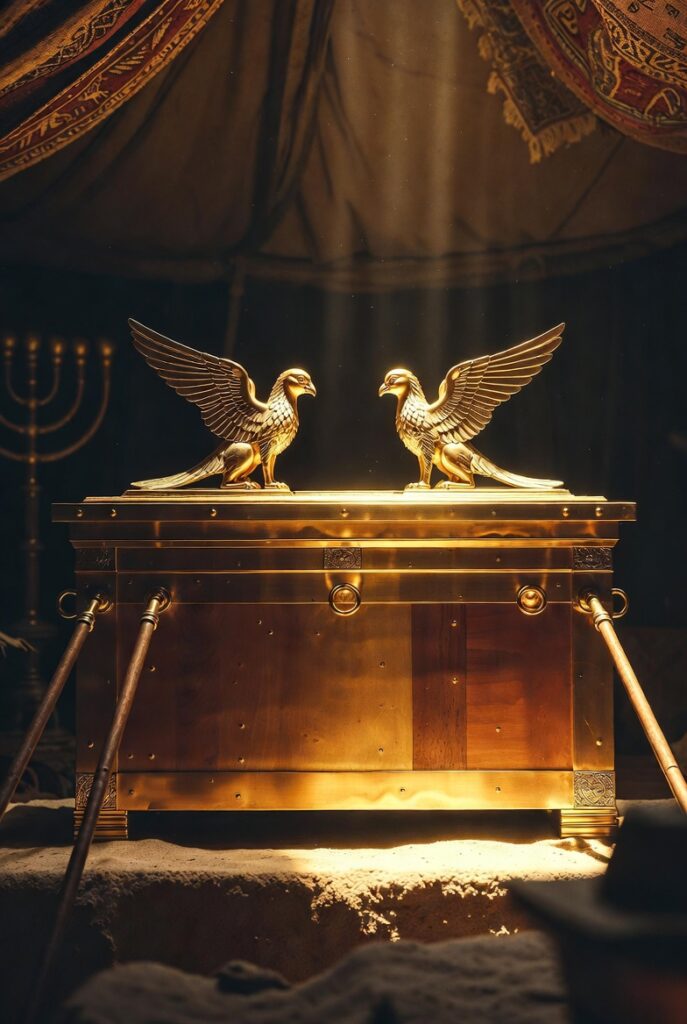
According to Exodus 25:10–22, the Ark was a gold-plated acacia wood chest, approximately 1.1 metres long and 0.7 metres wide. It housed the two tablets of the Ten Commandments and, according to Hebrews 9:4, a jar of manna and Aaron’s rod. On top sat the Mercy Seat — two golden cherubim facing each other, wings outstretched — where God’s presence dwelled. This wasn’t symbolic furniture. It was the physical locus of divine authority among the Israelites.
It lived first in the Tabernacle — a portable sanctuary — and then in Solomon’s permanent Temple in Jerusalem. Leviticus 16:2 warned that even the High Priest could enter its inner sanctuary only under strict ceremonial conditions. 2 Samuel recorded deadly consequences for those who touched or looked inside it. Whatever it was, people treated it as genuinely dangerous.
A Timeline of the Ark — What the Record Actually Shows
The Ark vanishes from the Hebrew Bible after 2 Chronicles 35:3 — a verse from around 621 BC, more than three decades before Babylon arrived. Its silence across Jeremiah, Ezekiel, and the entire late monarchic period is the single most important clue we have. And nobody has a fully satisfying explanation for it.
The Five Theories — Compared by Evidence
Below is an honest comparison before we go deep on each. The ratings reflect the scholarly consensus in peer-reviewed archaeology and textual criticism as of 2026, not popular media coverage.
| Theory | Primary Source | Archaeological Support | Textual Credibility | Scholarly Consensus |
|---|---|---|---|---|
| Mount Nebo, Jordan | 2 Maccabees 2:4–7 | None confirmed | Moderate — contested canon | Moderate |
| Temple Mount, Jerusalem | Rabbinic tradition; 2 Chr 35:3 | Inaccessible | High — coherent with Josiah reforms | Moderate |
| Ethiopia (Aksum) | Kebra Nagast (14th cent. AD) | Access denied | Low — document has political motive | Low |
| Tel Shiloh (former location) | 1 Samuel; Joshua 18:1 | Strong for Tabernacle site | High — not a current location theory | High (as origin site) |
| Destroyed / permanently lost | Absence from all records post-621 BC | No positive evidence | Moderate — silence is evidence | Significant minority view |
Theory 1 Ethiopia, Aksum — The Strongest Cultural Claim. The Weakest Textual Footing.
The Ethiopian Orthodox Tewahedo Church maintains that the Ark rests in a treasury chapel adjoining the Church of Our Lady Mary of Zion in Aksum. And this isn’t a casual claim. It is the foundation of Ethiopian national religious identity. Every Orthodox church in the country contains a tabot — a consecrated replica of the Ark — and one guardian monk devotes his entire life to the original, never leaving its side, dying in his post. That’s the depth of institutional commitment we’re talking about.
The textual source is the Kebra Nagast (“Glory of Kings”), an Ethiopian royal chronicle describing how Menelik I — son of Solomon and the Queen of Sheba — removed the Ark from Jerusalem and brought it to Ethiopia. The narrative is detailed and internally consistent. It reads like history.
The problem, documented by Tudor Parfitt (Professor of Religion, Florida International University) and widely acknowledged in Biblical Archaeology Review, is that the Kebra Nagast in its current form was compiled between 1314 and 1322 AD — during the reign of a dynasty that needed precisely this genealogical legitimacy to consolidate power after reclaiming the throne. The text does exactly what politically motivated texts do: it establishes divine lineage for the ruling house. That doesn’t make it fiction, but it does mean it cannot be read as disinterested historical reporting of events 2,300 years earlier.
Here’s the thing that keeps serious researchers engaged with this theory despite all that: the linguistic puzzle of the Ge’ez word for Ark — tabot. The 19th-century philologist Theodore Nöldeke described it as an “atrocious monstrosity” because the word should not exist in Ge’ez unless it had entered the language during Solomon’s era. Scholar Chaim Rabin subsequently concluded the term was genuinely ancient, originating from the Medina region of Arabia. That doesn’t prove anything. But a nation doesn’t build an entire liturgical practice around a word that shouldn’t exist unless something historically real lies underneath it.
What absolutely cannot be explained away is the cultural depth. The Timkat festival — Ethiopia’s Epiphany — centres on tabots being processed through city streets, attended by tens of thousands in extraordinary ceremony. A nation does not sustain that level of devotion across centuries for something it knows it doesn’t have. Whether the Aksum object is the original Ark, a very ancient replica with genuine Temple-era provenance, or something else entirely — that question remains genuinely open. Because no outside scholar has ever been allowed in to check.
Theory 2 Mount Nebo, Jordan — The Strongest Ancient Text. Zero Physical Evidence.
Second Maccabees 2:4–7 records that the prophet Jeremiah, warned by divine oracle of Jerusalem’s coming destruction, took the Ark, the Tabernacle, and the altar of incense to “the mountain which Moses had climbed to survey God’s heritage.” Scholars identify this as Mount Nebo in present-day Jordan. He placed them in a cave, sealed the entrance, and told followers who tried to mark the location: “The place shall remain unknown until God finally gathers his people together.”
This is the account National Geographic History (November/December 2025) identifies as the primary ancient textual case. And it has real strengths. Jeremiah was active in Jerusalem immediately before 587 BC. He had both the motivation and the authority to move the Ark. He disappears from the biblical record in ways consistent with a journey east of the Jordan. The timeline actually works.
The complication is canonical status. 2 Maccabees is accepted scripture by Catholic and Eastern Orthodox Christians but not by most Protestant traditions or by Judaism — which means its evidentiary weight varies enormously depending on who you ask. Treating it as straightforward historical reporting requires acknowledging that it’s a contested document.
As World History Encyclopedia documents, illegal excavations around Mount Nebo have continued for decades — which tells you that enough people take this theory seriously to risk criminal charges. No credible find has emerged from any of those activities. The Jordanian government actively monitors and suppresses them. The mountain is accessible. Nobody has found anything.
Theory 3 Beneath the Temple Mount — Plausible, Coherent, Completely Uninvestigable.
Rabbinic tradition holds that King Josiah, anticipating Jerusalem’s eventual fall, ordered the Ark hidden in tunnels beneath the Temple — chambers dug specifically for this purpose. The Temple Institute in Jerusalem formally states that the Ark is under the Temple Mount and will be revealed when the Third Temple is built. This is the institutional position of a scholarly organization, not a fringe claim.
The textual basis is 2 Chronicles 35:3, where Josiah commands the Levites to “put the sacred Ark in the temple that Solomon son of David of Israel built.” Some scholars read this as implying the Ark was being moved back from a previously hidden location — suggesting earlier concealment during Josiah’s reform period. If Josiah hid it deliberately in 621 BC, that explains why it never appears again in the biblical record: it was meant not to be found.
Leen Ritmeyer, the specialist in Temple Mount archaeology who published in Biblical Archaeology Review (Vol. 22, No. 1, 1996), established the probable precise location within Solomon’s Temple where the Ark physically stood — based on a notch in the bedrock of the Foundation Stone that matches Ark dimensions exactly. Ritmeyer’s work doesn’t establish where the Ark went. But establishing where it was is the necessary precursor to any serious search.
The practical problem is absolute: the Temple Mount is administered by the Islamic Waqf authority. Excavation is politically impossible. Ground-penetrating radar surveys have been conducted at the perimeter; results are not publicly available in peer-reviewed form. This theory cannot be confirmed or ruled out by physical evidence. It just sits there, intellectually coherent, permanently beyond reach.
Theory 4 Tel Shiloh, 2025 — Where the Evidence Is Actually Moving Right Now
Quick clarification first: Tel Shiloh is not a candidate for where the Ark is. The Ark demonstrably left Shiloh around 1050 BC, over 400 years before the Babylonian destruction. This theory belongs on this list because the 2025 excavations produced the most significant evidentiary developments in the entire Ark discussion — and understanding what they actually found matters for evaluating every other theory.
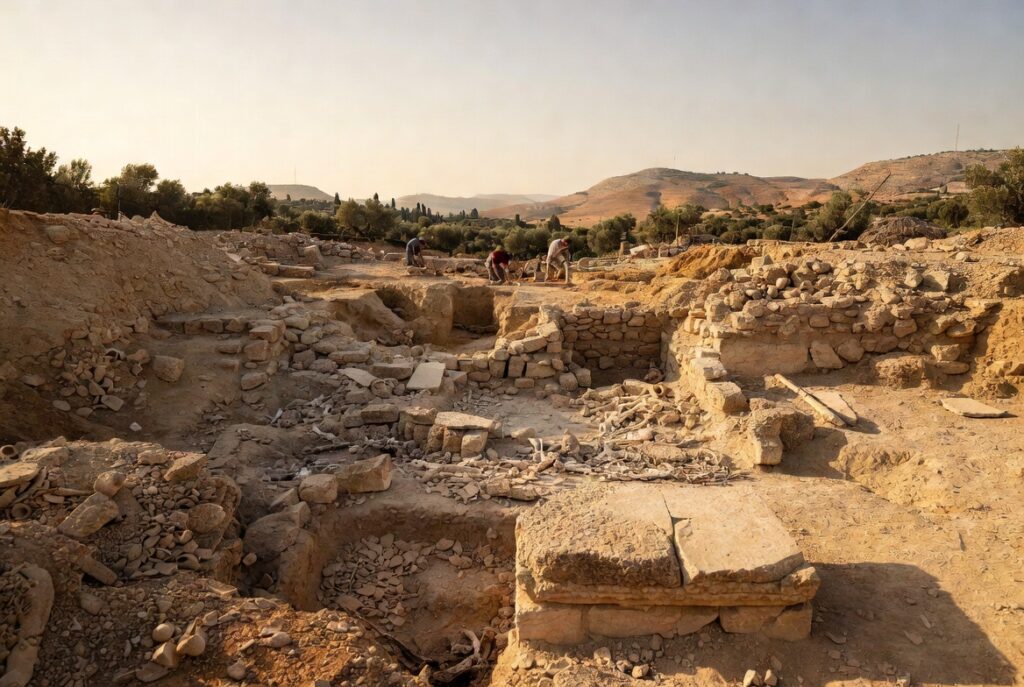
Dr. Scott Stripling and his team at the Associates for Biblical Research have led excavations at Tel Shiloh since 2017. In 2025, the team announced what may be the most compelling structural discovery in biblical archaeology in a generation:
“We discovered a monumental Iron Age I building that matches the biblical descriptions of the Tabernacle. The building is oriented east to west and divided in a 2:1 ratio, as described in Scripture.”
— Dr. Scott Stripling, Director of Excavations, Associates for Biblical Research (CBN, 2025)The numbers: over 100,000 animal bones excavated, predominantly sheep, goats, and cattle. Astonishingly, the vast majority came from the right side of the animals — matching Leviticus 7:32, which specifies that the right side was reserved exclusively for priestly sacrifice. That kind of specificity is extraordinarily hard to explain as coincidence. It’s not one detail matching. It’s an architectural 2:1 ratio, east-west orientation, and a sacrificial bone assemblage with right-side dominance, all converging at one site. Professor Shimon Gibson, currently excavating at Jerusalem’s Mount Zion, independently verified the ritual bone deposit.
The 2025 season also focused on what the team believes is the gate described in 1 Samuel 4 — where Eli received news of the Ark’s capture and died. The ABR’s June 2025 field report describes a breached gateway along Shiloh’s ancient city wall, with a multi-chambered gate complex design mirroring those at Megiddo and Hazor. The team is systematically removing collapsed mud-brick debris under protective canvas sheltering erected to preserve the mud-brick courses through winter.
The 2025 season wasn’t smooth, either — worth noting because it speaks to the reality of field archaeology in 2025 Israel. A Houthi missile strike on Ben-Gurion Airport on May 4 delayed international volunteers. A brief evacuation occurred on June 24 due to security concerns. The team reached full staffing by late June and continued. A Spring 2026 excavation season is now underway, with an on-site laboratory funded for thin-section petrography and residue analysis that will allow peer-reviewed results faster than before.
Why does any of this matter for where the Ark is now? Because if the biblical account of Shiloh is archaeologically accurate — and the evidence is compelling — then the subsequent accounts of where the Ark moved carry more evidential weight. The documents describing the Ark aren’t purely mythological. They’re historically grounded. That raises the stakes for every other theory on this list.
Theory 5 Destroyed or Permanently Lost — The Theory That Deserves More Respect
This is the most intellectually uncomfortable theory. It’s also the one most consistently buried under the excitement of the others. Israel Finkelstein of Tel Aviv University — the archaeologist who conducted the first major scientific excavation at Shiloh in the 1980s and one of the most respected figures in the field — approaches the Ark’s physical survival with methodological caution. His broader scholarly position, documented in The Bible Unearthed (co-authored with Neil Asher Silberman), holds that Temple treasures including the Ark were almost certainly destroyed or looted during one of Jerusalem’s multiple pre-Babylonian sieges — possibly Pharaoh Shishak’s 925 BC invasion.
The biblical record actually supports this reading more than popular accounts acknowledge. Think about what happens after 2 Chronicles 35:3 in 621 BC. Over the following 34 years, we have some of the most detailed, emotionally charged prophetic literature in the entire canon: Jeremiah, Ezekiel, Zephaniah, Habakkuk. These men wrote about national catastrophe with forensic precision. They catalogued every loss, every humiliation, every theological crisis of the period.
The Ark does not appear in any of it. Not once. If the Ark had been present in Jerusalem during those 34 years of documented crisis — or even if it had been recently destroyed or hidden — you would expect it to appear in prophetic writing. Its loss would have been the defining theological event of the era. Jeremiah’s lament over the Ark would have been one of the great texts of the Hebrew Bible. Instead: silence. Complete and total silence.
As Biblical Archaeology Review has noted: “Archaeology is not a treasure hunt, and the Bible does not need the recovered Ark to be proved accurate.” That’s not a dismissive statement. It’s a methodological position that takes seriously the possibility that the most important artifact in Israelite religion was destroyed centuries ago, and that its non-survival tells us something true about ancient history rather than constituting an unsolved mystery.
What Happened in 2025 — And What Actually Matters
Three developments generated significant coverage in the past 18 months. Their actual evidentiary value varies enormously.
The Tel Shiloh excavations — covered above — produced their most convincing structural evidence to date. This is real and significant. The monumental building’s dimensions, orientation, and sacrificial bone assemblage constitute the strongest material argument yet made for the physical reality of the Tabernacle. This does not locate the Ark, but it validates the documentary framework in which the Ark operated.
The CIA remote viewing documents, resurfaced in a March 2025 Daily Mail report, described Project Sun Streak — a Cold War remote viewing programme that purportedly pinpointed the Ark in an underground chamber somewhere in Ethiopia or Jordan. This generated substantial media coverage. It should be evaluated with extreme care: remote viewing has no established evidentiary basis, and these documents describe a programme that US intelligence has never formally validated as producing accurate results. It’s historically interesting. It’s not evidence.
A gold-plated fragment discovery reported in August 2025 generated international headlines with strong implications of an Ark connection. The actual source material is more careful: archaeologists described gold-plated fragments with inscriptions echoing Exodus descriptions. No peer-reviewed publication has established any specific link to the Ark. The gap between what excavations find and what headlines claim has widened considerably in Ark coverage — and this case illustrates that gap clearly.
How to Evaluate Any Location Claim — The Four-Question Test
The Evidentiary Framework Used by Serious Scholars
Before accepting any claim about the Ark’s location, apply these four questions in order. Most headline-generating “discoveries” fail at question one.
How close in time is the text to the events it describes? The Kebra Nagast: 2,300-year gap. 2 Maccabees: ~400-year gap. 1 Samuel: effectively contemporaneous.
Does more than one independent source describe the same event? The Shiloh Tabernacle: Joshua, 1 Samuel, and now material archaeology. Ethiopian claim: primarily one text with documented political motive.
If the Ark was taken to Ethiopia in the 10th century BC, why do no Egyptian, Assyrian, or Babylonian sources — which document Israelite affairs extensively — mention this extraordinary transfer?
Can physical evidence actually be examined? Shiloh: yes, actively. Aksum: access denied. Temple Mount: politically impossible. Nebo: ground accessible, nothing found.
The Honest Verdict: Where Evidence Points in 2026
What Tel Shiloh Actually Changed — And What It Didn’t
The 2025–2026 excavations at Tel Shiloh haven’t located the Ark. That needs saying clearly, because headlines sometimes suggest otherwise. What they have done is something arguably more important for long-term scholarship: they’ve demonstrated that the biblical framework within which the Ark operated is historically real.
A Tabernacle structure at the correct location, with the correct dimensions, the correct orientation, and surrounding material culture precisely matching Levitical sacrificial law — independently verified by a second archaeologist — is not a small discovery. It means the documents describing the Ark’s movements aren’t ancient fan fiction. They’re historically grounded accounts of real places and real religious practices. That raises the evidential weight of every subsequent claim those documents make about where the Ark went.
The Spring 2026 season is now underway. The on-site laboratory for thin-section petrography and residue analysis — funded last year — will allow results to be peer-reviewed faster. If the gate complex currently being excavated does prove to be the location described in 1 Samuel 4, it will represent the most direct physical connection to the Ark narrative ever established. Not the Ark itself. But the last confirmed place it was.
The search continues. The evidence, as of 2026, has not resolved it. But it has — for the first time in decades — given archaeologists a genuine, peer-reviewable foothold in the story.
Frequently Asked Questions
Sources & Further Reading
- Stripling, S. (2025). “Tel Shiloh Field Report, Summer 2025.” Associates for Biblical Research
- “Excavating Biblical History: New Discoveries at Shiloh and the Search for the Ark’s Gateway.” Israel365 News, July 2025
- “Has the Ark of the Covenant been Found? Monumental Structure Unearthed at Tel Shiloh.” Jerusalem Post, August 2025
- Ritmeyer, L. (1996). “Searching for the Temple Mount.” Biblical Archaeology Review Vol. 22, No. 1.
- Parfitt, T. (2008). The Lost Ark of the Covenant. HarperOne. — The most rigorous scholarly treatment of the Ethiopian claim, by a researcher who investigated it in the field.
- Finkelstein, I. & Silberman, N.A. (2001). The Bible Unearthed. Free Press.
- “Ark of the Covenant.” World History Encyclopedia
- National Geographic History (November/December 2025). “The Search for the Ark.”
- Ancient Origins. “Archaeologists Uncover Biblical Ark’s Home at Ancient Tabernacle Site.” August 2025.
https://www.neuralgrimoire.com/the-giza-power-plant-theory/
https://www.neuralgrimoire.com/we-built-the-baghdad-battery/
https://www.neuralgrimoire.com/vaimanika-shastra/
https://www.neuralgrimoire.com/alien-abduction/
https://www.neuralgrimoire.com/some-ai-should-never-be-built/
https://www.neuralgrimoire.com/gobekli-tepe-decoded/
https://www.neuralgrimoire.com/pole-shift-survival-rituals-mistake/