


Sirian Starseed
Activation Sequence
The complete, intellectually honest guide — what practitioners believe, what the science of Sirius actually says, and how to explore these practices without sacrificing your critical mind.
The Sirian Starseed Activation Sequence is a structured spiritual practice rooted in the belief that certain souls originate from the Sirius star system. It unfolds across seven stages — from initial resonance to full integration.
What’s real: Sirius is objectively the brightest star in the night sky, 8.6 light-years away, with a rich history across Egyptian, Greek, and Polynesian astronomy. What’s belief: Soul origins, DNA activation, and stellar energy transmissions have no empirical support — though the meditation practices themselves carry well-documented psychological benefits.
This guide covers both, clearly labeled throughout.
What Is a Sirian Starseed?
Let’s start with what practitioners actually believe — not a caricature, not a dismissal. Within starseed spirituality, a Sirian starseed is someone whose soul originated from or carries a strong energetic connection to the Sirius star system before incarnating on Earth. That’s the core claim. Everything else is built around it.
People who identify this way often describe a persistent sense of not quite belonging here — a feeling most of us know at some point, but which starseed frameworks interpret as cosmic displacement rather than ordinary alienation. The distinction matters, and we’ll get to it.
⚡ Belief vs. Fact — A Note We’ll Use Throughout
Whenever you see content labeled Spiritual Belief, it describes what practitioners hold to be true within this tradition. Content labeled Astronomy / Science is empirically verified. Psychology marks peer-reviewed behavioral science. These aren’t competing — they’re different kinds of knowledge.
Traits Attributed to Sirian Starseeds
| Attribute | Description | Status |
|---|---|---|
| Empathic sensitivity | Heightened emotional receptivity to others’ emotional states | Psychology |
| Technical-creative balance | Aptitude for both logical systems and artistic expression | Spiritual Belief |
| Water affinity | Strong pull toward oceans, rivers, dolphins, and whales | Spiritual Belief |
| Ancient Egypt connection | Past-life resonance or deep fascination with Egyptian civilization | Spiritual Belief |
| Mission-orientation | Sense of specific purpose related to healing, teaching, or technology | Psychology |
That last column is the interesting one. Some of these traits are genuinely measurable personality features — high sensitivity (Elaine Aron’s research covers this well) and purpose-orientation are real human experiences. Starseed frameworks give them a cosmic narrative. Whether that narrative is literally true or symbolically useful is the central question this entire article orbits.
The Real Astronomy of Sirius
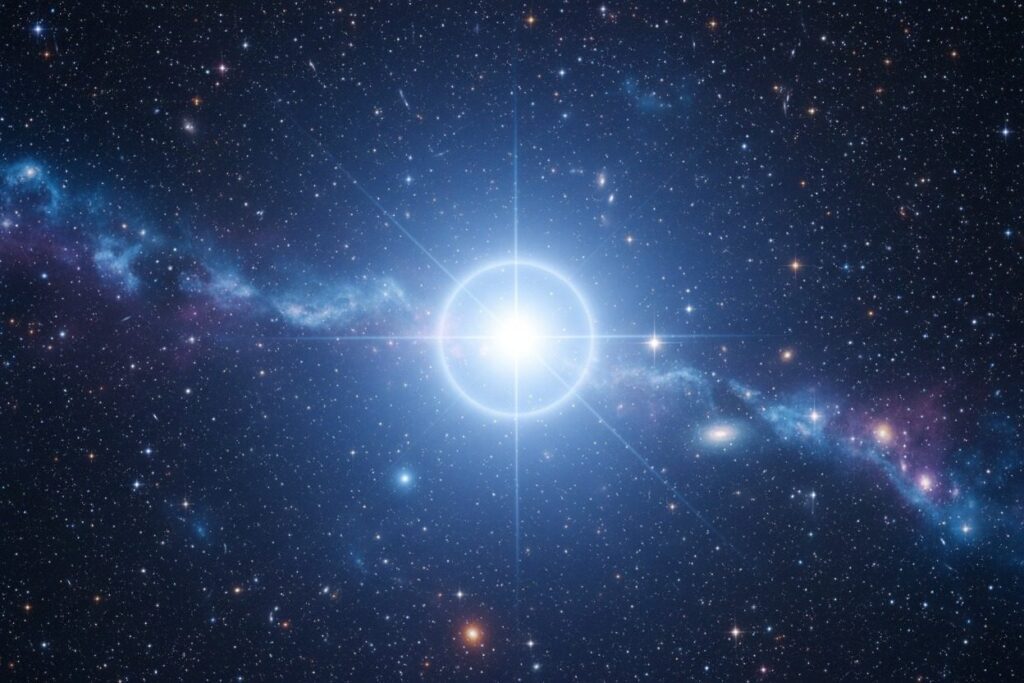
Here’s the thing: you don’t need mystical frameworks to find Sirius extraordinary. It genuinely is. It’s the brightest star visible from Earth — not barely, but dramatically so. On any clear night, it sits low in the winter sky blazing at magnitude −1.46, outshining everything except the Moon, Venus, and Jupiter at their peaks.
Sirius B: The “Pup Star”
Sirius B is the part that genuinely deserves attention. It wasn’t even visible until 1862, when Alvan Clark spotted it while testing a new telescope. Bessel had predicted it eighteen years earlier based purely on the wobble in Sirius A’s path across the sky — one of history’s more elegant astronomical deductions.
What Sirius B is: a white dwarf containing roughly the mass of our Sun compressed into a volume roughly the size of Earth. Its journey there took millions of years — it was once a massive, brilliant star that shed its outer layers as it aged. The shell it cast off is long gone. What remains is extraordinarily dense, extraordinarily hot, and fading slowly over billions of years.
Worth noting: The Dogon tribe of Mali famously feature in starseed literature because of claims that they knew about Sirius B without telescopes. The actual anthropological record — especially Walter van Beek’s 1991 follow-up fieldwork — doesn’t support this. Marcel Griaule, who first documented the Dogon-Sirius connection in the 1930s, appears to have been a significant contaminating influence. The “mystery” dissolved under closer scrutiny. This doesn’t diminish Dogon culture — it just means they didn’t need alien help to be remarkable.
How Ancient Cultures Actually Used Sirius
The ancient Egyptian relationship with Sirius (called Sopdet, personified as the goddess Isis in some traditions) was sophisticated and practical. Its heliacal rising — the morning it first becomes visible just before dawn after a period of absence — historically predicted the Nile flood within weeks. For an agricultural civilization, that wasn’t mysticism. That was climatology.
Ancient Egyptians were Sirian initiates preserving transmitted cosmic wisdom. The pyramids encode Sirian technology or star maps from extraterrestrial teachers.
Egyptian astronomy was terrestrially sophisticated — tracking stellar risings for agriculture and ritual timing. Pyramid construction used documented engineering methods. No hieroglyphic translation supports extraterrestrial contact.
You can appreciate ancient Egyptian achievement without needing to attribute it to alien assistance. Actually, attributing it to alien assistance is a subtle insult — it implies ancient humans couldn’t have accomplished this on their own. They absolutely could. And did.
How the Starseed Concept Was Born
These ideas didn’t appear fully-formed. They evolved through a specific sequence of cultural moments, each one building on the last.
| Era | Development | Key Figures |
|---|---|---|
| 1875–1920s | Theosophical Society founds the intellectual framework: root races, ascended masters, non-physical evolution | Helena Blavatsky |
| 1950s | UFO contactee movement: claims of extraterrestrial spiritual teachings; “star people” terminology enters culture | George Adamski, Brad Steiger |
| 1976 | The Sirius Mystery adds pseudo-archaeological credibility (later debunked); Alice Bailey’s esoteric astrology places Sirius as “spiritual Sun” | Robert Temple, Alice Bailey |
| 1990s–2000s | Channeling boom; Indigo/Crystal children frameworks medicalize starseed terminology; internet enables global community formation | Doreen Virtue, Dolores Cannon |
| 2010s–present | Social media amplification; Lion’s Gate Portal becomes annual commercial event; YouTube/TikTok normalize the framework | Distributed creator ecosystem |
That pattern — taking a scientifically or historically notable phenomenon and imbuing it with spiritual significance after the fact — is worth naming. It’s not unique to starseed beliefs. It’s how most esoteric systems are constructed. The prestige of a real astronomical object (Sirius genuinely is remarkable) gets borrowed to lend credibility to metaphysical claims that can’t otherwise be verified.
Understanding that process doesn’t make the belief system worthless. It just tells you something about how it works.
The 7-Stage Activation Sequence
This is the heart of the topic — and the part that requires the most careful dual-reading. What follows is a synthesis of teachings documented across starseed literature (Dolores Cannon, Patricia Cori, Barbara Marciniak, and contemporary practitioners). I’ve described each stage as believers experience it, then added what psychology and science actually say about the mechanisms involved.
Spontaneous attraction to Sirius, ancient Egypt, dolphins, or blue light. Recurring dreams with specific imagery. A felt sense that Sirius-related information “means something personal.” Synchronicities involving sevens or star patterns.
Meditation focused on blue-white light. Work with crystals (lapis lazuli, blue kyanite, aquamarine). Chakra focus on throat and third eye centers. Dietary shifts often toward raw or plant-based food to “raise vibration.”
Core claim: Sirian starseeds possess additional “etheric” DNA strands (often claimed as 12) requiring activation through sound (528 Hz, 741 Hz), light language, or intention-based visualizations.
Accessing past-life memories of Sirian existence through regression therapy, automatic writing, lucid dreaming, or vision questing. Practitioners describe vivid “recall” of non-human environments.
Understanding one’s specific incarnation purpose — typically mapped to one of several archetypal roles: healer, teacher, technologist, environmental guardian, or “grid worker” maintaining planetary energy structures.
Establishing a felt bond with dolphins and whales as “Sirian ambassadors” — beings believed to have incarnated from Sirius to hold planetary frequencies. Practices include whale song meditation and ocean immersion.
Alignment of human personality with Sirian soul essence. Ability to channel Sirian wisdom and facilitate healing in others. A settled sense of cosmic “home” — and notably, reduced fear of death, reframed as return.
“The power of this sequence isn’t supernatural. It’s narrative. Humans use story to organize experience, create meaning, and motivate behavior. That’s not a debunking — it’s the deepest compliment you can give to any symbolic system.” — Neural Grimoire Analysis
The Blue Star Meditation: Full Protocol
The following is documented from starseed practice literature, presented as-is for educational purposes. You don’t have to accept the Sirian framework to benefit from the attention-training and relaxation techniques it contains.
What you’ll actually experience: Relaxation response (reduced cortisol), altered state of consciousness via focused attention, emotional processing through symbolic imagery, and the documented benefits of slow, rhythmic breathing. These are real. The stellar transmission isn’t.
Slow breath to 4–6 cycles per minute. Visualize roots extending from the base of the spine into the Earth’s core. Feel the weight and temperature of the floor beneath you. This deliberately activates the parasympathetic nervous system — the “rest and digest” mode.
Hands on the chest. Generate a genuine feeling of gratitude — reaching for a specific memory works best. Visualize warm light expanding from the center of the chest. Research on loving-kindness meditation shows measurable increases in positive affect from this kind of practice.
Visualize the night sky. Find the brilliant blue-white point of Sirius. Imagine a thread of blue-white light descending to the crown of the head — cool, electric, and steady. Allow it to circulate. This is visualization in the tradition documented across cultures: a structured use of mental imagery for state change.
Shift to an oceanic environment. Actual recordings of whale or dolphin calls are often used here — available on most streaming platforms, and genuinely effective for inducing calm. Notice any imagery or emotional responses without forcing them.
Return to breath awareness. The practice ends with journaling — whatever arises: images, feelings, fragments, questions. The writing itself is valuable regardless of interpretation. Don’t force meaning onto what appeared; let it settle.
If you experience persistent hallucinations, delusional thinking, social withdrawal, functional impairment, or suicidal ideation connected to these practices, stop immediately and speak with a qualified mental health professional. Spiritual emergency is a recognized phenomenon — help exists from practitioners familiar with transpersonal psychology. No activation is worth your psychological safety.
Symbols, Archetypes & the Mythology of Sirius
The symbol set around Sirian starseed practice isn’t arbitrary. Each element connects to either genuine historical significance or deep archetypal patterns in human psychology — which is precisely why they feel resonant rather than random.
| Symbol | Starseed Meaning | Historical Origin |
|---|---|---|
| Blue-white star | Sirius; purity, spiritual truth | Astronomical observation — Sirius A’s spectral class A1V produces genuine blue-white color |
| Ankh | Eternal life; Egyptian-Sirian connection | Ancient Egyptian funerary and temple iconography, associated with Isis/Sopdet |
| Dolphin/Whale | Sirian ambassadors; higher consciousness | New Age cetacean mysticism; 1970s whale consciousness movement |
| Spiral | DNA, galaxy, evolution | Universal geometric pattern found in shells, galaxies, plant growth |
| Blue lotus | Egyptian sacred plant; altered states | Nymphaea caerulea — a mildly psychoactive plant genuinely used in ancient Egypt |
The Four Archetypes That Drive It
Belief in having “fallen” from an advanced civilization. Mirrors Plato’s Atlantis, Gnostic fall from divine fullness, Romantic nostalgia for lost golden ages.
Hidden knowledge; special mission invisible to ordinary people. Mirrors Rosicrucian tradition, superhero secret identities, adolescent uniqueness drives.
Service to less-evolved beings. Mirrors genuine helper personality types and prosocial motivation — but can shade into problematic savior dynamics if unexamined.
Fusion of advanced technology and spiritual wisdom. Mirrors Star Trek’s Federation, transhumanist aspirations, and modern discomfort with the science/spirituality split.
These archetypes fill genuine psychological needs: for meaning, for specialness, for purpose, for transcendence. Their power to move people doesn’t validate their literal truth — but it does explain why they’re not going anywhere.
The Lion’s Gate Portal: What’s Actually Happening on 8/8?
Every August 8th, the Lion’s Gate Portal generates enormous social media activity, crystal sales, activation webinars, and breathless countdown posts. Let’s untangle what’s real from what’s been constructed.
Sirius does become visible in the morning sky in August (its heliacal rising). The Sun is in Leo throughout August. These are real astronomical events. Sirius’s heliacal rising historically marked the Egyptian New Year.
The specific August 8 date is a modern commercial creation — numerologically pleasing (8/8), but the actual Sirius rising varies by latitude and has shifted by over a month since ancient Egypt due to precession. The “Galactic Center alignment” claim is wrong: the Galactic Center is in Sagittarius, not Leo.
Here’s the precession problem in plain terms: due to the slow wobble of Earth’s axis (one full cycle every ~26,000 years), the heliacal rising of Sirius that ancient Egyptians used to mark their New Year happened around June 21 – July 20 in 2700 BCE. Today, and fixed to modern calendar dates, 8/8 drifts further from actual astronomical reality with each passing century.
Consumer note: Fixed-date “energy windows” create artificial urgency. The pattern — limited-time activations, portal-exclusive readings, “don’t miss this alignment” marketing — is pressure tactics applied to spiritual longing. The potential psychological benefits of communal ritual are real. The specific date’s astronomical significance is not. You can have the former without the latter.
Psychology, Neuroscience & Honest Skepticism
Starseed experiences are real experiences. That sentence requires some unpacking, because it can sound like capitulation to believers or condescension to skeptics. It’s neither.
When someone sits in meditation, visualizes blue-white starlight, and feels a profound sense of recognition — something is happening neurologically. Decreased parietal lobe activity produces genuine boundary dissolution. Temporal lobe involvement creates real felt presence. Dopamine and serotonin systems activate. These are documented processes, not imagination in the dismissive sense.
| Experience | Neural Correlates | Interpretation |
|---|---|---|
| Unity / dissolution | Decreased parietal lobe activity | Boundary between self and environment temporarily reduced |
| Light perception | Occipital cortex stimulation | Visual cortex activating without external light source |
| Felt presence | Temporal lobe involvement | Similar to “sensed presence” in neurological conditions and extreme environments |
| Bliss states | Dopamine/serotonin release | Reward pathway activation via attention focus and emotional generation |
| Time distortion | Disrupted prefrontal-thalamic circuits | Normal in deep meditation and flow states |
Locating these experiences in brain activity doesn’t diminish them. It locates them in human capacity for transcendence — which is, if anything, more remarkable than attributing them to external stellar transmission.
The Forer Effect in Starseed Identification
Bertram Forer’s famous 1949 experiment showed that people rate vague, general personality descriptions as strikingly accurate when told they’re personalized. Starseed trait lists are textbook Forer material:
- “You feel different from others, like you don’t quite fit in.”
- “You have a strong sense of purpose but struggle to articulate it.”
- “You’re highly sensitive to energy and others’ emotions.”
- “You question authority and mainstream narratives.”
- “You feel drawn to help others, but sometimes feel drained.”
These are nearly universal human experiences presented as evidence of extraterrestrial origin. That’s not an accusation of gullibility — it’s the Forer effect, and it works on most people in most contexts. Being aware of it is the appropriate response, not self-criticism.
Healthy Engagement vs. Concerning Patterns
Most people who explore starseed frameworks do so in ways that are, at worst, harmless and, at best, genuinely enriching. A small number encounter problems. Knowing the difference matters.
✅ Healthy Engagement
- Beliefs held with flexibility, open to revision
- Practice enhances earthly relationships and responsibilities
- Financial investment proportional to means
- Critical thinking applied consistently
- Joy and empowerment without superiority
- Integrated with conventional healthcare
- Community is inclusive, not hierarchical
⚠️ Concerning Patterns
- Rigid dogma; hostility to questions
- Social withdrawal; neglect of responsibilities
- Escalating financial demands from leaders
- Contempt for “unawakened” others
- Rejection of conventional medical or psychological care
- Isolation from non-believing family
- Command-style “Sirians told me to…” experiences
If you or someone you know is experiencing command hallucinations attributed to Sirian beings, paranoid ideation about “matrix controllers,” increasing financial demands from a spiritual teacher, family or relationship destruction over “frequency mismatches,” or rejection of medical care in favor of “energy healing” — these warrant consultation with a qualified mental health professional. Spiritual experience and psychiatric symptoms can genuinely overlap; getting support isn’t a betrayal of your beliefs.
10 Essential Questions, Answered Honestly
Practical Meditation Alternatives (Evidence-Based)
Whether or not you engage with the Sirian framework, the meditation techniques it contains are worth separating from their metaphysical wrapper. These approaches carry documented benefits:
Mindfulness Meditation (MBSR-based)
Focus on breath; observe thoughts without attachment. 10–20 minutes daily. Evidence base: hundreds of peer-reviewed studies documenting stress reduction, focus improvement, and emotional regulation. The strongest evidence base of any meditation form.
Loving-Kindness (Metta)
Generate goodwill sequentially toward: yourself, loved ones, neutral persons, difficult persons, all beings. Demonstrated increases in positive affect and self-compassion, reduced self-criticism. This is structurally similar to the “heart opening” phase of the Blue Star meditation.
Body Scan
Systematic attention to physical sensations throughout the body. Particularly effective for pain management, anxiety, and interoceptive awareness. The “grounding” phase of the Sirian sequence is essentially this, reframed.
SOURCES & FURTHER READING
- Holberg, J.B. (2007). Sirius: Brightest Diamond in the Night Sky. Springer. — link.springer.com
- van Beek, W.E.A. (1991). Dogon Restudied: A Field Evaluation of the Work of Marcel Griaule. Current Anthropology, 32(2). — journals.uchicago.edu
- Forer, B.R. (1949). The fallacy of personal validation: A classroom demonstration of gullibility. Journal of Abnormal and Social Psychology, 44(1), 118–123.
- Aron, E.N. (1996). The Highly Sensitive Person. Broadway Books. — foundational work on high sensitivity as temperament.
- Newberg, A., d’Aquili, E. & Rause, V. (2001). Why God Won’t Go Away: Brain Science and the Biology of Belief. Ballantine. — penguinrandomhouse.com
- Kabat-Zinn, J. (1990). Full Catastrophe Living. Delacorte. — MBSR foundational text.
- Fredrickson, B.L. et al. (2008). Open hearts build lives: Positive emotions, induced through loving-kindness meditation, build consequential personal resources. Journal of Personality and Social Psychology, 95(5).
- Temple, R.K.G. (1976). The Sirius Mystery. St. Martin’s Press. — Primary source for the Dogon-Sirius claim (since substantially critiqued).
- Bailey, A. (1951). Esoteric Astrology. Lucis Trust. — Primary source for esoteric Sirius-as-spiritual-Sun cosmology.
Final Thoughts
The Sirian Starseed Activation Sequence is one of the more elaborate constructions in contemporary spirituality — and one of the more interesting. It takes a genuinely remarkable astronomical object, layers it with ancient Egyptian prestige, channels it through twentieth-century occultism, and arrives at a system that addresses some of the deepest human needs: for cosmic significance, for community, for purpose, and for a sense that this strange and often brutal existence means something.
You don’t have to accept its literal claims to find something valuable there. And you don’t have to be credulous to be respectful. The stars are real. The experiences people have under their light are real. The meaning we make of both — that’s the most human thing of all.
What this article tried to do, throughout, is hold two things at once: the genuine value of these practices and the genuine limits of their truth claims. That’s not a compromise position. It’s the intellectually honest one. And in a space where the discourse tends toward either uncritical devotion or contemptuous dismissal, it might be the most useful thing this article offers.
https://www.neuralgrimoire.com/hopi-prophecy-blue-star-kachina/
https://www.neuralgrimoire.com/ufo-landing-manifestation-ritual/
https://www.neuralgrimoire.com/crystal-skull-activation-prompts/
https://www.neuralgrimoire.com/anunnaki-dna-activation/
https://www.neuralgrimoire.com/forbidden-orgasm-delay-ritual/
https://www.neuralgrimoire.com/mayan-calendar/
https://www.neuralgrimoire.com/some-ai-should-never-be-built/