



The Vaimānika Shāstra:
What the Ancient Flying Machine Text
Actually Says
A century of myth, a mystic’s visions, five engineers in Bangalore — and why the real story is stranger and more interesting than ancient aliens ever could be.
Somewhere in Mysore, in 1918, a Brahmin mystic named Pandit Subbaraya Shastry sat down and began to talk. He had no formal education. He couldn’t write. What he did have — by his own account and the accounts of those who knew him — was a peculiar gift: when inspiration struck, Sanskrit verses would pour out of him in elaborate technical detail. He said an ancient sage named Bharadvaja was speaking through him. His scribe, G. Venkatachala Sharma, took it all down.
Five years and roughly 3,000 verses later, the Vaimānika Shāstra was complete. It described flying machines — their construction, their metals, their propulsion methods, their military applications. Shastry died in 1940. The manuscripts sat in an exercise book for decades. Then, in 1952, they surfaced at a Sanskrit exhibition in Mysore and changed the conversation about ancient Indian technology permanently.
Today, the text is cited constantly as evidence that ancient India possessed aerospace technology 7,000 years ago. It appears on YouTube channels with millions of subscribers. It gets presented at Indian science congresses. Defense researchers allegedly study it. Aerospace engineers are said to have reverse-engineered its designs with “favorable” results.
Almost none of that is accurate. And the gap between what the text actually is and what people believe it to be reveals something far more interesting than ancient aircraft: it reveals how a society processes the wound of colonialism, who benefits from ancient grandeur claims, and why the engineers who debunked the text in 1974 still haven’t been heard by the people who need to hear them most.
This is not a dismissal of ancient Indian scientific achievement — which was genuinely extraordinary in mathematics, metallurgy, and medicine. This is a careful reconstruction of what the Vaimānika Shāstra actually is, what qualified engineers actually found when they analyzed it, and why the mythology around it keeps growing despite the evidence.
Every claim in this article is sourced. Where the evidence is uncertain, I say so.
The Real Origin Story: A Mystic in Mysore, Not an Ancient Sage
The single most important fact about the Vaimānika Shāstra is also the most suppressed one in popular coverage: there are no manuscripts of this text predating 1918. Not one. This isn’t a matter of scholarly debate. It’s documented provenance. When five researchers at the Indian Institute of Science traced the text’s history in 1974, they interviewed Shastry’s associates, examined the manuscripts, and established the timeline with precision.
Pandit Subbaraya Shastry was born in 1866 in a village in Hosur Taluk. His parents died young. He spent his early life, by the IISc researchers’ account, in conditions of genuine deprivation. At some point he encountered a spiritual teacher at Kolar who “initiated him into spirituality and revealed to him several shastras, including the Vimana Shastra.” He could not read or write at the time — he learned only after returning from that encounter.
Pandit Subbaraya Shastry born in Hosur Taluk, Karnataka. Orphaned young, no formal education.
Shastry begins dictating technical Sanskrit verses he claims are psychically transmitted from the sage Bharadvaja. Scribe G. Venkatachala Sharma records them. Some passages may predate 1918; the main text was committed to paper from 1918 onward.
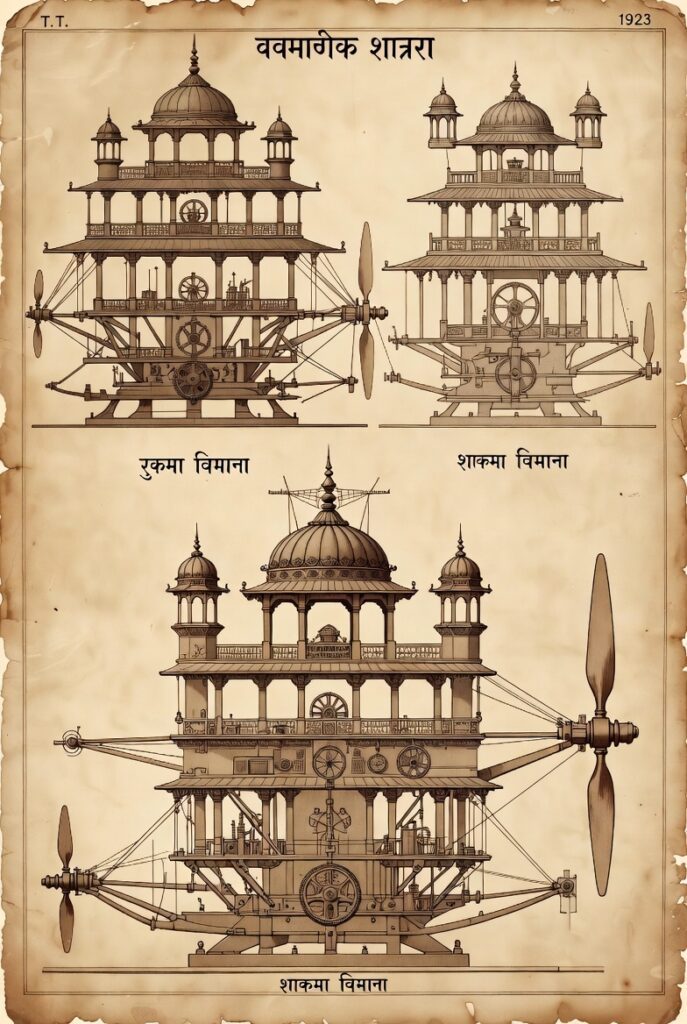
Drawings commissioned from T. K. Ellappa, a draughtsman at a local engineering college. Signed off on December 2nd. This is the last date any material was added to the manuscript. The drawings and text, researchers later note, do not correlate with each other thematically.
Shastry dies. Manuscripts pass to his adopted son and Venkatachala Sharma.
G. R. Josyer, founder of the International Academy of Sanskrit Research in Mysore, exhibits the manuscripts publicly. Press coverage follows. Global fascination begins.
Josyer publishes the English translation: Vymanika Shastra. His introduction makes sweeping claims about ancient origins. Scholars later criticize it as “least scholarly by any standards.”
Five aeronautical and mechanical engineering researchers at IISc Bangalore publish a systematic technical analysis. Their conclusion: the aircraft described cannot fly, and the text shows no understanding of aeronautics. The paper runs in Scientific Opinion and is largely ignored by popular audiences.
Here’s what makes Shastry’s story genuinely strange, and genuinely sympathetic: there’s no evidence he was a cynical fraudster. He was described by those who knew him as a legitimate mystic — a man who genuinely believed he was receiving transmissions from an ancient sage. His visions were real to him. The question of whether “channeling” is a valid epistemic mechanism is a different conversation. What’s not in question is the provenance: this text began in Mysore, between 1918 and 1923, from one man’s mind.
If Shastry was genuinely channeling ancient knowledge, that raises questions no engineer can answer. But if the test is “does physical evidence of this text predate the 20th century?” — the answer is unambiguously no. Proponents of ancient origins have had over seventy years to produce a pre-1900 manuscript. None has surfaced.
What the Text Actually Contains: Ingredients, Contradictions, and a Flat-Out Impossibility
Set aside the question of origin for a moment. What does the Vaimānika Shāstra actually say? The text covers 3,000 shlokas across eight chapters. Its subject list is ambitious: pilot qualifications, aerial routes, food and clothing for aviators, metals, metal production, mirrors and their military uses, thirty-two types of craft, and four aircraft described in greater detail — the Shakuna, Sundara, Rukma, and Tripura Vimanas.
Popular accounts tend to dwell on the technology. The reality of the text is messier. John B. Hare of the Internet Sacred Text Archive — who published an online edition of the Josyer translation in 2005, placing it in the site’s “UFOs” section — described it with characteristic bluntness: there is no exposition of the theory of aviation. The text never directly explains how vimanas get up in the air. What it does contain is long lists of often bizarre ingredients for constructing various subsystems.
- Heavy on: Ingredients lists, exotic materials, ritual instructions, pilot dietary rules, descriptions of 32 “secrets” including invisibility and enemy eavesdropping
- Light on: Any explanation of how thrust is generated, how lift is created, or how aerodynamic stability is maintained
- Absent entirely: Mathematical calculations, engineering diagrams predating 1923, material specifications that can be cross-referenced with real ancient Indian metallurgy
- Telling structural anomaly: Unlike any authentic engineering manual — ancient or modern — the text begins with quantitative descriptions as though a specific aircraft is being described, rather than starting with general principles
The Propulsion Claim That Won’t Die
The “mercury vortex engine” is the most-cited technical feature in popular coverage. The idea — that spinning mercury in a cylinder creates lift or thrust — gets compared to NASA’s ion thruster research, Hall effect thrusters, and magnetohydrodynamic (MHD) drives. Let’s be precise about what the text says and what modern physics says back.
The mercury propulsion concept, as it appears in popular versions of the text, largely comes not from the Vaimānika Shāstra itself but from David Hatcher Childress’s interpretation of the Samarangana Sutradhara — an 11th-century treatise on architecture attributed to King Bhoja. The Samarangana does mention something resembling a mercury-based device in one passage. What it does not do is provide a physically coherent propulsion mechanism. There’s no description of how mercury spinning in a cylinder would produce directed thrust in any direction that opposes gravity.
NASA’s SERT (Space Electric Rocket Test) program did test mercury as a propellant for ion thrusters in the 1960s and early 1970s — that part is real. Mercury’s high atomic mass makes it efficient for certain electric propulsion applications. The program was discontinued primarily due to toxicity concerns and the superior properties of xenon. But ion thrusters work by ionizing propellant and accelerating ions electrically to produce thrust. There is nothing in the Sanskrit texts that describes electrical ionization, ion acceleration, or the electromagnetic mechanisms required. The surface similarity — “mercury is involved in both” — is doing enormous work to paper over a complete absence of shared mechanism.
The text is top-heavy with long lists of often bizarre ingredients used to construct various subsystems. There is nothing here which Jules Verne couldn’t have dreamed up — no mention of exotic elements or advanced construction techniques.
— J. B. Hare, Internet Sacred Text Archive, 2005The Drawings Don’t Match the Text
The 1923 technical illustrations — made by T. K. Ellappa, the engineering college draughtsman — are the images most people see when the Vaimānika Shāstra is discussed. The IISc researchers were emphatic: the drawings and the text do not correlate with each other thematically. The drawings look like early 20th-century fantasy aircraft with an Indian aesthetic — what the IISc paper described, memorably, as resembling “brutalist wedding cakes,” with minarets, ornithopter wings, and small propellers. They look precisely like what someone who had read early aviation science fiction and worked in an engineering school in 1923 might produce.
The text that supposedly generated them describes things the drawings don’t show. The drawings show things the text doesn’t mention. This internal inconsistency alone is a significant problem for anyone arguing the material derives from a unified ancient technical tradition.
The 1974 IISc Study: What Five Engineers Actually Found
In 1974, five researchers — H. S. Mukunda, S. M. Deshpande, H. R. Nagendra, A. Prabhu, and S. P. Govindaraju — from the aeronautical and mechanical engineering departments at the Indian Institute of Science in Bangalore published a systematic technical analysis of the Vaimānika Shāstra. This paper is almost never accurately summarized in popular coverage. I’m going to summarize it accurately.
First, what they found on provenance: after tracing the manuscript history and interviewing associates of Shastry, they concluded the text could not be dated earlier than 1904. The linguistic analysis supported a 20th-century composition. They were not operating from anti-Hindu bias — they were five Indian scientists doing their jobs.
Then they did the aeronautics analysis. They took each aircraft type seriously, attempted to apply the described principles, and evaluated whether the craft could fly. Their conclusions were not ambiguous.
- Aircraft geometries “unimaginably horrendous from the point of view of flying”
- Propulsion principles that “make them resist rather than assist flying”
- Discussion of flight principles “largely perfunctory and incorrect, in some cases violating Newton’s laws of motion”
- The Rukma Vimana: “a decided impossibility” if taken as stated
- One partial exception: the Rukma’s ducted fan concept (air sucked from top, pushed down) at least makes aerodynamic sense directionally — though no energy source is specified
- “The planes described are at the best poor concoctions rather than expressions of something real.”
- “None of the planes has properties or capabilities of being flown.”
- “The text and the drawings do not correlate with each other even thematically.”
- “The drawings definitely point to a knowledge of modern machinery.” (i.e., 20th-century, not ancient)
Popular coverage often implies the IISc study was politically motivated — a knee-jerk post-colonial rejection of Hindu scientific heritage. This framing is unfair and inaccurate. Mukunda’s team was doing exactly what you’d want qualified engineers to do: applying domain expertise to claims made in their domain. They didn’t dismiss the cultural significance of vimana mythology. They evaluated whether the described machines could fly.
They couldn’t. That’s not a political conclusion. It’s an aerodynamic one.
In January 2015, at the 102nd Indian Science Congress at Mumbai University, a session on “ancient sciences through Sanskrit” included a presentation claiming mercury-vortex engines and Vedic-era flight. Pilot Anand J. Bodas stated that Vedic aircraft could fly “from planet to planet” and that ancient planes flew backwards — which modern planes cannot. More than 100 scientists walked out. The Indian Science Congress subsequently distanced itself from the session, calling it an embarrassment to scientific standards.
This is what happens when the IISc paper gets ignored for forty years: the claims don’t shrink. They grow.
What “Vimana” Actually Meant in Ancient India — and Why It’s More Interesting
Here’s what often gets lost in the flying saucer debate: vimana is a real Sanskrit word with a real documented history, and its evolution through thousands of years of Indian literature is genuinely fascinating. It just doesn’t mean what the ancient astronaut crowd thinks it means.
The word appears in the Rigveda and the Mahabharata. In its earliest usages, scholars trace it to a compound meaning roughly “well-measured” or “having the right proportions.” It was applied to divine palaces, temple towers, celestial chariots of the gods, and — yes — aerial vehicles described in epic poetry. The Pushpaka Vimana in the Ramayana, which Ravana used and Rama returned to Kubera, is the most famous example: a self-propelled aerial chariot.
These are mythological flying vehicles. That doesn’t make them less interesting — the Mahabharata‘s descriptions of aerial warfare, with weapons that produce fire and light from the sky, are extraordinary literature. They may reflect the imaginative ambitions of a civilization that watched birds and wondered. They may encode older oral traditions about the sun and wind. What they are not is engineering documentation for vehicles that existed.
| Text | Period | Usage of “Vimana” | Scholar Consensus |
|---|---|---|---|
| Rigveda | c. 1500–1200 BCE | Divine chariots; celestial vehicles of the Asvins | Mythological/cosmological, not aeronautical |
| Mahabharata | c. 400 BCE–400 CE (compiled) | Aerial vehicles used by gods and warriors; sky battles | Epic poetry; divine attributes, not physics |
| Ramayana | c. 500 BCE–100 CE (compiled) | Pushpaka Vimana; Ravana’s flying palace | Mythological; “self-propelled” implies divine will, not engines |
| Samarangana Sutradhara | c. 11th century CE | 200+ stanzas on vimana construction; mentions mercury device | Partly architectural; mercury passage is ambiguous; no flight physics |
| Vaimānika Shāstra | 1918–1923 CE | Detailed “technical” specifications for aircraft | 20th-century composition; aerodynamically infeasible (IISc 1974) |
The temple architecture point is real but misunderstood. The towered structures called “vimanas” in South Indian temple architecture — the soaring, layered shikhara above the inner sanctum — do sometimes produce aerodynamic-looking profiles. But they were designed as cosmic mountains, not aircraft. The resemblance to aircraft silhouettes is coincidental. A mountain that looks like a rocket from one angle is still a mountain.
India’s actual ancient technological achievements — the rust-resistant Delhi Iron Pillar, the decimal number system, the mathematical work of Aryabhata and Brahmagupta, the astronomical precision of early observatories — are extraordinary. They don’t need the support of a forged aerospace manual to be impressive. That’s the thing that bothers me most about the vimana mythology: it implicitly suggests that Indian civilization’s real achievements aren’t enough. They are more than enough.
Why the Myth Persists: The Psychology of Ancient Grandeur Claims
I want to take this seriously, because it deserves to be taken seriously. Millions of people believe the Vaimānika Shāstra is an ancient aerospace manual. They’re not stupid. They’re responding to real historical injuries and real cognitive patterns. Understanding why the belief persists matters more — for practical purposes — than cataloguing the aerodynamic errors in the text.
The Colonial Wound
British colonial administration systematically disparaged Indian intellectual and scientific traditions. The “civilizing mission” required Indian civilization to be portrayed as primitive, static, and in need of European guidance. The response to this — which was psychologically understandable and often led by genuinely brilliant thinkers — was to assert the opposite: that India had been not just equal to but ahead of the West, in antiquity, before the disruption of foreign rule.
This dynamic was already operating when Shastry was dictating his visions in 1918. India was under British rule. The first major aviation achievements — the Wright brothers flew in 1903, Bleriot crossed the Channel in 1909 — were framed in Western popular culture as exclusively Western. For Indian revivalists, a text that placed aviation in ancient India was not just interesting — it was politically powerful.
The Vaimānika Shāstra was, in this sense, produced in the right historical moment to become exactly what it became. It wasn’t ancient, but it served ancient purposes: restoring pride, asserting equivalence, answering colonial condescension with counter-narrative.
Vimanas are one of the common attempts to fit elements of ancient cultures into contemporary narratives. When put under scrutiny, the Vaimānika Shāstra comes off as jibberish.
— Brian Regal, Pseudoscience: A Critical EncyclopediaThe Pattern-Matching Problem
Human beings are extraordinarily good at finding patterns — and extraordinarily bad at calibrating whether the patterns they find are meaningful. The Vaimānika Shāstra describes something it calls a “mercury vortex engine.” NASA tested mercury in ion thrusters. Therefore: ancient connection. This reasoning bypasses the crucial middle question: do the two things share a mechanism, or just a material?
Ion thrusters work through electromagnetic ionization of propellant atoms. The Sanskrit text describes no electromagnetic principles, no ionization process, no concept that maps onto electric propulsion physics. Mercury is the shared word. The mechanism is entirely absent. But the pattern-match feels compelling because the brain registers similarity and stops there.
This is not stupidity. It is a cognitive tendency that affects everyone, including engineers and scientists. The difference between careful analysis and the ancient-technology genre is the discipline to ask “does this share a mechanism, or just a surface feature?”
The Conspiracy of Suppression
A persistent element of the mythology is that mainstream science has “suppressed” or deliberately ignored this knowledge. The IISc study gets described as politically motivated. Western academia gets accused of not wanting to acknowledge Indian technological primacy.
This is worth addressing directly. The IISc study was conducted by Indian scientists at India’s most prestigious research institution. They were not agents of Western suppression. They were aeronautical engineers applying their expertise to an aeronautical claim — and finding it wanting. The study is in the public domain, in English, freely available. It has not been suppressed. It has been ignored by people who prefer a different conclusion.
That’s not suppression. It’s selective attention. And it’s a very human thing to do when the evidence doesn’t support what you want to be true.
The Political Dimension: When Ancient Aircraft Become a Modern Weapon
The vimana mythology is not politically neutral, and pretending it is would be dishonest. Since the 1990s, and with accelerating intensity since 2014, claims about ancient Indian aerospace and other Vedic sciences have become associated with Hindutva nationalism — the ideological project of defining India as a Hindu civilization with a continuous tradition of Hindu supremacy.
The Grokipedia analysis of the text’s cultural reception is direct on this point: proponents aligned with organizations like the Rashtriya Swayamsevak Sangh (RSS) argue that knowledge was documented by sages like Bharadvaja and suppressed due to colonial historiography. This framing “aligns with broader ideological efforts to elevate Hindu scriptures as sources of empirical science, countering perceptions of pre-modern India as technologically stagnant.”
The 2015 Indian Science Congress session was a flashpoint precisely because it moved these claims from the fringes into an official scientific venue. When more than 100 scientists walked out, they were refusing to validate a conflation of scientific inquiry with nationalist mythology. That’s not anti-Indian. That’s pro-science — which, in the long run, is the most pro-India position of all.
There is a meaningful difference between:
Legitimate question: Did ancient Indian civilization have sophisticated scientific and technical knowledge that deserves serious scholarly attention? Answer: Yes, absolutely. The mathematical, astronomical, metallurgical, and medical traditions of ancient India are extraordinary and systematically understudied in Western academic contexts.
Illegitimate claim: The Vaimānika Shāstra is an ancient aerospace manual describing functional aircraft that flew. Answer: No. It is a 20th-century channeled text describing aircraft that cannot fly.
Conflating these two questions is not just intellectually dishonest. It actively harms the first — because associating genuine ancient Indian scientific achievement with demonstrably false claims makes the whole field easier to dismiss.
There’s a version of intellectual pride in Indian civilization that doesn’t require the Vaimānika Shāstra. Aryabhata calculated the Earth’s rotation in 499 CE. The Kerala school of mathematics anticipated calculus by two centuries before Newton. Indian steel — wootz — was the finest in the ancient world and its production method wasn’t replicated in Europe until the 19th century. These achievements are verified, dated, and real. They don’t need the company of forged aerospace manuals.
What We’re Actually Looking At
Let me try to land this properly, because I think the mainstream dismissal of the vimana mythology gets it slightly wrong — not in the aeronautics, but in the anthropology.
The Vaimānika Shāstra is not evidence of ancient aerospace technology. That part the IISc got right, and the evidence has not shifted in fifty years. But it is evidence of something — of how a talented, spiritually oriented man in Mysore in 1918, steeped in Sanskrit epic traditions and aware of the new aviation technology transforming the world, synthesized these streams into something that felt, to him and his scribe, like recovered ancient knowledge. That’s a genuinely interesting psychological and cultural phenomenon.
It’s also evidence of how knowledge claims propagate in conditions of cultural anxiety. The text was essentially inert for decades. It became explosive when it was translated, published, and reached audiences primed by colonial resentment to want ancient Indian technical supremacy to be real. Those audiences aren’t wrong to feel resentment about colonialism. They are wrong about the aircraft.
And the politicians and ideologues who amplify these claims while ignoring the IISc study — they know what they’re doing. They are using the longing for ancient grandeur to build contemporary political power. That is the most dishonest part of this whole story: not a mystic who genuinely believed he was receiving ancient transmissions, but the people who know better and say otherwise anyway.
The vimana myth persists not because the aeronautics are plausible — they’re not — but because the emotional need it serves is real. Until India’s verifiable ancient scientific achievements receive the serious attention they deserve in mainstream history and education, the fabricated ones will fill the vacuum. The engineers did their job in 1974. The historians, educators, and intellectuals still have work to do.
- Mukunda, H.S., Deshpande, S.M., Nagendra, H.R., Prabhu, A., & Govindaraju, S.P. (1974). “A Critical Study of the Work ‘Vymanika Shastra.'” Scientific Opinion, Indian Institute of Science, Bangalore. Semantic Scholar
- Josyer, G.R. (1973). Vymanika Shastra. International Academy of Sanskrit Research, Mysore. Archive.org full text
- Wikipedia. “Vaimānika Shāstra.” Comprehensive overview with provenance documentation. Wikipedia
- Hare, J.B. (2005). Introduction to the online edition of Vymanika Shastra. Internet Sacred Text Archive, UFOs section. Original text of the quote on the text’s origin and structure.
- Regal, B. Pseudoscience: A Critical Encyclopedia. Entry on Vimanas. Cited in Wikipedia’s “Vaimānika Shāstra” article.
- Grokipedia. “Vaimānika Shāstra.” Detailed analysis including cultural reception, political context, and IISc study reconstruction. Grokipedia
- Indian Express. (2015). “Science meet didn’t hear 40 years ago: IISc debunked flying claims.” Coverage of the 2015 Indian Science Congress controversy.
- Stranger Dimensions. (2014). “Vaimānika Shāstra: The Curious History of the Ancient Indian Flying Machines.” strangerdimensions.com
- Rare Books Society of India. Digital archive: Vaimanika Shastra by Pandit Subbaraya Shastry, with accompanying IISc study. RBSI
https://www.neuralgrimoire.com/constitutional-ai-and-the-pentagon-dispute/
https://www.neuralgrimoire.com/tartarias-300m-views/
https://www.neuralgrimoire.com/where-is-the-ark-of-the-covenant/
https://www.neuralgrimoire.com/mayan-calendar/
https://www.neuralgrimoire.com/the-giza-power-plant-theory/
https://www.neuralgrimoire.com/we-built-the-baghdad-battery/
https://www.neuralgrimoire.com/antikythera-mechanism-2-0/
https://www.neuralgrimoire.com/72-demons-of-goetia/
https://www.neuralgrimoire.com/forbidden-bible-books-attributed-to-jesus/
https://www.neuralgrimoire.com/atlantis-technology/