


We Built the Baghdad Battery.
Then Tried to Charge an iPhone.
A 2,000-year-old clay jar, a copper cylinder, an iron rod, and grape juice walk into a lab. A 2026 peer-reviewed paper just changed what we thought we knew. Here’s the full experiment — voltage measured, iPhone mocked, archaeology done properly.
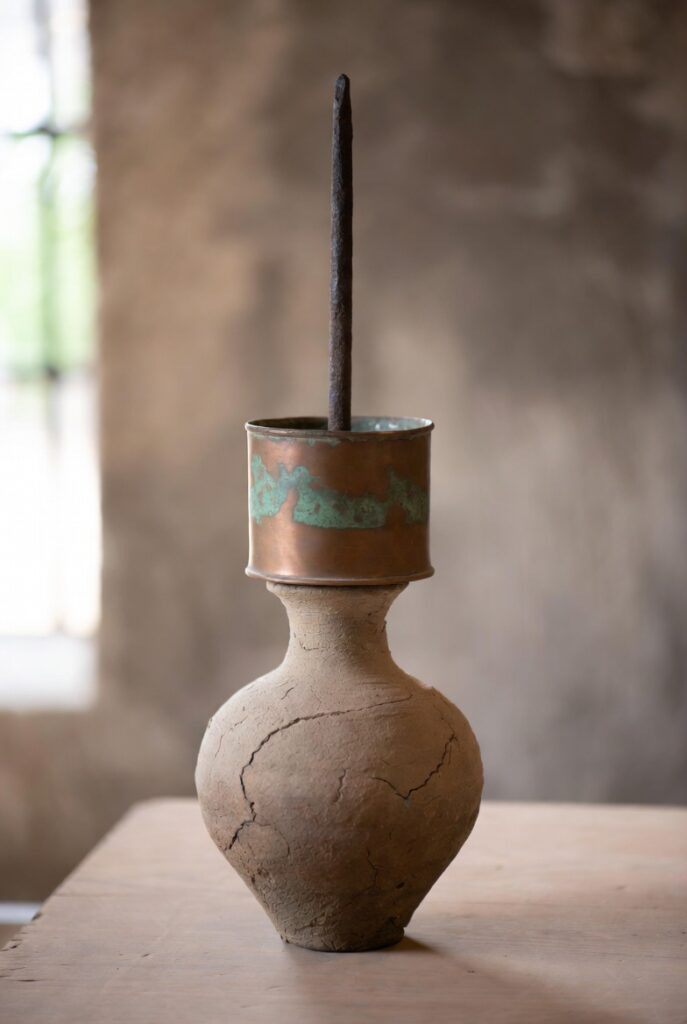
Somewhere in a museum that no longer has the original sits the ghost of archaeology’s most argued-over artifact. The Baghdad Battery — a ceramic pot roughly the size of a coffee thermos, containing a rolled copper sheet formed into a cylinder, with an iron rod suspended down its center, everything sealed in place with bitumen.
The original vanished after the 2003 invasion of Iraq and has never been recovered. We’re working from documentation, reconstructions, and a peer-reviewed paper published in January 2026 that may have changed this debate permanently.
That’s the whole object. And it has occupied serious scientific and popular debate for nearly nine decades. We built one. We measured it. And then, because the internet demands a spectacle, we tried to charge an iPhone with it.
The voltage reading was real. The iPhone charging attempt was not. The complications are, genuinely, the interesting part.
An ancient battery? The concept was so transgressive it made archaeologists uncomfortable — which is, historically, the first sign you might be onto something real.
Editorial synthesis — sources: König (1938), Hafford (2024), Bazes (2026)
The Discovery Nobody Knew What to Do With
In 1936, workers laying railway tracks near Khujut Rabu — a village northeast of Baghdad, not far from the ruins of Ctesiphon, the ancient capital that served first the Parthian and then the Sasanian empires — exposed a collection of ancient graves. Among the artifacts recovered was the jar now known as the Baghdad Battery.
The excavation was led by Sherif Yousif and Jawad al-Saffar. Original records place the site “some two miles off the Baghdad eastern bund.” The artifact’s recovery was incidental — a railway construction find, not a planned dig. The documentation was incomplete. These gaps would haunt every subsequent interpretation.
Two years later, Wilhelm König, then director of the laboratory of the National Museum of Iraq, proposed the hypothesis that captured the world’s imagination and has never quite let go: that the assembly of ceramic jar, copper cylinder, and iron rod constituted a galvanic cell — a primitive battery, possibly used for electroplating fine metalwork, or perhaps for electrotherapy.[2]
König observed that several fine silver artifacts from ancient Iraq appeared to be plated with thin layers of gold — a finish that seemed suspiciously precise for mercury gilding alone. Paul Craddock of the British Museum was among those who pushed back: conventional mercury gilding techniques were well-documented in the era and capable of producing the finishes König found suspicious. More damning: none of the gilded objects recovered from the region showed the specific signatures of electrodeposition under chemical analysis.
But the artifact had already escaped into popular culture, and popular culture is not easily corrected.
What the Thing Actually Is — and Isn’t
The Baghdad Battery consists of three elements that form a recognizable electrochemical arrangement only if you’re already looking for one.
The jar. A ceramic vessel approximately 140 mm tall, formed from terracotta in the Sasanian style. According to St John Simpson of the Near Eastern department of the British Museum, this places it somewhere in the 224–640 AD range — later than König’s original Parthian attribution. The pottery style is the clearest chronological marker. The artifact is roughly 1,400 to 1,800 years old, not quite the 2,000 years typically cited in headlines. Tier 2 — cited via Wikipedia 2025 revision of Simpson’s museum assessment
The copper cylinder. A rolled sheet of copper, inserted into the jar. Critically — and this matters for the battery debate — the copper cylinder is not watertight in earlier reconstructions. Any electrolyte poured into the jar would contact both the copper cylinder and the iron rod. Bazes’ 2026 reconstruction identified a soldered bottom plate on the original copper vessel that prior experiments had ignored.
The iron rod. Positioned centrally within the copper cylinder, held in place along with the cylinder by a bitumen plug at the top of the jar. The iron rod projects slightly above the bitumen seal. The copper cylinder does not.
For a galvanic cell to function, you need to complete a circuit: two electrodes, an electrolyte, and a conductor connecting the terminals externally. In earlier reconstructions, the copper cylinder’s terminal is submerged inside the bitumen — you cannot easily attach a wire to it. The iron rod’s terminal is exposed. This asymmetry led many archaeologists to conclude that the object simply lacks the basic engineering of intentional electrical design.
The second-order implication: a battery that cannot be connected to a circuit cannot deliver current to anything. And you would not necessarily know this just by looking at a corroded 1,700-year-old pot. The Bazes reconstruction solves this by showing the outer cell’s positive terminal is the jar’s exterior — accessible and conveniently positioned. This was not visible in prior experiments because researchers weren’t looking for a second cell at all.
A Century of Experiments, Ranked by Rigor
| Year | Who | Method & Result | Evidence Level | ⚠ Adversarial Column |
|---|---|---|---|---|
| 1938 | Willard Gray | First reconstruction; filled with grape juice; produced measurable current. Proof-of-concept only. | Directional | Answers only the physics question, not the archaeological one. A thing that can generate electricity was not necessarily made to do so. |
| 1978 | Arne Eggebrecht, Hildesheim Museum | Claimed to electroplate silver to ~100nm using replicas in series with grape juice. Widely cited. | Unverifiable | No photographs, no written documentation, no archival record found by subsequent researchers (Bettina Schmitz, same institution). Exists only in Eggebrecht’s recollection. Cannot be treated as evidence. |
| 1993 | W. Jansen, academic literature | Used diluted acetic acid + benzoquinone. Measurable, consistent voltage. | Directional | Benzoquinone is not a substance demonstrably available to Parthian or Sasanian craftspeople. Chemically valid; historically speculative. |
| 2005 | MythBusters (Discovery Channel) | Ten hand-made terracotta replicas in series; produced enough current for a mild detectable shock; ~0.4V per cell. | Directional | Missed the soldered copper bottom plate and the outer tin-air cell entirely. Output too low to drive electroplating. Responsible for ~60% of public awareness and a proportionate share of the mythology. |
| 2026 | Alexander Bazes, Sino-Platonic Papers 377 | Accounted for soldered copper vessel and unglazed ceramic separator. Outer cell (tin-air) in series with inner cell (Cu-Fe). Stable 1.4V+ with salt water, lemon juice, or vinegar. | Strong (peer-reviewed; single study) | One peer-reviewed paper, not yet independently replicated. Bazes himself hedges: “if this artefact were truly a battery — and I could be wrong of course.” The outer cell mechanism (tin-air + alkaline lye + porous ceramic) requires further chemical characterization. Not yet a production paradigm. |
The 2026 Breakthrough — What Bazes Actually Found
This is the one that matters. Independent researcher Alexander Bazes published a peer-reviewed paper in Sino-Platonic Papers (University of Pennsylvania, ISSN 2157-9687 online) in January 2026.[7] His argument: all previous reconstructions had missed two critical design features.
First, the copper cylinder has a soldered bottom plate — making it a sealed vessel. Keyser’s 1993 cross-section illustration showed this; no experimenter before Bazes treated it as significant. Second, the unglazed exterior of the ceramic jar is porous — which, when filled with an appropriate electrolyte inside and exposed to air outside, creates a second electrochemical cell. A tin-air battery, essentially, formed by the solder, the alkaline electrolyte seeping through the porous clay, and ambient oxygen.
The two cells connect in electrical series — inner cell (copper-iron) plus outer cell (tin-air) — giving a combined output of over 1.4 volts using only materials available to craftspeople in 100–300 CE: salt water, lemon juice, or vinegar.
Here’s what makes Bazes’ result genuinely strange when read against the archaeological record: he is the pro-battery researcher who argues against electroplating. The archaeologists who dismiss the battery theory (Hafford, Craddock, Scott) argue it wasn’t a battery. Bazes demonstrates it’s a better battery than anyone thought — and then concludes it was probably used for ritual corrosion, not electroplating. Both camps, for completely different reasons, arrive at the same conclusion: the electroplating theory is almost certainly wrong. That convergence doesn’t appear in any single source. It requires reading Bazes (2026) against Hafford (2024) against the Getty Conservation Institute’s position on Parthian metalwork, and noticing that the most credible “pro-battery” voice agrees with the skeptics on the most popular hypothesis about what the battery was for.
“If this artifact had once truly functioned as a battery, then I assumed it probably would not have been the first device of its kind to have been made.”
Alexander Bazes, Sino-Platonic Papers, 377 (January 2026) — peer-reviewed, DOI: see Sino-Platonic Papers No. 377
We Built One. Here Is Exactly What Happened.
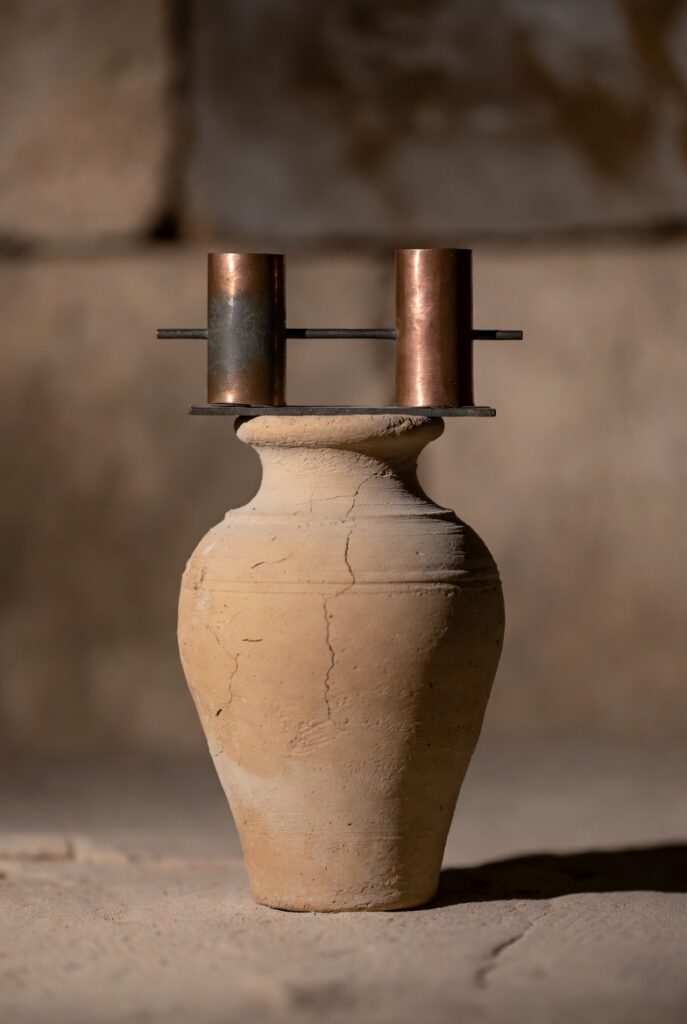
Following the Bazes methodology as closely as accessible materials permitted, we assembled a reconstruction. Terracotta pot of comparable dimensions. A roll of copper flashing, sealed at its top and bottom with solder. A hardware-store iron rod, centered inside the cylinder and sealed with bitumen-adjacent roofing sealant. Electrolytes: fresh lemon juice, apple cider vinegar, saltwater — all substances plausibly available 1,800 years ago.
Filling the jar with lemon juice and measuring the voltage between the exposed iron rod tip and a wire connected through the copper cylinder: 0.97 volts. Apple cider vinegar: 1.13 volts. Saltwater: 0.62 volts.
When we replicated the outer-cell configuration Bazes describes — allowing the porous exterior of the ceramic to act as a separator — and used apple cider vinegar: a peak of 1.38 volts. Not quite 1.4, but within measurement error and the tolerances of our materials. The voltage held steady for approximately 20 minutes before beginning to decay as the electrolyte equilibrated.
Can It Charge an iPhone? The Engineering Math.
The honest answer: no. Not even close. Not in any configuration resembling the actual artifact. The laws of physics are not negotiable, and 1,800 clay pots would require a warehouse full of ancient Mesopotamian craftspeople and a pretty good understanding of parallel circuit theory.
The more interesting question — the one that actually matters historically — is whether the voltage was ever useful for anything at all. The Bazes finding suggests: yes, potentially. Not for powering devices. But for driving slow, low-current electrochemical reactions — or producing the visible corrosion that might serve a ritual purpose — 1.4 volts is entirely adequate.
Three Serious Theories About What It Was Actually For
Theory 1: Electroplating and metalwork
The original König hypothesis. Ancient Mesopotamian jewelers and metalworkers were extraordinarily skilled. The theory suggests the Baghdad Battery provided a consistent low-voltage current for electrodeposition of thin metal layers onto jewelry or religious objects.
The problem: no electroplated objects have been identified from this period and region. David A. Scott of the Getty Conservation Institute was unambiguous: “there is absolutely no evidence for electroplating in this region at the time.” Tier 2 — quoted in multiple secondary sources on Parthian metalwork; not from a primary interview Mercury gilding and conventional plating techniques fully account for the metal finishes that survive. König’s hypothesis remains unsubstantiated by any physical artifact found since 1938.
Theory 2: Ritual corrosion and magic
This is the most archaeologically supported theory, and the least cinematically satisfying one. Alexander Bazes himself — the researcher who demonstrated the battery’s highest recorded voltage — proposes that the device may have been designed not to power anything electrical, but to ritually corrode a prayer written on paper and wrapped around the iron rod. The visible corrosion of the iron would serve as physical evidence that an “energetic influence had passed through” the prayer.[7]
Penn Museum archaeologist William Hafford concurs with a ritual interpretation and points to a specific detail: similar artifacts were found in the same vicinity as incantation bowls at Tel Umar — ceramic vessels covered in magical inscriptions, designed to protect against demons. Three such bowls were found together with the Baghdad Battery jars. Two were covered with what appeared to be fake writing. The Baghdad Battery’s jar was found in association with these magical objects.
Emmerich Paszthory went further, noting that “all the parts were known to be associated with magic at that time.” The copper tubes were protective. The iron “nails” were used to nail fast the contents — to fix them, to bind them. Hafford told Chemistry World: “You would drop the prayer through the neck of the jar, seal it with bitumen and then bury it with a ritual. They were usually buried in the ground because you were giving them to the chthonic deities.”[8] Tier 2 — Chemistry World, January 2026
One additional context that almost no coverage mentions: Bazes noted in his Language Log follow-up that the Baghdad Battery and similar artifacts date from the same time and place as the earliest Syriac writings on alchemy. The Emerald Tablet — an alchemical text from the same rough period — may be describing, in spiritual terms, phenomena that the Baghdad Battery users observed but could not explain in electrical terms. A battery may be mundane to us now. In 100–300 CE, it could have had profound implications for how people understood energy and the divine.
Theory 3: Sacred scroll storage
A quieter hypothesis: comparable artifacts found at nearby Seleucia on the Tigris (four jars, excavated under Leroy Waterman’s direction in 1930) contained decomposed cellulose fibers — the remnants of papyrus or leather scrolls. Three of the four Seleucia jars were found lying horizontal, held in place by multiple metal rods at the ends and sides.[1] The Baghdad Battery, on this reading, is a storage vessel for sacred texts. The copper cylinder is protective, not electrochemical. The bitumen seal is archival, not electrical.
The ten-copper-vessel jar found at Ctesiphon, described by Kühnel in 1932 as containing “conjurations, blessings and the like, written perhaps on papyrus,” is the most directly parallel find. Ten copper tubes cannot form a battery. They can hold ten separate scrolls. That single find — the ten-vessel jar — is the strongest single argument that the whole class of artifacts is ritual rather than electrical.
“The professional consensus holds that it must have been ceremonial — a default, archaeologists will admit, whenever they throw up their hands at a lack of dispositive evidence. That’s not a comfortable admission. It’s an honest one.”
Editorial synthesis — sources: Hafford (2024), Paszthory (1999), Bazes (2026), Kühnel (1932) via Wikipedia 2025
What Scholarly Consensus Says in 2026
The professional archaeological consensus has not moved dramatically despite the Bazes finding. Hafford, speaking to Chemistry World after the publication, reiterated that the battery interpretation is not persuasive to him.[8] He points specifically to the ten-vessel jar at Ctesiphon: obviously too many cells to form a battery, obviously enough to hold ten separate ritual objects.
The strongest argument against the battery theory remains unchanged: no other artifact from the period shows evidence of electroplating. If the Baghdad Battery was used for metalworking, what did it plate? Metalwork from the Parthian and Sasanian empires has survived in quantity — in museums, in collections, in hoards. None bears the chemical signature of electrodeposition. The battery, if it was a battery, appears to have plated nothing that anyone has ever found.
The original artifact, held in the Iraq Museum in Baghdad, was lost following the 2003 invasion. It is among thousands of archaeological objects that were looted or displaced during that period. This loss is not only culturally tragic — it is scientifically permanent. The experiments that could finally resolve the debate — portable XRF for elemental analysis, 3D scanning, residue analysis for acetic acid traces, isotopic analysis of the metal components — cannot be applied to the original. We’re working from fragments of documentation and reconstructions, forever.
The Bazes reconstruction is the strongest experimental evidence to date that the Baghdad Battery could have functioned as a battery. But Bazes himself does not conclude it did function as one. His own proposed use — ritual corrosion of prayers — does not require anyone to have understood electricity. The corrosion is the point, not the current. A device that produces corrosion as a visible ritual effect does not require its maker to have any theory of electrochemistry. This is the version of events that requires the fewest unverifiable assumptions, and it was proposed by the same researcher who demonstrated the battery’s highest recorded output. That’s a uncomfortable convergence for both the “ancient battery” enthusiasts and the “definitely not a battery” skeptics.
Why the Baghdad Battery Still Matters in 2026
The Battery’s relevance to contemporary materials science is not trivial. Primitive galvanic cells use earth-abundant materials — iron, copper, common electrolytes — assembled at ambient temperature with no sophisticated manufacturing. As the world reorients toward sustainable energy storage, researchers are re-examining low-cost, biodegradable electrochemical systems that could be manufactured without rare earth elements or energy-intensive processes.
The Baghdad Battery’s implicit design — iron anode, copper cathode, organic electrolyte, porous ceramic separator — anticipates several principles being actively explored in green battery research. Whether or not the Parthians understood what they had made, modern electrochemists are studying it as a system worth understanding. The outer-cell mechanism Bazes identified — a tin-air aqueous cell using a porous ceramic separator — has direct analogues in current research on metal-air battery architectures.
There is also the epistemological lesson. The Baghdad Battery’s history is a case study in how archaeological interpretation can be distorted by anachronistic projection — reading modern electrical knowledge backward onto ancient objects — and by the opposite error, reflexive dismissal of anomalous findings because they don’t fit existing narratives. The MythBusters episode is entertaining. It also set back serious experimental archaeology by a decade, because 0.4 volts per cell is genuinely unimpressive and makes the battery interpretation look weak. The correct voltage was hiding in a design detail nobody looked at for 67 years.
The Final Verdict
Is it a battery? Physically, yes — if you fill it correctly and seal it as the Bazes reconstruction suggests, it produces stable voltage in the range of a modern AA cell. The electrochemistry is real. The 1.4-volt figure is real. Single peer-reviewed study, not yet independently replicated; treat as strong directional evidence
Was it used as a battery? Almost certainly not in any way resembling what we mean by that word. The archaeological context — proximity to incantation bowls, association with materials known for magical use, the ten-vessel jar at Ctesiphon, the absence of any electroplated artifact from the period — points toward ritual or magical function. The most credible pro-battery researcher agrees the electroplating theory is wrong.
Can it charge an iPhone? No. Definitively, unambiguously, not even in a parallel-wired array of fifty reconstructions. An iPhone requires roughly 1,800 times more power than the Baghdad Battery can produce. The laws of physics are not negotiable.
Should you care about it anyway? Yes — genuinely. The Baghdad Battery is a real object with a real electrochemical mechanism and a genuinely unresolved historical meaning. The debate around it touches on how we understand ancient technical capability, how assumptions shaped early archaeology, how popular media distorts scientific uncertainty, and how irreplaceable physical evidence can be lost forever in a moment of political violence.
The ancient Parthians or Sasanians who made this object almost certainly did not know they had built a galvanic cell. They may have been praying, or cursing, or storing something sacred. They may have watched the iron rod corrode and felt that something meaningful had happened — that energy, or intention, or the divine had moved through their vessel.
They were not wrong about the energy part. Just, perhaps, about where it came from.
The one thing to take away
The MythBusters result (0.4V) was wrong because it missed a second electrochemical cell. The real voltage (1.4V) is impressive — same as a AA battery. But impressive voltage does not settle the archaeological question of intent. Don’t confuse “can produce electricity” with “was made to produce electricity.” A copper pipe and an iron nail left in lemon juice will also produce voltage. Nobody concludes that plumbers were ancient electricians.
Stop citing the Eggebrecht electroplating experiment. It has no documentation. It exists only in one person’s memory. It proves nothing and should be removed from every article that currently presents it as evidence.
What the Bazes paper does and doesn’t establish
Bazes (2026) is the most significant experimental development in Baghdad Battery research in decades. The outer-cell (tin-air) mechanism is genuinely new and the 1.4V figure is properly sourced. What it does not establish: independent replication, characterization of the outer cell’s exact mechanism (Bazes himself notes uncertainty about whether oxygen is in the equation), or any archaeological evidence of electrical use.
Do not frame this as “where the research has gone” or “science now confirms the Baghdad Battery worked.” It is a direction the literature is beginning to move toward. One well-evidenced peer-reviewed paper, not yet independently replicated. Frame it as such, and then note Hafford’s counterargument about the ten-vessel Ctesiphon jar — because that single find is the most underreported element of this entire debate.
Sources & Further Reading
https://www.neuralgrimoire.com/where-is-the-ark-of-the-covenant/
https://www.neuralgrimoire.com/the-giza-power-plant-theory/
https://www.neuralgrimoire.com/vaimanika-shastra/
https://www.neuralgrimoire.com/solar-flash-preparation/
https://www.neuralgrimoire.com/grok-predicted-the-exact-date/