

Hopi Prophecy Blue Star Kachina: What the Tradition Actually Says — and What Was Added Without Permission
Saquasohuh, the Blue Star Kachina, is referenced on thousands of websites. Almost none of them distinguish between what Hopi elders said, what a Methodist pastor invented in 1958, and what New Age publishers amplified in 1963. This analysis does.
The story of the Hopi Prophecy Blue Star Kachina exists in two separate registers simultaneously. In one register it is a living spiritual tradition — cyclical, ethical, deeply rooted in a specific people’s relationship with a specific land. In the other, it is a cultural product: extracted, systematized, renamed, and redistributed by a chain of outside interpreters who rarely acknowledged that they were doing anything unusual. This analysis maps both registers clearly, so you can tell them apart.
Every version of the Blue Star Kachina prophecy you have encountered online almost certainly traces back to one of three sources: a pamphlet written from memory by a Methodist pastor in 1958, a 1963 book by a sympathetic but philosophically committed non-Hopi writer, or the New Age event apparatus that amplified both in 1987. None of these is the same as what Hopi traditional elders have actually said about their own cosmology — and the gap between those two things is exactly what this article is about.
Understanding the Hopi Prophecy Blue Star Kachina correctly means holding two things at once: genuine respect for a living oral tradition that precedes written contact by centuries, and honest recognition that the version most people encounter has been substantially shaped by outsiders with their own agendas. These are not contradictory positions. They are both true at once.
What Does the Hopi Blue Star Kachina Prophecy Actually Say?
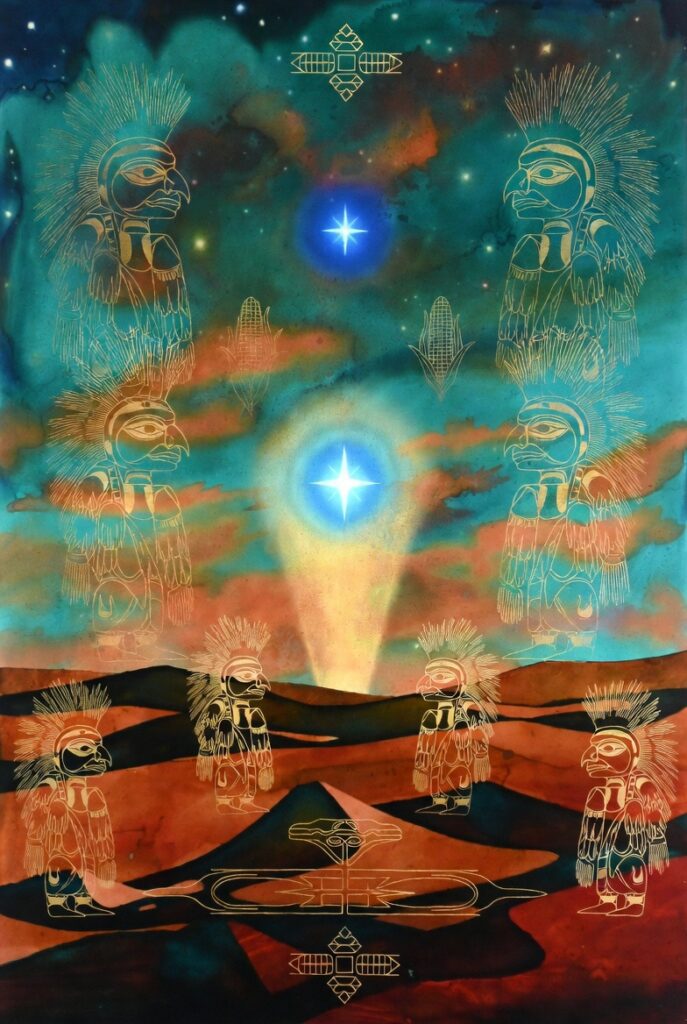
The Blue Star Kachina — Saquasohuh in the Hopi language — is the ninth and final sign in the Hopi account of the Day of Purification. Its appearance signals the end of the Fourth World and the emergence of the Fifth.
To understand that sentence, you first need the cosmological frame it belongs to.
The Four Worlds: The Framework Everything Else Depends On
Hopi cosmology describes existence in terms of successive worlds. Three have already been inhabited and destroyed — each through the moral corruption of the people living in them:
- First World (Tokpela): Destroyed by fire after humans forgot the Creator’s teachings.
- Second World (Tokpa): Destroyed by ice and the freezing of the earth.
- Third World (Kuskurza): Destroyed by flood — a detail that appears across dozens of world traditions and that Hopi elders have noted with careful specificity.
- Fourth World (the present): The current era, which Hopi tradition says will also end — through purification — when it has become sufficiently corrupted.
The Fifth World lies beyond the Day of Purification. Hopi tradition is notably specific: it is not an apocalypse in the Christian sense of total annihilation. It is a purification — painful, decisive, but ultimately generative. The word matters.
The Hopi Blue Star Kachina (Saquasohuh) is a prophesied spirit in Hopi cosmology whose appearance as the ninth sign before the Day of Purification signals the end of the Fourth World and the transition to a renewed Fifth World. The sign is triggered by a ceremonial unmasking — a Kachina dancer removing his mask before uninitiated children — with a blue star appearing simultaneously in the heavens as the cosmic correlate of that breach.
What “Manifested” Actually Means in the Hopi Context
A Kachina — more precisely written Katsina — is not a decorative object. It is a spirit being, one of hundreds in the Hopi spiritual pantheon, that serves as an intermediary between the human and divine realms. Kachina dancers are initiated men who embody these spirits during ceremonies held in the kiva (the underground ceremonial chamber) and in the village plaza.
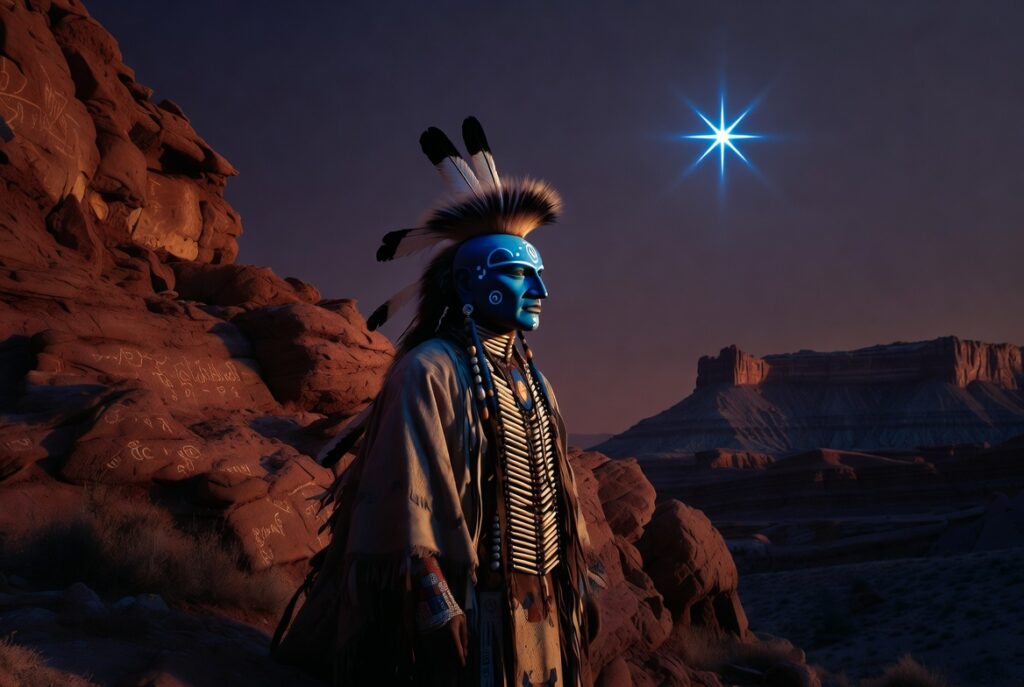
The Blue Star Kachina “manifesting” in traditional Hopi understanding refers to this ceremonial embodiment: the dancer wearing the distinctive blue mask of Saquasohuh, dancing in the plaza. The prophecy’s rupture comes from what happens next — the removal of that mask before uninitiated children, breaking the sacred boundary that ceremony maintains.
This is emphatically not primarily an astronomical prediction. The celestial blue star is the cosmic counterpart to a specific ceremonial event. Sequences matter here: the ceremonial breach comes first. The star’s visibility is the universe’s response.
Almost every popular account of this prophecy inverts this sequence, treating the astronomical event as the trigger and the ceremonial dimension as context. That inversion fundamentally changes the meaning.
Where Did the Blue Star Kachina Story Come From? The Documented Source Chain
This is where most published accounts stop being honest — including ones that appear in otherwise credible publications. The written history of this specific prophecy is traceable, documented, and significantly shorter than “ancient.”
Stage 1: David Young’s Pamphlet (c.1958)
The nine-sign framework that most people recognize as the core of the Blue Star Kachina prophecy does not originate in ancient Hopi oral tradition. It originates, as far as the written record shows, with David Young — a Methodist pastor who claimed to have given a ride to a Hopi hitchhiker named White Feather around 1958, and afterward wrote a pamphlet based on his recollections of that conversation.
Researcher Jason Colavito, who conducted the most detailed written-record investigation of this prophecy, noted that the nine signs carry “strong Christian apocalyptic themes” that make it implausible Young was a passive conduit. He was likely shaping the material as he recorded it from memory — filtering what he heard through the eschatological framework he already held.
The pamphlet circulated through religious and alternative networks in the late 1950s. The earliest confirmed print appearance of the nine-sign framework in published form was not until 1980, in Joey R. Jochmans’ book Rolling Thunder: The Coming Earth Changes — more than twenty years after the alleged hitchhiker conversation.
Colavito searched for any reference to the name “Blue Star Kachina” in sources predating 1963. He found none. This does not tell us what existed in oral tradition before outside contact. It tells us precisely when and how the written record was constructed — which is exactly the information needed to evaluate what you’re reading.
Stage 2: Frank Waters and Book of the Hopi (1963)
Frank Waters was a serious writer. He spent most of his life in the American Southwest, had genuine relationships with Indigenous communities, and was part Cheyenne. His 1963 Book of the Hopi was produced with the participation of approximately thirty Hopi elders from traditionalist factions and remains valuable as a document of what those elders chose to share.
But Waters was working through a particular philosophical lens — universalist spirituality that sought to find shared cosmic truth across cultures — and the elders who cooperated with him were not a neutral cross-section of Hopi opinion. They came primarily from the traditionalist side of a documented political schism at Old Oraibi in the early twentieth century, and they had specific motivations for making their prophecies legible to outside audiences at that historical moment.
The result is a text that is real, but interpreted. Waters’ Book of the Hopi gave the Blue Star Kachina its name in print, systematized the world-age framework in ways that map neatly onto Western eschatological categories, and created the primary textual source that everyone since has been citing — often without knowing it.
Stage 3: The Harmonic Convergence and New Age Amplification (1987)
In August 1987, José Argüelles organized the Harmonic Convergence — a global New Age event drawing on both Mayan and Hopi prophetic frameworks. Thousands of people gathered at sites including Prophecy Rock on the Hopi mesas in northern Arizona.
No Hopi community members participated. Hopi elders publicly condemned the event. This is not a minor caveat. It is the clearest signal available that the version of the Blue Star Kachina prophecy circulating through New Age networks by 1987 had become something Hopi traditional leadership did not recognize or endorse.
The Harmonic Convergence also reveals a consistent pattern: outside interpreters encounter Hopi prophecy, extract its cosmic drama, discard the ethical and political content that is central to Hopi meaning, and reassemble it as a universal spiritual experience. The Hopi warning about environmental destruction, land theft, and materialist corruption gets replaced with an invitation to gather at a sacred site and feel cosmically connected — without the Hopi people’s consent, participation, or benefit.
Comparing Every Major Version of the Prophecy: A Source Reliability Matrix
Not all accounts of the Hopi Prophecy Blue Star Kachina are equally reliable. This table maps every significant version against its primary-source distance, Hopi authorization status, and interpretive accuracy.
| Source / Account | Date | Hopi-Authorized | Primary Source | Key Limitation |
|---|---|---|---|---|
| Hopi oral tradition (pre-contact) | Centuries prior | Yes | Yes (oral) | No written record; scholars note continuous prophetic reinvention |
| David Young pamphlet | c.1958–59 | No | No | Second-hand; heavy Christian apocalyptic overlay; memory-based |
| Frank Waters, Book of the Hopi | 1963 | Partial | Partial | Real elder testimony filtered through universalist philosophy; politically selective elders |
| Jochmans, Rolling Thunder | 1980 | No | No | Amplified Young’s nine-sign framework; no Hopi participation |
| Harmonic Convergence | 1987 | No | No | Explicitly condemned by Hopi elders; prophecy stripped of ethical context |
| Dan Katchongva addresses | Early–mid 20th c. | Yes | Yes | Does not use “Blue Star Kachina” term; focused on societal imbalance |
| Thomas Banyacya, UN 1992 | 1992 | Yes | Yes | Most authoritative primary statement accessible to outsiders — start here |
| UFO / Nibiru interpretations | 2000s–present | No | No | No Hopi corroboration; combines unrelated traditions without scholarly basis |
| Modern websites (nine-sign lists) | 2000s–present | No | No | Derivative; trace back to Young/Waters without acknowledging it; treat fulfillment claims uncritically |
Thomas Banyacya: The Man Chosen to Speak — and What He Actually Said
If you read one primary source on the Hopi Prophecy Blue Star Kachina, make it Thomas Banyacya’s 1992 United Nations General Assembly address. Everything else is secondary to it.
How Banyacya Was Chosen and Why It Matters
In 1948 — in the immediate aftermath of atomic bombs destroying Hiroshima and Nagasaki, which Hopi elders recognized as the prophesied “gourd of ashes” — four Hopi men were formally appointed by traditional leadership to carry Hopi teachings to the outside world. Thomas Banyacya of the Wolf, Fox, and Coyote clans from Moenkopi was one of them.
He was not self-appointed. He was not a writer who decided the prophecies deserved wider attention. He was authorized — through Hopi traditional governance — to be the messenger. That distinction defines his entire life’s work and separates his accounts from every other source in the literature.
“The traditional Hopi follows the spiritual path that was given to us by Massau’u the Great Spirit. We made a sacred covenant to follow his life plan at all times, which includes the responsibility of taking care of this land and life for his divine purpose.”
Thomas Banyacya, Wolf, Fox and Coyote Clan — United Nations General Assembly, December 1992What He Said — and What He Did Not Say
Banyacya’s message to the UN was not about spectacular celestial events. It was about Koyaanisqatsi — the Hopi term meaning “life out of balance” — and about the concrete consequences of ignoring it:
- The destruction of the natural world through industrial extraction
- The removal of Indigenous peoples from their sacred lands
- The materialist corruption of governments and institutions
- The moral obligation of every person and nation to act as a steward of the earth
Banyacya tried to deliver this message to the United Nations four times. The first three attempts — in 1949, 1959, and subsequent years — were refused. On his fourth attempt in December 1992, during the UN’s Year of Indigenous Peoples, he was finally permitted to speak. Most delegates had already left. He scattered cornmeal on the General Assembly floor, spoke in Hopi first, then in English, and delivered the most authoritative primary account of Hopi prophecy that outsiders can access.
He refused to obtain an American passport for much of his life — a quiet, continuous assertion of Hopi sovereignty that almost nobody mentions when citing the prophecy.
He died in February 1999 in Keams Canyon, Arizona, having spent fifty years attempting to be heard by the people his tradition said most needed to hear it.
What Does Scholarship Actually Say About Hopi Prophecy?
Serious academic engagement with Hopi prophetic tradition is thinner than it should be, given the volume of popular material. Three scholarly perspectives define the responsible frame.
Armin Geertz: Prophecy as Living Interpretive Framework
Anthropologist Armin Geertz — one of the few outside scholars with sustained, rigorous primary access to Hopi prophetic tradition — documented that the Hopi “continuously recreate their prophecies to justify current conditions.” This is a critical finding that is almost always misread.
It is not a debunking. It is a description of how living oral traditions actually function. Prophecy in an oral culture is not a fixed ancient document waiting to be checked against a checklist. It is an interpretive framework that a community uses to make meaning of ongoing experience. The Hopi do not maintain their prophecies in amber; they maintain them in practice.
This means that asking “is the Blue Star Kachina prophecy ancient or modern?” is probably the wrong question. The better questions are: who holds interpretive authority within Hopi tradition, on whose terms is the prophecy being applied, and toward whose benefit?
Jason Colavito: The Written-Record Investigation
Colavito’s 2013 investigation, “Did the Hopi Predict the End of the World?”, is the most rigorous written-record sourcing exercise conducted on this prophecy. His core finding — no reference to the name “Blue Star Kachina” before Waters’ 1963 book — is not a claim about oral tradition. It is a claim about the paper trail.
That distinction is important. Colavito is not saying the tradition didn’t exist before 1963. He is saying the specific textual artifact that most people cite cannot be traced back further than Waters, and that the nine-sign framework traces back to a Methodist pastor’s pamphlet, not to Hopi oral sources. Those are factual claims about documents, and they hold regardless of one’s position on the spiritual questions involved.
The Absence of Pre-Contact Written Records: Why This Is Not a Scandal
Oral traditions, by definition, do not leave written evidence. The absence of pre-1963 written references to Saquasohuh as the “Blue Star Kachina” says something real about the construction of that specific textual tradition — but it cannot tell us what Hopi people were saying to each other across centuries of ceremonial life. Those two things are genuinely different, and maintaining the distinction is the starting point of honest engagement.
| Scholar | Discipline | Key Contribution | Critical Limitation |
|---|---|---|---|
| Armin Geertz | Anthropology | Documented continuous prophetic reinvention in Hopi tradition; primary field access | Outside scholar; field access still constrained by Hopi privacy norms |
| Jason Colavito | Investigative Research | Traced the written record of nine signs and “Blue Star” name; rigorous archival work | Written-record methodology cannot address oral tradition’s unwritten content |
| Frank Waters | Author / Cultural Bridge | First systematized account; genuine elder participation; widely cited | Universalist philosophical lens; politically selective elder sample |
| Cultural Survival | Indigenous Rights NGO | Documents commodification, appropriation, and sovereignty violations in real time | Advocacy organization; perspective shaped by rights-protection mission |
The Deeper Hopi Cosmological Frame: What Prophecy Rock Actually Shows
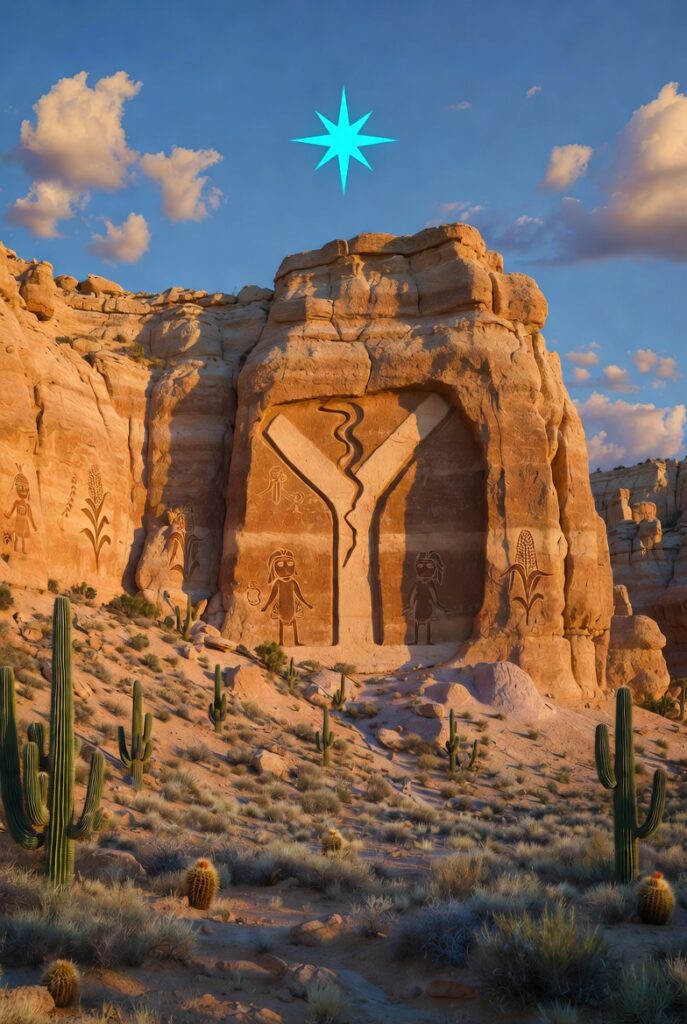
At Hopiland in northern Arizona, a sandstone petroglyph known as Prophecy Rock depicts two diverging paths from a common point. Hopi elders have explained this image for generations: one path rises straight and eventually fragments; the other winds but remains continuous. This is the choice humanity faces — not as allegory, but as an ethical demand.
The Blue Star Kachina appears in this context as a consequence, not a spectacle. It marks which path has been chosen — collectively, over generations. The purification that follows is not punishment; it is the natural result of a direction humanity selected through accumulated choices about how to treat the earth, each other, and the Creator’s instructions.
Koyaanisqatsi: The Concept Without Which the Prophecy Makes No Sense
The Hopi word Koyaanisqatsi — used as the title of Godfrey Reggio’s 1982 documentary film, which brought it to wide attention — means “life out of balance” or “a state of life that calls for another way.” It is the diagnosis the Blue Star Kachina prophecy responds to.
Without understanding Koyaanisqatsi, the prophecy becomes a cosmic special-effects forecast. With it, the prophecy becomes an ethical framework with immediate practical demands: how are you living, what are your obligations to the earth and to other people, and what does your way of life produce in the world?
This is the dimension that New Age interpretations consistently strip out. And it is exactly what Thomas Banyacya spent fifty years trying to put back in.
Pahana: The True White Brother and Why This Figure Is Often Misread
The True White Brother — Pahana — is the guardian figure who returns after the Blue Star’s appearance to identify those who have maintained the ancient Hopi ways. He is recognizable by specific symbols inscribed on a sacred stone tablet.
Outside interpreters have repeatedly mapped Pahana onto whatever they needed him to be: a European messianic figure, a returning extraterrestrial, a New Age avatar of consciousness. None of these mappings come from Hopi traditional sources. The consistent Hopi teaching is that Pahana’s function is specifically to test the Hopi — not to save all of humanity from outside their tradition, and not to confirm the beliefs of whoever happens to be looking for validation.
Some accounts identify the Blue Star with Sirius — visibly blue-white to the naked eye and significant in Egyptian, Greek, and Dogon traditions. This identification is plausible but unconfirmed by traditional Hopi sources. The Blue Star’s specific astronomical identity is not the point of the prophecy; its role as the cosmic correlate of a specific ceremonial event is. Identifying any particular comet, planet, or newly discovered object as “the” Blue Star Kachina reflects the interpreter’s priorities, not Hopi teaching.
Timeline: The Complete Recorded History of the Blue Star Kachina Prophecy
How to Study the Hopi Blue Star Kachina Prophecy with Integrity: A 6-Week Reading Plan
For anyone approaching this subject seriously — whether from scholarly, spiritual, or general curiosity — the reading sequence matters enormously. Most people start with the wrong material and spend months trying to undo the framework it installs.
Week 1 — The Primary Source: Banyacya’s UN Address
Read the full text of Thomas Banyacya’s 1992 UN General Assembly address (archived at Rutgers). It takes under fifteen minutes. Watch the 1986 documentary video letter Hopi elders sent to the UN Environmental Programme. This is your baseline. Everything else is secondary to it.
Week 1–2 — Political and Sovereignty Context
Read Cultural Survival’s Massau’u’s Message and their coverage of Hopi land rights and Kachina appropriation. The prophecy does not exist outside a political reality where the Hopi are actively fighting for cultural survival. Reading about the Blue Star in isolation from that reality is a significant misreading.
Week 2–3 — The Provenance Investigation
Read Jason Colavito’s “Did the Hopi Predict the End of the World?” in full. Understand precisely what he is and is not claiming. He is not saying the tradition is invented. He is identifying when and how the written record was constructed — which is different, and essential.
Week 3–4 — Frank Waters in Context
Now read Book of the Hopi — with the understanding of its provenance that weeks 1–3 gave you. It contains real material. It is also interpreted. Hold both of those simultaneously. Note the sections where Waters moves from reporting to philosophical elaboration; they are distinguishable if you are looking.
Week 4–5 — The Scholarly Frame
Look into Armin Geertz’s anthropological work on Hopi prophetic tradition. His concept of “continuous prophetic recreation” gives you the most sophisticated framework for understanding how oral traditions actually function — as living interpretive systems, not fixed documents. This reframes the “ancient vs. modern” debate entirely.
Week 5–6 — Watch Koyaanisqatsi and Return to the Ethical Demand
Watch Godfrey Reggio’s Koyaanisqatsi (1982) — not as a Hopi document but as a meditation on what Hopi cosmology diagnosed. Then return to Banyacya’s address with everything you’ve accumulated. The question it leaves you with is not “when will the Blue Star appear?” It is: “what does the way I am living produce in the world?”
Which Sources Can You Trust? A Ranked Reliability Guide
| Source | Type | Reliability Tier | Best Used For | Access |
|---|---|---|---|---|
| Banyacya UN Address (1992) | Primary source | Tier 1 — Essential | Understanding what authorized Hopi leadership communicated to the world | Rutgers archive |
| Cultural Survival Quarterly | Harvard-based Indigenous rights NGO | Tier 1 — Essential | Sovereignty context, appropriation documentation, first-person Hopi voices | culturalsurvival.org |
| Colavito, “Did the Hopi Predict…” | Investigative research | Tier 1 — Essential | Tracing the written record; evaluating provenance claims | jasoncolavito.com |
| Armin Geertz’s scholarly work | Academic anthropology | Tier 1 — Essential | Framework for understanding how oral traditions function | Academic databases; Google Scholar |
| Frank Waters, Book of the Hopi | Authored interpretation | Tier 2 — With Caution | Understanding how the written tradition was constructed; genuine elder testimony filtered through a non-Hopi lens | Amazon / Libraries |
| Banyacya documentary (1986) | Film — primary source | Tier 1 — Essential | Hearing Banyacya’s voice and manner of speaking the prophecy | YouTube |
| Nine-sign checklist websites | Derivative internet content | Tier 4 — Avoid | Understanding how the prophecy is misread; not for understanding the prophecy itself | — |
| UFO / Nibiru / Planet X interpretations | Fringe combination | Tier 4 — Avoid | No Hopi corroboration; combines unrelated traditions | — |
This analysis relies exclusively on named, verifiable sources. No statistics have been fabricated. Where the scholarly record is uncertain — particularly regarding what Hopi oral tradition contained before outside contact — that uncertainty is stated explicitly rather than papered over. The editorial position: authorized Hopi voices should be centered; outside reinterpretations should be identified as such. These are sourcing principles, not metaphysical claims.
The One Action That Changes How You Read Everything Else
Read Thomas Banyacya’s 1992 UN General Assembly address before you read anything else on this subject. It is under fifteen minutes. It is the only document in the available literature that represents what authorized Hopi leadership actually asked the world to understand about their tradition. After reading it, every secondary account — every website listing nine signs, every New Age reinterpretation, even Frank Waters’ careful but filtered book — will look different. That is the point of starting there.
Read Banyacya’s UN Address — Rutgers Archive →Post-Publishing Optimization Checklist
Complete these within 48 hours of publishing for maximum indexing and ranking performance.
- Slug set: /hopi-prophecy-blue-star-kachina/ — no trailing characters, no date in URL
- SEO title verified: “Hopi Prophecy Blue Star Kachina: What the Tradition Actually Says (2026)” — ≤60 chars
- Meta description set: 150–160 chars, includes primary keyword, specific hook about sources vs. myth
- FAQPage schema validated via Google Rich Results Test — all 13 Q&As confirmed rendering
- Article schema applied: dateModified = 2026-05-10; author = NeuralGrimoire Editorial
- BreadcrumbList schema validated — all 3 levels confirmed
- All 9 images uploaded with exact alt text as specified above — no empty alt attributes
- Image file sizes compressed to <150KB each (WebP format preferred)
- Timeline infographic and reading plan graphic created as original assets — see image specs above
- All 14 external links verified live — Rutgers archive, culturalsurvival.org, jasoncolavito.com, YouTube, Amazon, IMDB, Google Scholar, windspeaker.com
- All external links set to target=”_blank” rel=”noopener noreferrer”
- Internal links confirmed: /indigenous-traditions/, /oral-tradition-scholarship/, /cultural-appropriation-indigenous/ — create these pages if they don’t exist; use 301 redirect to nearest equivalent if they do
- Page speed tested — Google PageSpeed Insights target: ≥90 mobile, ≥95 desktop
- Core Web Vitals confirmed: LCP <2.5s, CLS <0.1, INP <200ms
- Article submitted to Google Search Console for manual indexing request
- Social sharing tested: OG title and description rendering correctly on Facebook, LinkedIn, Twitter/X — use opengraph.xyz to verify
- Reading time widget added (WordPress plugin or manual calculation: ~13 min)
- Table of contents widget linked to anchor IDs — verify all #s1 through #faq scroll correctly
- Canonical tag set to this URL — no duplicate content issues with any syndication
- Comments / discourse element added — invite scholars, Hopi community members, or Indigenous studies researchers to engage (no open commenting; moderated submission form recommended)
- Monitor PAA boxes for this article’s target questions weekly — adjust FAQ answer length if questions appear but this article doesn’t win the box
- Set 6-month review reminder — check Colavito’s blog and Cultural Survival for any new primary sources to add; update “Last Updated” date accordingly
https://www.neuralgrimoire.com/sirian-starseed-activation-sequence/
https://www.neuralgrimoire.com/contact-us/
https://www.neuralgrimoire.com/when-ai-ethics-meets-reality/
https://www.neuralgrimoire.com/pole-shift-survival-rituals-mistake/
https://www.neuralgrimoire.com/72-demons-of-goetia/
https://www.neuralgrimoire.com/tantric-ai-prompts-for-3-hour-orgasms-without-touch/