


Antikythera Mechanism 2.0: Rebuilding the Ancient Greek Computer That Predicted the Future
Modern engineers have built functional replicas from CT scan data — and a 2025 simulation has revealed something unexpected: the original may have jammed every four months.
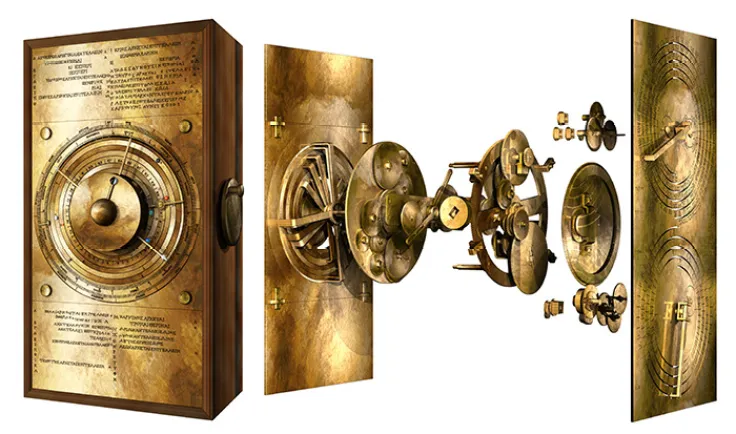
Stylised reconstruction of the Antikythera Mechanism’s gear trains — the original contained at least 37 bronze gears in a wooden case measuring 34 × 18 × 9 cm.
Updated April 2026
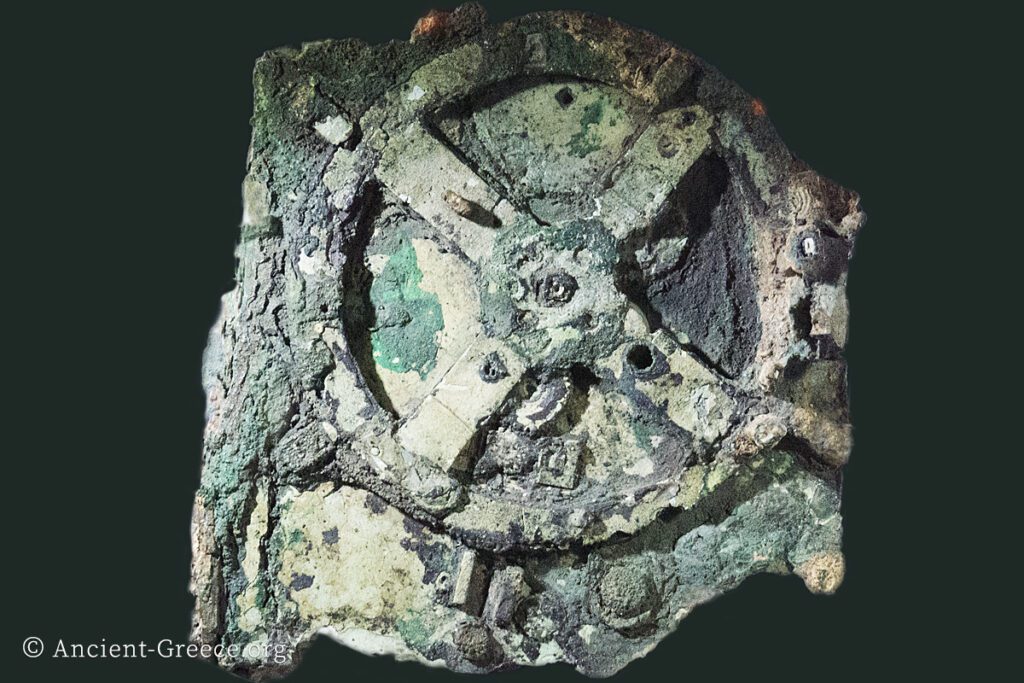
In 1901, sponge divers hauled a corroded lump of bronze and wood from a Roman shipwreck near the Greek island of Antikythera. The lump sat in an Athens museum for decades before anyone grasped what it was. When researchers finally X-rayed the fragments in 2005, they found a machine so far ahead of its time that the finding rewrote the history of technology: a hand-cranked analog computer, built sometime between 150 and 60 BCE, that could predict solar and lunar eclipses, track the Olympic Games calendar, and model the Moon’s irregular orbit with a pin-and-slot mechanism that would not be reinvented in Europe for another 1,500 years.
What you probably haven’t read is the messy, fascinating story of what happened next — the CT scans that revealed thousands of hidden inscriptions, the competing reconstructions that still disagree with each other, and a 2025 simulation from Argentina that suggests the original might have jammed every four months like a bad printer. That’s the story worth telling.
A 2,000-Year-Old Predictor: What It Actually Did
The mechanism fits in a shoebox — its wooden case measured roughly 34 × 18 × 9 cm — which is part of what makes it so astonishing. Inside that case, at least 37 interlocking bronze gears performed what we would now call a multi-variable simulation of the solar system. Turn the crank on the side and every pointer on every dial advances in sync, modelling celestial cycles that the ancient Greeks had inherited from Babylonian astronomers over centuries of meticulous sky-watching.
The front face displayed the Sun’s position in the zodiac and a calendar ring. Recent research — specifically a 2024 study by gravitational wave researchers at the University of Glasgow, who repurposed their statistical tools to analyze the calendar ring’s hole pattern — confirmed the ring almost certainly had 354 holes, corresponding to a lunar year rather than the 365-hole Egyptian calendar that some earlier researchers had proposed. The back face carried two large spiral dials: a Metonic dial that tracked 235 lunar months across 19 years, and a Saros dial that predicted eclipses over an 18-year, 223-month cycle. A subsidiary dial at the bottom right tracked the four-year Olympic cycle and the other major Panhellenic games.
“Ours is the first model that conforms to all the physical evidence and matches the descriptions in the scientific inscriptions engraved on the mechanism itself.”
Professor Tony Freeth, UCL Mechanical Engineering, Scientific Reports, March 2021The engineering that made all of this possible is worth slowing down for. The mechanism’s pin-and-slot gear drive — two pins on a rotating disk dropping into a slotted lever — modelled the Moon’s elliptical orbit at a time when Greek astronomers hadn’t yet formulated ellipses. The Moon moves faster when it’s closer to Earth (what we now call perigee), and the pin-and-slot mechanism reproduced that variable speed mechanically, with remarkable accuracy. Differential gearing calculated the angular difference between the Sun and Moon pointers, enabling the device to display lunar phases. All of this from a single hand-crank input, cascading through layers of interlocking gears. You could argue it was the first programmable analog computer ever built — or at least the first one that survived.
The 2021 Breakthrough: Solving the Planetary Display
For decades, the rear mechanisms were reasonably well understood. The front — specifically how the mechanism displayed the five visible planets (Mercury, Venus, Mars, Jupiter, Saturn) — defeated every researcher who tried. The problem is that only about a third of the original mechanism survives, and the planetary display gearing would have been at the front, behind the zodiac ring, in the section that’s mostly gone.
In March 2021, a team led by Professor Tony Freeth at University College London published a reconstruction in Scientific Reports that finally made sense of the surviving fragments. The key insight: the mechanism reused gear ratios across multiple planetary trains, using rational approximations for synodic cycles built from small prime factors — particularly 7 and 17. Venus, for example, uses a 462-year period relation, and the team found the 63-tooth gear in Fragment D played a crucial role in encoding it. Every previous reconstruction, Freeth’s team concluded, was “not at all compatible with all the currently known data.” Their model, they said, was the first one that matched both the physical fragments and the inscriptions.
The UCL team’s planetary reconstruction uses shared gear-trains across multiple planets, reducing the total gear count required. This solved a longstanding puzzle: how could such an intricate display fit within the available depth of the mechanism’s front face? Shared gearing made it geometrically possible. Whether ancient Greek craftsmen actually had the tooling to manufacture it to the required tolerances remains an open question.
Antikythera 2.0: The Modern Replicas
The term “Antikythera Mechanism 2.0” refers loosely to the wave of post-2005 reconstructions that incorporated high-resolution CT scan data unavailable to earlier researchers. Before the 2005 imaging project, builders were working largely from the surface geometry of the corroded fragments. After it, they had detailed internal structure — gear tooth counts, shaft positions, layer thicknesses — and thousands of inscribed text characters that functioned as the mechanism’s original user manual.
| Replica | Scale | Materials | Key feature | Status |
|---|---|---|---|---|
| Clickspring (YouTube) | 1:1 | Bronze alloy, period-accurate techniques | Hand-machined using only tools available in antiquity; fully documented on video | Ongoing / displayed |
| University of Sonora (Mexico) | 10:1 | Modern alloys | Largest functional replica ever built — over 3 metres tall; inaugurated 8 February 2024 | Permanent public display |
| 3D Solidforms / Aristotle University | 1:1, 3:1, 4:1 | Bronze (1:1 versions) | Nine copies built in four versions, tracking evolving research; team members have published in peer-reviewed journals | Museum/research use |
| Nick Andronis (Western Australian Museum) | 1:1 | Bronze | First replica based on the most current research and digital reconstructions; exhibited 2024 | Museum touring |
| UCL Antikythera Research Team | Computer model + physical replica in progress | 3D-printed prototype | First reconstruction to account for all five planets and all physical fragment data simultaneously | Research prototype |
The Clickspring project — a YouTube channel documenting one machinist’s attempt to recreate the mechanism using only ancient Greek tools and techniques — deserves special mention because it approaches the problem from the opposite direction to academic teams. Rather than asking “what did it look like?” it asks “how was it made?” Every tool, every filing technique, every casting method is researched and reproduced. The resulting videos are some of the finest science communication online, and the work has fed back into academic debates about manufacturing methods.
The 2025 Twist: Did It Actually Work?
Here’s where it gets genuinely interesting — and where the tidy “ancient genius” narrative hits a bump. In April 2025, two engineers at Argentina’s National University of Mar del Plata, Esteban Szigety and Gustavo Arenas, published a simulation on the arXiv preprint server that asked a blunt question: given the manufacturing errors we can measure in the surviving fragments, would this thing actually have run?
Their answer, with appropriate caveats, was: probably not smoothly. The simulation modelled two factors that previous reconstructions had simplified or ignored. First, the device’s distinctive triangular gear teeth — the kind no other ancient artefact has — rather than the rounded involute teeth used in modern gearwork. Second, the real-world manufacturing errors in gear spacing documented by researcher Mike Edmunds. The triangular teeth, it turned out, weren’t the problem: their shape alone produces negligible error. But the gear spacing imprecision mattered enormously. The simulation found that errors in gear spacing — errors that fall within the range Edmunds measured in the actual surviving fragments — would cause the mechanism to jam after roughly four months of simulated cranking, requiring a full reset each time.
The Szigety and Arenas study was posted to arXiv and had not passed peer review as of writing. Their conclusions depend on assumptions about which manufacturing errors applied to which gears, and the researchers acknowledge the speculative nature of those assumptions given that only 82 fragments survive. Some researchers have proposed the mechanism was always more of a demonstrative or symbolic object — not a tool for daily astronomical calculation. That remains an open debate.
That finding sits uncomfortably alongside the received narrative. It doesn’t mean the mechanism was useless — four months of eclipse-prediction data would still be valuable, and the device could obviously be reset. But it complicates the image of a smoothly humming 2,000-year-old computer. It may have been more like a high-precision but temperamental instrument, something a skilled astronomer used carefully and periodically rather than leaving to tick away unattended. Or — one hypothesis the Argentine researchers float, carefully — it was primarily a prestige object: an extraordinary demonstration of Greek astronomical knowledge, built to impress rather than to function as everyday scientific equipment.
Four months of eclipse-prediction data would still be valuable. The mechanism could be reset. But it complicates the image of a smoothly humming 2,000-year-old computer running unattended.
Neural Grimoire synthesis — citing Szigety & Arenas, arXiv 2504.00327, April 2025What makes this debate productive is that it forces a more nuanced question: “did it work” depends on what you think it was for. If it was built to sit on a scholar’s desk and be cranked occasionally to answer specific celestial questions — “when is the next lunar eclipse near these coordinates?” — then four-month operational windows before a reset might have been perfectly adequate. If it was meant to run continuously as a calendar machine, that’s a different story. The surviving inscriptions that serve as the device’s user manual might resolve this question if decoded more completely. A 2025 lecture series at the Max Planck Institute for the History of Science focused specifically on new readings of the back cover inscription, which hasn’t been fully translated.
Why Modern Replicas Matter Beyond the History Books
The University of Sonora’s 10:1 scale replica — inaugurated in Hermosillo, Mexico on 8 February 2024 — stands over three metres tall and was built specifically as a tool for training physics students. That purpose matters. When students turn its enormous crank and watch its dials advance, they are learning a lesson that no textbook diagram teaches well: that complex mathematical relationships can be encoded in mechanical geometry. The Saros cycle, the Metonic cycle, and the Olympic calendar are not abstract equations when you can physically drive them with a hand.
This is the Antikythera Mechanism’s most underappreciated legacy. It wasn’t just a technological achievement — it was a physical embodiment of the idea that nature’s patterns are computable. The Greeks who built it had observed the sky for long enough to find the ratios hiding inside the apparent chaos of celestial motion: 235 lunar months equals 19 solar years, reliably enough to stake calendars on. The mechanism is what happens when you take that discovery seriously enough to machine it into bronze.
Modern replicas also serve as experimental archaeology. When the Western Australian Museum exhibited Nick Andronis’s bronze replica in 2024, it gave conservators and researchers a working reference for understanding how the corroded original’s surviving features would have functioned. When the Aristotle University team at 3D Solidforms built nine versions across four research cycles, each incorporating the latest findings, they were effectively doing iterative peer review in metal — physical prototyping of academic hypotheses.
Researchers at the University of Glasgow adapted the statistical methods used to detect gravitational waves — one of the most sensitivity-demanding measurement tasks in modern physics — to analyze the spacing of holes in the Antikythera Mechanism’s calendar ring. Their analysis showed that 354 holes (lunar year) is hundreds of times more probable than 365 holes (Egyptian calendar). This resolved a longstanding dispute and confirmed the mechanism was built around a lunar calendar, not a solar one.
What the Mechanism Can Still Teach Us
There is a temptation, when writing about the Antikythera Mechanism, to reach for grandiose parallels: “the ancient Greeks had AI!” or “this proves Rome could have had an industrial revolution!” Both are wrong, and worth resisting. The mechanism was an exceptional object, almost certainly produced in extremely small numbers by craftspeople with unusual skills, for wealthy or scholarly patrons. It didn’t represent a general technological capability of the ancient world any more than a Stradivarius represents the average violin-making ability of 18th-century Italy.
What it does represent is something subtler and more interesting: the productive intersection of deep empirical observation, mathematical synthesis, and engineering craft. The Greeks hadn’t invented calculus. They didn’t have machine tools. What they had was centuries of precise sky-watching, a tradition of geometrical reasoning inherited from Babylonian and Egyptian sources, and craftspeople willing to solve genuinely hard mechanical problems in bronze. The mechanism is the output when all three align.
That intersection is still the thing worth studying. The 2024 gravitational-wave analysis of the calendar ring is a small example: a tool built to detect spacetime ripples was repurposed to resolve a 120-year-old archaeological dispute about hole-spacing in a corroded bronze ring. The Argentine jamming simulation is another: modern computational mechanics applied to reverse-engineer the failure modes of ancient manufacturing. Both advances came not from building better replicas but from asking sharper questions about what the original evidence actually constrains.
The mechanism is the output when deep empirical observation, mathematical synthesis, and engineering craft all align. We’re still waiting for the complete decoding of its inscriptions. That translation will rewrite what we know.
Neural GrimoireThe back cover inscription — the mechanism’s most extensive text, still only partially decoded — may hold answers about its origin, its original owners, and the astronomical tradition from which it emerged. The Max Planck Institute lecture series on new readings, ongoing in 2025, is the current frontier. When that work is complete, the mechanism will almost certainly surprise us again.
Frequently Asked Questions
- Freeth, T. et al. (2021). A Model of the Cosmos in the ancient Greek Antikythera Mechanism. Scientific Reports. nature.com/articles/s41598-021-84310-w
- Szigety, E.G. & Arenas, G.F. (2025). The Impact of Triangular-Toothed Gears on the Functionality of the Antikythera Mechanism. arXiv preprint. arxiv.org/abs/2504.00327
- University of Glasgow (2024). Gravitational wave researchers cast new light on Antikythera mechanism mystery. Phys.org. phys.org/news/2024-06-gravitational-antikythera-mechanism-mystery.html
- Western Australian Museum (2024). Reconstructing the Antikythera Mechanism — Nick Andronis exhibition. visit.museum.wa.gov.au
- UCL Faculty of Engineering (2021). UCL Engineering experts recreate a mechanical Cosmos for the world’s first computer. ucl.ac.uk
- 3D Solidforms / Aristotle University Antikythera Mechanism Research Team. antimech.com
- Max Planck Institute for the History of Science (2025). The Inscriptions of the Antikythera Mechanism. mpiwg-berlin.mpg.de
- Wikipedia editors. Antikythera mechanism. (Continuously updated — check for post-2025 research.) en.wikipedia.org/wiki/Antikythera_mechanism
- Smithsonian Magazine (2025). How Well Did the Mysterious Antikythera Mechanism Actually Work? smithsonianmag.com
https://www.neuralgrimoire.com/vaimanika-shastra/
https://www.neuralgrimoire.com/the-giza-power-plant-theory/
https://www.neuralgrimoire.com/the-nostradamus-numerology-pattern/