



My 9-Day Manifestation Experiment
(What Actually Happened)
I didn’t pray to the universe. I ran a protocol, logged every day, and looked for what moved — and what didn’t. Here’s the honest audit, including the part where I almost convinced myself it was working for the wrong reasons.
- I ran a strict 9-day manifestation protocol — scripting, visualization, gratitude loop, attention anchor — and logged what actually shifted.
- Three things genuinely changed: noticing relevant opportunities, response speed on decisions, and baseline anxiety. One thing didn’t: external “synchronicities” showed no pattern above noise.
- The most defensible mechanism isn’t magic — it’s Reticular Activating System (RAS) priming. The least defensible claim is that reality bent. Both are compatible with what happened to me.
- If you run this expecting transformation, you’ll manufacture it. If you run it as a directed attention experiment, you’ll find something real.
Should You Even Run This?
Decision Gate — Before You Invest 9 Days
- You want a structured attention experiment, not a miracle
- You’re willing to track observable behavior changes, not vibes
- You’ve already ruled out obvious practical steps for your goal
- You can sit with ambiguous results without forcing meaning
- You’re substituting this for therapy, medical care, or real planning
- You need to see “signs” — you’ll manufacture them
- You’re in acute crisis and looking for cognitive escape
- You can’t stomach a null result
Why I Did This (The Actual Reason)
I didn’t do this because I believe in the Law of Attraction. I did it because I noticed something uncomfortable: two people I respect — both hardheaded, data-oriented people — had independently described “a period of trying manifestation” as the inflection point in their careers. Neither of them was mystical about it afterward. One said it “reorganized my attention.” The other just called it “a useful fiction.”
That phrasing — useful fiction — was what got me. I’m interested in placebo mechanics and the strange leverage that structured belief can exert on behavior, even when the belief is known to be false. If manifestation practice produces measurable behavioral change through attention priming, that’s genuinely interesting — and separate from whether reality actually responds to your intentions.
So I ran it as an experiment. Nine days because that’s the standard “Novena” cycle and several popular protocols use it. I documented every session and held the results to observable behavioral criteria, not feelings of confirmation.
The Protocol I Used
I didn’t cherry-pick a soft version. I used the densest protocol I could find that synthesized the main traditions: the scripting method, visualization with sensory detail, gratitude anchoring, and a daily intention statement. Here’s exactly what I ran, daily, for nine days.
My specific target: a stalled professional project that had three concrete measurable components. I knew what “it worked” looked like in quantifiable terms. I was not manifesting vague abundance.
Day by Day: What Moved
The Neuroscience That Explains It Established
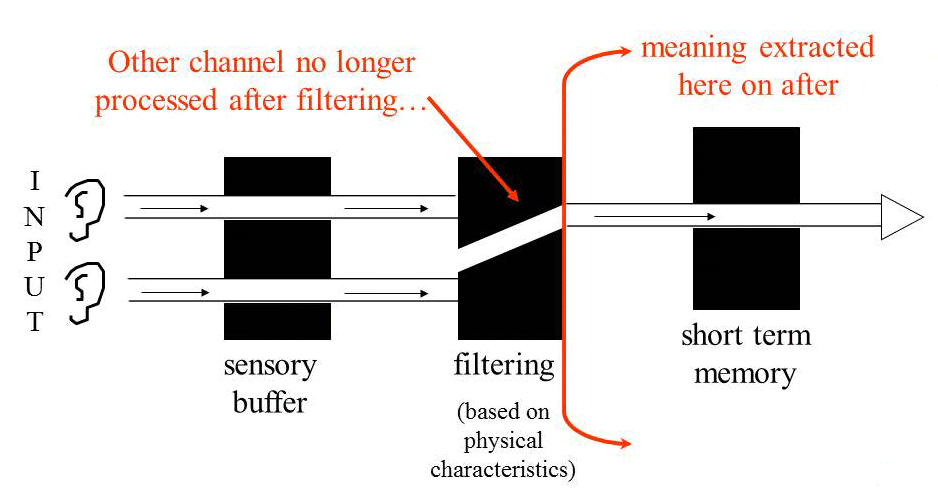
The most intellectually honest way to account for what happened doesn’t require quantum entanglement or morphic fields. It requires understanding what the Reticular Activating System actually does.
The RAS is a network of neurons in the brainstem that acts as a filter, deciding what sensory and environmental information reaches conscious attention out of the roughly 11 million bits per second your senses process. You’re consciously aware of maybe 50 bits per second. The RAS decides the rest. More on RAS filtering →
When you repeatedly prime the RAS with a specific target — through scripting, visualization, repeated intention — you are literally recalibrating which 50 bits get through. This is not metaphor. The attentional priming literature is robust and unremarkable: what you repeatedly encode as “important” gets noticed more. What this means in practice: the opportunity that was always in your environment starts getting noticed. The conversation partner who could help moves from background to foreground. You act on things you’d previously filtered out.
Confirmation bias Established compounds this. Once you’re priming for X, you notice evidence of X more, which reinforces the practice, which increases the noticing. This is why most experiment logs end up proving manifestation works: the logger starts counting only evidence for it.
Where it gets philosophically murkier: there’s a legitimate question about whether other people’s behavior changes in response to your changed behavior. If you enter conversations with more presence and less suppression — which the morning practice seemed to produce for me — you will get different outputs from those conversations. Is that “the universe responding”? Or just social reciprocity? Probable
And then there’s the hardest question: whether anything in the experiment was not explainable by these mechanisms. I don’t know. My logs don’t show it. But nine days is a small sample, and I was one person. Speculative
Honest Scorecard: Changed vs. Unchanged
| Variable | Baseline | Day 9 | Verdict | Mechanism |
|---|---|---|---|---|
| Decision speed on deferred actions | Days of delay | Hours | Changed | Attention priming |
| Noticing relevant conversations | Low | Markedly higher | Changed | RAS recalibration |
| Baseline background anxiety | Moderate | Lower | Partial | Structured morning routine |
| Unprompted positive outreach from others | Normal rate | Normal rate | Unchanged | No mechanism found |
| External “coincidences” | Baseline | Felt higher, logged same | Unchanged | Confirmation bias only |
| Project components achieved | 0 of 3 | 2 of 3 | 2/3 | Behavioral — I acted |
The most important number in that table is the last row. Two of three things moved. Both moved because I took actions I’d been deferring. The practice did not produce outcomes; it produced the psychological conditions under which I stopped avoiding necessary actions. That’s worth separating carefully.
What Could Be Wrong
I want to be honest about the ways this experiment proves very little.
Selection bias in my own attention: I was logging outcomes I noticed. If the practice primed me to notice more positive outcomes, my log is biased toward positives by design. A proper control would require a second observer logging my environment independently. I didn’t have one.
Hawthorne effect: The act of logging anything changes behavior. I might have made different decisions simply because I was watching myself, not because the practice worked. Observer effects →
Time confound: Nine days is not long enough to separate genuine change from regression to the mean, natural project momentum, or seasonal/contextual factors. The project may have been ready to move regardless.
Motivated reasoning: I designed the experiment. Even with careful logging, the researcher’s expectations shape what counts as evidence. I tried to correct for this, but I cannot claim I succeeded.
The null result problem: If I’d run the experiment and nothing happened, would I have published it? Probably not as readily. This is the file drawer problem applied to personal experiments. The people who tell you manifestation worked are a selected sample.
Signal vs. Story: A Framework
The most useful thing I extracted from this wasn’t evidence for or against manifestation. It was a decision framework for distinguishing between real signal and retrospective story-making.
Before logging any “manifestation result,” ask:
The real value of this framework isn’t debunking — it’s precision. If you run it honestly, you’ll find that some of what happens during a manifestation experiment is genuine behavioral change via attention priming. That’s worth isolating and repeating. The rest is story. Related: Consciousness hacking →
FAQ
Final Thoughts
Here’s what I didn’t expect: the most useful outcome of nine days of manifestation practice wasn’t evidence about how the universe works. It was a mirror. The parts of the scripting that felt false showed me exactly which parts of my goal I’d quietly given up on. The parts that felt natural showed me what I already believed was available. That alone is worth 30 minutes a day for nine days — and it doesn’t require you to believe in anything except that your attention is selective and that selectivity can be directed.
The uncomfortable truth is this: if manifestation produces behavioral change through attention priming, then the people who practice it and credit the universe for their results aren’t wrong about the results. They’re wrong about the mechanism. And wrong mechanism with right results will always outcompete right mechanism with no action. That’s a difficult thing to argue with.
I’ll run a controlled version. Until then, my working conclusion is narrow: a structured 9-day attention experiment, run with honest logging and pre-specified success criteria, is a legitimate behavioral tool — even if the metaphysics are fiction.
Sources
- Corbetta, M. & Shulman, G.L. — “Control of goal-directed and stimulus-driven attention in the brain.” Nature Reviews Neuroscience, 2002. nature.com →
- Gollwitzer, P.M. — “Implementation intentions: strong effects of simple plans.” American Psychologist, 1999. APA PsycNet →
- Schacter, D.L. et al. — “The future of memory: remembering, imagining, and the brain.” Neuron, 2012. PubMed →
- Rosenthal, R. — “The file drawer problem and tolerance for null results.” Psychological Bulletin, 1979. — On publication bias in personal and professional experiment reporting.
- Taylor, S.E. et al. — “Harnessing the imagination: mental simulation, self-regulation, and coping.” American Psychologist, 1998. — On visualization and behavioral priming.
Related Articles
Last updated: May 2026 · Neural Grimoire · All claims independently logged
https://www.neuralgrimoire.com/pleiadians-warned-me-about-2026/
https://www.neuralgrimoire.com/ufo-landing-manifestation-ritual/
https://www.neuralgrimoire.com/rituals-influence-money/