

40 Journal Prompts That Open the Third Eye — And What Nobody Warns You About
The prompts are below. But first — let’s be honest about what “opening the third eye” actually means, what the neuroscience says, and why some people wish they’d slowed down.
40 journal prompts across 4 activation phases, organized from foundational self-inquiry to deep intuitive expansion. These work best as a progressive 30-day practice — not a one-sitting sprint. The science behind why they work is linked throughout.
- Phase 1 (prompts 1–10): Clearing blocks and establishing baseline awareness
- Phase 2 (prompts 11–20): Activating intuitive faculties and dream intelligence
- Phase 3 (prompts 21–30): Expanding perception and symbolic thinking
- Phase 4 (prompts 31–40): Integration, surrender, and sustained clarity
- Risk section: real — read it before starting
What the Third Eye Actually Is (Not Just “Spiritually”)
Let’s start with something most guides dodge: the third eye is both a genuine object in your brain and a metaphorical construct. Both matter.
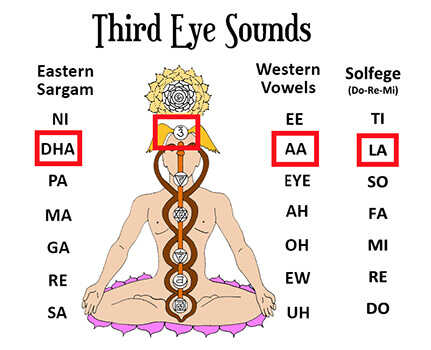
The pineal gland — a pea-sized endocrine structure at the brain’s center — has fascinated anatomists since Descartes called it “the seat of the soul” in the 17th century. It produces melatonin, regulates circadian rhythms, and responds directly to light. Its position, its isolation from the blood-brain barrier in a way most brain structures are not, and its photoreceptive cells have made it a persistent candidate for the biological correlate of what yogic traditions call Ajna — “the command center.”
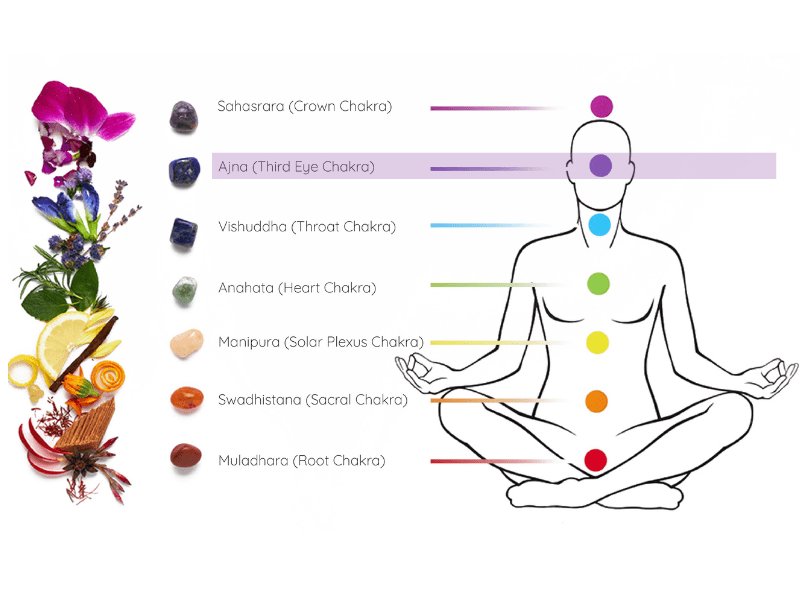
In Sanskrit, Ajna means “to perceive” and “to command.” That dual meaning is precise and intentional. The sixth chakra isn’t just about receiving impressions from the world — it’s about developing the discernment to act on them without flinching.
Harvard research on meditation and neural plasticity has documented measurable thickening of the prefrontal cortex in long-term meditators — the region governing decision-making, meta-cognition, and what contemplatives call “witnessing awareness.” Stanford’s Human AI Institute has documented altered default-mode-network activity during contemplative states, and MIT’s consciousness research links sustained meditative practice to increased alpha and theta wave activity — the bands associated with creative insight and hypnagogic states. Whether this constitutes “opening the third eye” semantically is a matter of framework. That something measurable happens in the brain during these practices is not in dispute.
The yogic model locates Ajna between the eyebrows, governing intuition, imagination, and what’s described as the capacity to see beyond surface appearances. When it’s blocked — by unprocessed fear, intellectual rigidity, sensory overload, or accumulated grief — the result is perceptual narrowing. You stop trusting your gut. You lose access to symbolic thinking. Dreams become dull. Decisions feel foggy even when the logic is clear.
Journal prompts work on this by creating structured conditions for self-inquiry. The process isn’t magic. It’s what happens when you systematically question your assumptions, stay with uncomfortable uncertainty, and practice receiving impressions before rushing to interpret them.
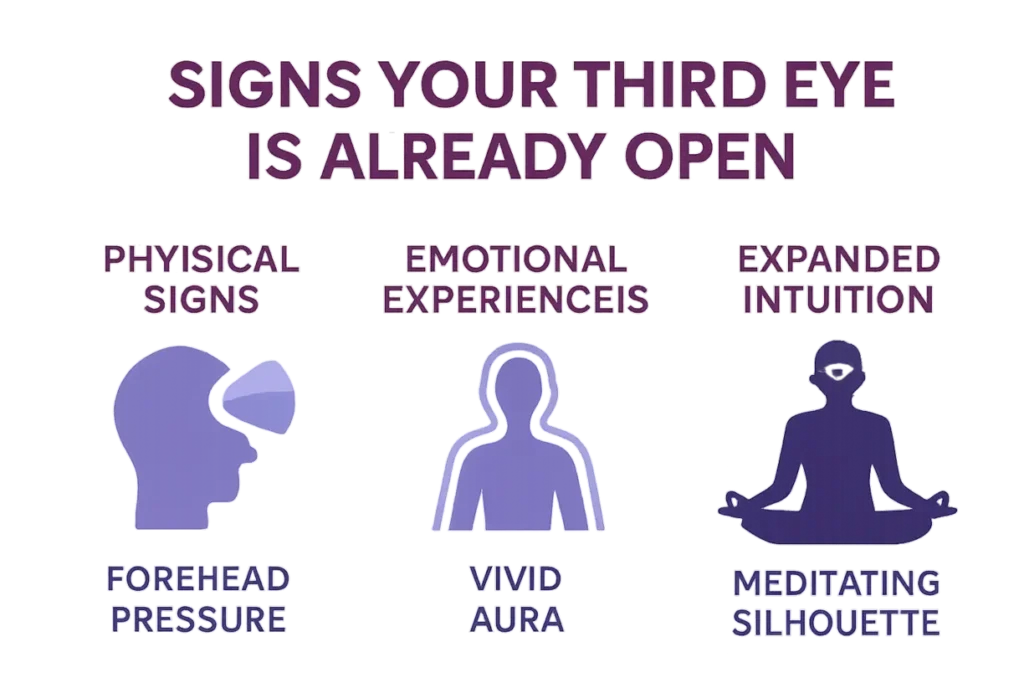
Signs Your Third Eye Is Opening — What to Expect at Each Phase
Here’s what frustrates me about most third-eye content: they list symptoms without telling you which ones are early, which come later, and which are signs something’s off track rather than on. So here’s a more honest breakdown.
Sensitivity
Weeks 1–3. Dreams become more vivid. You notice patterns you’d dismissed. Mild pressure between the eyebrows during meditation.
Disruption
Weeks 3–8. Old beliefs start feeling unstable. Relationships clarify suddenly. Sleep patterns shift. This phase is uncomfortable by design.
Expansion
Months 2–4. Synchronicities increase noticeably. Intuitive impressions arrive before logical reasoning. Creativity spikes.
Integration
Months 4+. The expanded perception stabilizes. You stop oscillating between “I felt something real” and “that was probably nothing.”
| Sign | When It Typically Appears | What It Actually Means |
|---|---|---|
| Vivid, narrative dreams | Phase 1 | Subconscious material surfacing — the journaling is working. Not necessarily prophetic yet. |
| Forehead pressure | Phase 1–2 | Increased blood flow or muscular tension from focused attention. Common, usually benign. |
| Increased emotional sensitivity | Phase 2 | Your empathic filter is expanding. This is also when it gets temporarily destabilizing. |
| Precognitive impressions | Phase 3 | Thoughts that precede events by hours or days. Keep a log — pattern over time confirms it. |
| Enhanced pattern recognition | Phase 3–4 | Structural thinking deepens. You begin seeing underlying dynamics before they become obvious. |
| Decreased need to explain yourself | Phase 4 | A quieter inner authority. You know what you know and require less external validation for it. |
The Risks Nobody Talks About Honestly
Most spiritual content either ignores risks entirely or lists them in a single sentence with “proceed mindfully” attached. That’s not enough. Let me be direct.
The honest risk of third-eye work isn’t demonic possession or psychic damage. It’s this: you may lose tolerance for relationships, environments, and belief systems that previously felt fine. That sounds abstract until it happens. Then it feels destabilizing in a very concrete, social, practical way.
What actually tends to go wrong:
- Ungrounded expansion. If you’re doing intensive third-eye work without strong root and sacral chakra foundation, the expanded perception has nowhere to anchor. Result: chronic anxiety, dissociation, difficulty with everyday tasks. The cure is always the same — return to body-based practices, reduce the introspective load temporarily.
- Spiritual bypass. Using the heightened perception to avoid processing difficult emotions rather than moving through them. Recognizing patterns in others while your own pain sits unexamined. This is common and the self-inquiry prompts in Phase 1 specifically address it.
- Overcalibrated sensitivity. Some people come out of sustained third-eye activation periods genuinely struggling with crowds, noise, conflict, and environments they previously handled fine. This isn’t a disorder — it’s recalibration that needs managed pacing. Slow down.
- Confirmation bias amplified. An open third eye doesn’t guarantee accurate perception. It guarantees more vivid perception. The discipline is learning to hold impressions lightly until they’re confirmed by evidence, not to treat every intuition as revelation.
If you experience persistent depersonalization (feeling detached from your own body or thoughts for more than a few days), intrusive visuals you can’t turn off, or severe sleep disruption lasting more than two weeks — pause the practice and consult a mental health professional. These symptoms are worth taking seriously regardless of their origin. The American Psychological Association’s mindfulness research is clear: intensive introspective practice is not appropriate for everyone at all times, and readiness is a genuine variable.
“The eye sees only what the mind is prepared to comprehend.” — Robertson Davies, Tempest-Tost
How to Prepare Before You Start the Prompts
Skip this if you want. But the people who do the most powerful work with these prompts are usually the ones who spend a week establishing conditions before they write a single word.
- 01Choose a dedicated journal. Not your phone’s notes app — a physical journal you touch only for this practice. The physical ritual of opening it trains your nervous system to enter a receptive state. Dark cover preferred; some practitioners find black or deep indigo notebooks reduce ambient distraction.
- 02Establish your baseline. Before starting the prompts, spend three days simply recording impressions — hunches you have, dreams you remember, patterns you notice — without acting on or analyzing any of them. This creates a pre-activation baseline you’ll compare against later. Most people are shocked by how much their intuition was already active.
- 03Create a grounding anchor. Choose a physical practice you’ll do for 5 minutes before every journaling session: barefoot contact with the floor, cold water on the face and wrists, or 10 slow breath cycles. This is your grounding cord. The expansion work requires the anchor or it floats free.
- 04Commit to the timing. 10–15 minutes per prompt, same time each day if possible. Early morning before your analytical mind fully engages is ideal. Late evening before sleep is second best. The worst time is in the middle of a busy workday — you won’t access the depth.
- 05Tell someone. Let one trusted person know you’re doing this practice. Not for permission — but because having a witness creates accountability, and because if you experience anything disorienting, you want someone who knows what you’ve been doing. Isolation amplifies both expansion and destabilization.
Phase 1 Prompts — Clearing & Foundation (Prompts 1–10)
These are not warm-up exercises. They’re the most important phase. The third eye doesn’t open through force — it opens through the removal of what’s blocking it. That means looking honestly at the fears, assumptions, and defended beliefs that keep perception narrow. This is the unglamorous part that most people rush through to get to the “cool” stuff.
Spend at least two weeks here. Longer if something in a prompt keeps pulling you back.
- 01 The thing you already know but keep talking yourself out of. Write about a situation where your first impression turned out to be correct — but you overrode it with logic. What did the override feel like in your body at the moment you made it?This identifies your intuitive signal vs. your rationalization pattern. The distinction is what Phase 1 is training.
- 02 The belief you inherited that was never actually yours. Identify one core conviction about how the world works that you can trace to a specific person or era of your life — not to your own verified experience. How does it shape what you let yourself perceive?
- 03 Where you perform certainty instead of admitting you don’t know. The third eye is the organ of “I don’t know yet — and I can stay with that.” Write about the domain of your life where not-knowing feels most threatening. What are you afraid will happen if you hold the question open?
- 04 Your relationship with being wrong. Do you update beliefs when evidence contradicts them — or do you find ways to defend the original belief? Be specific. Give an example from the last three months.Cognitive rigidity is the primary blocker of expanded perception. This prompt maps yours.
- 05 What you see in others that you refuse to see in yourself. Name three qualities — positive or negative — that you notice strongly in other people. Write about whether and how they’re present in you. Don’t rush to resolution.
- 06 The version of reality you’re most defended about. What story about your life would fall apart if you looked at it directly? Write the story. Then write: what if the opposite were equally true?
- 07 Your fears about seeing clearly. Be honest: what would it cost you to perceive reality without filters? What relationships, identities, or structures might not survive your clarity? Name them without trying to make peace with them yet.
- 08 The sensations of your intuition. When you have a strong gut feeling, where do you feel it? Chest? Stomach? Hands? Write a physical anatomy of your intuitive experience. Most people have never mapped this deliberately.This prompt builds somatic awareness — essential for distinguishing intuition from anxiety, which often feel similar until you’ve catalogued them carefully.
- 09 A conversation you’ve been avoiding because you already know what it will reveal. Describe it. Write the version of the conversation where you say what you actually think. What do you sense will shift when you have it?
- 10 What you’re ready to stop pretending. Not a dramatic confession. Just one small thing you’ve been performing — a role, an opinion, a level of certainty — that doesn’t actually reflect your experience. Write what the honest version looks like.
Phase 2 Prompts — Intuition & Dreams (Prompts 11–20)
Phase 2 is where you start actively working with the materials your subconscious is generating. Dreams become raw data. Synchronicities stop being dismissed as coincidence. The prompts here train two specific capacities: receptivity (letting impressions land before analyzing them) and discernment (learning to tell the difference between genuine intuitive signal and wishful thinking or anxiety).
- 11 Last night’s dream, examined as a message. Record every detail you can recall. Then ask: if this dream were describing something in my waking life using symbols, what situation would it be pointing to? Don’t force the interpretation — notice what emerges.
- 12 A synchronicity you dismissed. Think back over the last month. Identify one moment that felt meaningful but that you explained away rationally. Reexamine it without the rational explanation. What does it point toward?
- 13 Your body’s intelligence about a current situation. Choose one live decision in your life. Sit with each option for 30 seconds. Write down exactly what happens in your body — not your thoughts about the options, your body’s response to imagining each one. Which option brings expansion? Which brings contraction?This is a core somatic decision-making technique used in body-based therapy traditions. The third eye often speaks through the body before it speaks through the mind.
- 14 The image that keeps appearing in your mind this week. Not a thought. An image — a scene, a face, a place, an object. Write it in full detail. Then write freely about what it might be connected to in your life. Don’t censor.
- 15 What a wise version of yourself already knows about your current situation. Write a letter from your future self — five years from now — about the choice or challenge you’re in the middle of now. Write it in first person, from their perspective. What do they see that you can’t yet?
- 16 The emotion underneath the emotion. Name something you’ve been feeling lately. Then ask: what’s underneath that? Write down whatever arises, however irrational. Ask again. Usually by the third layer, you’re touching something real.
- 17 What this moment is trying to teach you. Not what you wish it were teaching you. Not the lesson that would be most convenient. What is the actual situation showing you about yourself, your patterns, your readiness?
- 18 A recurring dream from childhood, examined now. If you have one, describe it in full. What did it mean to you then? What does it represent symbolically from your current vantage point? How has its meaning shifted?
- 19 What your intuition says about someone in your life that you’ve been unwilling to voice even to yourself. Write it here. No audience. No consequences. What do you actually sense about this person’s motives, state, or direction?
- 20 The pattern your life keeps repeating — and why. Describe one recurring pattern across different relationships, jobs, or situations. Write about what belief, wound, or unmet need might be generating it. Not to fix it yet — just to see it clearly.
Phase 3 Prompts — Expanded Perception (Prompts 21–30)
By Phase 3, the clearing work is done and the intuitive faculty is more active. These prompts stretch toward genuinely expanded states — archetypal thinking, symbolic perception, the ability to hold multiple contradictory realities simultaneously. This is where things get interesting. And occasionally uncomfortable again, in different ways.
- 21 Your life as a mythological story. What archetype is the central character? What’s the quest? What’s the dragon? What threshold are you standing at right now? Write it as narrative, not analysis.
- 22 The version of reality where everything happening to you is exactly right. Not toxic positivity. The serious version: what if every obstacle, loss, and detour has been precise preparation? Write what that story looks like. Where does it take you?
- 23 What you sense in a room before anyone tells you anything. Describe a specific recent situation — a meeting, a family gathering, a first date — and write about the impressions you had before any words were exchanged. How accurate did they prove to be?
- 24 Visualize your ideal reality in physical detail. Not goals — reality. Write the colors in the room, the quality of light, the sounds, the texture of what you’re touching, the specific sensation in your body as you inhabit it. The more sensory the detail, the more useful this exercise.
- 25 A conversation with a version of yourself that has no fear. What does that version of you know? What would they do differently right now? What do they find baffling about the choices the fear-driven version keeps making?Fearlessness isn’t the absence of risk awareness — it’s the absence of self-contraction. This prompt accesses that space directly.
- 26 The symbol your subconscious keeps offering you. Animals, numbers, colors, objects — some image keeps appearing in your dreams, your peripheral vision, your doodling. Write about it without trying to decode it intellectually first. Let it speak on its own terms.
- 27 What universal pattern your current situation is an example of. Zoom out from the specifics. Is this a departure story? A dissolution? A return? A threshold? Name the universal shape, then write about what it typically asks of the person living it.
- 28 The decision from a place of complete inner silence. Before writing, sit for 5 minutes in genuine stillness — not forced emptiness, just paused activity. Then write about a current decision from that place. Notice how different the answer is from what you write when your mind is busy.
- 29 What reality looks like from above your current situation. Imagine viewing your life from an elevation — the way you might see a city from a plane. The conflicts, relationships, and daily concerns are visible but small. From that altitude, what matters? What becomes obviously trivial?
- 30 What you’re being asked to become. Not what you want or plan. What the circumstances of your life right now seem to be shaping you toward — the capacities being developed, the old self being dismantled. Write about the person on the other side of this period.
Phase 4 Prompts — Integration & Surrender (Prompts 31–40)
This final phase is often the quietest — and the most profound. The expanded perception is present. The task now is living with it stably, integrating what you’ve seen without letting it destabilize your ability to function, love, work, and remain present in ordinary life. That’s the actual test.
- 31 What you know now that you can’t unknow. Something has shifted in your perception through this practice. Name it as precisely as you can. Not dramatically — precisely. What do you see now that was invisible before?
- 32 The belief that dissolved — and what moved in to replace it. Something you held as truth before this practice has softened or collapsed. Write about what it was, the moment it gave way, and the more spacious understanding that’s taken its place.
- 33 Surrendering to uncertainty without losing yourself. Identify the most unresolved situation in your life. Write about what it feels like to genuinely stop trying to control its outcome — not resignation, but real surrender. What remains when the grasping stops?
- 34 Your relationship with guidance — and whether you trust it. Have you received impressions, dreams, or intuitive signals during this practice that you acted on? What happened? Write honestly about the quality of your trust in your own inner knowing.
- 35 What ordinary life looks like through an open eye. The mystical isn’t found by escaping the mundane — it’s found within it. Write about one genuinely ordinary moment from the past week — a meal, a walk, a conversation — and describe it as if it were luminous. Because it is.
- 36 The difference between intuition and projection now. At Phase 1, these were probably difficult to distinguish. Write about how you tell them apart now. What’s different in the felt sense of each? When is a strong feeling about someone actually about them — and when is it about you?
- 37 What you owe to the version of yourself who started this practice. Write a letter back to that person. Not inspirational — honest. What did they not know they were getting into? What would have helped? What are you grateful they began?
- 38 How your relationships have changed. Expanded perception changes what you’re able to tolerate — and what you find yourself drawn toward. Write about the relationships that have deepened, the ones that have naturally faded, and what that reveals about where you are now.
- 39 The practice you’ll carry forward. Not every prompt will remain relevant. But two or three will have become genuinely essential tools. Identify them. Write about how you’ll continue working with them beyond this 40-prompt arc.
- 40 What you see when you look at your life from here. The final prompt. No structure — just write. Where are you? What’s clear? What’s still open? Let it be exactly as complete and incomplete as it actually is.This is the most important prompt of the 40. Don’t rush it.
Complementary Practices That Actually Deepen the Work
The prompts carry most of the load. But these practices meaningfully amplify what’s possible when paired with regular journaling.
- Trataka (steady gazing). The traditional preparation for Ajna activation in Hatha yoga: fix your gaze on a candle flame or a single dark point on a white wall for 5–10 minutes without blinking. The sustained, unflinching attention it develops is exactly the capacity the prompts are building in written form.
- Yoga Nidra. A structured body-scan and visualization practice done in lying savasana — not to be confused with ordinary sleep or relaxation. Research at the Yoga Nidra Network and neuroscience studies on hypnagogic states suggest it reliably induces theta brainwave states associated with deep intuitive access. 20 minutes before journaling produces noticeably different responses than journaling cold.
- Chanting the seed syllable AUM (OM). Specifically, the “M” — the humming resonance that vibrates in the cranial cavity near the pineal gland. Three minutes of sustained OM before sitting to write creates a measurable shift in the quality of attention available.
- Amethyst and lapis lazuli. Both traditionally associated with Ajna. Place them on a surface within view while journaling — not for magical reasons per se, but because physical anchors train attention. The consistent visual cue reinforces the intention of the space.
- Dream journaling in parallel. Keep a separate notebook by your bed for immediate dream recording — before you check your phone, before you move significantly. The first 90 seconds after waking hold the most vivid material. Cross-reference dream themes with your prompt responses weekly. Patterns that appear in both are significant.
For deeper exploration of supporting practices, see our guides on advanced meditation techniques for chakra activation, the complete chakra system and its interconnections, and building practical intuition in daily decision-making.
Frequently Asked Questions
https://www.neuralgrimoire.com/some-ai-should-never-be-built/
https://www.neuralgrimoire.com/servitor-creation-prompts/