

Neural Grimoire · Sacred Texts · Eschatology
Book of Revelation
Decoded Verse by Verse
The most thorough scholarly guide to Revelation’s 22 chapters — every symbol, every seal, every vision, finally made clear.
Why Revelation Still Baffles Us — and Why It Shouldn’t
No book in Western history has been more interpreted, more argued over, more feared, and more misread than the Book of Revelation. It has inspired crusades and cults, masterpieces of art and outbreaks of panic, detailed prophecy charts and apocalyptic bestsellers. It has been called the most dangerous book ever written. It has also been called the most hopeful.
The confusion is understandable. Revelation does not read like anything else in the Bible. Within the span of twenty-two chapters, the reader encounters a glassy sea mingled with fire, a beast with seven heads and ten horns, locusts wearing golden crowns and carrying scorpion tails, a prostitute riding a scarlet beast, and a city made entirely of gold so pure it is transparent. For the modern reader, this seems like a fever dream. For the first-century believer in Asia Minor, it was a lifeline.
The single biggest error most readers make is treating Revelation as a coded newspaper — a secret timetable of events waiting to be matched against today’s headlines. This approach has been attempted in every generation since John first circulated his scroll, and in every generation it has failed. The second biggest error is dismissing the book entirely as ancient fantasy with no contemporary relevance.
This guide takes a third path: rigorous, honest, verse-by-verse engagement with the text as a piece of first-century apocalyptic literature that carries timeless theological weight. We will draw on the best of modern scholarship — from N.T. Wright, Craig Koester, G.K. Beale, David Aune, Richard Bauckham, and Robert Mounce — while making the content accessible to every thoughtful reader.
Gallup and Pew Research consistently show that around 40% of Americans believe the Book of Revelation predicts real future events. Understanding what the text actually says — rather than what pop-prophecy books claim it says — has never been more important for cultural literacy, faith, and rational discourse.
Revelation is not a puzzle to be solved. It is a vision to be inhabited. Read it on its own terms, and it becomes one of the most astonishing documents of the ancient world.
Origins: Who Wrote It, When, and From Where
Revelation opens with unusual directness for an apocalyptic text: “I, John, your brother and companion in the suffering and kingdom and patient endurance that are ours in Jesus, was on the island of Patmos because of the word of God and the testimony of Jesus” (Revelation 1:9). The author names himself. The location is specific. The context is persecution.
Patmos: The Prison Isle
Patmos is a small, rocky Aegean island roughly 34 square miles in area, about 60 kilometers southwest of Ephesus (modern Turkey). In the Roman Imperial period, it was used as a place of exile for political and religious dissidents — what we might today call a minimum-security political prison. John was sent there under Domitian (reigned AD 81–96), the emperor who promoted a cult of imperial worship so aggressive that refusing to declare “Caesar is Lord” could mean execution.
I was in the Spirit on the Lord’s Day, and I heard behind me a loud voice like a trumpet, which said: “Write on a scroll what you see and send it to the seven churches: to Ephesus, Smyrna, Pergamum, Thyatira, Sardis, Philadelphia and Laodicea.”
— Revelation 1:10–11The Question of Authorship
Early church testimony overwhelmingly attributed Revelation to John the Apostle, the son of Zebedee. Justin Martyr (c. AD 150) is the first extant writer to explicitly name John the Apostle as author. Irenaeus of Lyon (c. AD 180), who was personally connected to Polycarp — a disciple of John himself — affirmed this attribution. Tertullian, Hippolytus, and Clement of Alexandria followed suit.
Modern scholarship is more cautious. The Book of Revelation is commonly dated to around AD 95, under Domitian’s reign. The Greek of Revelation is distinctively rough and Semitic in flavor, quite unlike the polished Koine of the Gospel of John, leading scholars like Dionysius of Alexandria (already in the third century!) to suggest a separate author — perhaps “John the Elder” or “John the Presbyter,” a revered figure distinct from the apostle.
For our purposes — decoding the content — the question of precise authorship matters less than understanding the context. Whether the author was John the Apostle, John the Elder, or a prophetic figure writing under Johannine authority, the document emerged from Jewish-Christian communities in Asia Minor facing brutal Roman persecution around the final decade of the first century.
| Scholar / Church Father | Date | Position on Authorship |
|---|---|---|
| Justin Martyr | c. AD 150 | John the Apostle (Zebedee’s son) |
| Irenaeus of Lyon | c. AD 180 | John the Apostle; written late Domitian reign |
| Dionysius of Alexandria | c. AD 260 | A different John; distinct from Gospel author |
| Eusebius of Caesarea | c. AD 324 | Possibly “John the Elder”; records both traditions |
| G.K. Beale (modern) | 1999 | Apostolic authority; Domitian-era composition |
| David Aune (modern) | 1997–98 | John of Patmos; prophetic community context |
The Genre: What Kind of Writing Is This?
Revelation belongs to the literary genre of apocalypse (from Greek apokalypsis, meaning “unveiling” or “disclosure”). Apocalyptic literature flourished in Judaism and early Christianity from roughly 200 BC to AD 200. Examples include Daniel, 1 Enoch, 4 Ezra, 2 Baruch, and the Dead Sea Scrolls’ War Scroll. The genre has recognizable conventions:
- Visions received by a named seer
- Heavenly journeys and angelic guides
- Symbolic numbers, colors, and animals
- Cosmic warfare between good and evil
- The vindication of the righteous after suffering
- The destruction of the oppressive empire
Crucially, Revelation also identifies itself as prophecy (Rev. 1:3; 22:7, 10, 18, 19) and epistle — it opens and closes with the formal structures of a letter. Scholars today call it a “prophetic-apocalyptic letter,” a unique hybrid that must be read through all three lenses simultaneously.
The Four Schools of Interpretation
Before decoding a single verse, you must understand that sincere, learned Christians have read Revelation through four dramatically different lenses for nearly two millennia. None of these traditions is foolish; each captures something real. Understanding them honestly is the key to reading the text with appropriate humility.
Preterism
Past ViewMost or all of Revelation was fulfilled in the first century — specifically in the Roman destruction of Jerusalem (AD 70) or the fall of Nero. The “beasts” are Rome and its emperors. The “great tribulation” has already occurred. Advocates include R.C. Sproul and Kenneth Gentry.
Historicism
Ongoing ViewRevelation maps the whole of church history from John’s day to Christ’s return. Symbols like the Beast have been variously identified with the papacy, the Ottoman Empire, Napoleon, and Hitler. Was the dominant Protestant reading for three centuries. Now largely out of favor academically.
Futurism
Future ViewChapters 4–22 describe real events that have not yet occurred — a future seven-year tribulation, a literal Antichrist, and a physical millennium. Dispensational futurism (Tim LaHaye’s Left Behind series) is the most culturally dominant form in American evangelical culture.
Idealism
Timeless ViewRevelation is not primarily tied to specific historical events but depicts the eternal struggle between God and evil, applicable to every generation. It is essentially a “great drama” or extended theological metaphor. Associated with William Milligan and Vernard Eller.
Most academic New Testament scholars today favor an approach that is primarily preterist in historical grounding (reading Revelation against its first-century Roman context) while acknowledging its idealist or typological dimensions — recognizing that patterns of evil, suffering, and divine victory recur throughout history. Pure futurism, though culturally dominant, has the weakest support in technical scholarship.
As Richard Bauckham, one of the foremost Revelation scholars in the English-speaking world, argued in his landmark The Theology of the Book of Revelation (Cambridge, 1993): the book was written to interpret Rome, to provide a counter-narrative to imperial propaganda, and to sustain hope among communities facing martyrdom — not to encode a 21st-century timeline.
The Architecture of Revelation: A Map of 22 Chapters
Revelation is not a random cascade of visions. It has an intricate, intentional structure organized around the number seven — the biblical number of completeness and perfection. Understanding the architecture before entering the text transforms the experience from chaos to cathedral.
| Chapters | Section Title | Key Content |
|---|---|---|
| 1:1–20 | Prologue & Vision of Christ | John’s commission; Christ among the lampstands |
| 2:1–3:22 | Letters to Seven Churches | Individual messages to Ephesus, Smyrna, Pergamum, Thyatira, Sardis, Philadelphia, Laodicea |
| 4:1–5:14 | The Heavenly Throne Room | The Father enthroned; the Lamb worthy to open the scroll |
| 6:1–8:5 | The Seven Seals | Four Horsemen; martyrs; cosmic disruption; silence |
| 8:6–11:19 | The Seven Trumpets | Hail and fire; bitter waters; locusts; two witnesses |
| 12:1–14:20 | The Cosmic Drama | Woman, Dragon, two Beasts; the 144,000; harvest |
| 15:1–16:21 | The Seven Bowls | Seven plagues of God’s wrath; Armageddon assembled |
| 17:1–19:10 | Babylon the Great | The harlot on the beast; Rome decoded; her fall mourned |
| 19:11–20:15 | Victory & the Millennium | Christ’s return; binding of Satan; 1,000-year reign; final judgment |
| 21:1–22:21 | The New Creation | New Heaven and Earth; New Jerusalem; the River of Life; epilogue |
Notice something critical: the seals, trumpets, and bowls do not necessarily follow each other sequentially in time. Many scholars (Beale, Mounce, Koester) argue for a “recapitulation” structure, where each series of seven revisits and intensifies the same period from a different angle — much like a symphony returning to a theme with greater orchestration each time.
Chapters 1–3: The Letters to the Seven Churches
Revelation opens not with dragons or doom, but with pastoral letters. This alone tells us something profound: before Revelation says anything about the end of the world, it speaks to seven specific, historically real congregations in the Roman province of Asia — communities John knew personally, whose strengths and failures he understood intimately.
Chapter 1: The Vision of the Risen Christ
“The revelation from Jesus Christ, which God gave him to show his servants what must soon take place.”
Decoded: The Greek word apokalypsis here means an “uncovering” — a lifting of the veil. Note immediately that this is not John’s revelation about Jesus, but Jesus’s revelation given through John. The phrase “what must soon take place” (Gk: en tachei) signals urgency, not a multi-millennium timeline.
“‘I am the Alpha and the Omega,’ says the Lord God, ‘who is, and who was, and who is to come, the Almighty.'”
Decoded: Alpha (Α) and Omega (Ω) are the first and last letters of the Greek alphabet. God encompasses all of time — not just its beginning and end, but every point within it. This is not a claim about the future; it is a claim about sovereignty. Domitian called himself Dominus et Deus (Lord and God). Revelation immediately counters: there is only one true Alpha and Omega, and he is not sitting in Rome.
“I turned around to see the voice that was speaking to me. And when I turned I saw seven golden lampstands, and among the lampstands was someone like a son of man, dressed in a robe reaching down to his feet and with a golden sash around his chest. The hair on his head was white like wool, as white as snow…”
Decoded: Every detail of this portrait is drawn from the Hebrew Bible. The “son of man” echoes Daniel 7:13. White hair reflects Daniel’s “Ancient of Days” (7:9). A golden sash, feet like burnished bronze, a voice like many waters — these are all motifs from Ezekiel’s throne-chariot vision (Ezek. 1). John is not describing a literal photograph; he is assembling a mosaic of Old Testament images to say: this figure carries the full authority of Israel’s God.
Chapters 2–3: The Seven Letters Decoded
Each letter follows a precise template: an identification of Christ (drawn from chapter 1), a commendation, a criticism (with two exceptions), a call to repentance, a promise to “the one who is victorious,” and an exhortation to hear. The seven churches were real cities on a Roman postal circuit, and the messages address their specific geographical, economic, and spiritual situations.
| Church | Commended For | Criticized For | Key Threat / Local Context |
|---|---|---|---|
| Ephesus (2:1–7) | Perseverance, doctrinal discernment | Lost your first love | Major trade city; home of Artemis cult |
| Smyrna (2:8–11) | Enduring poverty and slander | Nothing | Strong Jewish community; imperial worship center |
| Pergamum (2:12–17) | Holding fast to Christ’s name | Tolerating Balaam’s teaching; Nicolaitans | “Where Satan’s throne is” — seat of imperial cult worship |
| Thyatira (2:18–29) | Love, faith, growing deeds | Tolerating “Jezebel” false prophetess | Trade guilds with pagan feast requirements |
| Sardis (3:1–6) | A few who have not soiled their clothes | Reputation of life, but dead | Once-great city; history of false security |
| Philadelphia (3:7–13) | Kept my word; not denied my name | Nothing | Gateway city; significant Jewish presence |
| Laodicea (3:14–22) | Nothing | Lukewarm — neither hot nor cold | Wealthy banking/textile city; famous for eye medicine |
“Here I am! I stand at the door and knock. If anyone hears my voice and opens the door, I will come in and eat with that person, and they with me.”
Decoded: Famously used as an evangelism verse, this is actually addressed to a church — specifically to the lukewarm, prosperous Laodiceans. Christ is outside his own community. The language of eating together evokes the covenant meal and eschatological banquet (a theme picked up in Rev. 19:9). The door-knocking is an image of patient, persistent love, not coercion.
Chapters 4–5: The Throne Room of Heaven
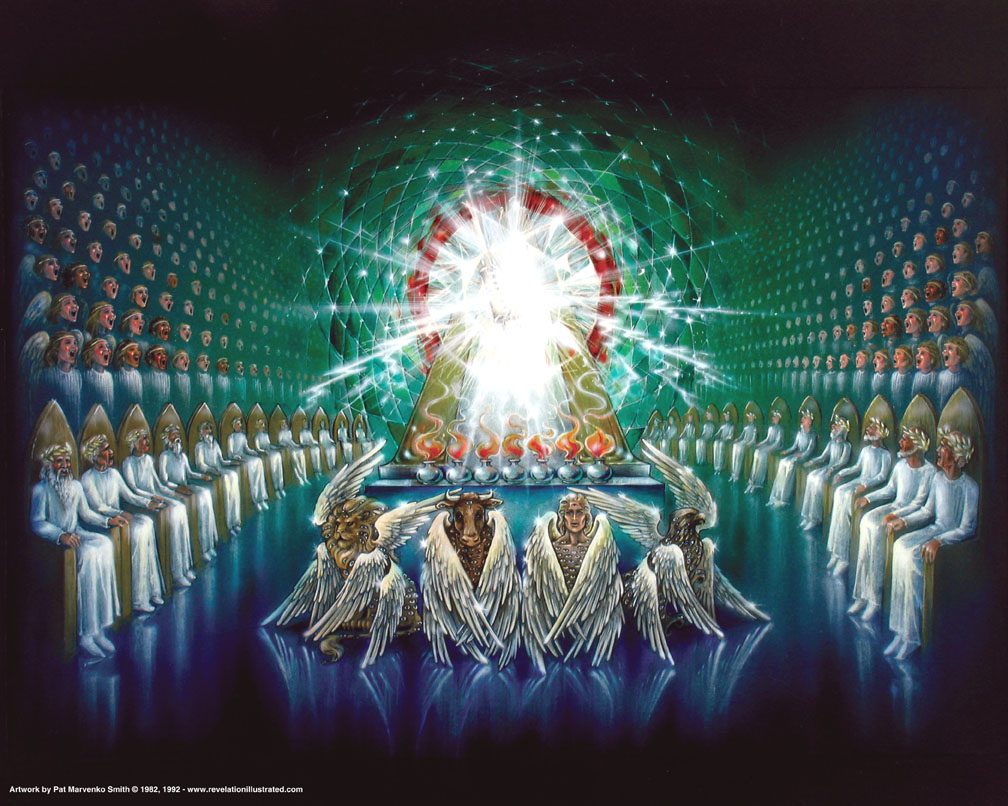
With the words “Come up here” (Rev. 4:1), John’s perspective shifts from earth to heaven, and the entire tone of the book transforms. What follows is the interpretive key to everything that comes after: a vision of God’s throne so glorious, so overwhelming, that nothing — not Rome, not plague, not dragon — can threaten its sovereignty.
At once I was in the Spirit, and there before me was a throne in heaven with someone sitting on it. And the one who sat there had the appearance of jasper and ruby. A rainbow that shone like an emerald encircled the throne.
— Revelation 4:2–3The image is drawn almost entirely from Ezekiel 1 and Isaiah 6. God himself is described not with human features but with gemstones — jasper (brilliance), sardius/ruby (fiery red), emerald rainbow (Noahic covenant mercy surrounding divine judgment). The twenty-four elders represent the totality of redeemed humanity: twelve tribes of Israel plus twelve apostles of the Lamb. The four living creatures — lion, ox, man, eagle — represent the pinnacle of wild, domestic, human, and aerial creation, echoing Ezekiel’s cherubim.
Chapter 5: The Scroll and the Lamb
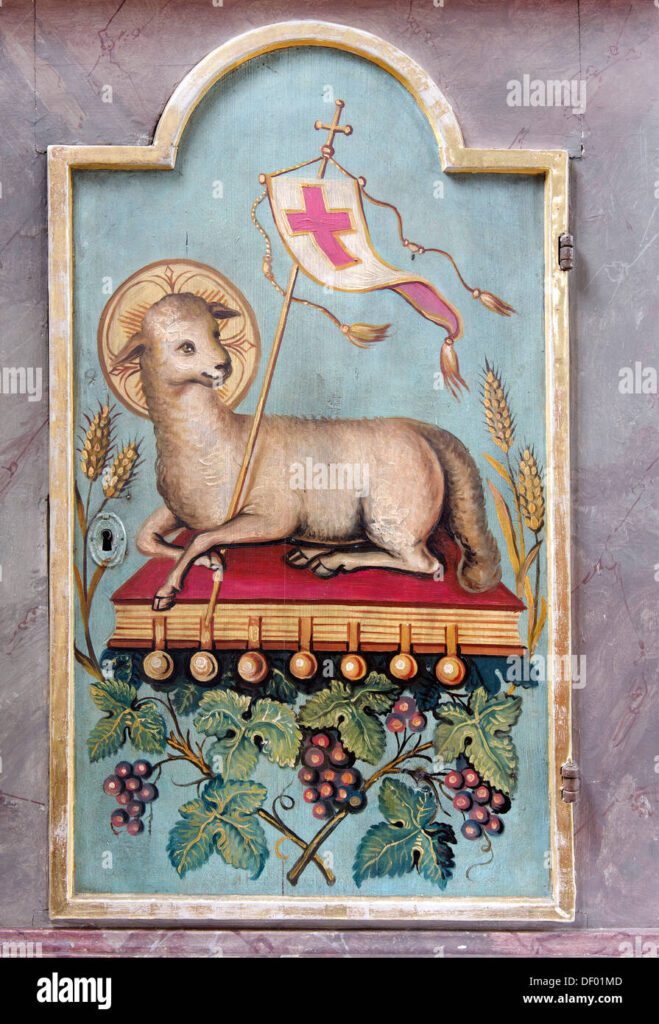
The drama of chapter 5 is among the most moving in all of Scripture. A sealed scroll representing God’s plan for history lies in the Father’s right hand. No creature in heaven or earth is found worthy to open it. John weeps. Then comes the pivot: “Do not weep! See, the Lion of the tribe of Judah, the Root of David, has triumphed. He is able to open the scroll and its seven seals” (5:5).
John looks up expecting a conquering lion — and sees a Lamb “looking as if it had been slain” (5:6). This is one of the great reversals of Revelation. Power in this book does not look like Roman military might. It looks like sacrificial death. The Lamb who was killed is the one who is worthy. The cross, not the sword, is what opens history. This single image reframes every vision that follows.
Revelation contains over 50 explicit uses of the number seven: seven churches, seven lampstands, seven stars, seven spirits, seven seals, seven trumpets, seven bowls, seven thunders, seven heads on the dragon, seven hills, seven kings. In the Hebrew tradition, seven signifies shalom — wholeness, completeness, divine perfection. The devil’s number 666 (or in some manuscripts 616) is precisely six-six-six: a number perpetually falling short of seven-seven-seven, the mark of divine completeness. This numeric theology saturates every page.
The Seven Seals Decoded: Chapters 6–8:5
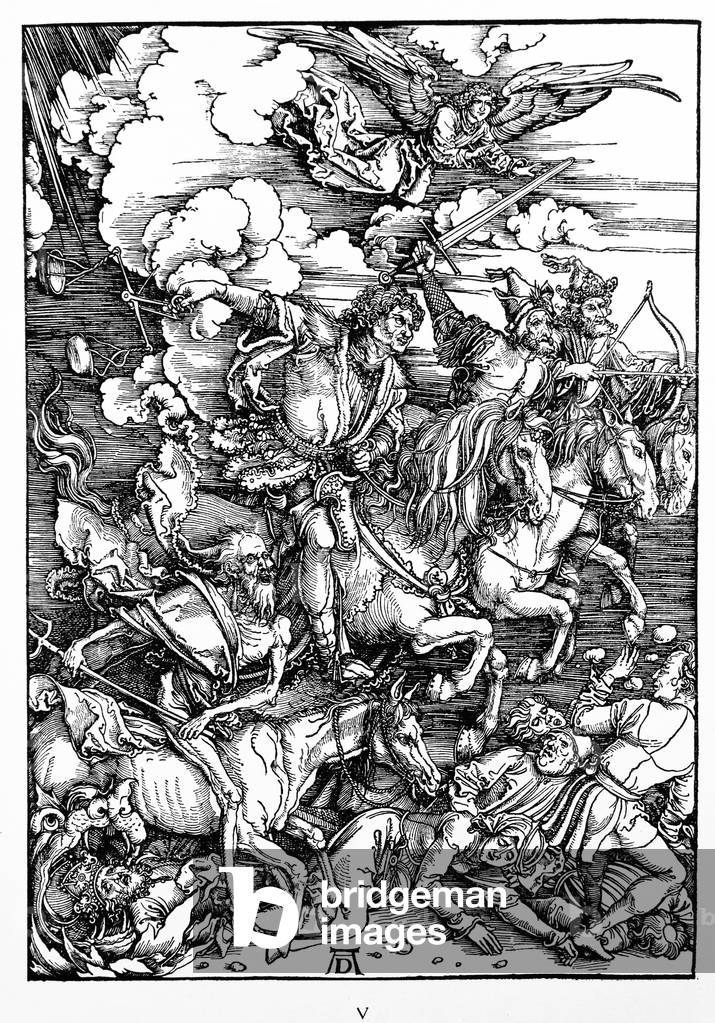
The Lamb opens the sealed scroll one seal at a time, and with each opening, a new crisis is revealed. The seven seals (Rev. 6:1–8:5) represent the most iconic imagery in Revelation: the Four Horsemen of the Apocalypse. These four figures have entered the common cultural vocabulary with such force that they now appear in everything from heavy metal albums to Marvel comics — usually stripped of their original context and meaning.
-
First Seal — The White Horse (Rev. 6:1–2)
A rider on a white horse carrying a bow, wearing a crown (stephanos, a victor’s crown), going out “bent on conquest.” Decoded: This is the most debated seal. Some identify the rider as Christ (citing 19:11–16), but the context — a sequence of judgments — suggests a demonic counterfeit: the spirit of militaristic conquest, possibly representing Roman imperial expansion or the Antichrist.
-
Second Seal — The Red Horse (Rev. 6:3–4)
A rider given power “to take peace from the earth and to make people kill each other.” He carries a great sword (machaira). Decoded: Warfare and civil violence. The red color evokes blood. In Rome’s Pax Romana, this represented the terrifying fragility of imperial peace — kept by violence, always one coup or border crisis from dissolution.
-
Third Seal — The Black Horse (Rev. 6:5–6)
A rider carrying a pair of scales. A voice announces: “A quart of wheat for a day’s wages.” Decoded: Famine and economic collapse. A day’s wage for a day’s food — no margin, no savings, no surplus. The detail that “oil and wine” are not harmed suggests luxury goods available to the wealthy while staples become unaffordable: economic inequality as much as scarcity.
-
Fourth Seal — The Pale Horse (Rev. 6:7–8)
Its rider’s name was Death, and Hades followed close behind him. Power given over a fourth of the earth to kill “by sword, famine, plague, and wild beasts.” Decoded: The Greek word for the horse’s color (chloros) is the same word used for green vegetation — it is the greenish-yellow pallor of a corpse. This is plague and death in their most concentrated form. The four agents of death echo Ezekiel 14:21.
-
Fifth Seal — The Martyrs’ Cry (Rev. 6:9–11)
Under the heavenly altar, the souls of those “slain because of the word of God” cry out: “How long, Sovereign Lord?” They are given white robes and told to wait. Decoded: The logic of Revelation pivots here: the sufferers are not forgotten. Their cries are heard. The altar is the place of sacrifice, but also the place of prayer. “How long?” is not doubt — it is the oldest prayer of the persecuted, reaching back to the Psalms (Ps. 13, 74, 79, 89). God’s answer is: “soon.”
-
Sixth Seal — Cosmic Disruption (Rev. 6:12–17)
A great earthquake; the sun turns black as sackcloth; the moon turns blood red; stars fall; the sky rolls up like a scroll. Every class of society — kings, generals, the wealthy, the powerful — hides in caves, crying: “Fall on us and hide us from the face of him who sits on the throne.” Decoded: This draws from Joel 2:31, Isaiah 13:10, and 34:4. The language is cosmic de-creation: God unmakes the orderly creation to reveal that behind the apparent order of Roman power, there is nothing stable. The great irony: the powerful, who considered themselves above accountability, now see accountability arriving.
-
Seventh Seal — Silence in Heaven (Rev. 8:1)
“When he opened the seventh seal, there was silence in heaven for about half an hour.” Then seven angels receive seven trumpets. Decoded: The silence is the most thunderous moment in the book. After the noise of cosmic catastrophe, heaven holds its breath. In Jewish liturgy, silence preceded the high priest’s entry into the Holy of Holies. This is the pause before the final act — a moment of awe, of holy anticipation, before God’s judgments take their final form.
Chapter 7 interrupts the seal sequence with two visions of the redeemed. First, 144,000 from the twelve tribes of Israel are sealed (12 × 12 × 1,000 — a symbolic number denoting the complete people of God, not a literal census). Second, “a great multitude that no one could count, from every nation, tribe, people and language” stands before the throne. These are not two different groups: they are the same community seen from two angles — structured covenant community, and vast unnumbered grace. The 144,000 is not a VIP list for end-times survivors. It is a symbol of the church’s completeness.
The Seven Trumpets Decoded: Chapters 8:6–11:19
The seven trumpets deliberately echo the plagues of Egypt in Exodus — hail, blood, darkness, locusts. The message is unmissable: what God did to Pharaoh, he will do to Rome. Trumpets in the Hebrew Bible signal military advance, divine warning, holy war, and the approach of God’s presence (cf. Exod. 19:16; Josh. 6; Joel 2). These are not random disasters. They are ordered judgments with a built-in call to repentance (Rev. 9:20–21).
-
First Trumpet (8:7)
Hail and fire mixed with blood; a third of the earth burned. Echoes the seventh plague of Egypt (Exod. 9:22–26). Partial judgment: only a third, leaving room for repentance.
-
Second Trumpet (8:8–9)
Something like a great mountain, blazing with fire, thrown into the sea; a third of the sea turned to blood; a third of sea creatures died; a third of ships destroyed. Recalls the first plague of Egypt (Exod. 7:20–21) and possibly the AD 79 eruption of Vesuvius, which devastated the Bay of Naples.
-
Third Trumpet (8:10–11)
A great star named “Wormwood” falls from heaven and poisons a third of the rivers. In Jeremiah 9:15 and 23:15, wormwood represents divine judgment on those who lead others astray. The poisoning of fresh water echoes Exodus 7:19–21.
-
Fourth Trumpet (8:12)
A third of the sun, moon, and stars struck, so they turned dark. Light reduced by a third. Echoes the ninth plague of Egypt (Exod. 10:21–23) and Amos 8:9.
-
Fifth Trumpet — First Woe (9:1–12)
A star falls from heaven; the shaft of the Abyss opens; smoke like a great furnace; locusts with scorpion stings emerge, tormenting those without God’s seal for five months. Their king is “Abaddon” (Hebrew: Destruction) or “Apollyon” (Greek: Destroyer). Decoded: These are demonic forces, not literal insects. The five months corresponds to a locust season. Apollyon/Apollon — remarkably similar to the name Apollo, Domitian’s patron deity. The early Christian audience would have caught the connection.
-
Sixth Trumpet — Second Woe (9:13–21)
Four angels bound at the Euphrates are released; an army of 200 million cavalry whose horses breathe fire, smoke, and sulfur. A third of humanity is killed. Despite this, “the rest of mankind… did not repent.” Decoded: The Euphrates was Rome’s eastern frontier — the feared Parthian cavalry beyond it. The demonic army vastly exceeds any literal Parthian force; it represents apocalyptic warfare at civilizational scale. The refusal to repent is the theological climax: judgment reveals the hardness of hearts.
-
Seventh Trumpet (11:15–19)
“The kingdom of the world has become the kingdom of our Lord and of his Messiah, and he will reign for ever and ever.” Lightning, thunder, earthquake, great hail. Decoded: Not a new judgment but a proclamation of the accomplished fact. Christ’s sovereignty is announced before the final bowl judgments — because the victory is certain even before the last battles are depicted.
The Interlude: The Two Witnesses (Chapter 11)
Before the seventh trumpet, Revelation inserts the mysterious episode of two witnesses who prophesy for 1,260 days (= 42 months = 3½ years, half of seven — the period of tribulation), are killed by the beast, lie unburied for 3½ days, and are then raised and ascended. They have power reminiscent of Moses (turning water to blood) and Elijah (shutting up the sky). Decoded: they represent the witnessing church, embodying the law and the prophets. The 3½-day death echoes Christ’s three days in the tomb. The resurrection confirms that faithful witness, even unto death, is not the end.
Chapters 12–14: The Cosmic War — Woman, Dragon, and the Two Beasts
The center of Revelation is not seals or trumpets or plagues. It is a cosmic drama that explains why all those catastrophes are happening in the first place. Chapters 12–14 provide the heavenly backstory — the spiritual reality behind the surface of history.
The Woman Clothed with the Sun (Chapter 12)
A great sign appeared in heaven: a woman clothed with the sun, with the moon under her feet and a crown of twelve stars on her head. She was pregnant and cried out in pain as she was about to give birth.
— Revelation 12:1–2The woman is not Mary (though Mary embodies the type). She is Israel — the covenant community — giving birth to the Messiah. The twelve stars recall Joseph’s dream (Gen. 37:9). The dragon (Satan) attempts to devour the child at birth — an allusion to Herod’s massacre of the innocents and, behind that, to Pharaoh’s killing of Hebrew boys. The child is “caught up to God and to his throne” (12:5) — a compressed reference to Christ’s resurrection and ascension.
The Dragon Defeated (Rev. 12:7–12)
War breaks out in heaven. Michael and his angels fight the dragon. The dragon — identified explicitly as “the ancient serpent called the devil, or Satan, who leads the whole world astray” (12:9) — is hurled to earth. This is not a future event: the aorist tense and the context make clear this refers to the defeat of Satan accomplished through Christ’s death and resurrection. “They triumphed over him by the blood of the Lamb and by the word of their testimony” (12:11). The weapons against evil are testimony and sacrifice — not military force.
The Beast from the Sea (Chapter 13:1–10)
A beast with ten horns and seven heads rises from the sea, wearing ten diadems. It combines features of Daniel’s four empires (lion, bear, leopard, ten-horned beast — Dan. 7) into one monstrous composite. The whole world worships it, asking: “Who is like the beast?” — a deliberate parody of the ancient Hebrew question “Who is like God?” (Mi cha-el — the very name of the archangel).
Decoded: The beast is Rome — specifically the Roman Empire as a system of totalizing power and enforced worship. The seven heads are seven emperors (17:9–10). One head received “a fatal wound that had been healed” — most scholars identify this as the Nero redivivus myth: the popular belief after Nero’s suicide in AD 68 that he would return from the east with a Parthian army. Domitian was widely seen as “Nero come back.”
The Beast from the Earth / False Prophet (Rev. 13:11–18)
A second beast rises from the earth, looking like a lamb but speaking like a dragon. It enforces worship of the first beast, performs signs and wonders, and causes everyone to receive a mark on their right hand or forehead. Later called the “False Prophet” (16:13; 19:20), this beast represents the apparatus of imperial religious enforcement — the provincial priests and officials who promoted the imperial cult, threatening economic exclusion and death for those who refused.
The Number 666 — Finally Decoded
The “number of the beast” (Rev. 13:18) is 666 (some early manuscripts read 616). John’s text says it is “the number of a man” and that those with wisdom can calculate it. This refers to gematria — a common first-century practice of assigning numerical values to letters.
In Hebrew, “Neron Caesar” (נרון קסר) calculates to exactly 666. In Latin, “Nero Caesar” calculates to 616 — which precisely explains the manuscript variant. This is the overwhelming consensus of modern scholarship (Bauckham, Aune, Koester, Beale). Nero embodied the beast: he blamed Christians for the Great Fire of Rome (AD 64) and launched the first systematic imperial persecution, executing Christians in the most grotesque ways.
The “mark” (Greek: charagma) on hand and forehead mirrors the Jewish practice of wearing phylacteries (Deut. 6:8) and echoes the sealing of God’s servants in Revelation 7. Those who bear the beast’s mark are those fully given over to the empire’s values — the economic and social system that demands total loyalty. It is a symbol of allegiance, not a microchip.
Chapter 14: The Lamb on Mount Zion and the Harvest
Chapter 14 provides a counterpoint to the beast’s dominion: 144,000 standing with the Lamb on Mount Zion, singing a new song, described as those who “did not defile themselves” — faithful under persecution. Three angels then announce the gospel, the fall of Babylon, and the fate of beast-worshipers. The chapter ends with two harvests: grain (the redeemed) and grapes (the winepress of God’s wrath, treading out “the great winepress of God’s wrath” — echoing Isaiah 63:1–6).
The Seven Bowls of Wrath Decoded: Chapters 15–16
The bowl judgments are the final, undiluted series — “the seven last plagues” that complete “the wrath of God” (15:1). Unlike the seals (which affected a quarter of the earth) and the trumpets (a third), the bowls are total: they fall on all who bear the mark of the beast. The Exodus parallels, present in the trumpets, now reach full intensity.
| Bowl | Reference | Event | Exodus Echo |
|---|---|---|---|
| 1st Bowl | 16:2 | Ugly, festering sores on beast-worshipers | Sixth plague: boils (Exod. 9:9–11) |
| 2nd Bowl | 16:3 | The sea becomes like blood; every living thing in the sea dies | First plague: water to blood (Exod. 7:20–21) |
| 3rd Bowl | 16:4–7 | Rivers and springs become blood; angel declares God’s justice | First plague extended to all fresh water |
| 4th Bowl | 16:8–9 | Sun given power to scorch people with fire; they cursed God | No direct Exodus echo; intensification of 4th trumpet |
| 5th Bowl | 16:10–11 | Darkness poured on the beast’s throne; people in agony | Ninth plague: thick darkness (Exod. 10:21–23) |
| 6th Bowl | 16:12–16 | Euphrates dried up; three frogs / demonic spirits gather kings to Armageddon | Second plague: frogs (Exod. 8:2–7) |
| 7th Bowl | 16:17–21 | “It is done!” — Greatest earthquake ever; Babylon split in three; hailstones | Seventh plague: hail (Exod. 9:22–26); intensified to cosmic scale |
Armageddon: What It Actually Means
The word “Armageddon” appears exactly once in the Bible — here (16:16). It derives from Hebrew Har Megiddo (“Mountain of Megiddo”), the site of decisive Old Testament battles (Judg. 5:19; 2 Kings 23:29). It is not primarily a geographical prediction but a symbolic name for the final, decisive confrontation between God’s sovereignty and all opposition. The actual battle is described not here but in 19:11–21 — and it lasts precisely one verse: Christ speaks a word, and it is finished.
Chapters 17–18: Babylon the Great — Decoded
One of Revelation’s angels carries John to see “the great prostitute, who sits on many waters” — a woman “drunk with the blood of God’s holy people.” She sits on a scarlet beast, clothed in purple and scarlet, adorned with gold, jewels, and pearls, holding a golden cup “filled with abominable things.” On her forehead is written: “Babylon the Great, the Mother of Prostitutes and of the Abominations of the Earth” (17:5).
The identification is explicit in the text itself: “The seven heads are seven hills on which the woman sits” (17:9). Every educated first-century reader knew immediately: Rome was the City of Seven Hills (Urbs Septicollis). Babylon was Rome’s code name in early Christian literature (cf. 1 Peter 5:13). The imagery of the wealthy, seductive prostitute drew on the Old Testament prophets’ use of prostitution as a metaphor for unfaithful cities and imperial powers (Isaiah 23, Jeremiah 51, Ezekiel 16 and 23).
Fallen! Fallen is Babylon the Great! She has become a dwelling for demons and a haunt for every impure spirit, a haunt for every unclean bird, a haunt for every unclean and detestable animal.
— Revelation 18:2Chapter 18 records the lament of those who profited from Rome: kings who committed immorality with her, merchants who grew rich from her trade, sea captains who carried her cargo. The cargo list in 18:12–13 is revealing: gold, silver, jewels, fine linen, horses, chariots — and “human beings sold as slaves.” Rome’s economy was foundationally dependent on slave labor. The passage is simultaneously a prophetic announcement of collapse and a moral indictment of an economic system built on exploitation.
The church is called: “Come out of her, my people, so that you will not share in her sins” (18:4). This is not a call to physical relocation but to spiritual and economic non-participation in a system built on violence, exploitation, and idolatry.
Chapters 19–20: Armageddon, Christ’s Return, and the Millennium
The Rider on the White Horse (19:11–21)
Heaven opens. A rider on a white horse appears — “Faithful and True.” His eyes are like blazing fire; on his head are many diadems (diadema, the royal crown — not the victor’s stephanos of the first seal’s rider). He is clothed in a robe dipped in blood. His name is “the Word of God.” An army of heaven follows. Out of his mouth comes a sharp sword (the Word of God as the weapon of judgment). “He treads the winepress of the fury of the wrath of God Almighty.”
The beast and the false prophet are captured and thrown into the lake of fire. The rest are killed by the sword coming from Christ’s mouth — his word, his truth. The “battle” is one-sided to the point of not being a battle at all. No war is fought. Evil simply collapses before the presence of Truth.
The Millennium (20:1–10): The Most Debated Passage
Satan is bound for a thousand years; the saints reign with Christ for a thousand years; after that, Satan is released briefly, gathers the nations for one last rebellion, and is finally thrown into the lake of fire. This passage, appearing in exactly one chapter of Revelation, has generated more interpretive controversy than almost any other passage in the New Testament.
| View | The “1,000 Years” | Key Advocates |
|---|---|---|
| Premillennialism | A literal future 1,000-year reign of Christ on earth after his return | Justin Martyr, Tim LaHaye, John MacArthur |
| Postmillennialism | The church Christianizes civilization; Christ returns after a golden age | Jonathan Edwards, B.B. Warfield, R.C. Sproul Jr. |
| Amillennialism | Symbolic period = the entire church age between Christ’s ascension and return | Augustine, Calvin, G.K. Beale, N.T. Wright |
The amillennial reading (held by the majority of academic NT scholars today) sees the “binding of Satan” as the effect of Christ’s death and resurrection (cf. John 12:31 — “Now the prince of this world will be driven out”), with the “reign of the saints” referring to the present spiritual reign of the martyrs and the church in the heavenly realm during the current age.
Chapters 21–22: The New Jerusalem — God’s Final and Greatest Vision
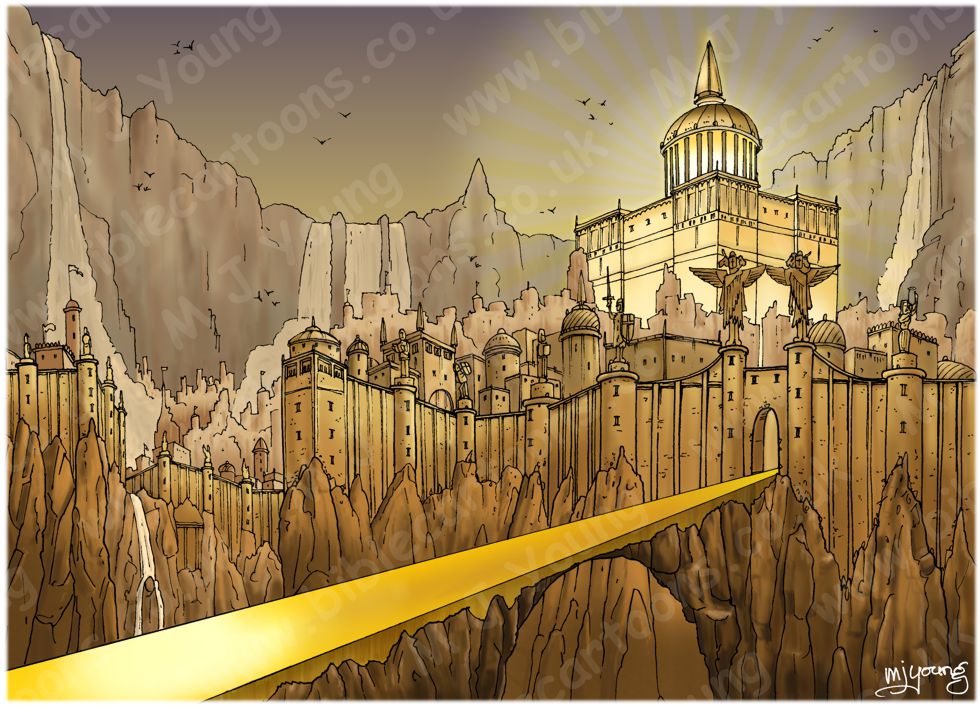
After the fall of Babylon (Rome), after the defeat of evil, after the great white throne judgment — Revelation does something extraordinary. It does not end with destruction. It ends with architecture. God does not abandon the creation; God renews it. The final two chapters of the Bible are a vision of the most beautiful city ever conceived — the New Jerusalem descending from heaven like a bride adorned for her husband.
He will wipe every tear from their eyes. There will be no more death or mourning or crying or pain, for the old order of things has passed away.
— Revelation 21:4This verse, perhaps more than any other in Revelation, reveals the book’s ultimate purpose. It is not a manual for predicting catastrophe. It is a promise to the suffering: your tears will be wiped away. Your loss is not permanent. The worst thing is not the last thing.
The Dimensions and Symbolism of the New Jerusalem
| Feature | Description (21:10–27) | Theological Meaning |
|---|---|---|
| Shape | A perfect cube, 12,000 stadia on each side | The Holy of Holies in the Temple was a perfect cube (1 Kings 6:20) — all of creation becomes God’s sanctuary |
| Gates | 12 gates, 3 on each side, named for 12 tribes; 12 foundations named for 12 apostles | Complete continuity of Israel and the Church — one people of God |
| Material | Pure gold, clear as glass; jasper walls; 12 gemstone foundations | Transcendent beauty beyond physical materials; echoes Isaiah 54:11–12 |
| No Temple | “I did not see a temple in the city” (21:22) | God himself is the temple — direct, unmediated divine presence; no more separation |
| No Sun | “The city does not need the sun or the moon… for the glory of God gives it light” (21:23) | God’s own glory supersedes natural light; fulfills Isaiah 60:19–20 |
| Open Gates | Gates never shut; nations bring their glory into it (21:24–26) | Radical openness; the wealth of all cultures redeemed and offered to God |
The River of Life and the Tree of Life (22:1–5)
The final image brings Revelation full circle to Genesis: a river of the water of life, clear as crystal, flowing from the throne of God and of the Lamb. On each side of the river stands the tree of life, bearing twelve crops of fruit each month, its leaves “for the healing of the nations.” The curse of Genesis 3 is explicitly reversed: “No longer will there be any curse” (22:3).
What was lost in Eden is restored — not merely restored, but gloriously exceeded. The paradise of the new creation is a garden-city: the organic goodness of Eden with the social, architectural richness of human civilization — redeemed, purified, offered back to God.
I am the Alpha and the Omega, the First and the Last, the Beginning and the End… The Spirit and the bride say, “Come!” And let the one who hears say, “Come!” Let the one who is thirsty come; and let the one who wishes take the free gift of the water of life.
— Revelation 22:13, 17Revelation ends not with a threat but with an invitation. The last word of the entire Bible — before the benediction — is not “judgment” or “wrath” or “doom.” It is Come.
Master Symbol Dictionary: Revelation’s Visual Language
Revelation is written in a symbolic code that was not secret in its original context — it was drawn from a shared vocabulary of Jewish scripture and early Christian tradition. Here are the key symbols decoded:
Divine completeness and perfection. Dominates the entire structure.
The covenant people — 12 tribes × 12 apostles = 144 = completeness of the redeemed.
Blood, persecution, the empire’s violence, the dragon, Babylon.
Purity, victory, divine holiness — given to the overcomers and worn by the heavenly armies.
In ancient Hebrew cosmology, the sea symbolizes chaos, the abyss, the origin of monster-like evil (Dan. 7:3). The new creation has “no more sea” (21:1).
Christ is announced as the Lion (power), but revealed as the Lamb (sacrificial death). Both are true simultaneously.
Explicitly identified as “the ancient serpent called the devil, or Satan” (12:9). The great adversary behind all earthly opposition.
Code name for Rome — any empire that demands absolute loyalty and persecutes faithful witness. Typologically applicable to any similar system in any age.
The seven churches (1:20). The light-bearing community in a dark world. Echoes the temple menorah.
Angels or spiritual guardians of the churches (1:20). “Falling stars” represent fallen spiritual powers.
God’s plan for history, sealed until the Lamb is found worthy. Once opened, the judgments that move history toward its consummation begin.
The Word of God as the instrument of divine judgment. Not a literal sword — truth itself is the most powerful weapon in Revelation’s cosmology.
Scholarly Verdict: What Revelation Is Really About
After walking verse by verse through all twenty-two chapters, what can we say with confidence about the Book of Revelation’s actual message — stripped of two thousand years of speculation, sensationalism, and cultural noise?
Revelation is, at its core, a theology of witness. It was written to communities of Christians who were being asked to choose between Caesar and Christ — between the economic comfort of participation in the imperial system and the dangerous integrity of faithful testimony. John’s answer was not a detailed timeline of future events. It was a vision: look behind the curtain of apparent Roman power and see what is actually real. What is actually real is a Lamb on a throne, a multitude no one can count singing praises, and a New Jerusalem already prepared.
The seals, trumpets, and bowls are not a sequence of events to be awaited. They are a symbolic portrayal of the reality of living under any oppressive system — war, famine, plague, injustice — seen through the lens of divine sovereignty and ultimate vindication. They tell suffering people: your persecutors are not writing history; God is.
The beast, 666, and Babylon were not invented as puzzles for 21st-century prophecy enthusiasts. They were urgent, coded pastoral messages to first-century believers saying: do not compromise with the imperial cult; the Rome that seems all-powerful will fall; hold on.
But Revelation’s vision is also universal, because the patterns it identifies — totalizing power demanding absolute loyalty, economic systems built on exploitation, the persecution of the faithful, the temptation to accommodate and survive rather than resist and witness — these patterns have recurred in every century since John wrote. The book remains a lamp in every generation’s darkness precisely because it refuses to be pinned to a single moment.
1. God is sovereign. No empire, no dragon, no beast has the final word. The throne at the center of heaven is not empty.
2. The Lamb’s death changes everything. The scroll of history is opened not by power but by sacrifice. This fundamentally inverts every human notion of how the world works.
3. Faithful witness matters, even unto death. The martyrs are not victims. They are the victors. “They triumphed over him by the blood of the Lamb and by the word of their testimony; they did not love their lives so much as to shrink from death” (12:11).
4. Evil is parasitic, not ultimate. The beast mimics the Lamb. Babylon mimics the New Jerusalem. Evil has no original form — only distorted copies of the good. That is why it ultimately fails.
5. The future is restoration, not annihilation. God does not destroy creation; God renews it. The New Jerusalem is a garden-city — culture and nature redeemed together. Your tears, your losses, your work done faithfully — none of it is wasted.
Essential Scholarly Resources
- Bauckham, Richard. The Theology of the Book of Revelation. Cambridge University Press, 1993. — Cambridge
- Beale, G.K. The Book of Revelation: A Commentary on the Greek Text. Eerdmans, 1999. — The most thorough single-volume commentary in English.
- Aune, David. Revelation. 3 vols. Word Biblical Commentary, 1997–98. — Exhaustive historical and philological analysis.
- Koester, Craig R. Revelation and the End of All Things. Eerdmans, 2018. — Accessible scholarly overview.
- Wright, N.T. Revelation for Everyone. Westminster John Knox, 2011. — Superb lay-level commentary from a leading NT scholar.
- Mounce, Robert H. The Book of Revelation. NICNT. Eerdmans, 1998. — Balanced evangelical commentary.
- Britannica. Revelation to John — Encyclopedia entry.
- Wikipedia. Book of Revelation. — Well-sourced overview of scholarship and reception history.
Explore the depths of sacred texts, mystical traditions, and esoteric wisdom