

https://www.neuralgrimoire.com/goetia-demons-explained/
Neural Grimoire · Ancient Knowledge Series
The Book of Thoth
Separating Myth from Reality
Three distinct artifacts. One enduring legend. What Egyptology actually found, what the myths encode, and why the confusion is not accidental.
- The “Book of Thoth” refers to at least three distinct things: a mythological object in ancient storytelling, a real Demotic priestly text discovered in the 20th century, and Aleister Crowley’s 1944 tarot commentary — none of which is the same artifact.
- The mythological version was deliberately designed to be untouchable. Its narrative function was to warn against unauthorized access to divine knowledge — it was never meant to be a literal manual.
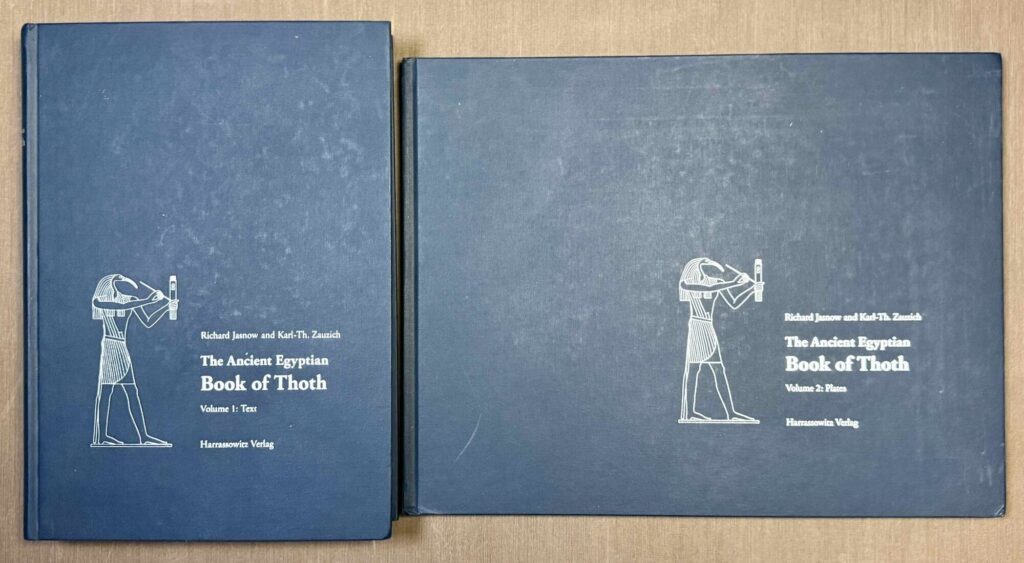
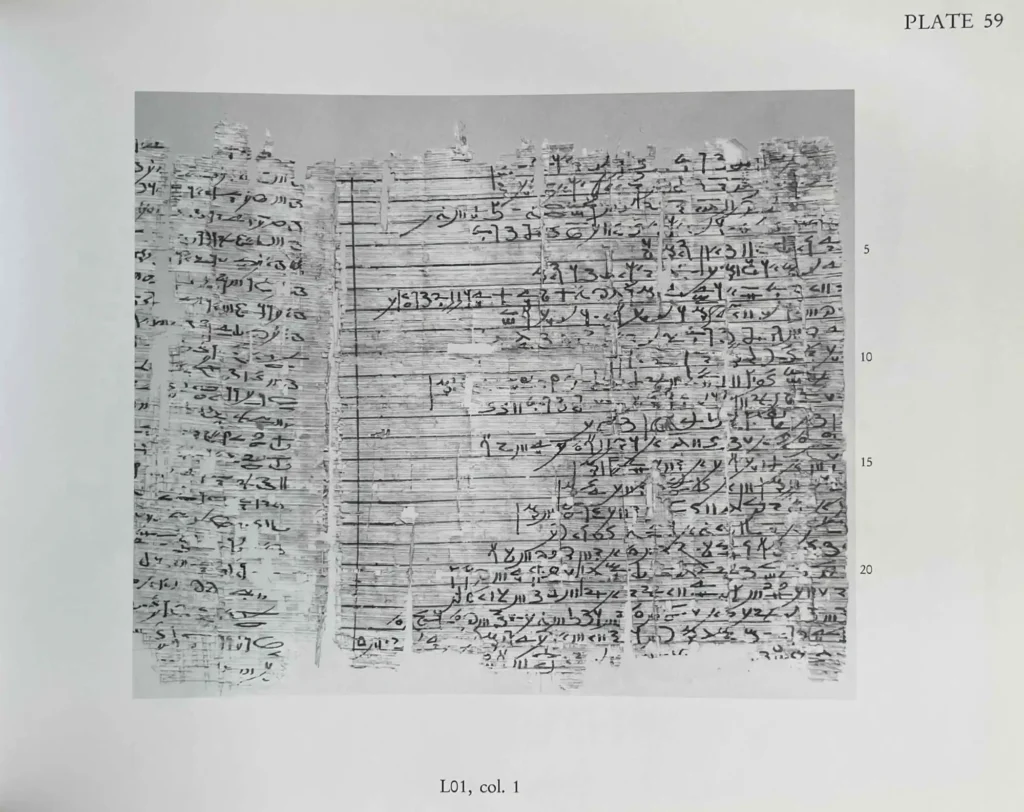
- The real scholarly text (Jasnow & Zauzich, 2005) is a dialogue between a deity and a student about scribal craft, sacred geography, and wisdom — closer to a philosophical treatise than a grimoire.
- Crowley’s version borrows the name but is an entirely modern Western esoteric synthesis combining Hermetic Qabalah, astrology, and Thelema. It has no direct lineage to ancient Egyptian temple texts.
- The persistent conflation of these three is not ignorance — it is the mythology working exactly as intended.
Should You Even Engage With This?
Before spending hours reading about the Book of Thoth, it is worth asking what you are actually looking for — because the answer determines which strand of this subject matters to you.
| If you are interested in… | What to focus on |
|---|---|
| Ancient Egyptian religion and temple practice | → The Demotic priestly text (Jasnow/Zauzich) |
| Egyptian narrative mythology and its moral architecture | → The Setne Khamwas cycle and the Neferkaptah legend |
| Western occultism, Tarot, Thelema, or Hermetic Qabalah | → Crowley’s 1944 text — explicitly modern, explicitly Western |
| A single ancient master-text containing all cosmic knowledge | → Stop here. It does not exist in the form you imagine. |
| The origin of the idea that writing itself is sacred and dangerous | → All three versions — this is the connecting thread |
The Confusion Is the Point
Most articles about the Book of Thoth begin with breathless excitement and end with vague disappointment. They describe a legendary Egyptian grimoire containing the secrets of the universe, then quietly acknowledge that no physical copy has ever been found, then pivot to either conspiracy or Crowley, rarely explaining how those two things are related.
This article takes a different approach: the confusion surrounding the Book of Thoth is not a failure to find the right information. It is the subject. The idea of a forbidden repository of cosmic knowledge, deliberately hidden and catastrophically dangerous to possess, was engineered by ancient Egyptian scribal culture to encode something specific about the nature of esoteric knowledge itself.
Understanding the Book of Thoth properly means holding three distinct threads without tangling them: the myth, the real archaeological text, and the modern occult synthesis. Each is legitimate. Each is useful. And each is radically different from the others.
The Three Books of Thoth
| Layer | What it is | Origin | Nature |
|---|---|---|---|
| I. The Myth | A narrative object in Ptolemaic-era Egyptian fiction | Setne Khamwas cycle, ~300–100 BCE | Deliberately untouchable; its power lies in its inaccessibility |
| II. The Text | Real Demotic priestly papyri reconstructed by scholars | 1st century BCE – 2nd century CE; published 2005 | Philosophical dialogue on scribal craft, wisdom, and sacred geography |
| III. The Synthesis | Crowley’s 1944 tarot commentary | Modern Western esotericism | Hermetic Qabalah + astrology + Thelema; Egyptian name, Western architecture |
The Mythological Book: Designed to Be Forbidden
The most famous appearance of the Book of Thoth in ancient Egyptian literature is the story of Neferkaptah, a prince and accomplished magician of the Ptolemaic period. Consuming in its obsession with a single object, the narrative describes how Neferkaptah learned of the Book’s location — hidden at the bottom of the Nile near Koptos, sealed inside a series of nested boxes, guarded by immortal serpents — and set out to retrieve it despite every warning from priests, his wife, and divine omens.
He succeeded. He read the Book. And then Thoth, the god who authored it, killed his son and wife as punishment before ensuring Neferkaptah’s own death.
The second narrative in the cycle, featuring Prince Setne Khamwas — a character based loosely on the historical son of Ramesses II who was known for his antiquarian interests — refines this further. Setne retrieves the Book from Neferkaptah’s tomb, is tormented by supernatural visions and illusions, and ultimately returns it as a suppliant. His encounter with the Book is structured entirely as a lesson in the vanity of transgressive knowledge-seeking.
What is striking about these narratives, when read alongside the broader Egyptian theological tradition, is their consistency with the general Egyptian view of Thoth as keeper of cosmic order. Thoth invented writing, yes — but in Egyptian theology, that meant Thoth was responsible for the boundary between what can be communicated and what must remain unspoken. The Book of Thoth, in this reading, is not a collection of spells. It is the embodiment of knowledge that exists at — and by definition must remain at — the threshold of the sayable.
What the Myth Is Actually Encoding
Reading the Neferkaptah cycle as ancient Egyptians would have read it: the buried, guarded, nested-inside-boxes structure of the Book mirrors the Egyptian concept of esoteric initiation. Knowledge was not hidden because it was dangerous in the modern sense (dangerous like a weapon). It was hidden because comprehension without preparation was a form of violence against understanding itself. Manetho, an ancient Egyptian priest, reportedly claimed that Thoth had written tens of thousands of books — suggesting the name “Book of Thoth” was a category, not a single title, applied to any text at the outer edge of sanctioned knowledge.
The Real Demotic Text: What Scholars Actually Found
The text is written in Demotic script, the standard form of priestly Egyptian writing during the Ptolemaic and Roman periods, and is dated between the 1st century BCE and 2nd century CE. The fragments are scattered across museum collections in Berlin, Copenhagen, Florence, New Haven, Paris, and Vienna — a single composition split across continents by the dislocations of the modern antiquities trade.
What the text contains is not what most people expect. There are no spells. There is no hidden name of God. There is no formula for speaking with animals in any operational, magical-instruction sense. What there is, across its multiple sections, is a sustained philosophical dialogue between a figure called “He-who-praises-knowledge” (almost certainly Thoth himself) and a disciple called “He-who-loves-knowledge” — a structure that maps directly onto the Greek concept of the philosophos.
| Section | Subject Matter | Scholarly Significance |
|---|---|---|
| Scribal Dialogues | The craft and ethics of writing; what it means to be a scribe of Thoth | Direct parallel to discussions of writing in Plato’s Phaedrus |
| Sacred Geography | Identification of Egyptian nomes and sacred sites; the “Vulture Text” | Unique in Egyptian literature; nomes mapped onto vulture symbolism |
| Underworld Knowledge | Descriptions of the Duat; the nature of divine versus human knowledge | Connects to the broader Book of the Dead tradition |
| Animal Knowledge | Symbolic treatment of animals as carriers of cosmic intelligence | Likely source of the “language of animals” motif in the fictional versions |
| Wisdom Discourse | Philosophical reflections on the nature of true knowledge versus acquired information | Possible influence on or parallel to early Greek Hermetic texts |
One of the most striking scholarly observations about this text — made both by the Bryn Mawr Classical Review and in comparative scholarship since — is the degree to which Thoth is called “thrice-great” in the Demotic text. This is the same epithet that would later attach to Hermes Trismegistus in the Greek Hermetic Corpus, suggesting a living textual lineage rather than mere parallel development.
The Hermetic Thread: From Thoth to Hermes Trismegistus
The transition from Thoth to Hermes Trismegistus (“Thrice-Great Hermes”) is the single most important pivot point in understanding how ancient Egyptian temple knowledge became modern Western esotericism — and how the Book of Thoth migrated from one world to the other.
In the Hellenistic period, as Greek culture absorbed and reinterpreted Egyptian religion, Thoth was identified with Hermes. Both governed writing, boundaries, communication, and the movement between worlds. The composite figure — Hermes Trismegistus — became the attributed author of the Greek Hermetic Corpus, a body of philosophical and theological texts produced roughly between the 1st and 4th centuries CE.
These texts are not Egyptian in content. They are largely Platonist and Stoic in their philosophical architecture, using Egyptian prestige as a framing device. But the structure of the Demotic Book of Thoth — a master-disciple dialogue about the nature of knowledge, writing, and cosmic order — appears to have been a genuine influence on or parallel to this tradition. Scholarship on this connection remains active: a 2021 academic paper argued for a possible direct relationship between the Demotic text and the critique of writing in Plato’s Phaedrus, a question that has not been resolved.
This matters for readers of Neural Grimoire because Hermeticism is not a vague ancient wisdom tradition. It has a specific, traceable intellectual history, and understanding where Thoth ends and Hermes Trismegistus begins is foundational to understanding what you are actually working with when you engage with Hermetic texts.
Crowley’s Book of Thoth: Brilliant, But Not Ancient
Aleister Crowley’s The Book of Thoth, first published in 1944, is a commentary on the Thoth Tarot deck he designed with artist Lady Frieda Harris between 1938 and 1943. It is one of the most sophisticated texts in 20th-century Western esotericism, and it deserves to be read on its own terms — which means reading it for what it actually is, not for what its title implies.
The book combines Hermetic Qabalah, astrology, numerology, ceremonial magic, and the philosophical framework of Thelema — Crowley’s own religious and philosophical system. The Egyptian iconography throughout the deck and the text is deployed as symbolic vocabulary, not as historical documentation. Crowley knew the difference. He was drawing on Egyptian symbols because they had accumulated enormous associative power within Western esoteric tradition, not because he was channeling literal ancient temple practice.
| Use it if… | Avoid leading with it if… |
|---|---|
| You are working within Thelemic, Hermetic, or Golden Dawn traditions | You want accurate knowledge of ancient Egyptian religion |
| You use the Thoth Tarot and want its internal philosophical logic | You are researching the historical Book of Thoth |
| You are interested in Western esoteric synthesis at its highest level | You want a grimoire descended from Egyptian temple magic |
| You are studying how ancient symbols migrate and transform across traditions | You want the Demotic priestly dialogue tradition |
Crowley’s genius was not archaeological. It was synthetic. He took the name “Book of Thoth,” loaded with millennia of accumulated mystique, and used it to anchor a 20th-century occult system that genuinely needed grounding in something older and more authoritative than its recent Western origins. This is a legitimate move within the history of esoteric thought — it is how the tradition has always worked. But it becomes a problem when readers assume the anchor is structural rather than rhetorical.
Why the Conflation Happens — and What It Costs
This is not an accident of history. The Neferkaptah legend was designed to enforce the idea that certain knowledge is categorically off-limits. The Demotic text was deliberately difficult — written in a script that even within Egyptology is still comparatively understudied — and preserved in a form (fragmented, scattered, dispersed) that mirrors the inaccessibility of its subject. Crowley’s use of the name added another layer: a modern system that is genuinely complex and rewards deep study, but that points backwards toward an ancient authority it does not actually possess.
The cost of conflating them is not just intellectual imprecision. In many workflows within occult study and esoteric practice, people build their understanding of Egyptian tradition on top of Hermetic Western texts, which are themselves built on top of a Hellenistic interpretation of Egyptian religion, which has already translated and transformed the original. This is a chain with multiple points of drift, and treating Crowley’s Book of Thoth as a window into ancient Egypt is like treating a Victorian novel as a window into medieval life: there may be gestures of accuracy, but the architecture is entirely of its own time.
Practical Application: Using This Knowledge Correctly
The question of how to actually engage with the Book of Thoth — across all three of its versions — comes down to understanding which layer you are working in and what that layer’s internal logic requires.
| Resource | Purpose | Layer |
|---|---|---|
| Jasnow & Zauzich (2005) | The only scholarly edition of the actual Demotic text; foundational for historical accuracy | Archaeological |
| Setne Khamwas Papyri | The mythological tradition; available in translation via E.A. Wallis Budge and more recent Egyptological translations | Mythological |
| Corpus Hermeticum | The Greek Hermetic bridge between Egyptian Thoth and Western esotericism; the Copenhaver translation is the scholarly standard | Transitional |
| Crowley (1944) | Western esoteric synthesis; use with the Thoth Tarot for its intended purpose | Modern Synthesis |
One workflow that recurs in serious esoteric study: begin with the mythological layer to understand the function the Book of Thoth was designed to serve — not what it contains, but what its inaccessibility was meant to encode. Then read the Demotic text (or scholarly summaries of it) to understand what temple-educated Egyptians were actually writing when they produced philosophical dialogue under Thoth’s authority. Then read Hermetic texts to track how that tradition transformed as it moved through Hellenistic and Late Antique culture. Then, and only then, engage with Crowley as a sophisticated modern endpoint of that tradition rather than a window back into its origins.
This is not a linear progression you have to complete before engaging with the material. It is a map that prevents the most common failure mode: assuming the tradition is more unified than it is.
What We Still Don’t Know
Honest engagement with the Book of Thoth requires holding several open questions that current scholarship has not resolved.
The relationship between the Demotic text and the Greek Hermetic Corpus is genuinely contested. The Bryn Mawr Classical Review noted that the texts share structural features and the “thrice-great” epithet, but further research has found these parallels to be, in many cases, general rather than specific — the kind of similarities that might arise from shared intellectual environment rather than direct textual borrowing. A 2021 academic paper introduced the argument that the Demotic text may have influenced Plato’s Phaedrus, but this remains an extended abstract awaiting full development.
The exact provenance of many Demotic papyri is unknown, which means the scribal community that produced the “Book of Thoth” cannot be precisely identified. The editors suggest the “House of Life” — the temple scriptorium — but this is an inference from the text’s content and register, not a documented fact.
And the original mythological Book of Thoth — the one Neferkaptah retrieved from the Nile — was probably not meant to refer to a single physical text at all. The ancient Egyptian category of “books of Thoth” was expansive and varied. The specific object in the Setne Khamwas cycle is a narrative device, not a catalogue entry. Whether it was inspired by any real temple text, including the Demotic dialogue, is an open question.
FAQ
Has the Book of Thoth ever been physically found?
The Demotic text reconstructed by Jasnow and Zauzich is the strongest candidate for a real text that circulated under Thoth’s authority in ancient Egyptian priestly circles. It survives in over forty fragmented papyri across European museum collections. The supernatural grimoire of Egyptian fiction has not been found because it was a narrative object, not a physical one.
Is Crowley’s Book of Thoth connected to ancient Egypt?
Indirectly, through the Hermetic tradition. Crowley worked within a Western esoteric lineage that includes the Hermetic Corpus, which itself drew on Hellenistic re-readings of Egyptian religion. The connection is real but multiple layers deep — it is a tradition in conversation with Egypt, not a continuation of Egyptian temple practice.
What did the real Demotic text contain?
A philosophical dialogue between a divine teacher and a student, covering scribal craft, sacred geography, the underworld, wisdom, and animal symbolism. The tone is closer to a wisdom text or philosophical treatise than a magical manual. The “Vulture Text” — a section mapping the 42 nomes of Egypt onto vulture symbolism — is noted as unique in Egyptian literature.
Why does the legend claim the Book grants the ability to understand animal speech?
In Egyptian religious thought, animals were understood as manifestations of divine intelligence — carriers of cosmic order in physical form. The ability to understand their speech was a shorthand for comprehending the divine order written into the structure of nature. It is a theological claim, not a literal description of what any text contained.
Should I approach the Book of Thoth as a practitioner or a scholar?
This is the wrong binary. The most rigorous practitioners understand the historical and textual layers of what they are working with. Assuming that scholarly analysis of the tradition undermines its value is itself a position worth examining — it may reflect an unconscious anxiety that the tradition cannot survive honest scrutiny. In many cases, the historical complexity makes the tradition more interesting, not less.
Final Thoughts: The Uncomfortable Truth
The most honest thing you can say about the Book of Thoth is this: the version most people are looking for does not exist, and the versions that do exist are more philosophically interesting than the one they imagined.
The mythological Book of Thoth was designed to be unfindable. Its power was the power of the threshold — the knowledge that something exists just beyond the boundary of the permissible. The real Demotic text is a sophisticated philosophical dialogue that encodes a serious epistemological position: that wisdom is not information, that scribal craft is a spiritual discipline, and that the relationship between a teacher and a student is the actual mechanism by which knowledge transmits. And Crowley’s synthesis is a genuinely ambitious 20th-century attempt to organize the entire Western esoteric tradition into a coherent symbolic system, using Thoth’s name because it carries the weight of everything the tradition aspires to.
The Neferkaptah legend, read carefully, is not a warning against knowledge. It is a warning against the belief that knowledge can be simply possessed. Neferkaptah did not suffer because he read the Book. He suffered because he believed that reading it would make him its owner. The scribes who preserved and transmitted this story understood something that still applies: the relationship to knowledge matters more than the knowledge itself.
That, in the end, is what the Book of Thoth has always been about.
Sources
Primary
- Jasnow, R. & Zauzich, K.-T. (2005). The Ancient Egyptian Book of Thoth: A Demotic Discourse on Knowledge and Pendant to the Classical Hermetica. Harrassowitz Verlag. Johns Hopkins University overview
- Crowley, A. (1944). The Book of Thoth: A Short Essay on the Tarot of the Egyptians. O.T.O. / Weiser reprint 1974.
- Setne Khamwas Papyri (Ptolemaic period). British Museum and Cairo Museum collections. Trans. M. Lichtheim (1980), Ancient Egyptian Literature, Vol. III. University of California Press.
Secondary
- Widmer, G. (2011). Book review of Jasnow & Zauzich. Journal of Near Eastern Studies, 70, 113–116. Semantic Scholar
- Bryn Mawr Classical Review (2006). Review of Jasnow & Zauzich. bmcr.brynmawr.edu
- Hagen, F. (2011). Review, Journal of Near Eastern Studies. Academia.edu
- Copenhaver, B. (1992). Hermetica: The Greek Corpus Hermeticum and the Latin Asclepius. Cambridge University Press. (Standard scholarly translation of the Hermetic Corpus.)
Related Articles
https://www.neuralgrimoire.com/ai-generated-necronomicon/
https://www.neuralgrimoire.com/book-of-revelation/
https://www.neuralgrimoire.com/forbidden-bible-books-attributed-to-jesus/
https://www.neuralgrimoire.com/tartarias-300m-views/
https://www.neuralgrimoire.com/anunnaki-dna-activation/