
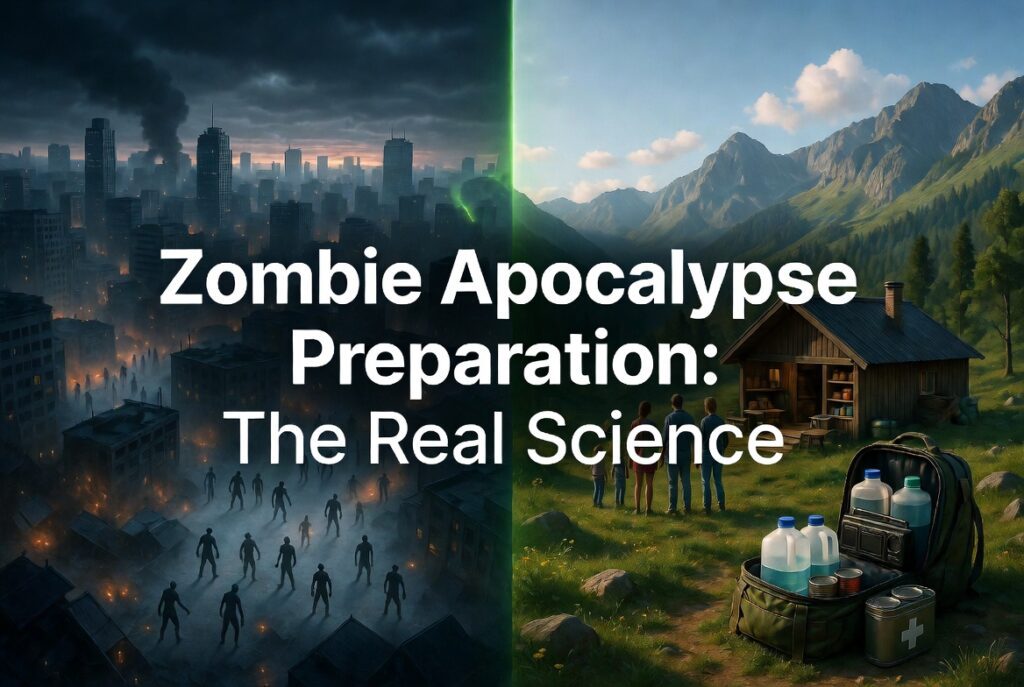
Zombie Apocalypse Preparation: The Real Science Behind Emergency Survival
The CDC’s zombie campaign wasn’t a joke. Here’s what 15 years of data, Cornell simulations, and FEMA guidelines actually teach us about staying alive when systems collapse.
Bottom line: The CDC’s 2011 zombie campaign used pop culture to teach real emergency skills. Cornell’s 2015 statistical model proves cities collapse within days, while remote mountain regions buy you months. Your survival hinges on three things: a 72-hour self-sufficiency kit, low-population shelter, and community networks — not weapons or bunkers.
Action now: Store 1 gallon of water per person per day. Build a 14-day food reserve. Know your neighbors. That’s it. Everything else is optimization.
Why Zombie Preparedness Actually Works (And Why the CDC Did It)
Back in May 2011, Dr. Ali S. Khan — then Director of the CDC’s Office of Public Health Preparedness and Response — published a blog post with a title that made the internet lose its mind: “Preparedness 101: Zombie Apocalypse.”
The post went viral. The CDC’s servers crashed within three days. Traffic spiked from an average of 80 page views per hour to over 30,000. The Atlantic covered it. So did CNN, The Wall Street Journal, and pretty much every newsroom on the planet.
But here’s the thing most people missed: the advice inside was completely legitimate. Water storage. Emergency kits. Family communication plans. It was standard FEMA guidance wrapped in zombie fiction — and it worked because people actually read it.
“If you are generally well equipped to deal with a zombie apocalypse, you will be prepared for a hurricane, pandemic, earthquake, or terrorist attack.” — Dr. Ali S. Khan, Former CDC Director of Public Health Preparedness and Response [CDC Blog, 2011]
The campaign cost the CDC zero additional dollars. Dave Daigle, the associate director for communications who pitched the idea, later admitted he was just tired of publishing the same hurricane preparedness posts every year and watching engagement flatline. Zombies were the hook. Preparedness was the payload.
By mid-2022, the CDC retired the zombie theme and replaced it with the more conventional Prep Your Health portal. But the lesson stuck: engagement drives behavior change. If you want people to prepare for disasters, you have to meet them where they are — and in 2011, that was Twitter, talking about the undead.
The Cornell Simulation: What Actually Happens When Systems Collapse
In 2015, four researchers at Cornell University — Alexander Alemi, Matthew Bierbaum, Christopher Myers, and James Sethna — presented something unusual at the American Physical Society March Meeting: “The Statistical Mechanics of Zombies.”
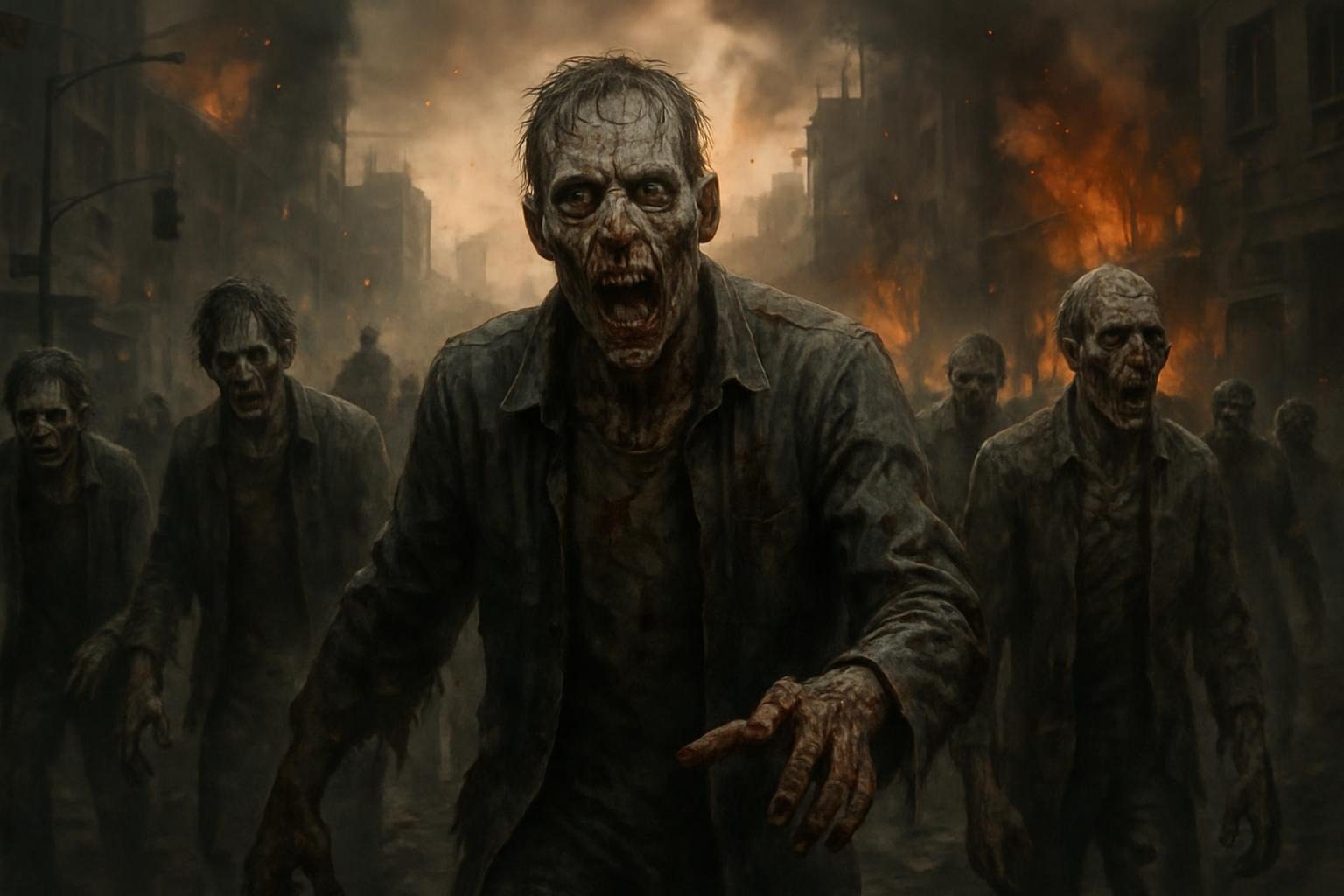
They weren’t joking either. Their model treated a zombie outbreak as a stochastic dynamical system, mapping four possible states across roughly 300 million people: human, infected, zombie, or dead zombie. Each interaction — a bite, a kill, a movement — was modeled like radioactive decay with variable half-lives.
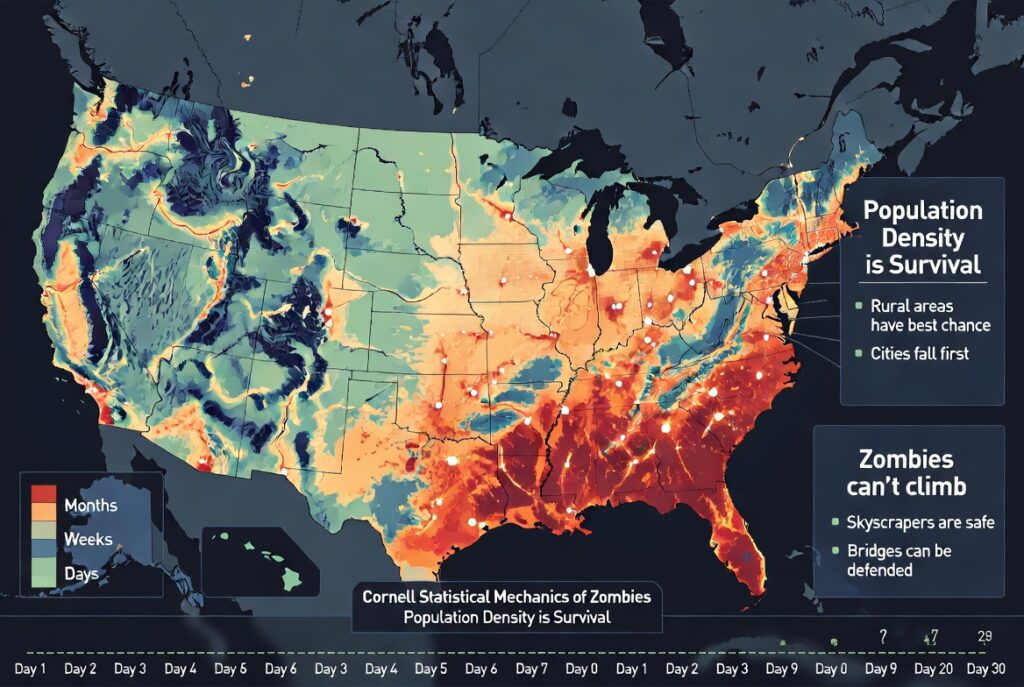
Their conclusion? Population density is the single biggest survival variable. Major cities collapse almost immediately. Suburban areas get a few weeks. Remote mountain regions in Montana and Idaho? They might have months to prepare.
Here’s why this matters for real disasters: the same math applies to pandemics, infrastructure failures, and supply chain collapses. When a system breaks, density amplifies the damage. Distance is your friend. The zombie model just made that visceral.
Alemi himself put it best: “I’d love to see a fictional account where most of New York City falls in a day, but upstate New York has a month or so to prepare.” That’s not just good storytelling. It’s exactly how real epidemics behave.
The Three Pillars of Survival (That Apply to Every Disaster)
Here’s a principle I keep coming back to, and it’s not from a zombie movie — it’s from Georgetown University emergency management professor David Frazier: you are your own first responder.
Professional emergency services get overwhelmed. Roads get blocked. Communication networks fail. In the first 72 hours of Hurricane Katrina, Superstorm Sandy, or the 2021 Texas winter storm, help simply didn’t arrive for thousands of people. Not because responders weren’t trying. Because physics and geography made it impossible.
That 72-hour window isn’t arbitrary. FEMA has studied this extensively. It’s the gap between “disaster happens” and “organized help reaches you.” If you can’t survive that gap alone, you’re gambling.
Securing shelter, avoiding threats, establishing communication. This is hour zero to hour 24. Don’t think about long-term plans yet. Think about not dying today.
Water, food, medical supplies, utilities for extended periods. You need 1 gallon of water per person per day minimum. Two weeks of non-perishable food. A first-aid kit that can handle more than a Band-Aid.
Cooperative networks that multiply individual capabilities. One person with a generator is useful. A neighborhood with shared generators, medical skills, and security rotations is survivable.
Most people over-index on pillar one (weapons, bunkers, escape routes) and under-index on pillar three. That’s a mistake. The data from every major disaster — from Katrina to COVID-19 — shows the same pattern: communities with pre-existing social cohesion recover faster and lose fewer people. Lone wolves don’t survive collapses. Networks do.
Where to Shelter: The Cornell Data vs. Hollywood Myths
The Cornell simulation identified the Northern Rocky Mountains — particularly Montana and Idaho — as the optimal survival zone in a continental U.S. outbreak. Low population density, abundant natural resources, and geographic isolation from urban centers. It’s not romantic. It’s math.
But most people don’t live in Montana. So what do you do if you’re in a city?
The Shopping Mall Myth
Despite what every zombie movie since Dawn of the Dead has taught you, shopping malls are terrible shelter locations. Here’s why:
- Massive glass surfaces = zero ballistic or impact protection
- Dozens of ground-level entry points, many with automatic doors that fail open
- Food courts stock 2-3 days of fresh inventory, not long-term supplies
- Flat roofs, poor water collection, limited defensive sightlines
- Every other survivor in a 10-mile radius has the same idea
In a real emergency, the places that look “safe” in movies are often death traps. Malls, hospitals, and police stations attract crowds, which attracts problems. The best shelter is the one nobody else is thinking about.
The Prison Paradox
Here’s a counterintuitive option that actually holds up: prisons.
Dr. Lewis Dartnell, an astrobiologist and author of The Knowledge: How to Rebuild Our World From Scratch, has argued that prisons are surprisingly defensible. High walls. Barbed wire. Security infrastructure already built in. Many have independent water supplies and food storage. The problem isn’t keeping zombies out — it’s that prisons were designed to keep people in, which happens to work both ways.
Obviously, this isn’t practical advice for most people. You can’t just walk into a prison. But the principle matters: look for existing infrastructure with passive defensive properties. Industrial warehouses with few windows. Schools with cinderblock construction and large kitchens. Fire stations with backup generators and radio equipment.
Building Your Emergency Kit: What FEMA Actually Recommends
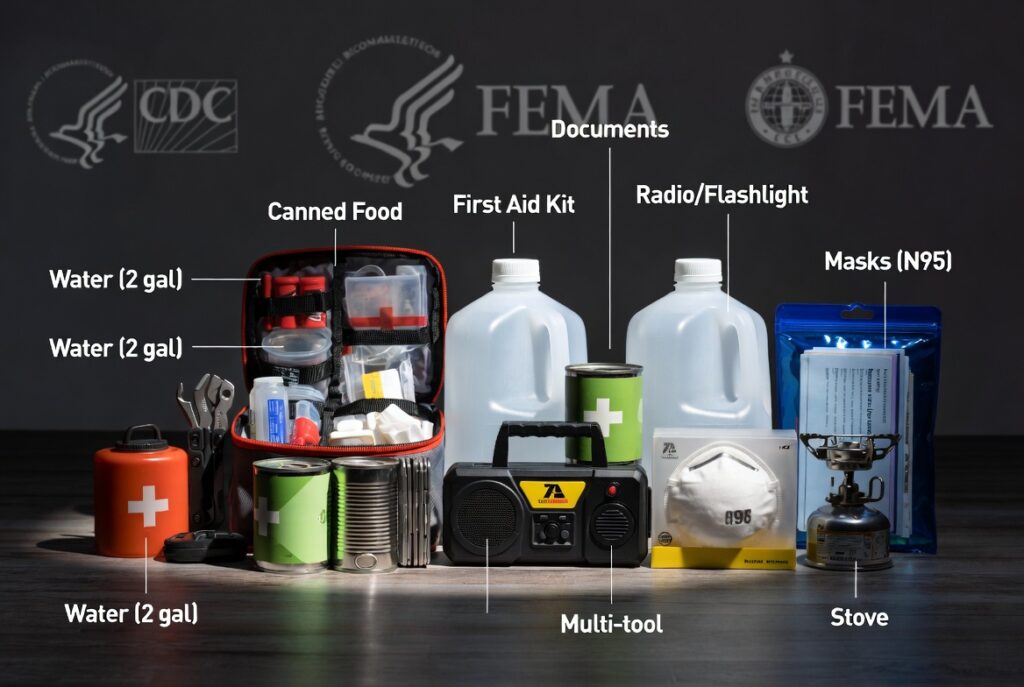
Let’s get specific. The CDC’s original zombie post included a supply list that was nearly identical to FEMA’s standard emergency kit guidance. Here’s what that looks like in practice, broken down by time horizon:
| Item | 72-Hour Minimum | 14-Day Target | Storage Notes |
|---|---|---|---|
| Water | 1 gal/person/day | 14 gal/person | Store in cool, dark place. Rotate every 6 months. |
| Food | Non-perishable, ready-to-eat | Calorie-dense: rice, beans, oats, canned protein | Check expiration dates annually. Include manual can opener. |
| First Aid | Basic kit + personal meds | Expanded kit + 30-day med supply | Include prescription copies. Know expiration dates. |
| Tools | Flashlight, radio, multi-tool | Camp stove, fuel, water filter, fire starter | Battery-powered or hand-crank. Test quarterly. |
| Documents | ID, insurance, bank info | Waterproof copies + digital backup | Store in waterproof/fireproof container. |
| Communication | Phone + portable charger | Two-way radios, whistle, signal mirror | Cell towers fail. Radios don’t. |
A few things the movies get wrong about supplies:
- Weapons are not on FEMA’s list. The CDC explicitly refused to recommend weapons when asked. Their job is public health, not combat training. Focus on avoidance and shelter first.
- Canned food beats MREs for most people. MREs are calorie-dense but expensive and heavy. A $50 stockpile of rice, beans, and canned vegetables feeds a family for weeks.
- Water is the bottleneck. You can survive weeks without food. You die in 3-4 days without water. Prioritize water storage and purification above everything else.
Community Building: Why Lone Survivors Die and Groups Thrive
I used to think preparedness was a solo sport. Stockpile food, learn some skills, ride out the storm. Then I started looking at actual disaster data.
During Hurricane Katrina, neighborhoods with pre-existing community organizations — churches, block associations, even informal neighbor networks — had dramatically better outcomes than isolated households. Same supplies, same storm, different results. The difference was coordination.
Here’s what a functional survival group looks like:
- Medical: Someone with first-aid training, ideally EMT-level or higher
- Communications: Ham radio operator or someone with signal equipment
- Security: Not weapons — situational awareness, perimeter checks, noise discipline
- Food/Water: Someone who knows purification, rationing, and foraging
- Mechanical: Generator repair, vehicle maintenance, basic construction
- Navigation: Maps, compasses, local terrain knowledge
You don’t need a militia. You need a block party that happens to know how to purify water. Start there. Meet your neighbors. Share a skill. Build trust before you need it.
The zombie metaphor actually helps here. In fiction, the group that fractures dies. The group that cooperates survives. That’s not Hollywood fantasy — it’s backed by every sociological study of disaster behavior ever conducted.
Your 6-Step Action Plan (Start This Weekend)
Analysis paralysis kills more preparedness plans than actual disasters. Here’s a progressive framework that won’t overwhelm you:
- Week 1: Water. Buy two cases of bottled water per person in your household. Cost: ~$15. Done. You now have a 3-day buffer.
- Week 2: Food. Add $30 of non-perishables to your next grocery trip. Rice, beans, canned goods, peanut butter. Don’t overthink it.
- Week 3: First Aid. Assemble a kit with bandages, antiseptic, pain relievers, and a 7-day supply of any prescription medications.
- Week 4: Documents. Photocopy IDs, insurance cards, and bank info. Store in a waterproof bag. Email digital copies to yourself.
- Month 2: Communication. Buy a battery-powered or hand-crank radio. Test it. Know your local emergency broadcast frequencies.
- Month 3: Community. Talk to two neighbors about preparedness. Share this article. Form a loose contact plan.
That’s it. Three months, maybe $100 total, and you’re objectively more prepared than 80% of the population. Everything after that is optimization.
Want the Full Breakdown?
Get the complete 1,400+ word PDF with detailed checklists, supply tables, purification methods, and community coordination templates.
Download the Complete Guide (Free)The Bottom Line
Whether the threat is a pandemic, natural disaster, infrastructure failure, or the theoretical shambling horde, the principles don’t change: secure water, maintain nutrition, establish shelter, build community, and develop self-sufficiency skills.
Start small. A single week of stored water and food provides meaningful security against the emergencies that actually happen — hurricanes, ice storms, power outages, water main breaks. Expand from there.
The zombies may never come. But here’s what will: hurricane season, wildfire season, flu season, ice storms, floods, earthquakes. The CDC knew this in 2011. Cornell proved it with math in 2015. FEMA has been saying it for decades.
“Preparation isn’t about fear. It’s about empowerment. When you know you have plans, supplies, and skills to handle disruption, everyday uncertainty becomes more manageable.” — CDC Zombie Preparedness Campaign, 2011
That quote is 15 years old. It still holds up. Because preparedness isn’t about predicting the future — it’s about reducing your vulnerability to it. And that’s something worth doing whether the dead walk or not.
Sources & Further Reading
- CDC — “Preparedness 101: Zombie Apocalypse” (2011)
- Cornell University — “The Epidemiology and Statistical Mechanics of Zombies” (2015)
- ScienceDaily — Cornell Zombie Outbreak Study (2015)
- The Atlantic — “Why Did the CDC Develop a Plan for a Zombie Apocalypse?” (2011)
- FEMA — Ready.gov Official Emergency Preparedness Portal
- American Red Cross — Emergency Preparedness Guidelines
- [Internal Link] Neural Grimoire — More Survival & Preparedness Guides
https://www.neuralgrimoire.com/pole-shift-survival-rituals-mistake/
https://www.neuralgrimoire.com/solar-flash-preparation/
https://www.neuralgrimoire.com/gobekli-tepe-decoded/
https://www.neuralgrimoire.com/blog/