

The Signal & Sigil Literacy Test
Ten questions on the real neuroscience behind altered states, the actual mechanics of chaos magick, and how AI is quietly reshaping both ritual and misinformation. No mysticism for its own sake — just what's verifiable. Answer honestly, no going back.
—
Reading review
Study what you missed
20 Bashar Channeling Prompts That Actually Work — Ranked by Depth
The question structure determines the answer depth. Here are the 20 prompts that activate the belief-investigation method — for live Darryl Anka sessions and AI tools alike. Includes a 4-step chaining sequence and an honest look at where the framework fails.
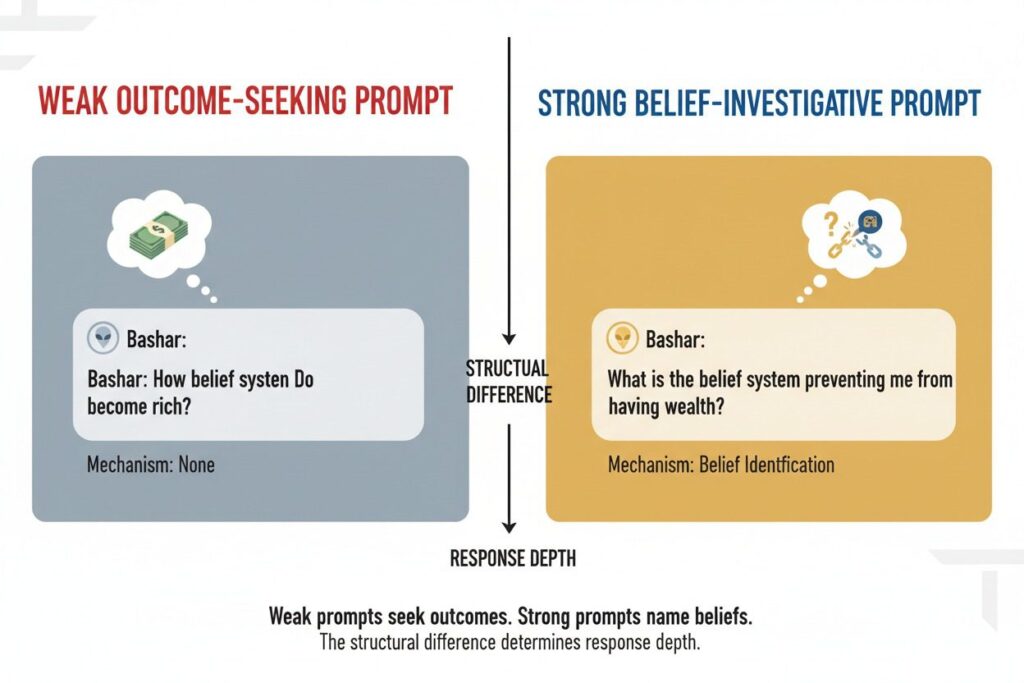
Vague questions get generic answers. Belief-specific questions get the method. The single most effective structural addition to any Bashar prompt: preface it with “I currently believe that [your actual belief].”
This guide gives you 20 ranked prompts, a 4-step chaining sequence that turns one question into a complete self-inquiry session, and an honest accounting of where this framework breaks — including the 2024 prediction failure and what the community said afterward.
Why the Question Structure Determines Everything
A pattern shows up across recorded Bashar sessions again and again. One person asks: “Am I on the right path?” The response is warm, brief, generic. The next person asks: “I notice I feel most excited when I write, but I hold a belief that creative work can’t pay my bills. What is that belief protecting me from?” Bashar engages for several minutes. People in the audience with completely different questions recognize their own pattern in the answer.
The difference is structural, not spiritual. The second question names a specific belief, supplies the emotional charge, and asks what the belief is protecting — giving the investigation method a concrete entry point. That’s it. That’s the whole trick.
“What would I have to believe is true about my relationship to this situation to feel this way?”
— Bashar’s Belief Investigation Method, bashar.orgBashar’s communication style is Socratic and responsive. He works with what’s given. A vague question produces a framework restatement. A belief-anchored question activates what his documentation calls the belief investigation method — the process of tracing an emotion back to the specific belief that generated it, then testing whether that belief still holds up once it’s visible.
The operational core is Steps 3 and 5 of the Follow Your Excitement Formula. Step 3 — act with no insistence on outcome — addresses where attachment creates resistance. Step 5 — constantly investigate your belief systems — is the explicit invitation for belief archaeology. The definition grounding all of it, from bashar.org/principles: “Excitement is the physical translation of the vibrational resonance that is your true, core natural being.” Which makes one question the most productive structure in the entire framework:
What is currently overriding my excitement signal — and why? Every prompt below is engineered to get at this. The surface question varies. The target doesn’t.
The 20 Prompt Library
As of March 2026, Bashar no longer answers questions on health/medicine, specific future predictions, or political situations at live events (bashar.org/private-sessions). All 20 prompts below are compatible with this restriction — they target beliefs, not outcomes. 2026 confirmed events: Palm Springs (July 11) and New York. Full schedule at bashar.org/event-calendar.
This is the core domain. Prompts 5–10 are where the method does its heaviest lifting. I’d recommend working through at least two of these in a journal before attending any live session — the answers you find yourself will make the live exchange significantly sharper.
Preface any question with: “I currently believe that [state your actual belief].” This single addition supplies the specific belief state the method is designed to trace and reliably deepens responses from any source.
The 4-Step Chaining Sequence
A single question produces a single insight. A structured chain produces a complete self-inquiry session — one you can run with AI tools, in a journal, or if you’re lucky enough to get a follow-up at a live event. The pattern is always the same four moves: surface → belief → root → action.
For AI tools — search “Bashar” at chatgpt.com/gpts, or use Claude, Gemini, or Perplexity with Bashar-specific system prompts — submit one question per turn. Let the response land before moving to the next step. For live sessions, write your Q1 on paper before approaching the microphone. If offered a follow-up, use Q2.
To test honestly: write the answer down and sit with it for 48 hours. Test against your actual behaviour over 2–4 weeks. Notice whether “accuracy” brings new insight or merely confirms what you already believed. The distinction matters enormously.
Why Some Prompts Produce “Mind-Blowing Accuracy” — And What’s Actually Happening
Two peer-reviewed findings are worth naming directly before you get deep into this.
But a structural explanation operates independently of both biases — and this is the part most guides skip. When you ask “what belief am I holding that creates X?” you supply the domain, the pattern, the emotional charge, and the implicit acknowledgement that a belief is involved. A response from any source mirrors that information back with more precision than a vague outcome question provides.
Belief-investigative prompts feel most accurate because they supply most of the information needed to answer them. The resonance is structural. Whether it is also something more remains an open question four decades in.
— Tom Morgan, Neural GrimoireWhere the Framework Fails — The Honest Account
This section is the one most guides in this space leave out. They shouldn’t.
Emotional investment in prediction-based hope accumulates over months. The crash, when predictions fail, is immediate. The framework’s track record for belief investigation and for specific predictions are genuinely separate datasets. Treating them as one is the error.
The positive practitioner pattern is equally documented and structurally different. One long-term observer described being initially repelled — “completely turned off, having listened to what I thought was a fruitcake” — before returning because the message was sound regardless of its packaging. James Morisson’s The Follow Your Excitement Formula (2024) documents the specific failure-then-recovery arc: practitioners who followed Step 1 without Step 5 — acting on excitement without investigating the beliefs overriding it — and got stuck. The pattern is consistent across both positive and negative accounts.
Darryl Anka’s own framing cuts through most of this: “Is the information real? Can you prove that it works?” I find this the most intellectually honest position available — test the outputs, not the source.
How to Prepare for a 2026 Live Bashar Event
Confirmed: Palm Springs (July 11) and New York. Full schedule at bashar.org/event-calendar. Note the topic restrictions above before formulating your question.
Write your question on paper before you arrive. The ideal format: “I have noticed [specific personal pattern]. What belief is most likely responsible?” Working through prompts 5–10 in a journal beforehand is the single most effective preparation available — the answers you find yourself will make the live exchange sharper.
- Work through prompts 5–10 in a journal before the event
- Write your Q1 in the format: “I have noticed [pattern]. What belief is responsible?”
- Include your actual current belief — not the belief you think you should have
- Have your Q2 ready: “What is the belief beneath that?”
- Check topic restrictions at bashar.org/private-sessions before attending
- Avoid prediction-seeking questions — they’re now disallowed, and they were already the weakest use of the method
For AI-based sessions: the 40-year session archive is now absorbed into training data. AI tools will increasingly match live sessions for individual belief work — and they eliminate the prediction temptation by default. What AI cannot replicate is the communal dimension: 200 people hearing one answer and recognizing their own pattern simultaneously. Both formats serve genuinely different functions.
Frequently Asked Questions
What This Analysis Lacks
This guide is a secondary-source analysis: session recordings, transcripts, official documentation, two peer-reviewed papers, and independent skeptical investigation. No controlled measurement of prompt-tier response quality exists. No practitioners were interviewed on-record about multi-year outcomes.
The first gap is closable by anyone attending multiple sessions with a structured note-taking practice. The second requires original reporting — and I don’t have it yet.
A forward pattern emerges when three datasets are read together. The Forer Effect research establishes that generic guidance produces false accuracy signals. The prediction failures establish where this framework breaks. The 40-year session archive establishes that belief investigation has a separate track record. What they jointly imply through 2027–2028: AI tools will increasingly handle the individual belief work; what remains irreplaceable is the communal dimension of live sessions.
Explore related guides: Belief Work Methods Compared · History of Modern Channeling · AI Tools for Self-Inquiry · The Follow Your Excitement Formula, Step by Step
References
- [1]Bashar Communications — Follow Your Excitement Formula & Basic Principles
- [2]Bashar Communications — Private Sessions / 2026 Topic Restrictions
- [3]Bashar Communications — 2026 Event Calendar
- [4]Forer, B. R. (1949). The fallacy of personal validation. Journal of Abnormal and Social Psychology, 44(1), 118–123. doi:10.1037/h0059240
- [5]Wiseman, R., & Watt, C. (2006). Belief in psychic ability and the misattribution hypothesis. British Journal of Psychology, 97(3), 323–338. doi:10.1348/000712605X72523
- [6]Blocher, R., & Poppy, C. (2022–2023). Oh No, Ross and Carrie! Bashar episodes 377–378. maximumfun.org
- [7]Morisson, J. (2024). The Follow Your Excitement Formula. Amazon Kindle.
- [8]Good Vibe Blog — Bashar’s belief-change method
- [9]Klimo, J. (1998). Channeling (2nd ed.). North Atlantic Books.
- [10]MysteryLores — Criticism of Bashar Channeling: Honest or Scam? (June 2025)
- [11]Farsight Forums — Bashar’s prediction on the outcome of the 2024 election (community discussion, 2024)
https://www.neuralgrimoire.com/rapture-simulation-prompt/
https://www.neuralgrimoire.com/channeling-dead-celebrities/
https://www.neuralgrimoire.com/the-forbidden-prompt-that-opens-hells-gates/
https://www.neuralgrimoire.com/5-permission-slip-method/
https://www.neuralgrimoire.com/the-nostradamus-numerology-pattern/