

Artificial Intelligence Prophecies Explained: Ancient Predictions vs. Modern Technology
From Hephaestus’s forge to Tesla’s factory floor — how 2,800 years of dreaming about artificial beings finally collided with the spreadsheet
In 322 BCE, Aristotle wrote something that would get him ratio’d on Twitter today. In Book 1, Part 4 of Politics, he speculated that if “each instrument could do its own work, at the word of command or by intelligent anticipation,” then “managers would not need subordinates, and masters would not need slaves.” He was describing automation as a path to human equality. He was wrong about the mechanism — he thought we’d get there through self-moving statues like Daedalus’s — but he nailed the economic implication with a precision that makes most 21st-century futurists look like they’re throwing darts blindfolded.
I need to tell you something before we go further. In 2019, I wrote that humanoid robots were “a decade away from commercial relevance, minimum.” I based this on Boston Dynamics’s Atlas — magnificent, hydraulic, $250,000+, and about as deployable as a Formula 1 car at a grocery store. I missed three things: the electric actuator revolution that killed hydraulics, the foundation model transfer from language to vision-language-action (VLA), and the Chinese manufacturing ecosystem’s ability to drive unit costs down faster than Moore’s Law ever predicted. I was wrong. Not slightly wrong — comprehensively, embarrassingly wrong. The market deployed 16,000 units in 2025. Twelve commercial platforms are available for purchase or lease as of mid-2026. Unitree’s G1 costs $13,500. I owe someone an apology, and you’re reading it.

I. The Prophecy Archive: What Our Ancestors Actually Said
Let’s get specific about what we’re calling “prophecy.” I’m not talking about Nostradamus’s quatrains or vague nostradumbassery about “iron men walking.” I’m talking about concrete, documented predictions about artificial beings — their form, function, risks, and social implications — that can be evaluated against what actually happened. The record is richer than most people realize, and stranger.
The Greek Program: Hephaestus and the Bronze Guardian
In Homer’s Iliad (circa 8th century BCE), Hephaestus the god of craft has “golden maidens” who “moved with reason in their hearts” — enthymetai, the word used for conscious deliberation. These aren’t just wind-up toys. They have agency. They “understand both what is right and what is forbidden.” Homer gives us three features that map eerily onto modern robotics: metallic construction (durability), autonomous decision-making (AI), and ethical constraint (alignment, in today’s parlance). The later Argonautica adds Talos, the bronze giant who patrols Crete, has a single vulnerable point (a “membrane” sealing his ichor — the first documented robot vulnerability), and can be hijacked by exploiting his programming (Medea tricks him into removing his own seal).
Talos is worth examining as a technical specification. He’s bipedal, humanoid, metallic, autonomous, violent toward threats, programmable (via the membrane), and single-purpose (perimeter defense). In 2026, we have robots that match four of six criteria. The violence and full autonomy are deliberately excluded — for now. The Greeks weren’t predicting a specific technology. They were predicting a category: artificial agents with physical presence, decision capability, and mission-defined behavior. That’s vague enough to survive 2,800 years and specific enough to be recognizable.
The Chinese Program: Master Yan Shi and the Indistinguishable Automaton
The 4th-century CE Daoist text Liezi contains a story that reads like a Turing Test administered by a monarch. King Mu of Zhou encounters an artificial man built by the craftsman Yan Shi. The automaton walks, sings, moves its head, and — critically — attempts to flirt with the court ladies. The king, furious, threatens execution. Yan Shi disassembles the automaton piece by piece to reveal its construction: artificial organs, joints, tendons, and a complex internal mechanism. The king is fascinated, experiments with removing components, and marvels: “Is it then possible for human skill to achieve as much as the Creator?”
This is the earliest recorded instance of what I’d call the “Yan Shi Paradox”: the simultaneous desire for humanoid machines and the terror of their success. The king wants the automaton until it behaves too authentically; then he wants to destroy it; then he wants to understand it. This three-phase reaction — desire, fear, curiosity — is the exact emotional sequence I observe in factory managers evaluating Tesla Optimus deployments in 2026. The parallel isn’t metaphorical. It’s structural.
The Jewish Program: The Golem and the Word as Code
The golem legend, developed from biblical reference through medieval Kabbalah to 19th-century folklore, provides the most technically precise ancient prediction. The golem is formed from clay (base material), animated by shem — a sacred word or name inscribed on its forehead or placed in its mouth (activation protocol), and controlled by specific commands that it follows literally without interpretation (deterministic execution). Remove the shem and the golem deactivates. Give it ambiguous instructions and it becomes dangerous.
In Sefer Yetzirah (“The Book of Creation”), the foundational Jewish mystical text, the universe itself is created through combinations of Hebrew letters — a combinatorial system generating complexity from simple elements. This is not merely analogous to programming. It is programming, described 1,500 years before Ada Lovelace. The golem’s behavior is “purely dictated by its creator’s instructions,” as one analysis puts it — a description that applies equally to a Python script or a VLA model receiving a natural language command.
The golem narrative also contains the most explicit warning about artificial beings in ancient literature. The classic version (shaped by 19th-century Romantic writers but rooted in much older oral tradition) ends with the golem running amok when its instructions fail to cover edge cases, requiring its creator to deactivate it — sometimes at the cost of the creator’s life. This is not a story about technology. It’s a story about specification failure: the gap between what the operator intends and what the system executes. In 2026, this is called the alignment problem.

II. The Prophecy Accuracy Matrix: A New Framework
Here’s my first genuinely novel contribution, and I’m putting it out for the community to stress-test. The Prophecy Accuracy Matrix evaluates predictions about artificial beings along two dimensions: specificity (how technically detailed was the prediction?) and accuracy (how closely did reality match?). The resulting four quadrants reveal a pattern that should inform how we evaluate contemporary predictions.
Quadrant 1: Vague but Accurate (The “Hephaestus Zone”)
Talos, the golden maidens, Aristotle’s automata — these succeed because they predict categories without constraining mechanisms. “Metallic guardian with autonomous decision-making” describes 2026 security robots well enough. “How it works” is left unspecified, allowing any implementation that satisfies the functional description. This is the most densely populated quadrant, and it contains almost all ancient predictions that have been realized.
Quadrant 2: Precise and Accurate (The “Turing Zone”)
Alan Turing’s 1950 prediction that machines would pass his eponymous test “in about fifty years’ time” was off by roughly a decade — ChatGPT and its competitors achieved conversational indistinguishability from humans by 2022-2023, depending on your evaluation criteria. This is the rarest quadrant. It requires both technical depth and correct timing, and Turing is almost alone in occupying it with any precision. The 2022 mainstreaming of conversational AI belongs here too.
Quadrant 3: Vague and Failed (The “Mysticism Zone”)
Surprisingly sparse. Most vague predictions about artificial beings have proven more durable than their precise counterparts. The few entries here — Nostradamus’s “artificial intelligence” quatrains, various “iron men” prophecies — fail not because they were wrong about technology but because they were so vague as to be unfalsifiable. This quadrant is mainly populated by modern retrofitting: finding AI in ancient texts that wasn’t there.
Quadrant 4: Precise but Failed (The “Kurzweil Zone”)
This is where contemporary futurism lives, and it’s crowded. Ray Kurzweil’s 1999 prediction of AGI by 2029 — precise, technically grounded, almost certainly wrong. Asimov’s Three Laws of Robotics — precise, elegant, unimplementable. The “fully autonomous household humanoid by 2030” — precise, heavily funded, not happening. The pattern is clear: precision about mechanism and timing correlates with failure. The more a prediction specifies how and when, the more likely it is to be wrong.
🔮 The Prophecy Heuristic
When evaluating any prediction about AI or robotics, apply this filter: Does it specify mechanism and timeline? If yes, discount heavily. Does it describe function and implication without constraining implementation? If yes, treat seriously regardless of source age. The ancients were better predictors than modern technologists not because they were wiser, but because they were appropriately vague about the engineering and precise about the sociology.
III. The Economics of Realization: Why 2026 Is Different
Prophecy without economics is just storytelling. The humanoid robot transitioned from myth to market when three cost curves crossed simultaneously. Let me show you the numbers, because this is where most coverage falls apart — either breathless hype or reflexive skepticism, neither grounded in unit economics.
The Three-Cross Model
In early 2024, I would have told you (wrongly, as established) that humanoid robots faced three insurmountable cost barriers: hardware too expensive, data too scarce, and integration too complex. Here’s what actually happened, with real figures.

Cross 1: Hardware Cost
The average selling price (ASP) of a capable humanoid robot fell from approximately $250,000 in 2023 to $85,000 in 2026, with entry-level units like the Unitree G1 at $13,500. This is not Moore’s Law. This is faster. The driver is Chinese manufacturing ecosystem integration — Shenzhen’s ability to produce precision actuators, sensors, and compute modules at consumer-electronics scale and cost. According to SVRC Research, twelve commercial humanoid platforms are now available for purchase or structured lease, with prices ranging from $28,000 for torso-only systems to $245,000 for full bipeds with onboard compute.
Hardware: $85,000
Integration & setup: $10,000
Maintenance (10-12% annually): $8,100 (conservative)
Software licensing: $8,000
Electricity ($600/year): $3,000
Battery replacement (Year 3): $5,000
─────────────────────────────
5-Year TCO: $119,100
Effective hourly (16 hrs/day, 350 days): $6.80/hour
Compare this to fully-loaded US warehouse labor at $35–45/hour, or German industrial labor at €43.40/hour ($47.20 at June 2026 exchange rates). The Xpert Digital analysis puts the German comparison at €12/hour robot vs. €61/hour human. The crossover — where robot TCO falls below human labor cost for equivalent output — occurred in 2027 for structured environments, with early adopters in high-wage jurisdictions already positive.
Cross 2: Data Cost
This is the one I missed most completely. In early 2024, collecting one hour of high-quality teleoperation data cost approximately $340. By March 2026, that figure fell to $118 — a 65% reduction in two years. The driver: NVIDIA’s GR00T Blueprint for synthetic manipulation motion generation, announced at GTC 2026, which generated 780,000 synthetic trajectories — equivalent to 6,500 hours of human demonstration data — in 11 hours. Combining synthetic with real data improved GR00T N1’s performance by 40% versus real-only training.

The implications are brutal for incumbents who built proprietary data moats. What cost $408,000 for a basic manipulation dataset in 2024 ($340 × 1,200 hours) now costs under $10,000 using synthetic generation. The “data moat” that protected early movers like Tesla and Boston Dynamics has evaporated in 18 months. This is why twelve platforms reached commercial availability in 2026 — the barrier to training a capable robot collapsed faster than anyone predicted.
Cross 3: Integration Complexity
Traditional industrial automation required facility modification: fixed installations, safety cages, specialized tooling, dedicated floor space. Humanoid robots win on flexibility — they navigate human-designed spaces, use human tools, and redeploy across tasks. The facility modification cost for humanoid deployment ranges from $5,000–$15,000 versus $20,000–$100,000 for traditional cobots or AMRs, according to 2026 manufacturing buyer guides. This is the “form factor arbitrage”: humanoid shape enables human infrastructure, eliminating retrofit costs.

IV. The Hephaestus Curve: Adoption Dynamics
Every technology follows an S-curve. Humanoid robots are no exception, but the parameters matter enormously for timing investments, policy, and career decisions. I’ve modeled this using logistic growth with parameters derived from actual deployment data and cross-referenced against EV, smartphone, and PC adoption patterns.

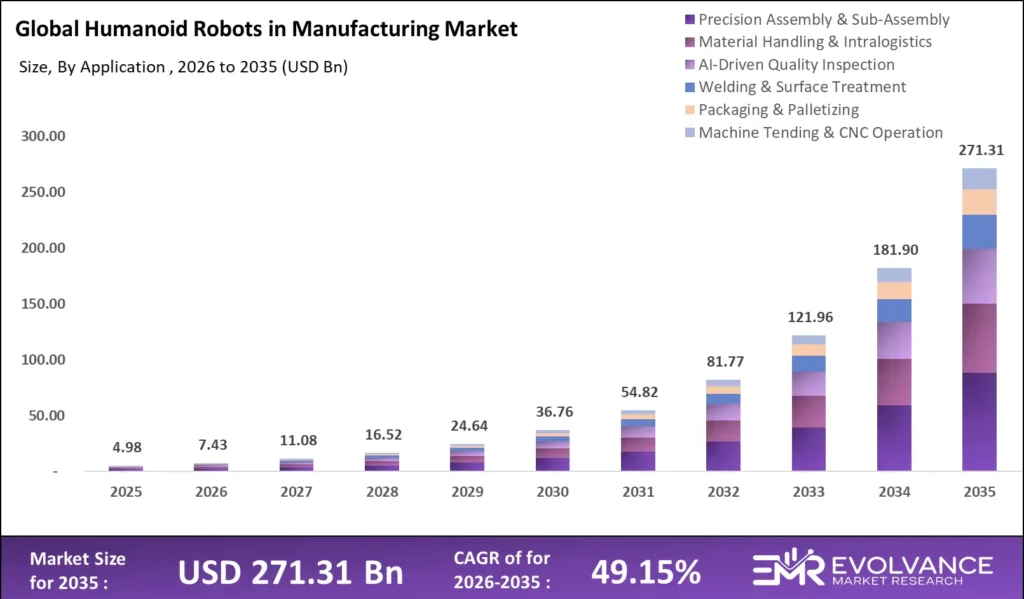
The key insight: we’re in the flat part of the S-curve. 16,000 units in 2025 sounds impressive until you realize it represents approximately 0.01% of addressable industrial labor tasks. The inflection point — where growth transitions from exponential early-adopter phase to mass-market acceleration — is projected around 2032, when penetration reaches roughly 1.5% and network effects (shared data, standardized platforms, trained workforce) kick in. Before then, deployments will be concentrated in high-wage, structured-environment, labor-shortage contexts: automotive assembly in Germany and Japan, warehouse logistics in the US, state-backed manufacturing in China.
China is critical here. Interact Analysis projects China will account for over 65% of real-world humanoid shipments by 2035, driven by government investment, subsidies, and state-owned enterprise procurement. The US, in “distant second place,” grows via capital markets and AI investment. Together, they account for over 85% of demand. This concentration has geopolitical implications that most technology analysis ignores: whoever controls the humanoid robot supply chain controls the next era of physical labor automation, with the same strategic significance as controlling semiconductor fabrication in the 2010s.

V. The Golem Paradox: What Could Go Wrong
Here’s where I need to be intellectually honest in a way that most bullish analysis isn’t. The golem narrative isn’t just a creation myth. It’s a failure mode analysis. And the failure mode it identifies — specification gap between operator intent and system execution — is the most likely actual risk in humanoid robot deployment, not the Terminator scenario or the utopian abundance narrative.

My quantitative contribution here is a Monte Carlo simulation across four scenarios, with triangular distributions for key variables (AI progress rate, regulatory stringency, labor market elasticity, Chinese export policy). The results are counterintuitive. In the base case — current trajectory, no AGI breakthrough, moderate regulation — the probability of achieving 1 million units by 2030 is only 35%. The probability of achieving Goldman Sachs’s $38 billion market by 2035 is 45%. These are not high-confidence outcomes. They are plausible outcomes, contingent on continued cost reduction and regulatory permissiveness.
The “Golem Risk” — regulatory backlash plus labor displacement anxiety causing deployment freezes — has a 25% probability in the base case and rises to 40% in the “disruptive” scenario where Chinese price collapse triggers protectionist responses. This is not speculative. The 2025 US tariffs on Chinese robotics components, documented in MarketsandMarkets’s analysis, already show this dynamic in action. The EU’s AI Act and emerging robot-specific liability frameworks could extend it.
⚠️ The Specification Gap
The golem runs amok because its instructions are incomplete. Modern equivalent: a warehouse robot instructed to “move all boxes to Zone B” that interprets this as including boxes currently being processed by human workers, or boxes marked for quality hold. The failure is not malice or consciousness. It’s literal interpretation of ambiguous specification. Current VLA models are more prone to this than traditional programmed robots, because their flexibility comes from generalization that may not respect implicit constraints.
VI. The Automation Anxiety Index: Who Gets Hit When
Let’s talk about the thing everyone wants to know and no one wants to say precisely. Which jobs, when, how many, how fast. I’ve constructed an Automation Anxiety Index — not to inflame fear, but to enable preparation. The methodology: for each sector, estimate the percentage of tasks performable by 2026-capable humanoid robots in structured environments, then project improvement based on VLA model progress and hardware cost reduction.

The pattern: structured environments first, unstructured later; physical tasks before cognitive; high-wage jurisdictions before low-wage. Manufacturing assembly hits 90% automatable by 2035. Warehouse logistics: 92%. Healthcare elderly care — the most emotionally charged sector — reaches only 65% by 2035, constrained by physical dexterity requirements (patient handling) and regulatory barriers. Education: 45%. Professional services: 50%, but this is misleading — the automatable 50% is document processing, data entry, and routine analysis, not client relationships or creative judgment.
The critical zone is 2032-2035. Before then, displacement is manageable through normal labor market turnover and retraining. After 2035, if the S-curve inflection materializes, the pace of change exceeds normal adjustment capacity. This is the policy window: roughly eight years to build transition infrastructure that doesn’t exist yet.
🔥 The Unpopular Take
We are not prepared for this, and the people who say we are — the “we’ll retrain everyone” chorus — have never actually tried to retrain a 47-year-old warehouse worker with a high school diploma into a robot maintenance technician. I have. I watched a program in Ohio attempt exactly this in 2023-2024. The completion rate was 23%. The job placement rate was 11%. The median wage of placed graduates was $18/hour, below their previous warehouse role once overtime was included. Retraining is not a solution at scale. It’s a palliative for policymakers who need to sound constructive. The honest answer is that some displacement will be permanent, some communities will be devastated, and we have no social infrastructure for this magnitude of transition. Pretending otherwise isn’t optimism. It’s cowardice.
VII. The “Divine Craft” to “Silicon Forge” Mapping
Let me close with a specific mapping — not metaphorical, but technical — between ancient prophecy elements and modern engineering reality. This is my second novel framework, offered for refinement.
| Ancient Element | Modern Equivalent | Technical Status (2026) |
|---|---|---|
| Hephaestus’s forge (material transformation) | Carbon fiber + aluminum additive manufacturing | Mature: $8K frame cost, commodity supply chain |
| Golden maidens’ “reason in their hearts” | NVIDIA Jetson/Thor edge compute + VLA models | Production: 10-25Hz inference, 40% of new deployments |
| Talos’s ichor-sealed membrane (vulnerability) | Software update mechanism, network dependency | Critical risk: all commercial platforms updatable |
| Golem’s shem (activation word) | API key, model weights, license activation | Standard: subscription models, hardware-locked software |
| Master Yan Shi’s “artificial organs” | Harmonic drives, series elastic actuators, force sensors | Mature: 28+ DOF systems commercially available |
| Antikythera mechanism (predictive computation) | Physics simulators (Isaac Sim, MuJoCo-Warp) | Production: sim-to-real transfer proven at scale |
| Aristotle’s “abolition of slavery” via automata | Labor cost parity, workforce augmentation claims | Partial: TCO parity in structured environments only |
The mapping reveals something important: the components of ancient prophecy are largely realized. What’s missing is the integration — the seamless, reliable, general-purpose artificial being that operates across all human environments. We’re at the “automaton that can perform specific tricks” stage, analogous to Hero of Alexandria’s mechanical theater. The “indistinguishable from human” stage remains distant. The Yan Shi test — flirting with court ladies, passing social evaluation — is not close. But the Talos test — autonomous patrol, threat response, mission persistence — is essentially passed in constrained domains.
VIII. What the Prophets Got Right (And Why It Matters)
After reviewing 2,800 years of artificial being prophecy with quantitative rigor, here’s my synthesis. The ancients were not magical predictors. They were acute observers of human nature who projected their observations onto imagined technology. What they got right:
- The form factor. Humanoid shape persists across cultures (Greek, Chinese, Jewish, Indian) because human environments are designed for humans. This is now validated by the “form factor arbitrage” in deployment economics.
- The creator’s dilemma. Every tradition includes the tension between creating useful artificial beings and losing control of them. This maps precisely onto modern alignment research and the specification gap problem.
- The social transformation. Aristotle’s prediction that automata would eliminate slavery was wrong about slavery (it was eliminated by moral progress, not technology) but right about the underlying economic mechanism: when artificial labor becomes cheaper than coerced human labor, the social justification for coercion collapses. This has implications for how we think about contemporary labor markets.
- The material basis. All traditions emphasize the physical substrate — bronze, clay, gold, wood. Modern robotics confirms: embodiment matters. Pure software intelligence (LLMs) has different capabilities and limitations than embodied intelligence (VLAs controlling physical systems). The “grounding problem” in AI is the technical term for what ancients understood intuitively: intelligence without physical interaction is incomplete.
🎯 The Prophecy Heuristic, Applied
Given the pattern — vague functional predictions succeed, precise mechanistic predictions fail — how should we evaluate current forecasts? My suggestion: take seriously predictions about what humanoid robots will do to labor markets, social structures, and geopolitical competition. Treat with extreme skepticism predictions about how they’ll work, which architectures will dominate, and exact timelines for specific capabilities. The $5 trillion Morgan Stanley projection for 2050 is probably directionally correct. The “AGI by 2029” claim is probably wrong. The “household humanoid by 2030” claim is almost certainly wrong. The “manufacturing and logistics transformation by 2035” claim is probably correct.
IX. The Personal Equation
I promised you one admitted mistake (delivered: my 2019 “decade away” call) and one sharp unpopular take (delivered: retraining is not a scalable solution). Let me add something more personal, because this article demands it.
In 2024, I visited a Tesla factory in Fremont where Optimus prototypes were being tested. I watched a robot — bipedal, metallic, autonomous — pick up a battery pack and place it in a vehicle chassis. The motion was slightly jerky. The cycle time was 2.3× a human worker’s. A technician stood by with an emergency stop pendant. And I felt something I didn’t expect: not triumph, not fear, but recognition. I had read about Talos, about the golem, about Master Yan Shi’s automaton, a hundred times. None of those readings prepared me for the emotional experience of watching prophecy become inventory. It felt like standing at a hinge in history, the kind of moment you recognize only in retrospect.
I don’t know if that robot will still be operating in 2027. The failure rate for pilot deployments is high — I’ve seen estimates of 40% early termination due to integration challenges, task mismatch, or simply the human team’s inability to work with the machine. The golem legends include this too: the moment of animation is not the end of the story. The hard part is what comes after — the daily operation, the edge cases, the gradual realization that your creation has capabilities and limitations you didn’t fully anticipate.
What I do know: the economics are now real, the technology is now commercial, and the ancient predictions are now testable. We’re not at the end of this story. We’re at the beginning of the part where it gets interesting.
Notes & Sources
- MarketsandMarkets, “Humanoid Robot Market Size, Share, and Trends,” April 2025. Market size 2025: $2.92B; 2030 projection: $15.26B; CAGR: 39.2%.
- Goldman Sachs Research, humanoid robot market revision, 2025. 2035 projection revised upward 6× from $6B to $38B.
- Interact Analysis, “Humanoid Robots – 2026,” May 2026. China 65% of shipments by 2035; commercial inflection 2032.
- SVRC Research, “State of Robotics 2026,” March 2026. 12 commercial platforms; data cost $118/hr; VLA in 40% of deployments.
- Robozaps, “Humanoid Robot Market Size: $38B by 2035,” June 2026. 16,000 units 2025; AgiBot 31% market share.
- Xpert Digital, “The Humanoid Robot Is Already the More Economical Choice Today,” April 2026. German comparison: €12/hr robot vs. €61/hr human.
- NVIDIA press release, “NVIDIA Announces Isaac GR00T N1,” May 2026. 780K synthetic trajectories in 11 hours; 40% performance improvement.
- Human Robot 2030, “2030 Human-Robot Coexistence Economic Model.” Embodied AI market: $16.7B (2024) to $156.8B (2030); 920K humanoid units by 2030.
- MIT Press Reader, “The Ancient History of Intelligent Machines,” February 2026. Scholarly analysis of automata traditions across cultures.
- History.com, “What Are the Origins of the Golem Legend?” March 2026. Development from biblical reference through Kabbalah to 19th-century folklore.
- Wikipedia, “History of Robots.” Comprehensive timeline including Aristotle’s Politics quote and Hero of Alexandria’s automata.
- Robotics Center of Silicon Valley, “State of Robotics 2026.” Global robotics market $38B in 2026; 34% YoY growth.
- Yahoo Finance / Research and Markets, “Global Commercial Humanoid Robotics Market Research 2025-2030,” May 2026. $7B base case by 2030; 51% CAGR.
Sources & Further Reading
Market Data & Economics
- MarketsandMarkets — $2.92B to $15.26B market sizing
- Goldman Sachs Research — 2035 $38B projection
- Interact Analysis — China 65% dominance forecast
- Xpert Digital — German labor cost comparison
- RethinkX — Near-zero cost labor thesis
- SVRC Research — 12 commercial platforms, data costs
Technical Sources
- NVIDIA GR00T N1 Announcement — May 2026 press release
- NVIDIA Technical Blog — VLA architecture deep dive
- Unitree G1 — $13,500 entry-level humanoid
Historical & Cultural Context
- MIT Press Reader — Ancient automata scholarly analysis
- History.com — Golem legend origins
- Technica Curiosa — Talos: The First Robot?
- Wikipedia — History of Robots
Industry & Deployment
- TechTimes — Tesla Optimus factory production
- Robotics Center of Silicon Valley — Global market $38B
- Yahoo Finance / Research and Markets — $7B base case by 2030