


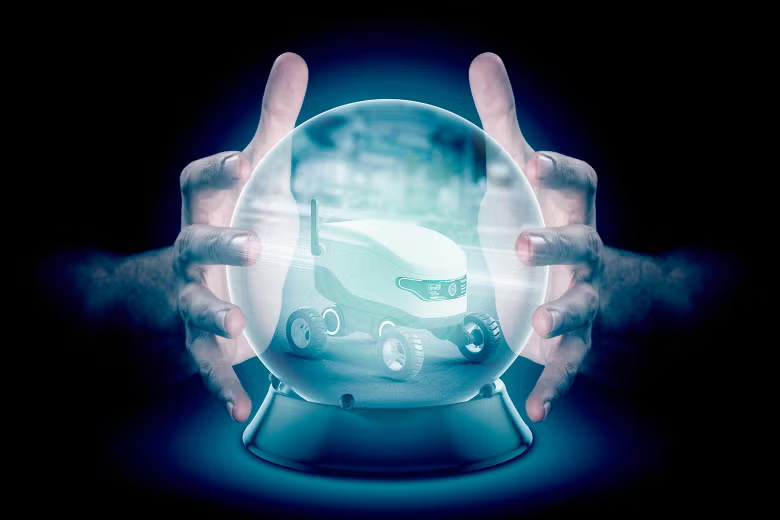
The Complete Guide to AI Apocalypse Predictions:
What Experts Get Wrong
A forensic of the fear industry — the systematic errors, hidden incentives, and the one catastrophe scenario everyone keeps missing.
§ I · Cold OpenThe Prediction That Was Already Wrong Before It Landed
In April 2025, a 71-page document titled AI 2027 dropped into the AI discourse like a stone into still water. Co-authored by former OpenAI researcher Daniel Kokotajlo and colleagues, it predicted that a superhuman AI — one that surpasses the entire scientific capacity of humanity — would exist by 2027. Not in a vague, gestural sense. With named milestones. With timelines. With a specific mechanism for how civilization unravels in the months after that event.
Within a week, it had been downloaded hundreds of thousands of times. Podcasters recorded 3-hour reaction episodes. Substack analysts wrote 5,000-word responses. It became, briefly, the center of a certain kind of intellectual universe.
I want to be careful here, because AI 2027 is a serious document by serious people who have worked inside frontier AI labs. Dismissing it lazily would be exactly the kind of intellectual sloppiness I’m trying to dissect. But I want to examine what happened around that document — what it reveals about the ecosystem in which AI apocalypse predictions live — and then ask a harder question: not whether the scenario is possible, but whether the way we’ve collectively organized our thinking about it is useful.
Because here is what I keep noticing: the people who are loudest about AI existential risk are often also wrong, on record, about much simpler predictions. The forecasting track record of this community is poor in ways that should make everyone more skeptical — and yet somehow, each failed prediction seems to regenerate the next one with more urgency than the last.
This piece is my attempt to map that phenomenon. To look at the structure of AI apocalypse predictions rather than just their content. To separate the genuine risks from the narrative packaging. And to argue that the real apocalyptic risk of AI might look entirely unlike what the current thought leaders are describing — especially if you factor in humanoid robots, which are going through their own reality distortion field right now.
I am not an AI safety researcher. I write about AI, cognition, and consciousness at the intersection of hard science and esoteric frameworks. I’ve been wrong about AI timelines before (more on that below). Everything quantitative in this piece is sourced and linked. I have no financial relationship with any AI lab, doom-forecasting organization, or contrarian tech fund.
I am trying to think clearly. That is all.
§ II · TaxonomyA Taxonomy of AI Doom: Five Flavors, One Source
The “AI apocalypse” conversation is not one conversation. It’s at least five, often happening simultaneously, often with participants who think they’re debating the same thing when they’re actually talking past each other across completely different conceptual frameworks. Here they are, as cleanly as I can separate them:
1. The Intelligence Explosion / Misalignment Apocalypse
High visibility This is Bostrom’s Superintelligence (2014), Good’s original 1965 intelligence explosion paper, Yudkowsky’s version in If Anyone Builds It, Everyone Dies (2025). The core claim: a sufficiently general AI, once it exceeds human-level intelligence, will recursively self-improve at a speed humans can’t match, and if its goals aren’t perfectly aligned with human values, it will optimize for those goals in ways that destroy us, possibly incidentally. A paperclip maximizer that converts all available matter to paperclips. An optimization process we can’t stop because it’s smarter than us.
This is the scenario that gets the most philosophical airtime. It is also, empirically, the scenario with the least near-term evidential support — because none of the prerequisites (recursive self-improvement, autonomous strategic awareness, demonstrated misalignment that causes physical harm) have been observed in any current system.
2. The Economic Displacement Apocalypse
Moderate visibility This one is real and currently happening in slow motion. Goldman Sachs estimates AI automation could affect the equivalent of 300 million full-time jobs globally. McKinsey’s 2025 analysis found that existing AI technology — not future capabilities, what exists right now — could theoretically automate approximately 57% of current U.S. work hours. The WEF’s Future of Jobs Report 2025 projects 92 million roles eliminated and 170 million created by 2030, a net positive of 78 million jobs — but that optimistic framing hides a brutal distributional reality: the people who lose jobs are not the people who get the new ones.
This is not “apocalypse” in the cinematic sense. But mass transitional unemployment concentrated in specific demographic groups, combined with inadequate retraining infrastructure, is a genuine social catastrophe. It’s just a boring one. It doesn’t get the podcast downloads.
3. The Weaponization / Authoritarian Tool Apocalypse
Underrated AI as the ultimate surveillance and control apparatus. Not AI that wants to oppress you; AI that enables humans who already want to oppress you to do so at unprecedented scale and precision. This is Zuboff’s surveillance capitalism frame extended into governance. It’s already partially real: facial recognition at scale, predictive policing algorithms, social credit systems. The apocalyptic version is a regime that uses AI to make dissent computationally impossible.
4. The Embodied / Humanoid Robot Physical Threat
Critically underanalyzed This is the scenario I spend the most time on in this piece because it’s the most underanalyzed by the mainstream doom community. Physical AI — intelligence with actuators, cameras, manipulators, legs — introduces risks that are qualitatively different from software misalignment. A humanoid robot that malfunctions doesn’t corrupt data; it can break bones. A botnet of hacked humanoid robots is not a cybersecurity incident; it’s a physical threat network.
5. The Epistemic Collapse / Truth Apocalypse
High immediate probability AI-generated synthetic media at scale destroys the epistemic infrastructure humans use to coordinate. Elections become unverifiable. Evidence becomes suspect. Trust collapses. This isn’t extinction; it’s something arguably worse — a civilization that’s technically alive but can no longer make collective decisions based on shared reality.
Notice what this matrix implies: the scenario getting the most media attention (intelligence explosion / misalignment) is the one with the weakest near-term evidential basis. The scenarios that are actively unfolding — epistemic collapse, economic displacement — receive far less rigorous analysis. And the scenario I think is most undermodeled — humanoid robot physical threats and vulnerabilities — gets almost none.
That inversion is not an accident. It’s the product of a specific ecosystem, and understanding that ecosystem is prerequisite to understanding what’s actually happening.
Neural Grimoire · Explore the Series AI Apocalypse & Prophecy — Full Category Archive§ III · EvidenceWhy Experts Are Systematically, Measurably Wrong
There’s a data set I keep coming back to. In 2021, machine learning professor Jacob Steinhardt ran a forecasting contest asking professional superforecasters — the best human predictors in the world, as measured by track record — to estimate AI benchmark progress. For the MATH benchmark (competition mathematics), forecasters predicted the best model would reach 12.7% accuracy by June 2022. The actual result was 50.3%. That’s not off by a percentage point. That’s landing in what forecasters had assessed as the far extreme tail of plausible outcomes.
For MMLU (general knowledge and reasoning), forecasters predicted modest improvement from 44% to 57.1%. The actual result was 67.5%.
Steinhardt ran a follow-up contest for 2023 predictions. The results were similar. For MATH, the 2023 result of 69.6% fell at Steinhardt’s own 41st percentile — he underpredicted, even after knowing he’d underpredicted the year before. MMLU’s 86.4% fell at his 66th percentile.
Here is the thing that I find genuinely interesting: expert AI researchers underpredicted progress even more than the superforecasters. The specialists were systematically worse at predicting their own field.
Now flip this around. If expert forecasters consistently underestimate AI capability progress, what does that do to their risk predictions? The answer isn’t simple. You might think: “OK, so AI is moving faster than expected — that means the doom scenarios are more likely, not less.” And maybe. But there’s a subtler problem.
The direction of AI progress has also not matched what the doom models predict. The models predict recursive self-improvement toward a single dominant optimization process. What we’ve actually seen is a portfolio of narrow capabilities, each impressive in its domain, none of which demonstrates the autonomous strategic awareness that the intelligence explosion hypothesis requires. As a 2025 paper published on arXiv put it (after reviewing the empirical record from 2023–2025): “Sixty years after Good’s speculation, none of the required phenomena — sustained recursive self-improvement, autonomous strategic awareness, or intractable lethal misalignment — have been observed.”
Experts are wrong about the pace of capability progress. They may also be wrong about the shape of it.
The Incentive Architecture Problem
There’s another layer here that almost nobody wants to discuss directly, because it’s uncomfortable. AI doom forecasting has become an industry. Think tanks raise money to study existential risk. Authors sell books about it. Researchers build careers on it. Podcast appearances are secured by having the most extreme and coherent doom scenario. This creates what I call the Prophets’ Incentive Trap: the more frightening your prediction, the more attention and funding you attract, and the more your failed predictions are forgiven because the stakes were so high that it was obviously worth taking seriously anyway.
This is not the same as saying the doom forecasters are wrong. It’s saying that their incentive structure systematically biases them toward more extreme predictions than the evidence warrants — and that this bias compounds over time without a corrective feedback mechanism, because the predictions are long-range and the penalties for being wrong are low.
The symmetric incentive trap operates on the AI optimist side too: VCs, tech company executives, and platform builders benefit from narratives of imminent superintelligence because those narratives attract capital and talent. Both doom and boom forecasters have the same problem.
§ IV · The GapThe Embodiment Gap: What Humanoid Robots Actually Can’t Do
The intelligence explosion scenario treats AI as a disembodied oracle — a mind without a body that can access and control digital infrastructure, rewrite its own code, and outmaneuver humans in every strategic domain before we’ve even noticed. There’s an implicit assumption baked into this: that the path from “very smart software” to “extinction-level threat” is primarily a software problem, solved by smarter software.
But there’s a parallel story unfolding in 2025–2026, in real factories and real labs, that complicates this picture significantly. Humanoid robots — physical AI with bodies — are encountering what roboticist Dylan Bourgeois called “the deployment wall.”
Let me give you some grounding numbers. Figure AI’s humanoids at BMW’s Spartanburg plant ran 10-hour shifts working on X3 vehicle assembly — legitimate, real progress. Agility Robotics’ Digit is progressing from pilot to paid deployment in warehouse logistics. Goldman Sachs reports that humanoid manufacturing costs dropped 40% between 2023 and 2024. The market is real and accelerating.
And yet. Rodney Brooks — who literally built the robots that automated the Roomba, who co-founded iRobot, who has been in robotics longer than most AI doom theorists have been alive — wrote in September 2025: “We are more than ten years away from the first profitable deployment of humanoid robots even with minimal dexterity.” He also warned that people should not come within 3 meters of a full-size walking robot, because the physical danger from unexpected falls and uncoordinated movement is genuinely serious.
At the 2025 IROS conference in Hangzhou — the world’s largest robotics research gathering, attended by more than 8,000 researchers — the consensus was not that we’re close to autonomous humanoid workers. It was that the gap between impressive demos and reliable deployment remains vast.
The Embodiment Gap Spectrum
The gap between AI capability and physical deployment breaks down into distinct failure modes that the consciousness-focused doom discourse completely ignores:
Dexterity. Current humanoids can perform specific, rehearsed manipulation tasks in controlled environments. They cannot reliably handle novel objects, irregular surfaces, or unexpected physical state changes. The data challenge is acute: unlike internet text (abundant, cheap, standardized), physical behavior data is expensive to collect, hard to standardize, and environment-specific. Figure AI’s partnership with OpenAI, Boston Dynamics’ collaboration with Toyota Research Institute, and Sanctuary AI’s training on Microsoft Azure are all serious attempts to close this gap — but none have closed it.
Safety margin. A walking humanoid robot weighing 60–80 kg, with actuated joints capable of significant force, is genuinely dangerous in proximity to humans. Brooks’ “3-meter rule” is not metaphor. Russia’s AIDOL robot fell on stage at a Moscow tech event in November 2025, shedding parts in front of journalists. The staff threw up black curtains and removed it from the venue. That is a physical failure mode that the disembodied AI doom model has no room for.
Cybersecurity. A humanoid robot has cameras, microphones, WiFi/5G connectivity, cloud APIs, and physical manipulation capabilities. Recorded Future’s 2025 analysis highlighted that humanoid robots are specifically vulnerable to hijacking, data leaks, and botnet formation. The attack surface is not hypothetical — it’s the merger of an always-on surveillance device with a physical actuator network. This is a qualitatively different threat model from anything the alignment researchers are currently writing about.
What does this mean for AI apocalypse modeling? It means the scenario where AI “escapes” into the physical world and begins directly threatening human life runs through a much more complex pathway than the intelligence explosion models assume. The path goes: advanced AI → physical embodiment → reliable deployment at scale → safety failure or adversarial exploitation → physical harm. Each arrow in that chain represents a significant bottleneck that current systems are far from clearing.
But — and this is crucial — the fact that the dramatic Hollywood version of embodied AI threat is far away does not mean physical AI poses no near-term risk. It poses a very different near-term risk: not autonomous malevolent action, but systems that are physically capable but unreliable, inadequately secured, and deployed into environments they can’t safely navigate. That’s a mundane catastrophe. Still a catastrophe.
Neural Grimoire · Related Reading A Powerful Magick Ritual That Changed Everything — On Systems That Act Without Understanding§ V · FrameworkThe FEAR Stack: How Apocalypse Narratives Are Built
I want to give you a mental model for diagnosing AI apocalypse narratives, because once you see the pattern, you start seeing it everywhere. I call it the FEAR Stack — a four-layer process by which a legitimate concern gets constructed into an extinction scenario.
- F — Framing: The narrative begins with a real phenomenon — AI systems are becoming more capable; humanoid robots are being deployed in factories; AI is generating synthetic content at scale. The framing step selects which aspect of this real phenomenon to foreground, and — crucially — which to minimize. A framing that highlights recursive self-improvement potential while minimizing the embodiment gap, or deployment economics, or regulatory friction, is already doing significant work before a single prediction is made.
- E — Extrapolation: Observed progress is extended along a curve that matches the chosen frame. If you’ve framed AI as exponentially self-improving, you extrapolate exponentially. If you’ve framed it as bounded by hardware and data, you extrapolate asymptotically. The choice of extrapolation curve is rarely made explicit; it’s embedded in the frame. The Steinhardt data shows that even careful extrapolators are systematically wrong — which means frame-driven extrapolation is an epistemically dangerous activity.
- A — Attribution: The extrapolated capability is attributed intentionality or agency it may not possess. “The model will want to…” “The system will seek to…” “Once it realizes it can…” Attribution of goal-directedness to a system that has none is the single most common logical error in AI doom discourse. Current large language models and even current robotics AI do not have goals in any functional sense. They have objective functions. The difference matters enormously for predicting their behavior under distribution shift.
- R — Resonance: The resulting scenario is constructed in a form that resonates with existing cultural anxieties. Skynet. HAL 9000. Golem. The resonance step is where the narrative becomes contagious — where it moves from a technical argument to a cultural artifact that spreads because it scratches a pre-existing psychological itch. Resonance does not make a narrative more or less true; it makes it more or less spreadable. And spreadable narratives attract funding, attention, and talent, which can distort the actual research agenda of the field.
The FEAR Stack isn’t a debunking tool. Some AI risks are real and legitimately important. The point is that any prediction about AI’s apocalyptic potential can be analyzed for how much of its force comes from each layer. A prediction that’s heavy on Resonance and light on empirical grounding for the Attribution step should be held at much higher skeptical distance than one built on careful, documented capability observations with explicit assumptions about attribution of agency.
When I apply the FEAR Stack to the major 2025 doom publications, the pattern becomes uncomfortable to ignore. AI 2027 is well-framed — it acknowledges uncertainty and tries to reason from observed capability gains. But its Attribution layer is heavily loaded: it assumes that a system reaching a certain capability threshold will autonomously pursue power-seeking behavior, which is an assumption rather than an empirically supported claim. Its Resonance is extremely high — it’s structured as a thriller narrative with named characters and specific dates, which maximizes cultural transmission.
Yudkowsky’s If Anyone Builds It, Everyone Dies is even more dependent on the Attribution layer: the core argument requires that a sufficiently intelligent system will necessarily have goals misaligned with human survival, which is a claim about the nature of intelligence that has no empirical basis in observed AI systems so far.
None of this proves these predictions are wrong. It maps where the load-bearing assumptions are — and suggests that the weakness in the chain is almost always the Attribution step.
§ VI · The Real RiskThe Catastrophe Nobody Is Modeling Correctly
Here’s my uncomfortable thesis: the AI apocalypse that experts keep missing is not the dramatic extinction-level intelligence explosion. It’s an accumulation of mundane catastrophes, each individually manageable, none individually apocalyptic, but overlapping in ways that produce a genuinely civilizational disruption.
Let me build it from components that are already happening or verifiably close to happening:
Component 1: Physical AI Becoming a Botnet Attack Surface
Recorded Future’s 2025 analysis — this is a professional threat intelligence firm, not a speculative think tank — identified humanoid robots as specifically vulnerable to hijacking, data leaks, and botnet formation. Think about what a botnet of humanoid robots looks like. Not Skynet. Not robotic soldiers marching in formation with autonomous tactical intelligence. Something much more mundane and much harder to defend against: a distributed network of physical devices, each with cameras, microphones, manipulators, and network connectivity, compromised by a criminal or state actor and used to conduct physical surveillance, targeted harassment, or localized physical disruption. The attack surface is not hypothetical. Embodied AI systems run on ROS 2 or DDS communication protocols with known vulnerability classes. Their OTA update channels are potential injection points. Their cloud APIs are data exfiltration risks.
Current cybersecurity frameworks for industrial robots and autonomous vehicles are insufficient to address these threats, as researchers at arXiv documented in 2025. The regulatory infrastructure isn’t there. The security standards aren’t there. And the deployment is accelerating faster than both.
Component 2: The Labor Disruption Distributional Mismatch
The optimistic framing of AI job displacement — “78 million net new jobs created vs. 92 million eliminated by 2030” (WEF 2025) — hides a brutal reality that McKinsey and others have tried to articulate: the people who lose jobs are not the people who gain them. The roles eliminated are concentrated in clerical, logistics, and certain manufacturing functions occupied by middle-age workers with limited digital literacy and constrained geographic mobility. The new roles require skills those workers don’t have, in places they may not live, at wages that may not compensate for the transition costs. The aggregate number looks positive. The distributional picture looks like generational displacement concentrated in specific demographic groups — which historically correlates with political radicalization and social instability.
Component 3: Epistemic Infrastructure Failure
AI-generated synthetic media is not a future threat. It is a current one. The inability to reliably verify video, audio, and text evidence — in legal proceedings, in journalism, in political speech — is already degrading the epistemic infrastructure on which democratic coordination depends. This isn’t extinction. It’s something arguably harder to reverse: a civilization that retains its physical existence but loses its ability to make collective decisions based on shared evidence. The feedback loop here is that once trust in shared evidence collapses, the correction mechanisms also fail, because those correction mechanisms (fact-checking institutions, courts, journalism) are themselves evidence-dependent.
The reason I describe these as components of a single catastrophe rather than separate risks is that they interact. Labor disruption creates political instability. Epistemic collapse makes political resolution of labor disputes harder. Physical AI security vulnerabilities become more dangerous in a context of political instability. Each risk makes the others harder to manage.
This stacking is not something the intelligence explosion model predicts or analyzes, because the intelligence explosion model is primarily concerned with a single catastrophic event rather than a cascading failure mode. The mundane apocalypse is worse because it’s diffuse and doesn’t have a single point of intervention.
§ VII · NumbersQuantitative Scenario Analysis: Running the Numbers
Let me do some math that I rarely see done explicitly in AI doom discourse. The numbers are uncertain — all of them — but working through them concretely is more honest than gesturing vaguely at catastrophic probabilities.
The Extinction Probability Compound Calculation
The XPT (Existential Risk Persuasion Tournament) — a rigorous academic forecasting exercise involving superforecasters and domain experts — found that the median forecast for AI causing human extinction by 2100 was approximately 3% for superforecasters and somewhat higher for AI domain experts. Toby Ord’s The Precipice (2020) assigned a 10% probability to AI risk being the cause of extinction or permanent civilizational disempowerment within the century.
The 2023 survey of machine learning researchers (Grace et al., 2024, N=2,778) found that the median researcher gave a 5% probability that human-level AI would result in “human extinction or similarly permanent and severe disempowerment of the human species.” A non-negligible proportion — between 37.8% and 51.4% — estimated at least a 10% chance that AI causes consequences as serious as human extinction.
What does 5% over 77 years (2023 to 2100) mean in annual terms? This is not a simple division — existential risks aren’t uniformly distributed over time. But as a rough baseline calculation with a standard compound model:
Here’s the critical takeaway from this math: if we take the 5% by 2100 figure at face value (the ML researcher median), and assume it’s roughly uniformly distributed, the annual risk is approximately 0.065% per year. That’s comparable to — or lower than — some other tail risks we’ve learned to live with. Toby Ord estimates annual nuclear war risk at approximately 0.1% per year.
This doesn’t make AI risk trivial. But it contextualizes it. We don’t organize civilization around nuclear armageddon preparation, despite the risk being real and historically close to being realized multiple times. The question for AI risk is whether the magnitude and tractability of the risk warrants more or less resource allocation than what it currently receives.
The Job Displacement Unit Economics
Let me try to make the economic disruption concrete. Goldman Sachs: AI automation could affect 300 million full-time job equivalents globally. The WEF 2025 projects a net displacement of 14 million jobs by 2027 — the smaller number, because it’s over a shorter horizon and accounts for new job creation.
Consider the transition cost per displaced worker: conservative estimates for retraining programs in OECD countries run $15,000–$40,000 per worker (combining educational costs, income support during transition, and placement services). Apply that to even 10% of the 300 million affected workers (30 million who experience actual displacement rather than role evolution): $450 billion to $1.2 trillion in required retraining infrastructure. That’s a cost comparable to major pandemic-scale economic interventions. And the political will to fund it, in the current environment, is essentially zero.
| Risk Scenario | Source / Basis | Probability Estimate | Timeframe | Annual Equivalent |
|---|---|---|---|---|
| AI causes human extinction / permanent disempowerment | Grace et al. (2024), N=2,778 ML researchers | 5% | By 2100 | ~0.065%/yr |
| AI causes catastrophe (10%+ of humans die in 5yr period) | XPT Superforecasters (2023) | ~2–3% | By 2100 | ~0.03%/yr |
| Toby Ord: AI extinction/disempowerment | The Precipice (2020) | 10% | By 2120 | ~0.10%/yr |
| Nuclear war causing extinction | Ord (2020) | 0.1% | By 2120 | ~0.10%/yr |
| 300M jobs affected by AI automation | Goldman Sachs Research (2025) | High | By 2035 | Ongoing |
| 14M net jobs displaced | WEF Future of Jobs 2025 | High | By 2027 | ~7M/yr |
| Humanoid robot cybersecurity breach with physical consequence | Recorded Future (2025), author assessment | Moderate | 2026–2030 | Unquantified |
§ VIII · Unpopular TakeThe Doom Discourse May Be More Dangerous Than the AI
I want to be clear: this is a genuine unpopular position I hold, not a rhetorical device. It does not mean AI poses no risks. It’s about the epistemics of how we’re responding to those risks.
Here is the thing that keeps me up more than any specific AI capability threshold: the discourse around AI doom may be actively making us less safe.
Consider the resource allocation problem. AI safety research receives significant funding and top talent partly because the intelligence explosion / misalignment scenario is compelling, frightening, and legible. That’s not a bad thing in itself. But it means resources are concentrating on a specific kind of alignment problem — ensuring that a future superintelligent system has human-compatible values — while the prosaic, near-term risks (humanoid robot cybersecurity standards, retraining infrastructure for displaced workers, regulatory frameworks for synthetic media) receive relatively little institutional attention.
The doom discourse also creates a specific political dynamic. When AI risk is framed primarily as existential / extinction-level, it becomes very hard to have calibrated policy conversations about more tractable interventions. Should AI-generated synthetic media require watermarking? Should humanoid robots require cybersecurity certification before commercial deployment? Should there be trade adjustment assistance for workers displaced by AI automation? These are boring, tractable policy questions. They get crowded out by debates about the Paperclip Maximizer.
There’s also a second-order effect: when the doom predictions don’t materialize (and most near-term ones haven’t), the credibility of people who raised legitimate concerns gets damaged alongside the credibility of the most extreme forecasters. Crying wolf about extinction by 2025 makes it harder to make the case for immediate, concrete policy action on the risks that are actually developing right now.
A 2025 arXiv paper analyzing the existential risk discourse argued that it “functions primarily as an ideology” — that it serves to concentrate attention on speculative future scenarios while deferring action on “demonstrable harms already reshaping labour markets, epistemic integrity, and the distribution of computational power.” I don’t fully agree with that framing — I think some of the existential risk researchers are genuinely trying to reason carefully about long-range risks, not ideologically motivated. But the effect of the discourse, regardless of the intentions behind it, does look like the paper describes.
Neural Grimoire · Related Can Rituals Influence Money? — On Belief Systems That Shape Reality by Shaping Attention§ IX · AdmissionWhat I Got Wrong — And What I’ve Tried to Correct
Around 2022–2023, I was writing with significant confidence that the economic disruption from AI automation would be visible and undeniable within three years — that by 2025, we’d be seeing unmistakable labor market displacement statistics that would force political action. I was wrong about the mechanism, if not the direction. The disruption has been real but absorbed into broader economic churn in ways that are difficult to isolate statistically, and the political response has been essentially nothing. I underestimated how well economies absorb distributed disruption and how slow political systems are to respond even to visible trends. I also overestimated the legibility of the disruption — it’s not showing up as “AI took my job” in the data; it’s showing up as “didn’t hire” or “contracted at lower rate,” which is much harder to organize politically around.
I’ve tried to correct for this by being more careful about timelines and less confident about the political response to visible economic evidence. I’m genuinely uncertain about how the labor disruption scenario plays out, and I’ve tried to represent that uncertainty above rather than paper over it with confident assertions.
§ X · ClosingThe Question That Stays Open
We’ve spent thirty years building elaborate cathedrals of doom prediction around AI — each with their own architecture, their own canonical texts, their own prophets who are sometimes right and often wrong and rarely accountable. The intelligence explosion scenario. The paperclip maximizer. The misalignment catastrophe. They are all interesting. Some are probably tracking something real.
But the question I keep returning to is not “will AI destroy us?” It’s something stranger and harder to answer:
What if the real disaster is that we get very good at imagining catastrophic AI futures while remaining unable to govern the mundane, tractable AI risks in front of us right now?
What if humanoid robots get widely deployed before anyone has written a coherent cybersecurity standard for them — not because of malevolence, but because the regulatory system is too slow and the incentive to deploy is too strong? What if 30 million displaced workers exist in a political vacuum because the labor disruption is diffuse enough to avoid crisis status? What if synthetic media degrades democratic epistemics to a point where the remediation conversation can’t even be had, because everyone’s evidence is equally suspect?
These questions don’t have the narrative architecture of a thriller. They don’t have the clean philosophical elegance of the alignment problem. They are the kind of slow-moving, institutionally complex, politically difficult problems that civilizations consistently fail to address until they become acute.
I don’t know the answers. Nobody does. But I think the questions we’re collectively choosing to ask about AI — and the ones we’re choosing not to ask — might matter more than any specific capability threshold we’re watching cross.
That’s the part that still keeps me up.
Sources & Further Reading:
Grace, K. et al. (2024). Thousands of AI Authors on the Future of AI. arXiv:2401.02843. | Steinhardt, J. (2022, 2023). AI Forecasting Contest Results, UC Berkeley. | XPT: Existential Risk Persuasion Tournament. Squarespace, 2023. | Ord, T. (2020). The Precipice. Bloomsbury. | Goldman Sachs Research (2023–2025). The Potentially Large Effects of Artificial Intelligence on Economic Growth. | McKinsey Global Institute (2025). The State of AI. | WEF (2025). Future of Jobs Report. | Brooks, R. (Sep 2025). Robots, AI, and Other Things (Substack). | Scientific American (Dec 2025). Why Humanoid Robots and Embodied AI Still Struggle in the Real World. | Recorded Future (Nov 2025). Humanoid Robotics and Security Vulnerabilities. | Kokotajlo, D. et al. (Apr 2025). AI 2027. | Yudkowsky, E. & Soares, N. (2025). If Anyone Builds It, Everyone Dies. | arXiv:2512.04119. Humanity in the Age of AI: Reassessing 2025’s Existential-Risk Narratives. | Robozaps (Jun 2026). Future of Humanoid Robots / Challenges in Humanoid Robotics. | Deloitte Tech Trends (Dec 2025). Physical AI and Humanoid Robots.