

Lemegeton Clavicula Salomonis · First Book · All 72 Spirits
Ars Goetia:
The 72 Demons
Ranks, powers, sigils, and modern interpretations — drawn from primary manuscripts, not the usual copy-paste grimoire.
The Definition Everyone Gets Wrong
The Ars Goetia is defined as a book of demons. That’s the popular definition. The operational definition is different: it’s a catalog of intelligences with specific functional domains, organized by rank and legion count, with protocols for compulsion and binding.
The word “demon” in this context carries no necessary moral weight. It derives from the Greek daimōn — an intermediary spirit, neither purely good nor evil, but purposive. What the Goetia catalogs is closer to a medieval bureaucratic directory than a horror anthology. Each spirit has a job. Some teach languages. Some reveal treasure locations. Several teach astronomy, philosophy, and rhetoric. Three are recorded as healers. One — Stolas, 36th spirit — teaches astronomy and knowledge of precious stones. The grimoire treats him like a specialist contractor, not a monster.
This framing matters before you read any list of the 72, because how you frame the source material determines what you can actually do with it. Read the Goetia as a record of evil entities and you get a horror compendium. Read it as a Renaissance taxonomy of psychological and elemental forces given names, ranks, and sigils — and you get something far more interesting and far more useful.
“The Renaissance didn’t invent the Goetia’s demons. It inherited them, classified them, and put them to work — the same way it classified plants, planets, and political offices.”
Synthesis — sources: Weyer, Pseudomonarchia Daemonum (1577); Flint, The Rise of Magic in Early Medieval Europe (1991)The correction, then: the Ars Goetia is not a list of evil spirits to fear. It is a structured taxonomy of named forces — each with a domain, a rank, a seal, and a set of attributed capacities. Whether those forces are literal entities, psychological archetypes, or cultural constructions is a question the text itself doesn’t answer, and neither should any honest guide to it.
The Source Problem No One Admits
Most Goetia content online traces back to a single edition: the 1904 Mathers/Crowley publication, The Book of the Goetia of Solomon the King. Aleister Crowley is a compelling figure, but he was not a neutral transcriber. He added Thelemic commentary, reframed several spirits through his own cosmological system, and the edition contains documented transcription errors — including corrupted sigil drawings that have been reproduced in thousands of subsequent publications.
The most philologically reliable text currently available is Joseph Peterson’s 2001 critical edition, Lemegeton Clavicula Salomonis, which works backward from the Sloane 2731 and Sloane 3825 manuscripts held at the British Library. Where the Mathers/Crowley edition has Crowley’s fingerprints on it, Peterson’s edition shows the manuscript chain. The difference matters if you’re doing serious comparative work. It matters less if you’re looking for cultural context.
Primary Manuscript Lineage
The Ars Goetia’s nearest print ancestor is Johann Weyer’s Pseudomonarchia Daemonum (1577) — a satirical appendix to his treatise on witchcraft listing 69 spirits. Reginald Scot incorporated Weyer’s list in The Discoverie of Witchcraft (1584). The Goetia expanded the list to 72, a number corresponding to the 72 angels of the Shemhamphorasch in Kabbalistic tradition — establishing a symmetry between infernal and celestial hierarchies that is structurally deliberate, not coincidental. The number 72 is theological, not statistical.
Any guide claiming to give you “the definitive” sigil for a spirit should specify which manuscript tradition it draws from. Several popular Goetia sites reproduce the Crowley edition’s corrupted sigils without noting that discrepancy. For this article, spirit descriptions synthesize the Peterson critical edition where it diverges from Crowley, with Weyer’s original text as secondary reference.
One more thing the list-makers skip: rank counts don’t add up cleanly across editions. The Crowley edition counts 72 spirits; Peterson’s critical edition notes several spirits holding dual ranks (listed as both Count and President, for example), which pushes the effective rank-count to 77 across some manuscript variants. This isn’t an error — it’s evidence of a living textual tradition where copyists made interpretive choices.
Infernal Hierarchy: The Six Ranks
The Goetia’s hierarchy mirrors medieval European noble structures — Kings, Dukes, Princes, Marquises, Earls, and Presidents — with one anomaly: a single Knight, Furcas, who stands alone in his rank and whose singular status has no clear theological explanation in the text.
| Rank | Count | Primary Domain | Legion Range | Planetary Assoc. |
|---|---|---|---|---|
| Kings | 9 | Broad authority, transformation, commanding lesser spirits | 22–200 | Sol |
| Dukes | 23 | Love, wealth, natural phenomena | 10–48 | Venus |
| Princes | 7 | Wisdom, foresight, philosophy | 20–66 | Jupiter |
| Marquises | 15 | Time, illusions, emotions, battle | 19–40 | Luna |
| Earls / Counts | 14 | War, alchemy, arcane knowledge | 6–40 | Mars |
| Presidents | 8 | Sciences, secrets, transmutation | 29–50 | Mercury |
| Knight | 1 | Logic, palmistry, philosophy (Furcas only) | 20 | Saturn |
All 72 Demons: Complete Reference
What follows is the complete list of the 72 spirits of the Ars Goetia, cross-referenced against the Peterson (2001) critical edition and the Crowley/Mathers (1904) edition where they diverge. Each entry includes rank, legion count, primary power domain, and one detail that most lists omit or misstate.
On Sigils: What They Are and Aren’t
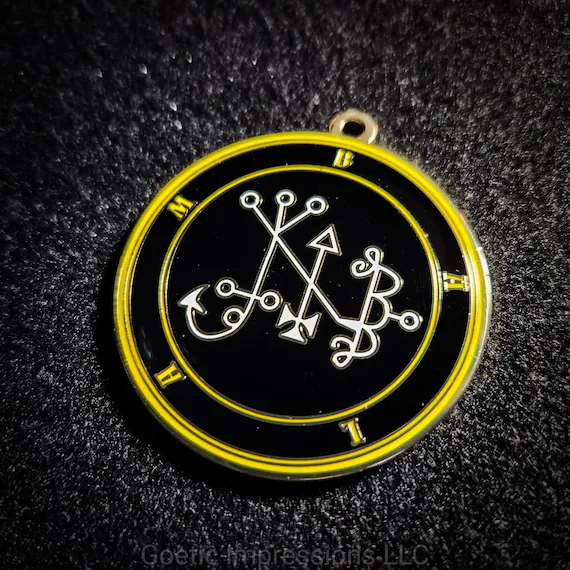
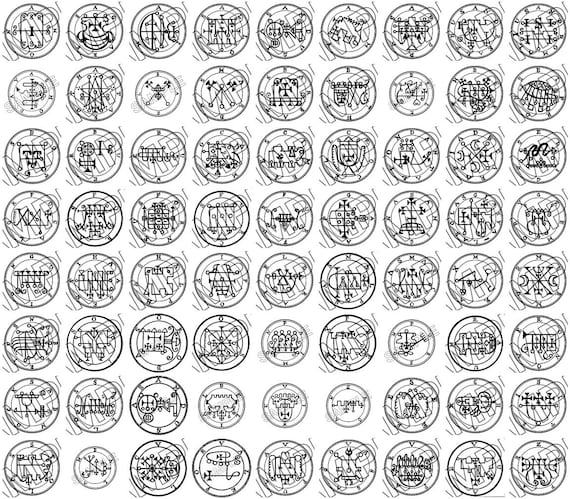
Every spirit in the Goetia has an associated seal — a geometric or linear symbol used in ritual practice to summon or bind the spirit. The word “sigil” comes from the Latin sigillum, meaning seal or signature. In the Goetia’s logic, the sigil is a kind of binding contract — proof of identity, proof of authority, and a channel for compulsion.
The sigils in surviving manuscripts were derived from the Rose Cross cipher system and Kabbalistic letter-path traditions, where each Hebrew letter corresponds to a path on the Tree of Life and therefore a spatial position in a geometric system. Trace the letters of a spirit’s name through that grid and you get the spirit’s sigil. This is not mysticism for its own sake — it’s a systematic encoding method, closer in logic to a signature cipher than to arbitrary symbol design.
Power Domains: A Map of Human Desire
Aggregate the 72 spirits’ attributed powers and you get something unexpected: not a catalog of destruction, but a map of medieval European human anxiety and aspiration. Read it as such and the Goetia becomes a different kind of document.
What does it mean that 24 of 72 spirits are primarily associated with teaching knowledge and sciences? It means the people who compiled this text were thinking about access to information, not access to hellfire. The dominant anxiety encoded in the Goetia is not damnation — it’s ignorance. And the dominant aspiration is not power over others (though that’s present), but mastery of hidden systems: languages, astronomy, rhetoric, natural philosophy.
The love and social category (22 spirits) tells a related story. Most of those spirits facilitate not just romantic love but the restoration of broken relationships — between friends, between lords and servants, between enemies. Reconciliation is a recurring function. Several spirits specifically “cause love between man and woman” AND “reconcile friends and foes” in the same entry.
Only 14 spirits are primarily martial. The Goetia is not a manual for warfare despite its surface features: the circles, the compulsion, the triangles of binding. The overwhelming weight of the text is oriented toward knowledge, social connection, and resource access — the same anxieties that would produce any reference book in any century.
Modern Interpretations: Four Frameworks
The Goetia has never stayed in one interpretive container. Since the 19th century, four distinct frameworks have dominated how practitioners and scholars approach the 72 spirits. Each extracts something real from the text; each also loses something.
None of these frameworks is mutually exclusive. The most interesting practitioners in 2026 tend to hold all four simultaneously — treating spirits as entities worth taking seriously on their own terms (traditional), while remaining curious about what neurological or psychological mechanisms might explain the ritual’s documented effects (scientific), while also reading pop culture as a kind of involuntary reception history (cultural).
On Practice: The Grimoire’s Own Warnings
The Goetia is not a manual that encourages casual use. The text’s own protective protocols are elaborate: a nine-foot magic circle inscribed with the divine names YHVH, Adonai, and Agla; the names of the four archangels at the cardinal points; a triangle outside the circle where the spirit is bound; a brass vessel containing the Seal of Solomon as a binding instrument. These aren’t decorative. In the text’s framework, they are load-bearing safety systems.
Andras (#63) is the clearest case. The Goetia states explicitly that he will kill the summoner’s assistants if the practitioner is not firmly within the protective circle. Several other spirits are described as liars or deceivers unless constrained within the triangle: Berith (#28), Furfur (#34), Shax (#44). The text treats the spirits not as obedient servants but as intelligent agents who will find loopholes if given any. This is why the ritual protocol is so specific — it’s written by people who took the spirits’ agency seriously enough to build in redundant constraints.
The modern chaos magic tradition tends to strip the protective protocols and work with spirits through pure intention and visualization. Whether this works or doesn’t is outside the scope of what can be verified here. What’s documentable is that the historical text treats the protocols as essential — and any interpretation that removes them while claiming fidelity to the Goetia is making a significant editorial choice that the text itself would not endorse.
What Will Be Outdated
Everything in this article about how the Goetia is interpreted will be different in ten years. The spirits themselves won’t change — Weyer’s 1577 text is fixed. What will change is the interpretive frame: which disciplines consider the material legitimate, which media properties amplify specific spirits into cultural icons, and what the next predictive-processing or neuroscience paper says about why ritual spaces produce consistent psychological effects.
The spirits described as “obscure” in 2024 may be household names by 2035 if the right game, film, or animated series uses them. Stolas went from manuscript footnote to globally recognized character in five years of Helluva Boss. Dantalion — the spirit of faces, who knows all thoughts — is the one I’d bet on for the next cycle. His function maps too cleanly onto AI anxiety to stay obscure.
The manuscript tradition itself is as stable as it’s going to get. Peterson’s 2001 critical edition resolved most of the major textual questions. What’s unstable is everything layered on top of it. The Goetia has survived four centuries of changing interpretive frameworks by being specific enough to be taken seriously and ambiguous enough to absorb whatever the current century needs it to mean.
That’s not a mystical quality. It’s good document design.