

Göbekli Tepe Decoded:
The Mystery That Keeps Rewriting Itself
A 12,000-year-old complex in southeastern Türkiye just produced its most significant finds in a decade — a human statue, a possible ancient calendar, and evidence that blows up everything we thought we knew about who built this place and why.
- What is it? The world’s oldest known monumental structure — built by Stone Age hunter-gatherers around 9600 BCE, roughly 7,000 years before the Egyptian pyramids.
- New 2025 discovery: A rare human statue with defined head and torso was unearthed between Enclosures B and D, now drawing global archaeological attention.
- The calendar theory: A 2024 study in Time and Mind argues Pillar 43’s carvings may represent a lunisolar calendar recording a catastrophic comet impact around 10,850 BCE — though this remains debated.
- Is there an AI connection? No. Not remotely. But the reasons people reach for that claim are genuinely interesting — and worth understanding.
- How much remains unexcavated? About 90%. Archaeologists estimate 150+ years of work left. At least 15 more enclosures lie buried. One may date to 15,000 BCE.
There’s something that keeps nagging at me every time I dig into Göbekli Tepe: the people who built it didn’t have writing. They didn’t have metal. They had no wheels, no pottery, no agriculture to speak of. And yet they coordinated the transport and precise carving of limestone pillars weighing up to 20 tons, built multiple interlocking circular enclosures over several centuries, and decorated them with a symbolic vocabulary rich enough that we still argue about what it means.
That gap between what we think people “should have been able to do” in 9600 BCE and what they actually did — that’s the real shock. Not alien intervention, not a lost advanced civilization, not a prehistoric AI blueprint. Just human intelligence operating at full capacity, several thousand years earlier than anyone expected.
The site was discovered properly in 1994 (a 1963 survey had dismissed it as a medieval cemetery — one of archaeology’s great embarrassments). Since then, every season of excavation has produced something that shifts the interpretation. The 2025 season was no different. Neither, in a quieter way, was 2024.
(minimum)
than Stonehenge
the Pyramids
What the 2024–2026 Excavations Actually Found
The original article you might have read about Göbekli Tepe — wherever it was published — almost certainly missed these. The site has been yielding new material at a pace that makes annual recaps genuinely necessary.
During the 2025 excavation season — which ran roughly five months under dig leader Necmi Karul — archaeologists found a human statue with clearly defined head and torso characteristics. It was unearthed between Enclosures B and D.
This matters more than it might sound. Göbekli Tepe has produced animal carvings in abundance. Clearly anthropomorphic sculptures with realistic human features are rarer. A comparable discovery at nearby Karahantepe (part of the same broader Taş Tepeler project) produced a 2.45-meter human statue with “realistic facial details” attached to a bench — the largest known from this entire period.
What the 2025 find adds is evidence of a developing sculptural tradition — not just abstract symbols, but something closer to portraiture. Whether these figures represent deities, revered ancestors, or something we don’t have a category for yet is genuinely unknown. That uncertainty is the interesting part.
In July 2024, Dr. Martin Sweatman of the University of Edinburgh published a study in the journal Time and Mind arguing that the V-shaped carvings on Pillar 43 in Enclosure D represent what may be the world’s oldest lunisolar calendar — 12 lunar months plus 11 additional days, tracking solar and lunar cycles simultaneously.
Sweatman’s interpretation goes further: he argues the calendar was carved to memorialize a comet impact around 10,850 BCE — an event thought to have triggered a 1,200-year cooling period (the Younger Dryas), wiped out numerous megafauna species, and potentially catalyzed the transition from hunting to agriculture in the Fertile Crescent.
The evidence for the comet impact itself is reasonably solid — platinum and nanodiamond concentrations in soil sediments from North America and Greenland do suggest an extraordinary event around that period. The specific claim that the Göbekli Tepe carvings record that event astronomically is where it gets contested.
It’s worth being honest about the debate: Sweatman is a chemical engineer, not an archaeologist. That doesn’t disqualify his analysis — interdisciplinary work is how breakthroughs happen — but the mainstream archaeological community remains skeptical. The interpretation is speculative. What isn’t speculative is that the V-shaped carvings are there, they’re complex, and we still don’t have a consensus reading of what they meant.
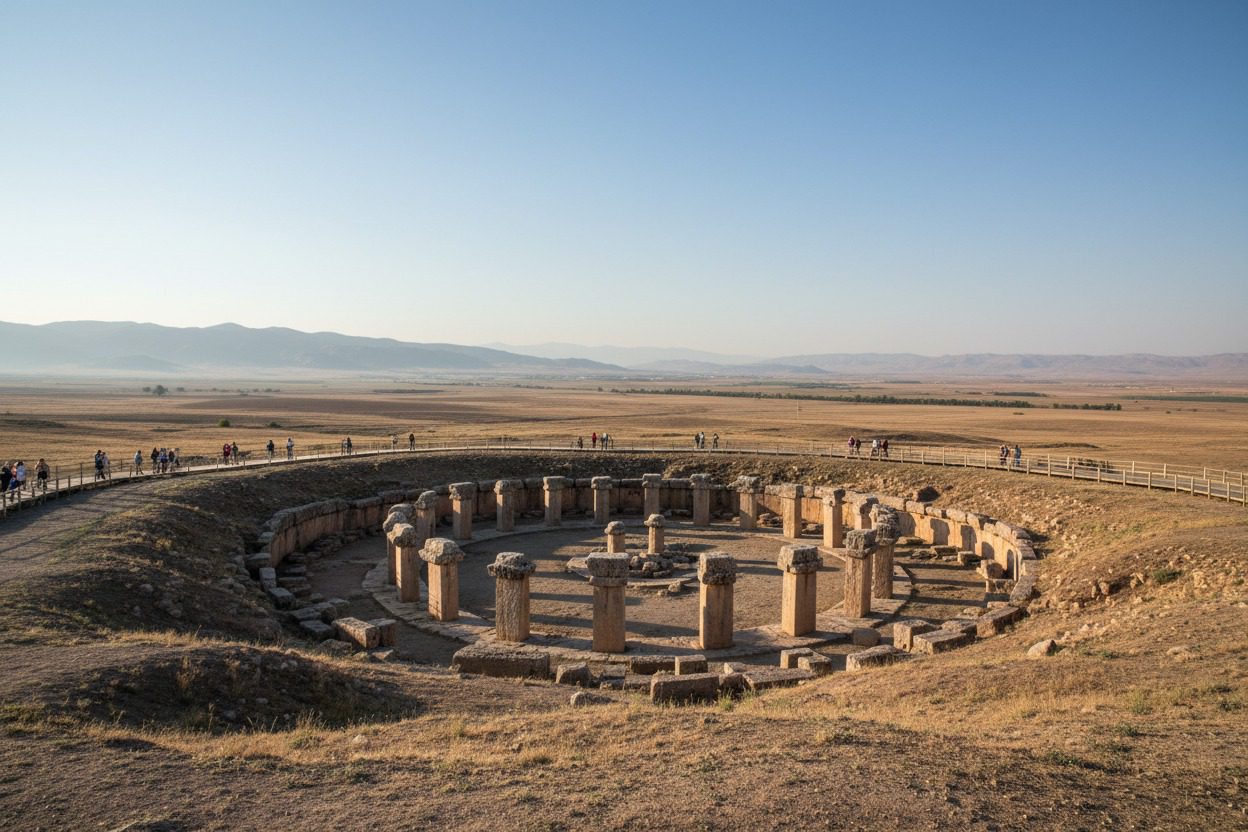
The 2025 season concentrated heavily on Enclosure C — one of the largest enclosures under the protective shelter — with comprehensive restoration, including wall reinforcement and the reassembly and re-erection of several standing pillars. Karul described it as necessary groundwork before the sections already exposed begin to deteriorate.
On the public access side: new visitor facilities were slated to open by end of 2025, including a modern visitor center, expanded parking, and guided pathways. A major international exhibition — “Myths in Stone: Göbekli Tepe and the World of the Last Hunters” — opened at Berlin’s James-Simon Gallery in February 2026, featuring 96 artifacts from the Şanlıurfa Museum. It runs through July 31, 2026. A previous exhibition at Rome’s Colosseum drew over six million visitors.
For decades, the site was characterized as a purely ceremonial center — a gathering place for hunter-gatherers who traveled from up to 200 kilometers away, performed rituals, and left. No permanent habitation. No agriculture. Just ritual.
Recent excavations have complicated that picture significantly. Researchers have found grinding mills, flint sickles, plant residues, and what appear to be domestic living quarters. This doesn’t mean Göbekli Tepe was an agricultural settlement — the evidence isn’t that strong. But it does suggest that some people stayed for extended periods, and that the boundary between “ritual space” and “living space” was more permeable than anyone assumed.
The revised picture looks something like this: a major regional gathering site, probably anchored by a semi-permanent community of specialists or guardians, visited periodically by wider hunter-gatherer networks across a large area of Upper Mesopotamia. Religion and community organization may have preceded agriculture — not followed it.
The AI Myth: Where It Comes From and Why It’s Wrong
Let’s get into this, because it comes up constantly and the explanation is actually more interesting than a simple debunking.
No credible archaeological source — none — connects Göbekli Tepe to artificial intelligence, pre-digital knowledge systems, or computational thinking. The site predates writing by roughly 5,000 years and computation by roughly 11,500. Claims to the contrary are a product of modern pattern-recognition anxiety, not archaeological evidence.
Here’s what’s actually driving the “AI connection” narrative, and it’s genuinely worth understanding rather than just dismissing:
The real mechanism: cognitive projection
Humans are, by a wide margin, the best pattern-finding machines in the history of the planet. That ability kept us alive for hundreds of thousands of years. It also produces a specific error: finding patterns that aren’t there, especially when we’re anxious about something.
In 2026, the dominant cultural anxiety is about machine intelligence — what it means, whether it surpasses us, what human cognition is actually “for” in a world where AI can write code and pass exams. Into that anxiety, Göbekli Tepe arrives: 12,000-year-old carvings that we can’t fully decode, built by people who “shouldn’t” have been capable of this level of organization, using a symbolic vocabulary that looks systematic. The pattern-finding brain says: this looks like an information system.
That’s not an insane cognitive leap. It’s just wrong.
“The real disruption Göbekli Tepe introduces is not technological. It is cognitive.”
— The core insight that every AI-myth theorist missesThere’s a deeper irony here worth sitting with: the AI myth actually diminishes the achievement. If Göbekli Tepe was built with “lost advanced knowledge,” then Stone Age humans were just contractors following instructions they didn’t invent. The reality — that they invented and executed all of it using the same cognitive hardware we have — is far more extraordinary.
Timeline: From Construction to Current Excavation
-
~10,850 BCEPossible comet impact (Younger Dryas onset) Sweatman’s 2024 study argues Pillar 43 commemorates this event, which triggered a 1,200-year cooling period and environmental disruption across the Northern Hemisphere. The impact hypothesis remains scientifically debated but has some physical evidence (platinum, nanodiamond deposits).
-
~9600 BCEConstruction begins The earliest enclosures at Göbekli Tepe take shape. Hunter-gatherers from across a 200km radius coordinate to quarry, transport, and carve massive limestone pillars using only flint tools. This is the Pre-Pottery Neolithic A (PPNA) period — no metal, no wheel, no agriculture yet.
-
~8700 BCELater building phases The Painted Boar Statue found in Enclosure D is thought to date to roughly this period — slightly later than the site’s initial occupation. Artistic styles shift between construction phases, suggesting evolving belief systems rather than a single frozen tradition.
-
~8000 BCESite deliberately buried The most debated event in Göbekli Tepe’s history. The enclosures are systematically backfilled with rubble, flint, and animal bones. This wasn’t abandonment — it was intentional. Leading theories include ritual closure, protection against looters, or a cultural transition as agriculture began to dominate.
-
1963First survey — missed entirely A Turkish-American team from Istanbul and Chicago universities surveys the area. Peter Benedict’s report notes “strange hills” and many broken flints but misidentifies the buried architecture as a natural mound. The report mentions possible medieval use. One of the more consequential misreadings in modern archaeology.
-
1994Klaus Schmidt recognizes the site’s true significance While preparing his academic habilitation thesis, Schmidt visits the site and realizes the mound cannot be natural. The discovery of a large rectangular stone matching pillar tops at the known site of Nevalı Çori convinces him immediately. Systematic excavations begin the following year under the German Archaeological Institute.
-
2014Klaus Schmidt dies mid-excavation At 60 years old, Schmidt dies during an active field season — the archaeologist who dedicated two decades to the site never saw its full story. Excavations continue under the Stone Hills Project (Taş Tepeler).
-
2018UNESCO World Heritage designation Göbekli Tepe receives formal international protection — a recognition that also significantly increased tourism, global research interest, and the Turkish government’s investment in the site.
-
2024Calendar study published; living quarters confirmed Sweatman’s astronomical calendar paper appears in Time and Mind. Separately, evidence of domestic structures and food processing tools challenges the “purely ceremonial” model that had dominated for 30 years.
-
2025Human statue discovered; Enclosure C restored A human statue with clearly defined head and torso features is unearthed between Enclosures B and D. Major restoration work on Enclosure C stabilizes the site’s most impressive standing pillars. A new visitor center opens.
-
2026Berlin exhibition opens “Myths in Stone: Göbekli Tepe and the World of the Last Hunters” opens at Berlin’s James-Simon Gallery, February 5 to July 31, 2026. 96 artifacts from the Şanlıurfa Museum. The site continues to be excavated; the buried portion may contain enclosures dating as far back as 15,000 BCE.
What Göbekli Tepe Actually Tells Us About Intelligence
This is where I think most coverage — including the original version of the article I was asked to improve — gets too cautious and undersells the real insight.
The standard line is: “Göbekli Tepe shows that symbolic thinking and organized construction existed before agriculture.” True. But the implication is almost always underplayed.
The “religion built civilization” hypothesis
Klaus Schmidt’s core thesis — developed over 20 years of fieldwork — was that the causality runs backwards from what we assumed. The traditional model said: agriculture → surplus → specialization → religion → monumental architecture. Göbekli Tepe suggests: shared belief → coordinated labor → monumental architecture → eventually, agriculture to feed the workers.
In other words, meaning came first. Community organization structured around ritual came first. The practical food economy may have followed, not led.
That inversion has enormous implications for how we think about human motivation — and about what holds large groups together. It also, frankly, has implications for how we think about AI, though not the ones the conspiracy theorists imagine. The question isn’t whether ancient people had AI. It’s whether any intelligence — artificial or biological — can organize complex cooperative behavior without shared symbolic frameworks. Göbekli Tepe suggests the answer is no.
The “last song of the hunters” reading
German archaeologist Thomas Zimmermann proposed what I think is one of the most poignant interpretations: that Göbekli Tepe represents a cultural last stand. Hunter-gatherer societies, sensing that the agricultural transition was underway and their way of life was ending, mobilized one final enormous effort to leave a monument to what they were. A swan song in stone. Built over centuries, then sealed — perhaps intentionally, as a kind of burial.
We can’t verify this. But it has a human logic to it that I find more compelling than any of the alien/AI explanations, because it requires no special assumptions about the builders. Only that they were people.
Göbekli Tepe vs. Other Ancient Sites
| Site | Approximate Era | Writing? | Metal Tools? | Agriculture at time? |
|---|---|---|---|---|
| Göbekli Tepe | 9600 BCE | None | No — flint only | No — hunter-gatherers |
| Jericho (earliest walls) | 8000 BCE | None | No | Early — transitional |
| Çatalhöyük | 7500–5700 BCE | None | No (early copper later) | Yes |
| Stonehenge (Phase I) | 3000 BCE | None | No — Neolithic stone | Yes |
| Giza Pyramids | 2560 BCE | Hieroglyphs | Copper tools | Fully agricultural |
| Mesopotamia (writing begins) | ~3500 BCE | Cuneiform | Bronze Age | Yes — city-states |
Nine Things About Göbekli Tepe That Genuinely Surprised Me
Some of these are in every article. Some aren’t.
- Only about 10% of the site has been excavated. The current team estimates it will take more than 150 years to complete. What we know now is a tiny fraction of what’s there.
- A buried enclosure may date to 15,000 BCE — predating even the earliest current Göbekli Tepe dates by 3,000 years. Dr. Mehmet Önal of Harran University has stated this possibility openly. If confirmed, it rewrites the timeline entirely.
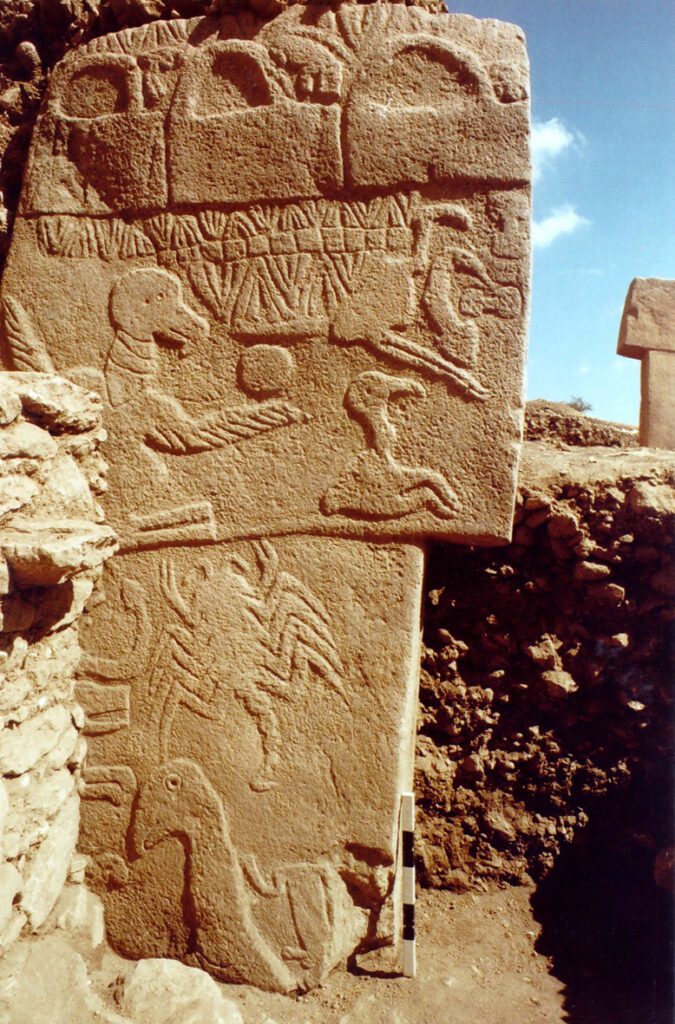
- The Painted Boar Statue found in Enclosure D retains original red, white, and black pigments. It measures roughly 1.35m wide. When first carved, Göbekli Tepe wasn’t grey stone — it was in color.
- A slab embedded in Enclosure D’s wall features carvings aligned with the winter solstice sunrise — verified using astronomical simulations for 9,500 BCE. Whether intentional or coincidental is debated. But it’s aligned.
- The site was identified in 1963 and then ignored for 31 years. A different archaeologist with a different hypothesis could have changed the entire field of prehistoric archaeology three decades earlier.
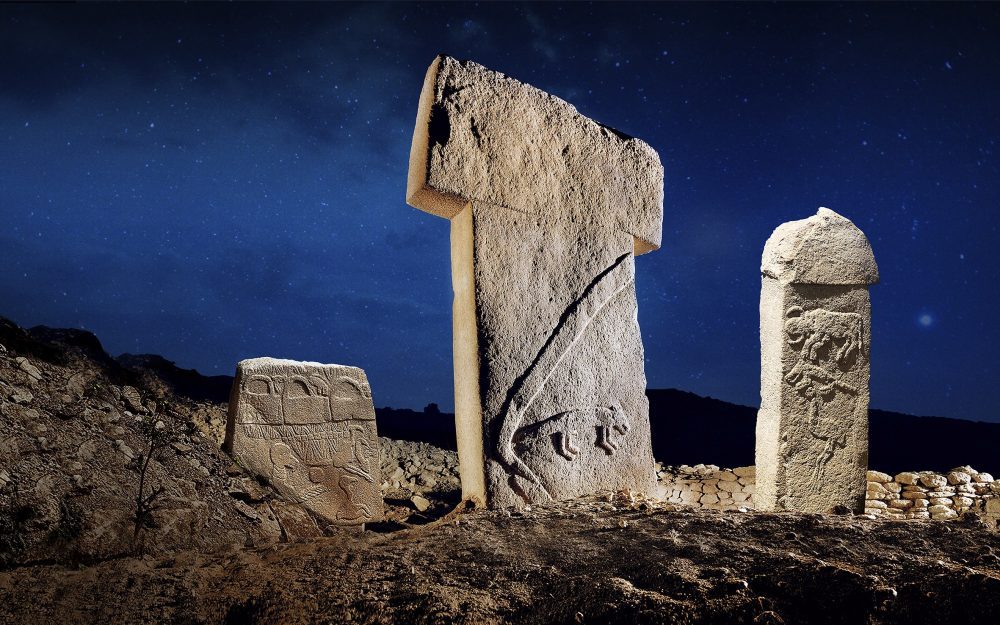
- The T-shaped pillars are now thought by some researchers to represent stylized humans — the T being the head and shoulders in abstracted form, with arms sometimes carved along the pillar’s sides. If so, the central pillars of each enclosure may be ancestor figures, not abstract monuments.
- The hunting of wild boar, gazelle, and aurochs dominated the animal remains in early layers. No domesticated animals. The carvings match the hunted species closely — suggesting the symbolic world was directly tied to the hunt.
- Klaus Schmidt described the site as “ground zero of history” — the phrase that most of the Turkish Ministry’s current communication uses. It was his phrase, and it’s striking how exactly right it turned out to be.
- The 2025 Berlin exhibition runs through July 31, 2026 at the James-Simon Gallery of the Near East Museum. 96 artifacts from Şanlıurfa. If you’re in Europe this summer, this is the closest most people will get to the real thing.
Frequently Asked Questions
No — and the framing of the question reveals the assumption worth challenging. There’s no need to invoke a “lost advanced civilization” because the builders weren’t using any technology we don’t understand. They used flint tools, ropes, sledges, levers, and organized human labor. Extraordinary coordination, yes. Unknown technology, no. The T-shaped pillars and their carvings are consistent with late Stone Age skill sets applied at unusual scale. The “advanced civilization” theory tends to appear when people underestimate what human intelligence can do without machines — which is quite a lot.
We genuinely don’t know for certain. Three main theories have traction: (1) ritual closure — the enclosures were intentionally decommissioned and sealed as part of a symbolic act, possibly tied to cyclical religious belief; (2) environmental transition — as the regional climate shifted and agriculture began to emerge, the site’s cultural function changed and it was preserved rather than abandoned; (3) deliberate preservation — the backfilling protected the structures from weathering and possibly from later destruction. The fact that the backfill itself contained artifacts (flint, animal bones) suggests it wasn’t purely practical. It was a considered act.
It’s a legitimate hypothesis published in a peer-reviewed journal, but it’s contested. Dr. Martin Sweatman’s 2024 paper in Time and Mind makes a careful astronomical argument, and the comet impact component of his thesis has independent physical evidence behind it (platinum and nanodiamond deposits in North American and Greenland sediments). The specific claim that the Pillar 43 V-carvings represent a calibrated lunisolar calendar is harder to verify because we have no contemporary written explanation of the carvings’ intent. Sweatman himself is an engineer rather than an archaeologist, which has attracted criticism — but interdisciplinary work is often where breakthroughs happen. Treat it as a serious hypothesis under investigation, not confirmed fact.
Yes. The site is partially open to controlled tourism under Turkish heritage protection, with new visitor facilities completed in late 2025, including a modern visitor center, expanded parking, and designated walking paths. You can reach the site via Şanlıurfa, which is served by domestic flights and is approximately 15 km from the site. Access to active excavation areas is restricted, but the main enclosed structures are viewable from designated pathways. If you can’t get to Türkiye this year, the “Myths in Stone” exhibition in Berlin runs until July 31, 2026 — 96 artifacts, including material from recent excavations.
Schmidt died in July 2014 at the age of 60, during an active excavation season — a death that genuinely affected the global archaeological community. He had dedicated roughly 20 years to the site after recognizing its significance in 1994. He never saw its full extent excavated, and several of the most significant recent discoveries came after his death. The current excavations are led by Necmi Karul as part of the broader Stone Hills Project (Taş Tepeler) under the coordination of the Turkish Ministry of Culture and Tourism. Schmidt’s core thesis — that communal ritual preceded and potentially catalyzed agriculture rather than following it — remains the dominant framework, though it continues to be refined.
Possibly. Dr. Mehmet Önal of Harran University has stated that at least 15 more enclosures remain buried underground, with one potentially dating to around 13,000 BCE — and possibly earlier. If that estimate is correct, and if excavation confirms it, Göbekli Tepe’s timeline would extend back to approximately 15,000 BCE. That would make it a product of the Paleolithic rather than the Neolithic period — a staggering revision. The current excavation pace means this question might not be definitively answered for decades.
What It Actually Means
Göbekli Tepe doesn’t hide artificial intelligence or lost advanced knowledge. It reveals something more unsettling: that human intelligence, at full capacity, doesn’t need machines to build things that outlast every empire.
Stone Age people organized large-scale cooperative labor around shared symbolic frameworks, tracked astronomical cycles, produced sophisticated representational sculpture, and built structures that survived 12,000 years of weather, earthquakes, and human history — then deliberately sealed their work and walked away.
We still can’t fully read what they carved. That’s not because it’s a code we haven’t cracked. It’s because it’s a language whose speakers are gone.
Updated May 2026 · 2025 excavation season data · Berlin exhibition: Feb 5 – Jul 31, 2026
Primary Sources & References
- Daily Sabah — 2025 excavation season concludes with human statue discovery (Oct 2025)
- Greek Reporter — New discoveries challenge purely ceremonial model (Feb 2025)
- Jerusalem Post — Living quarters found at Göbekli Tepe, theory revision (Feb 2025)
- Archaeology News Online — World’s oldest calendar hypothesis (2024)
- Sci.News — Sweatman 2024 study overview: Pillar 43 astronomical interpretation
- Sweatman, M.B. (2024). “Representations of calendars and time at Göbekli Tepe and Karahan Tepe.” Time and Mind. doi:10.1080/1751696X.2024.2373876
- Ancient Origins — Human figure found entombed; 2026 Berlin exhibition announcement (Sep 2025)
- Schmidt, K. (2010). “Göbekli Tepe — the Stone Age Sanctuaries.” Documenta Praehistorica 37: 239–256.
- Turkish Ministry of Culture and Tourism — Stone Hills Project (Taş Tepeler) official documentation, 2025
- UNESCO World Heritage Convention — Göbekli Tepe inscription records, 2018