


Tartaria Got 300 Million Views.
Debunking Made It Worse.
The fake civilization spreading across TikTok isn’t a failure of public intelligence. It’s what happens when grief, algorithmic beauty, and institutional distrust operate simultaneously — and no single intervention can close that corridor.
- Tartaria is historically false — historians at Oxford, Nebraska-Lincoln, and Chicago have confirmed this. The Russian Geographical Society, whose old maps fuel the theory, called it an “extremist fantasy.”
- 300M+ TikTok views weren’t generated by gullibility. Three forces combined: a visual algorithm that serves beauty without context, six-in-ten people globally distrusting institutions, and real grief over what modern architecture actually destroyed.
- Official debunking accelerated the spread. The theory’s own logic turns every correction into evidence.
- The propagation corridor only closes if all three forces are addressed. Right now, none are.
Walk through almost any American downtown and count what’s gone. The Beaux-Arts post office, replaced by a parking structure. The neoclassical train hall, demolished for a glass tower. The grief is real — not manufactured, not performed. And it’s doing something very specific to a generation of people who grew up watching YouTube and now spend their lunch breaks on TikTok.
That grief generated over 300 million views for #tartaria on TikTok (GNET Research, February 2023), plus another 150 million for #mudflood — the supposed cataclysm that erased it all. Combined floor: ~450 million views, probably higher now. For a theory that historians dismiss completely.
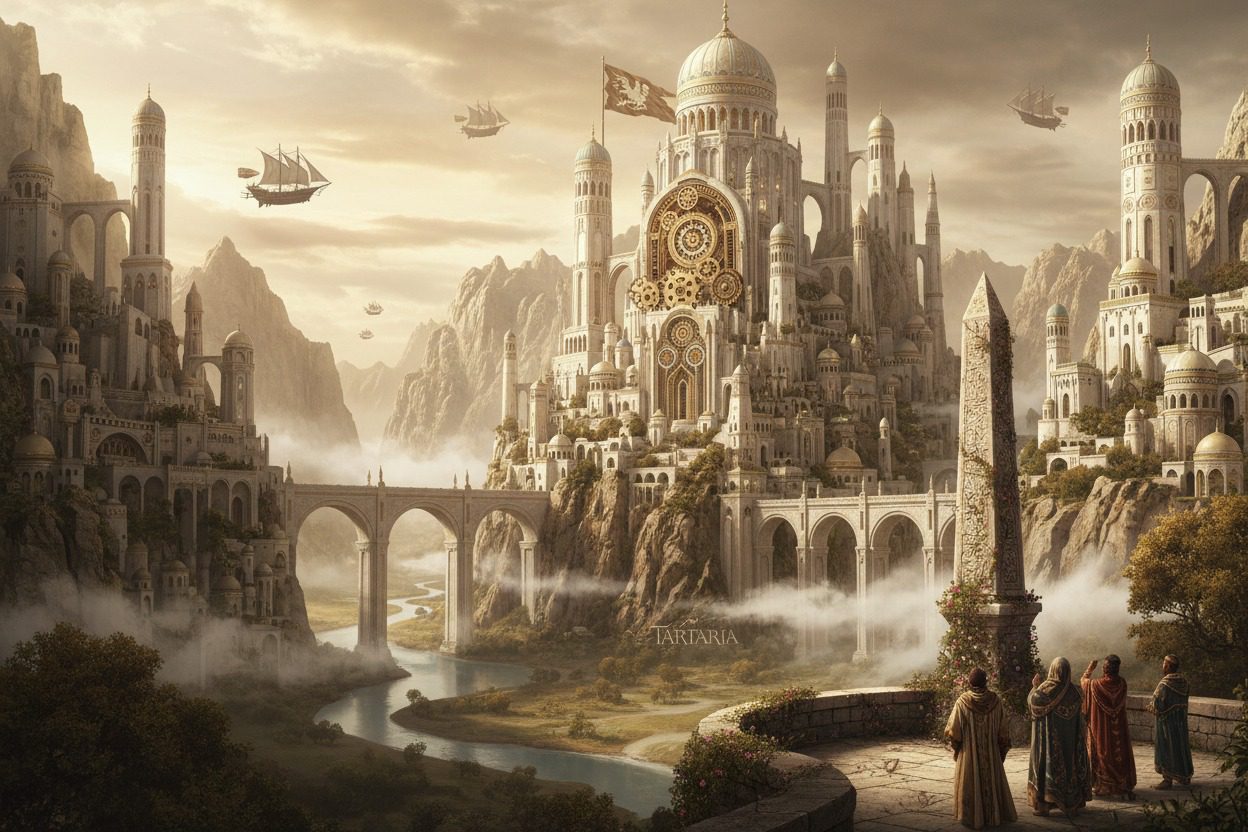
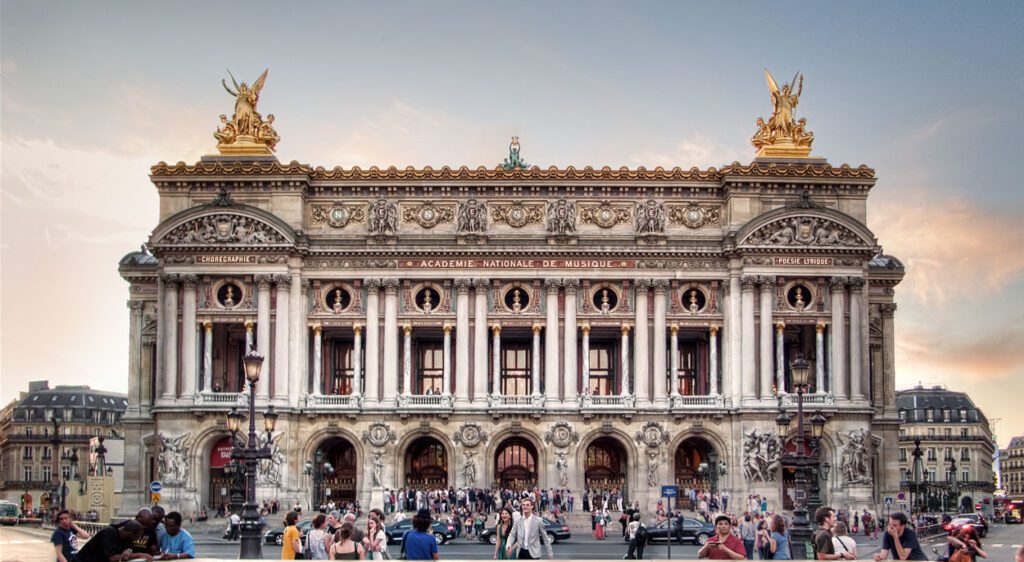
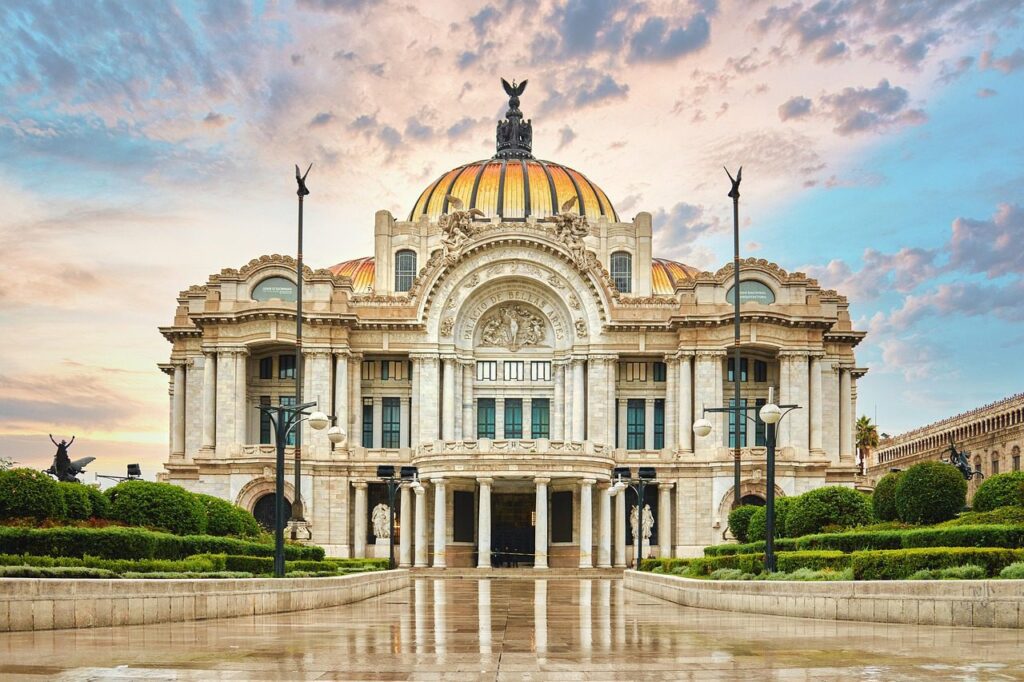
Tartaria, for anyone who missed it: a pseudohistorical conspiracy theory claiming that an advanced, beautiful global civilization was deliberately erased from history — its ornate civic buildings supposedly built by Tartarian engineers, not by the craftspeople history actually documents. The theory is false. Not “contested” or “debated” — false. Historians at the University of Nebraska-Lincoln, the University of Chicago, and Oxford have each confirmed this. The Russian Geographical Society — whose own map collection provides most of Tartaria believers’ “evidence” — labeled it an “extremist fantasy” and noted their maps are publicly available, free, accessible to anyone.
The question isn’t whether it’s real. It’s not. The question is why it spreads at a velocity that almost no properly fact-checked theory achieves — and why the fact-checks appear to accelerate it.
(GNET, Feb 2023 floor)
combined tag ecosystem
(Edelman 2025)
moderate-to-high grievance
Three Forces. Only Together.
Here’s what I find genuinely strange about the existing analysis of Tartaria: every major write-up correctly identifies one or two of the mechanisms, then acts like they’ve explained the thing. GNET nails the platform dynamics. Bloomberg’s Zach Mortice gets the aesthetic grief exactly right. The academic literature on trust collapse is exhaustive. Nobody puts all three together and asks what happens specifically at their intersection.
What happens is this: the combination creates a propagation corridor that bypasses both the cognitive resistance to conspiracy content and the keyword-based moderation designed to catch it. That’s not an emergent coincidence. It’s a structural vulnerability.
The Algorithm Doesn’t Care What It’s Amplifying
EstablishedTikTok’s recommendation engine — the For You Page — operates on an interest graph, not a social graph. Sociologist Paolo Gerbaudo, writing in New Media & Society (2024), describes this as creating “clustered publics”: algorithmic audiences shaped entirely by platform logic, not user intent. The practical number: over 75% of TikTok video views come from the For You Page (Romero, 2023). Most people receiving Tartaria content never searched for it.
This matters for a specific reason that the fear-based conspiracy analysis misses. QAnon, anti-vaccine content, flat earth — these feel conspiratorial on first contact. A user who encounters them cold has some cognitive warning signal firing. Tartaria doesn’t feel like a conspiracy theory on first contact. It presents as an appreciation video: a slow pan across ornate stonework, a voiceover asking why we don’t build like this anymore. Research by Corso, Pierri, and Morales (arXiv:2407.12545, 2024) found that TikTok’s multimodal format presents “additional challenges” for both detection and resistance specifically because visual and audio together lower the genre-recognition barrier.
There’s an engineering detail worth noting. TikTok’s algorithm counts video loops as additional views. Short, visually compelling clips that users replay — to catch all the details in the photographs of ornate facades, the old maps with “Tartaria” printed on them, the partially underground windows that the theory claims were buried by mud — are disproportionately rewarded. The theory’s “evidence” was inadvertently optimized for loop-triggering long before anyone knew that’s what they were doing.
“Conspiracy content easily seeps, through algorithmic recommendations, into the feeds of users who did not directly seek it — particularly when it presents in an engaging way.”
— GNET Research, 2023 analysis of TikTok algorithm dynamicsThis mechanic alone would not produce 300M views. It’s the amplifier, not the fuel source. Without the trust environment described below, a user who enjoys the architecture video still has institutional resources to consult and believe. The algorithm matters, but only in combination.
When Debunking Is Structurally Indistinguishable from Confirmation
EstablishedThe 2025 Edelman Trust Barometer — drawn from 30-minute interviews across 28 countries, conducted in late 2024 — found that six in ten global respondents report a moderate to high sense of grievance: the specific belief that government and business serve narrow interests while regular people struggle. Five of the world’s ten largest economies rank among the least trusting nations surveyed: the U.S. (Trust Index: 47), the UK (43), Germany (41), Japan (37), and France (48). The media is the least trusted institution globally, distrusted in 15 of 28 countries — including the U.S. at 39% and the UK at 31%.
Now consider the structure of Tartaria’s core claim: that powerful institutions deliberately erased a beautiful civilization. In a high-trust environment, that claim requires evidence. We are not in a high-trust environment — and the Tartaria theory is built to exploit exactly this gap.
When the Russian Geographical Society published a detailed rebuttal in October 2020 — noting “no one hides information about Tartary” and pointing to their freely accessible map collection — Google Trends data compiled by Lead Stories shows search interest in “Tartaria” continued climbing through and beyond that rebuttal. The Society is the most credible possible debunker. Its response was accurate, thorough, and sourced. It didn’t arrest the spread. The theory’s own logic consumed the correction as fuel: of course the Russian Geographical Society says there’s nothing to see. They would, wouldn’t they?
This is not unique to Tartaria — Lewandowsky et al. (Psychological Science, 2012) documented that corrections can entrench beliefs when they conflict with strongly held priors. The specific boundary condition here: the backfire effect is most pronounced when the correcting institution is the very institution the theory claims is suppressing information. Academic historians debunking Tartaria face a structural disadvantage — they’re the record-keepers the theory says falsified the record.
The Grief Is Real. That’s the Whole Problem.
ProbableStrip away the pseudoscience and Tartaria is a coherent expression of something accurate: contemporary architecture, particularly in the United States, is often demonstrably worse than what preceded it. This isn’t nostalgia or aesthete whining — it’s a documented pattern. The 1893 Chicago World’s Fair was genuinely extraordinary: a planned urban environment of Beaux-Arts grandeur that drew 27 million visitors and influenced American civic design for a generation. It was demolished, yes — because the structures were built of plaster and steel lath designed for temporary exhibition, as documented in the Chicago Tribune archives and the Library of Congress construction records.
Tartaria cannot accommodate this explanation. Its narrative requires the demolition to be willful erasure, not engineering reality. But here’s the thing — the theory survives that fact-check because the underlying aesthetic grief doesn’t need the theory to be true in order to be valid. The buildings were magnificent. Many were destroyed. The question “why don’t we build like this anymore” has a real, boring answer involving economics, materials, and modernist ideology — but “someone took this from you, deliberately” is emotionally far more satisfying to someone standing in front of a parking structure where a train hall used to be.
Bloomberg’s Zach Mortice (October 2024) calls Tartaria “the QAnon of architecture” and identifies cultural discontent with modernism as the driver. That’s correct. What Mortice doesn’t go into: the propagation corridor this creates. The entry point is aesthetic, not political. GNET Research notes that Tartaria “appears benign and attractive to curious viewers” — it looks like architecture appreciation. A Reddit community of 23,000 members describes itself as “Maybe the History we’ve been told is a lie!” — not as what some strands of it eventually become.
Because extremism researcher Abbie Richards places Tartaria in the second-most harmful “Reality Denial” segment of her Conspiracy Chart — and GNET confirms the theory has been used to support Russian ethnonationalist territorial supremacy claims. The same video that begins with a beautiful pan across an ornate facade can, without a single banned phrase, progress from “why was this destroyed?” to “what are they hiding?” to ideological territory that no keyword filter was built to catch. Grief isn’t a keyword. It’s a feeling, and feelings travel algorithms differently than arguments.
What the Existing Analysis Gets Wrong
Every major source on Tartaria identifies one or two of the three mechanisms. None of them synthesize all three — and the synthesis is where the actual explanation lives.
| Source | Gets Right | Critical Gap |
|---|---|---|
| GNET Research (2023) | Platform amplification; ethnonationalist links; algorithmic mechanics | Treats grief as incidental, not structural. No synthesis of all three forces. |
| Lead Stories fact-checks (2023–24) | Accurate historical debunking; primary source verification | Ignores why debunking accelerates spread. No structural analysis of denial-as-confirmation. |
| Bloomberg / Mortice (2024) | Correctly identifies architectural grief as the emotional driver | No platform mechanics. No trust data. Treats the aesthetic as the whole explanation. |
| Ward MA Thesis, Univ. of Wales (2023) | Best platform-specific analysis in the academic literature | Academic register misses why emotional dynamics override historical evidence. |
| This piece | All three forces; interaction structure; propagation corridor concept | See What Could Be Wrong section below. |
Three Scenarios for What Happens Next
Speculative-
1Moderation Improves UpstreamClassifiers trained on gateway audio phrases — “why was this destroyed,” “free energy suppressed,” “they don’t want you to know” — combined with engagement velocity signals could flag content before it crosses the virality threshold. Technically feasible. Requires TikTok to act on content that currently violates no stated policy. Political likelihood: low.
-
2Trust Recovers Enough That Debunking LandsInstitutional trust recovers to a level where official denial reads as information rather than confirmation. Historically, that takes a generation. The Edelman data shows no meaningful recovery trajectory in any G7 economy since 2019. Call this the optimistic scenario.
-
3Plateau Through Saturation — Then MigrationThe most likely near-term outcome: English-language TikTok Tartaria plateaus as mythology fragments into contradictory sub-theories. Harder ethnonationalist content migrates to less-moderated platforms. Bloomberg’s October 2024 documentation of Tartaria entering U.S. electoral discourse confirms the escalation path is already partially traveled.
Two signals support concern over reassurance. TikTok’s Research API faces systematic methodological problems (Entrena-Serrano et al., 2025) meaning measurement is currently outpacing moderation. And the view counts are still climbing.
What Practitioners Can Actually Do
The structural problem doesn’t yield to a single intervention. But named audiences have specific levers.
TikTok content classifiers: The theory’s gateway content bypasses keyword filters. Train classifiers on audio cue phrases combined with engagement velocity monitoring. Flag for human review before content crosses virality thresholds. This is the only intervention that catches the problem upstream of the grief-to-conspiracy conversion.
Museum and heritage institution communicators: When a Tartaria video claiming your building was “Tartarian architecture” exceeds 100,000 views, publish a 30-second vertical video using the building’s actual construction records. Not a press release. A TikTok, in the same visual format, with the same aesthetic quality that makes Tartaria videos compelling. The Russian Geographical Society’s written rebuttal didn’t arrest the spread. A video of actual construction ledgers might. Institutional authority communicates differently on visual platforms.
Educators: Tartaria is an unusually clean pedagogical case — its falsifiability is total and its documentary trail is intact. Assign students to trace a single claim back to primary source documentation. The Chicago Tribune archives, the Library of Congress construction records, and the Fair’s official reports are all accessible and free. The research skill transfers directly to evaluating any information environment.
The three-forces framework assumes the forces operate independently before combining. That may not be true — architectural grief might itself be partially platform-constructed, meaning TikTok isn’t just amplifying pre-existing grief but generating aesthetic nostalgia that wouldn’t have taken this form without the algorithm. If so, “grief” is less a discrete force than an output of Force 1, and the model needs revision.
The backfire effect’s robustness has been disputed in subsequent meta-analyses (Wood & Porter, 2019). It may be less universal than Lewandowsky’s original framing suggests, which would weaken the “debunking-as-confirmation” mechanism — though the structural logic (correcting institution = accused institution) still holds even if the psychological mechanism is more conditional than originally documented.
View count data comes from GNET’s February 2023 snapshot. TikTok doesn’t publish real-time hashtag totals. Current figures are estimated, not measured. This is a genuine methodological gap, not a minor caveat.
- GNET Research. (February 2023). The Mudflood and Tartaria Conspiracy Theory. Global Network on Extremism and Technology. gnet-research.org
- Edelman. (2025). 2025 Edelman Trust Barometer. edelman.com
- Corso, A., Pierri, F., & Morales, G.D.F. (2024). How Conspiracy Theories Spread on TikTok. arXiv:2407.12545. arxiv.org
- Gerbaudo, P. (2024). Clustered Publics and Platform Logic. New Media & Society.
- Lewandowsky, S., Ecker, U. K. H., Seifert, C. M., Schwarz, N., & Cook, J. (2012). Misinformation and Its Correction: Continued Influence and Successful Debiasing. Psychological Science in the Public Interest. sagepub.com
- Mortice, Z. (October 2024). Tartaria: The Far-Right History Conspiracy Goes Mainstream. Bloomberg. bloomberg.com
- Ward, A. (2023). Pseudoarchaeology and TikTok’s Circular Ecosystem. MA Thesis, University of Wales Trinity Saint David.
- Entrena-Serrano, M. et al. (2025). Methodological Problems in TikTok Research API Studies. arXiv:2501.05624. arxiv.org
- Wood, T., & Porter, E. (2019). The Elusive Backfire Effect. Political Behavior, 41(1), 135–163.
- Lead Stories. (2023–2024). Tartaria Fact-Checks, multiple entries. leadstories.com
- Richards, A. (2021). Conspiracy Chart. abbieasr.com
- Chicago Tribune Historical Archives. 1893 World’s Columbian Exposition Construction Records. chicagotribune.com/archives
The theory spread not because people are credulous — but because the platform wasn’t built to distinguish between beauty and truth, and right now, neither are we.