



▸ Deep Practice Guide
The Void State Method That Actually Works
A neuroscience-grounded, no-hype walkthrough — what the void state really is, why most attempts fail at the first step, and the exact conditions required to enter it on purpose.
- The void state is the hypnagogic threshold between wakefulness and sleep, where the analytical mind goes offline and the subconscious becomes highly receptive.
- Neuroscience calls this the alpha-to-theta transition — a measurable brainwave shift with real, documented effects on cognition and suggestion.
- Most people fail because they try too hard. Effort is the enemy of this state. You drop into it; you do not climb toward it.
- The method requires three conditions to work: physical stillness, non-engagement of thought, and a specific kind of passive attention.
- What you do inside the void state matters far less than whether you actually entered it first.
Should You Even Do This?
Not every practice is suited to every person at every time. Before committing an hour a night to void state attempts, run this quick filter.
- Can lie still for 20–40 minutes without urgency
- Have practiced any form of meditation or breathwork before
- Are willing to measure success by state quality, not immediate results
- Understand this is a conditioning process, not a one-shot event
- Are approaching this with curiosity, not desperation
- Are in a high-stress period with poor sleep
- Expect results within 1–2 sessions
- Cannot separate the practice from anxious checking for outcomes
- Have clinical insomnia — the hypnagogic threshold will be disrupted
- Are trying to use this as a replacement for necessary action
What the Void State Actually Is
Strip away the community mythology, the TikTok claims, and the manifestation marketing, and you are left with something specific and real: the void state is the hypnagogic threshold — the narrow band of consciousness between full wakefulness and sleep onset.
In this zone, the body has relaxed to the point of functional stillness, but awareness has not collapsed into sleep. The ordinary stream of inner commentary — the planning, remembering, judging, analyzing — has slowed or stopped. What remains is a quality of quiet attention that is both alert and empty.
This is not a metaphysical event. It is a neurological one. And it has been documented, measured, and studied under clinical conditions.
The confusion begins when people treat the void state as a mysterious spiritual destination rather than a natural state the brain cycles through every night uninvited. You have already been there thousands of times. You just have no memory of it, because awareness typically drops away before you can register the experience. The practice is simply learning to remain present while everything else goes quiet.
The Neuroscience Behind It
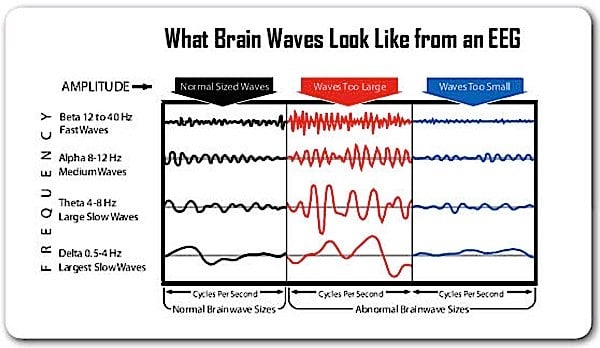
The brain’s electrical activity operates in measurable frequency bands. When you are actively engaged — thinking, problem-solving, worrying — beta waves (13–30 Hz) dominate. As you relax, alpha waves (8–13 Hz) increase. These are associated with restful wakefulness, reduced sensory processing, and the early stages of letting the analytical mind idle.
The critical transition happens when alpha activity yields to theta (4–8 Hz). Theta waves dominate the hypnagogic state — the transitional period between waking and sleep — but also appear during deep meditation, creative insight, and memory encoding. This is where the void state lives.
What makes this zone functionally different is what happens to the prefrontal cortex. Research on meditators and hypnagogic states consistently shows that the prefrontal cortex — the brain’s editor, critic, and reality-checker — significantly reduces its activity during this transition. The internal censor that intercepts new beliefs, contradicts affirmations, and generates doubt becomes temporarily quiet.
“During hypnagogia, the brain’s normal top-down processing weakens. The prefrontal cortex, your brain’s editor and critic, loosens its grip. Associations that would normally be suppressed bubble up.” — Neurosity, Theta Brain Waves and Meditation: Neuroscience Guide
A 2020 study published in the journal Consciousness and Cognition examined EEG recordings of 43 experienced meditators from three traditions — QiGong, Sahaja Yoga, and Ananda Marga Yoga. It found that achieving a state of “mental emptiness” correlated with specific changes in alpha-theta cross-frequency dynamics, representing a measurable shift away from effortful cognition toward what the researchers described as “thoughtless awareness.”
A separate study analyzing yoga nidra (a practice that deliberately targets this same threshold) found that its brainwave signature — dominated by delta and theta rhythms — represents “a state between sleep and awake, something similar to the state of Turiya as mentioned in ancient yogic literature.” The cross-cultural convergence on the same neurological zone is not coincidental.
Void State vs. Meditation vs. SATS — Not the Same Thing
This distinction matters because people try to apply the wrong technique to the wrong state, then blame the practice when it fails.
| State | Brainwave Zone | Analytical Mind | Best For |
|---|---|---|---|
| Focused Meditation | Alpha (8–13 Hz) | Still present, disciplined | Stress reduction, concentration, emotional regulation |
| SATS (Neville Goddard) | Alpha-Theta border | Drowsy, loosened | Scene-based visualization, imaginal impression |
| Void State | Theta (4–8 Hz) | Effectively offline | Identity-level subconscious impression without resistance |
| Sleep | Delta (0.5–4 Hz) | Offline + unconscious | Biological restoration |
Neville Goddard taught a related but distinct practice he called the State Akin to Sleep (SATS). In that method, the practitioner enters a drowsy, hypnagogic state and plays out a short imaginal scene as if the desired outcome has already occurred — feeling into it until it becomes real. The void state, as typically described in modern practice, is deeper: closer to pure empty awareness than drowsy visualization. Both exploit the same weakening of analytical resistance, but through different depths of stillness.
Why Most People Never Get There (The Real Obstacles)
Most content on the void state fails to say this clearly: the majority of failed attempts are the direct result of trying to succeed at them. This is not a spiritual paradox. It is a straightforward consequence of neurology.
Effort maintains beta brainwave activity. Monitoring your progress maintains beta activity. Feeling frustrated that it hasn’t worked maintains high-beta activity. The act of trying to enter the void state creates precisely the mental conditions that prevent entry into it.
The void state is not something you achieve. It is something you stop preventing. Every technique in this guide is really just a method of removing the obstacles — not constructing a path toward the state, but clearing the interference that keeps you out of it.
The Five Real Obstacles
1. Physical tension held unconsciously. Most people do not realize how much chronic tension they carry in the jaw, shoulders, abdomen, and hips. Even lying still, this tension sends a continuous stream of sensory signals that keep the nervous system from downshifting into theta.
2. Mental monitoring. The internal commentary of “is it working yet?” is itself the problem. Awareness of the process is awareness of self, which is alpha activity, not the void.
3. Urgency and attachment to outcome. Approaching the practice with need — with the feeling of wanting something badly enough that you must have it — introduces exactly the kind of high-frequency mental activity that blocks the transition. Research on stress neuroscience consistently shows that urgency activates the sympathetic nervous system, raising cortisol and holding the brain in a state of readiness rather than receptivity.
4. Confusing drowsiness with the void. The drowsy, heavy-lidded feeling that precedes sleep is not the void state. It is the approach. Most people either lose consciousness before reaching the actual threshold or mistake that heavy feeling for the state itself and stop there.
5. Inconsistency in timing. The hypnagogic window is easiest to access at natural transition points: shortly after waking (the hypnopompic state has similar properties), in the early afternoon, or in the 15–20 minutes after a light meal when the parasympathetic system is naturally more active. Random attempts at arbitrary times fight against the body’s own rhythms.
The Three Conditions That Make It Work
In many workflows, the void state is overcomplicated. Strip it back and you find three non-negotiable conditions. Without all three, you are practicing something adjacent to the void state — not the void state itself.
- Physical stillness. Not forced stillness — released stillness. The body must feel genuinely heavy and comfortable, not rigid. This is why lying down outperforms sitting for most people in early practice.
- Non-engagement of thought. Thoughts will arise. The condition is not the absence of thoughts — it is the non-engagement with them. You observe a thought appear and dissolve without following it, like watching a leaf float past on a river without stepping in to examine it.
- Passive, formless attention. This is the hardest condition to describe. You remain aware, but your awareness has no object. It is not fixed on the breath, an image, or a feeling. It is diffuse, open, directionless — pointing at everything and nothing simultaneously.
When all three conditions are present simultaneously, the brain naturally descends into the theta range. The analytical editor goes quiet. What remains is a peculiar kind of alert emptiness — which is the void state. At this point, any intention, image, feeling, or identity you choose to rest in will be received by the subconscious without the usual pushback of analytical resistance.
Step-by-Step: The Void State Method
The following is a practical sequence. Each step is listed in order of necessity, not preference. Do not skip the earlier steps to reach the later ones — they are conditions, not checklist items.
Choose your timing deliberately
The easiest entry windows are immediately upon waking (before fully engaging with the day), in the early afternoon (2–3 PM), or 20 minutes after lying down at night. Avoid attempting this when you are either too alert or severely sleep-deprived. Both states are hostile to the threshold.
Set the physical environment
Lie flat on your back in a quiet, dark space with a consistent temperature. Remove potential interruptions. The goal is a sensory environment that gives the nervous system nothing urgent to process. Earplugs or white noise both serve this function.
Release the body deliberately — not relaxation as a concept, but as a physical scan
Start at the crown of the head and move slowly downward. At each region — forehead, jaw, neck, shoulders, chest, abdomen, hips, legs — consciously allow the muscles to release. Do not force. This is a releasing, not a tensing-and-releasing. Give each region 10–15 seconds. Most people discover held tension in the jaw, throat, and hands that they were completely unaware of.
Slow the breath without controlling it
Aim for a natural respiratory rate of approximately 4–6 breaths per minute, but achieve this by not interfering — simply let the breath deepen and slow as the body relaxes. Forced breath control keeps cortical activity elevated. This distinction is important: the breath should slow as a consequence of relaxation, not be forced into slowness as an act of will.
Locate and release the inner voice
Internal monologue — the voice in your head commenting on what you are doing — is the primary signal that you have not yet entered the threshold. Notice it. Do not argue with it, suppress it, or follow it. Simply recognize that it is arising and allow it to be present without feeding it. Over 3–10 minutes, in most cases, the internal voice naturally diminishes. When it falls silent, you are approaching the threshold.
Maintain formless awareness as the voice dissolves
As mental activity drops, you may notice visual patterns, brief flashes of imagery, or a feeling of heaviness or floating in the limbs — these are hypnagogic phenomena and indicate you are at the correct threshold. Do not get excited by them. Excitement reactivates the analytical mind and collapses the state. Simply continue to be present, passively, without directing your attention at anything specific.
Recognize the arrival — it is quiet, not dramatic
The void state does not announce itself with a feeling of power or expansion. It is typically experienced as a profound stillness — a sense that you are aware but not of anything in particular, that thought is absent rather than suppressed, and that identity has temporarily loosened. If it feels like effort, you are not there yet. If it feels like nothing is happening in the best possible sense, you are.
What to Do Once You’re Inside
Here is where most guides spend their energy — and where your emphasis should actually be the smallest. The mechanism is not what you do inside the void state. The mechanism is that you arrived there at all.
Once you are at threshold, the subconscious is receptive. You can introduce one of the following:
A single affirmation, stated once and released. Not repeated in a loop — that is a form of effort, and effort pulls you back out. State the identity or condition once, feel it as real, then return to formless awareness.
A brief sensory scene. This is Goddard’s SATS approach applied at threshold depth. A 10–15 second scene — not a movie, a moment — from inside the perspective of the desired outcome. Feel it, then release it.
Nothing at all. For many practitioners, the act of sustained entry alone — the repeated practice of reaching this threshold without agenda — produces noticeable shifts in orientation and behavior over time, without any specific intention introduced.
The Most Common Mistakes — Decision Table
Limitations and Hard Truths
Any honest guide has to include this section — and most don’t.
This is a conditioning practice, not a technology. The results are not uniform, not instant, and not guaranteed. What the neuroscience shows is that the hypnagogic state is genuinely associated with reduced analytical resistance and heightened subconscious receptivity. What it does not prove is that any specific set of beliefs, affirmations, or intentions introduced during that state will produce any specific external outcome.
The subconscious is not a vending machine. The void state removes a layer of interference. What happens after that removal depends on a vastly complex network of biological, behavioral, social, and circumstantial factors — most of which operate well outside the meditation room.
Community claims are not evidence. The manifestation community contains both genuine practitioners and people who have survived confirmation bias so thoroughly they cannot distinguish correlation from causation. Success stories are real. They are also systematically selected and shared in ways that overrepresent dramatic results and underrepresent the majority of practitioners for whom results were modest or absent.
The most consistent benefit of this practice has nothing to do with manifestation. Regular engagement with the hypnagogic threshold — the practice of reaching and dwelling in deep mental stillness — produces measurable reductions in stress reactivity, improvements in sleep quality, increased creative insight, and a broader capacity for non-reactive awareness. These effects are independently documented and do not require any metaphysical framework to explain or experience.
The people who benefit most from void state practice are not those who desperately need specific outcomes. They are those who have developed enough equanimity to practice without urgency. The state requires non-attachment to access — which means the people most motivated to use it are often least positioned to enter it. The practice itself is the cure for that condition, but it takes time to take effect.
FAQ
Final Thoughts
The void state method works for one reason that is easy to state and difficult to act on: it creates conditions under which the analytical mind — the part of you that argues with new possibilities and reinforces existing ones — temporarily stops running the show. In that interruption, something different can take root.
But the uncomfortable truth that almost no one says plainly is this: the void state doesn’t give you anything. It removes what’s blocking you. And what’s blocking most people is not lack of technique — it is the quality of attention they bring to the practice. The urgency, the monitoring, the need for it to work, the checking for results, the trying. These are not signs of dedication. They are the obstacle.
The most advanced thing you can do with this practice is the same as the most basic thing: simply arrive at stillness, release everything including the need to arrive anywhere in particular, and remain present in that silence long enough for it to matter.
Practice that consistently for thirty days and then assess. Not after three sessions. Not after one extraordinary night. Thirty days. The conditioning effect is cumulative, and it requires more time than impatience will allow.
If you are ready for deeper work on the mechanism behind this — the architecture of the subconscious and how impressions actually install — the Law of Assumption framework covers the underlying model in full. And if you want to understand what you are working with at the level of identity and belief structure, the subconscious reprogramming guide on this site covers the adjacent territory.
Primary Sources
- Berkovich-Ohana, A. et al. (2020). “From thoughtless awareness to effortful cognition: alpha-theta cross-frequency dynamics in experienced meditators during meditation, rest and arithmetic.” bioRxiv / PMC7096392. ncbi.nlm.nih.gov
- Lomas, T. et al. (2015). “A qualitative analysis of experiential challenges associated with meditation practice.” Mindfulness. Cited via: “Decreased electrophysiological activity represents the conscious state of emptiness in meditation.” PMC3925830. ncbi.nlm.nih.gov
- Neurosity Research Team (2026). “Theta Brain Waves and Meditation: Neuroscience Guide.” neurosity.co
Secondary Sources
- Pramanik, T. et al. (2022). “Electroencephalographic dynamics of rhythmic breath-based meditation.” bioRxiv. biorxiv.org
- Barrett, D. (2014). “Sleeping on, and dreaming up, a solution.” Scienceline (Harvard Medical School). scienceline.org
- Goddard, N. (1954). The Power of Awareness. DeVorss Publications. (Original SATS source text.)