

Neural Grimoire · Demonology & Western Esotericism
King Paimon — The Ninth Spirit and the Problem of Who He Actually Is
Five centuries of grimoires describe him differently. Crowley said he was psychological. Modern practitioners call him a teacher. Ari Aster made him a villain. The question isn’t which version is real — it’s why the disagreement has always been the point.
The Demon Who Keeps Changing His Description
The ninth spirit in the Ars Goetia is listed as a Great King who arrives on a dromedary camel, preceded by hundreds of musicians playing trumpets and cymbals. He commands 200 legions of spirits — a number that, if you take grimoire logic seriously and estimate a legion at 6,000, puts his standing army at 1.2 million entities. He teaches all arts and sciences. He answers any question. He grants dignities and bestows familiars. He is, by almost every metric the medieval demonological system could devise, among the most powerful entities in the entire catalogue.
He is also, in Weyer’s 1563 Pseudomonarchia Daemonum, described as having an effeminate face — a detail that later editions quietly removed. In some manuscript traditions he is the King of the West. In others, the South. He appears as the 9th spirit in the Ars Goetia, the 22nd in Weyer’s catalogue, the 6th and then 3rd in the Liber Officiorum Spirituum, and a Duke in the Book of Abramelin. These are not minor inconsistencies. These are different figures assembled under the same name.
The name itself is unresolved. Some scholars trace it to a Hebrew root meaning “tinkling sound,” which occultist Carroll “Poke” Runyon linked to Isis through a proposed connection to the bell-sounds associated with Egyptian goddess worship. Others see a derivation from a form of the word peh-iman, meaning “bell” or “jingling” in certain ancient Near Eastern contexts. Neither etymology has been definitively established.
What this means, practically, is that King Paimon entered Western demonology already carrying contradictions. He did not emerge from a single coherent tradition. He was compiled.
Five Hundred Years of Grimoire Appearances
The paper trail for Paimon spans from the early 16th century to the present. What follows is not a timeline of his “evolution” in a progressive sense — the later entries are not improvements on the earlier ones. They are editorial choices, each shaped by the concerns of the compiler and the culture that produced them.
c. 1500s — Early manuscript tradition
Livre des Esperitz & Liber Officiorum Spirituum
Among the earliest texts to feature what appears to be Paimon under the name “Poymon.” The Livre des Esperitz places him as one of four principal kings without explicitly calling him a king himself — a notable structural ambiguity. The Liber Officiorum Spirituum lists him first as the sixth spirit, then later in the same text as the third king, suggesting the document itself was assembled from multiple source layers.
1563 / published 1577
Pseudomonarchia Daemonum — Johann Weyer
The Dutch physician Johann Weyer, writing in a spirit of critical scepticism toward the prosecution of accused witches, appended a catalogue of demons to his De praestigiis daemonum. Here Paimon appears as the 22nd spirit, referred to also as “Paimonia,” with detailed notes on his effeminate appearance and the requirement that he be received with “great offerings and specific rituals.” Weyer’s version is unusual: he was attempting to debunk diabolism, yet his detailed catalogue became a foundational source for later practitioners.
17th century (c. 1640s)
Ars Goetia — The Lesser Key of Solomon
The anonymous Lemegeton promotes Paimon to the ninth spirit, adding the theological detail absent in Weyer: before his fall, Paimon belonged to the Order of Dominions (some manuscripts say Cherubim — Weyer himself noted this confusion). The Ars Goetia assigns him 200 legions, two attendant kings (Labal and Abali), and specifies that if summoned alone, a sacrifice must be made. This version is the one most practitioners and researchers know today.
1818
Dictionnaire Infernal — Jacques Collin de Plancy
De Plancy’s illustrated encyclopaedia of demons gave many Goetic spirits their canonical visual form in popular imagination. His Paimon entry describes a man with a woman’s face — echoing Weyer’s androgyny note — and provided one of the first widely reproduced visual interpretations. De Plancy was a Catholic writing for a Catholic audience, so his framing carries the specific moral charge of 19th-century apologetics.
1904
The Goetia — Crowley & Mathers translation
Samuel Liddell MacGregor Mathers translated the Lesser Key for the Hermetic Order of the Golden Dawn. Aleister Crowley published it, adding essays that reframed the entire Goetia as a system of psychological exploration — the 72 spirits as aspects of the magician’s own unconscious. Crowley even drew a self-portrait supposedly depicting his conjuration of Paimon. This reinterpretation changed everything about how 20th-century occultists approached the text.
2018
Hereditary — Ari Aster
Director Ari Aster explicitly researched the Ars Goetia for the film’s occult architecture. “No pentagrams, no upside-down crosses,” he told Newsweek. The Seal of Paimon appears throughout the film’s production design. The colour yellow — associated in some esoteric traditions with Paimon — saturates the film’s palette. Hereditary introduced Paimon to a mainstream audience of tens of millions who had never opened a grimoire.
2025 — present
New Thinking Allowed Foundation — Academic lecture series
In June 2025, the New Thinking Allowed Foundation hosted a dedicated lecture examining Paimon across the entire arc from ancient grimoires to modern demonolatry, describing his transformation into “a mentor-like figure” in contemporary practice. The lecture’s bibliography spans Agrippa, academic historians of esotericism, and post-horror film scholarship — a reasonable map of how Paimon research currently looks at the serious end of the field.
The Iconography: Crown, Camel, and the Problem of the Face
Most readers who know Paimon’s description hold a single composite image: a crowned king on a camel, surrounded by musicians. What the sources actually show is more fractured — and the fractures are not accidental.
The Dromedary
The dromedary camel is Paimon’s most consistent attribute across all major sources. But why a camel? No grimoire explains this. The most plausible interpretation connects to the camel’s association with Near Eastern royalty and long-distance travel across hostile terrain — the animal of endurance, of deserts, of trade routes that crossed between worlds. In the symbolic logic of early modern demonology, which borrowed heavily from late antique cosmology, Paimon’s camel locates him as a ruler of distant, arid, western spaces. The dromedary is not a European animal. It signals foreignness, which in this tradition means power operating outside the familiar Christian order.
One variant in the Sloane MS 3824 manuscript describes the camel itself as crowned — not Paimon. If that reading is correct, it shifts the entire symbolic axis: the beast of burden becomes the royal figure, and Paimon’s status derives not from what he wears but from what carries him.
The Androgynous Face
Weyer’s “effeminate face,” de Plancy’s “woman’s face” — this is the detail that later versions of the Ars Goetia strip out. The Goetia itself makes no mention of Paimon’s face at all. The omission is striking because the face is where most demonic descriptions anchor identity.
Occultist Runyon’s interpretation — that Paimon ultimately derives from a Middle Eastern goddess tradition, with the “tinkling sound” name pointing toward Isis and bell-associated feminine divine power — is speculative but not incoherent. The androgynous face appears consistently in the earliest sources. Someone editing the Ars Goetia decided to drop it. That editorial choice has never been explained.
The Musical Procession
No other demon in the Ars Goetia arrives with musicians. This detail is consistent across every major source. The trumpets and cymbals serve multiple symbolic functions: they announce royalty, they produce sound that vibrates at frequencies associated with invocation, and they fill the space before Paimon himself speaks — because when he does first speak, it is apparently unintelligible. His initial roar must be compelled into comprehensible speech.
This is unusual in demonological literature, where most spirits either speak clearly or not at all. Paimon speaks too loudly and too strangely, then must be made to adjust. The implication is that his natural mode of communication operates outside the range that human ritual can comfortably contain.
The Sigil
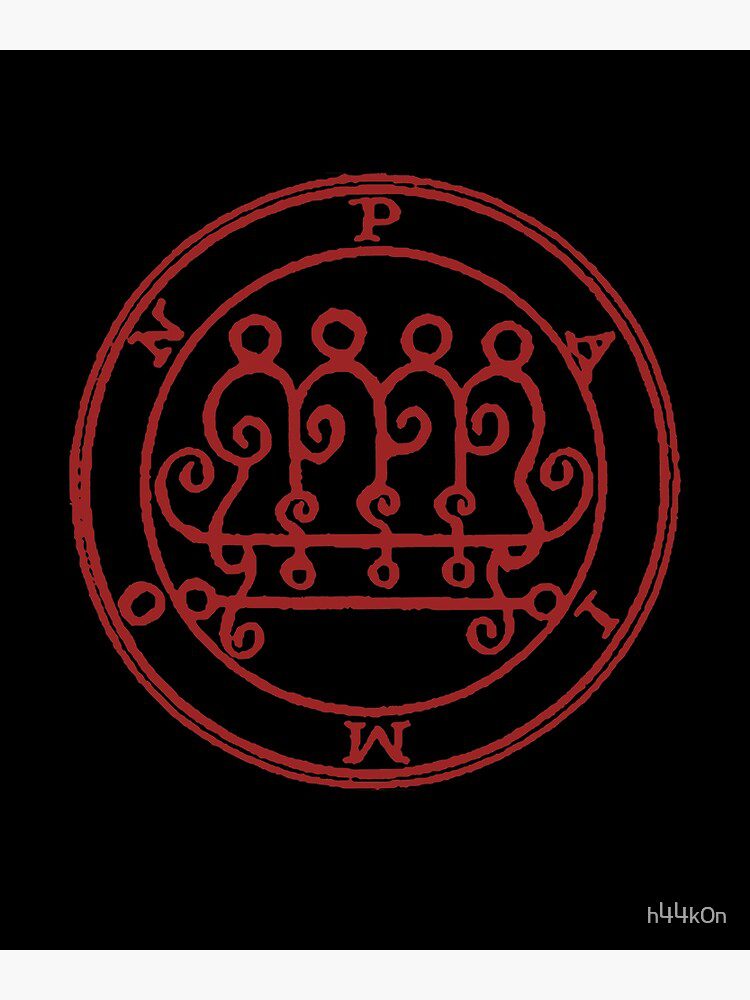
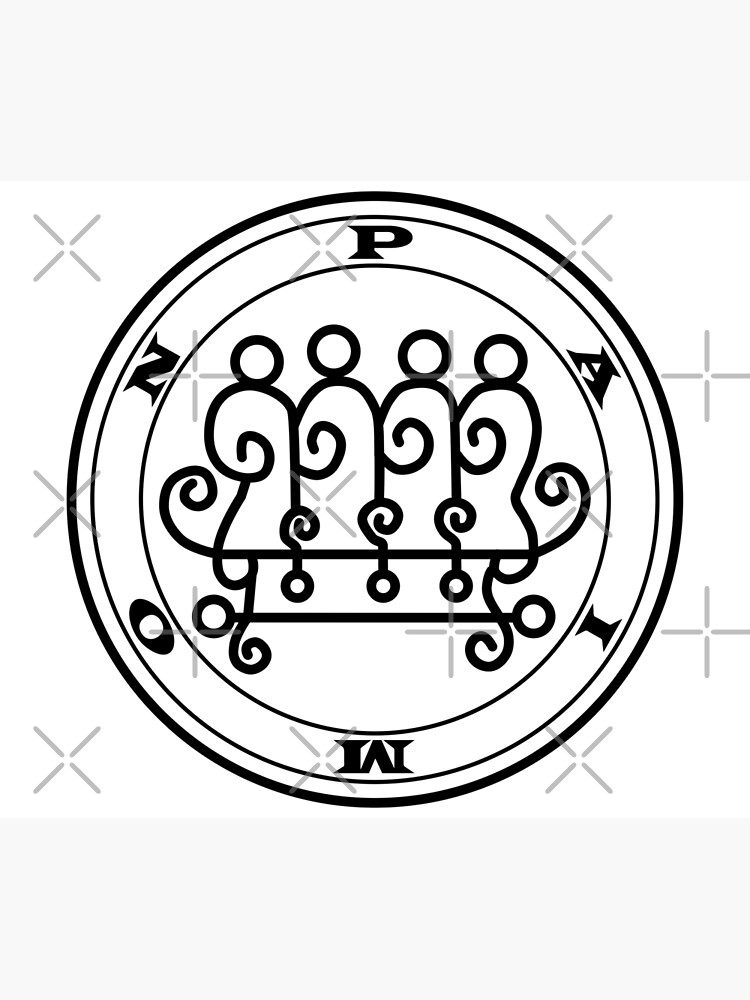
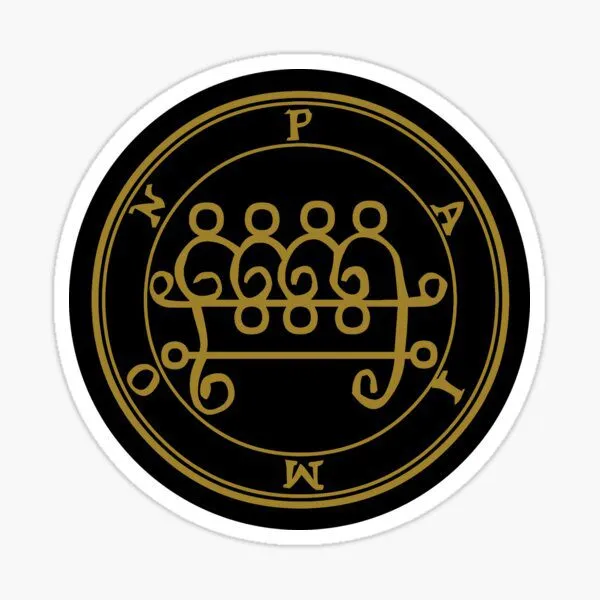
Paimon’s sigil — the geometric seal used in evocation — achieved mainstream recognition through Hereditary but has appeared in grimoire manuscripts since at least the 17th century. The sigil functions in Goetic tradition as a kind of signature or binding mark: drawing it creates a channel; the spirit must be compelled within its geometry. What’s striking about Paimon’s seal compared to others in the Ars Goetia is its relative complexity and circular structure, suggesting a closed system — an entity whose power cycles back into itself rather than projecting outward.
Where He Sits in the Infernal Hierarchy — and Why It Matters
The Goetic hierarchy is a bureaucratic system, and like most bureaucracies, its organising logic is worth examining closely because it reveals what the people who built it were actually worried about.
Rank
Great King (one of nine)
Position
9th spirit in Ars Goetia
Legions
200 (largest in catalogue)
Direction
Northwest / West (varies)
Pre-fall order
Dominions (or Cherubim)
Obedience to Lucifer
Highest among kings
Attendant kings
Labal & Abali
Constraining angel
Haziel (Shemhamphorasch)
Two details in Paimon’s hierarchy are genuinely strange when examined against the rest of the catalogue. First: he is described in multiple sources as the most obedient of all kings to Lucifer. Not just obedient — specifically more obedient than the other kings. This is a redundant specification in a system where all Goetic spirits are theoretically subject to the same infernal command structure. The emphasis suggests something that needed clarifying: perhaps older versions of Paimon traditions showed a more autonomous figure, and later compilers needed to firmly locate him within the Luciferian hierarchy.
Second: Paimon’s 200 legions include spirits from the Order of Angels and the Order of Potentates — celestial hierarchies. The other Great Kings command spirits from various infernal ranks. Paimon commands fallen celestials. The implication is that when he fell, he took parts of the heavenly hierarchy with him.
“He has under him 200 Legions of Spirits, and part of them are of the Order of Angels, and the other part of Potentates.”
— Ars Goetia, 17th century. Mathers/Crowley translation, 1904
What Paimon Supposedly Gives — and What the Texts Actually Say
The internet version of King Paimon’s powers has been considerably simplified. Most summaries mention wisdom, persuasion, and hidden knowledge. The actual grimoire descriptions are more specific — and some are weirder than the cleaned-up version suggests.
The “answers any question” attribution is both the most frequently cited and the most theologically dangerous, from a traditional demonological standpoint. A spirit that answers any question cannot be safely confined to the role of a wisdom-dispenser. The Goetia’s instruction that the conjurer must first let Paimon ask what he wishes, and be answered, before making demands — this is not a minor ritual detail. It acknowledges that the encounter is a negotiation between two parties with competing interests, not a service transaction.
The binding power — enchaining enemies “in his own chains” — receives almost no attention in contemporary discussions of Paimon. It should. This is a hostile, punitive capability. The grimoire is describing not a mentor but a king who can also act as an enforcer.
The Crowley Move: Turning Paimon Into a Psychology
Aleister Crowley’s 1904 publication of the Goetia did more to shape how educated 20th-century occultists read these spirits than any other single intervention. His framing essay proposed that the 72 spirits of the Goetia are “72 psychological pathologies of the unconscious mind” — externalized aspects of the magician’s own psychology, made real and workable through ritual. Crowley did not invent this reframing; it had been present in occult discourse at least since the Golden Dawn’s founding in 1887. But he articulated it in accessible prose and tied it to a published, widely circulated edition of the source text.
For Paimon specifically, this interpretation produces an interesting result. If Paimon represents a psychological principle — knowledge-acquisition as an autonomous complex within the psyche, the part of you that demands total information and resents every constraint on what it can know — then the ritual of summoning him becomes an act of encountering that principle directly rather than letting it operate unconsciously. The roaring voice that must be compelled to speak clearly becomes the noise of the unconscious before it becomes language.
This reading is elegant. It is also a significant departure from what the grimoires actually describe. The original texts are not psychological documents. They are procedural manuals for interacting with entities that the authors believed existed externally and could cause genuine harm if mishandled. Crowley’s reframe was not a discovery — it was a product of a specific moment in Western intellectual history, when Freudian and depth psychological models were beginning to colonise every available metaphysical territory.
Context note
The tension between the “external entity” and “psychological projection” models of Goetic spirits remains unresolved in contemporary occult scholarship. Both positions generate different ritual behaviours, different ethical frameworks, and different criteria for success. Most practitioners hold both simultaneously without formal acknowledgment of the contradiction.
Hereditary (2018): The Grimoire Goes to the Cinema
Ari Aster’s debut film Hereditary made King Paimon’s name recognisable to audiences who had never engaged with Western demonology. What Aster did with the source material is worth examining carefully, because he made specific interpretive choices that diverge from the grimoire tradition — and those divergences carry their own meanings.
The film’s central mechanism is inheritance: Paimon, in Aster’s version, requires a male host body, and the cult around the Graham family grandmother has spent decades engineering the conditions for his possession of Peter Graham. The Goetic tradition contains no such host-possession doctrine. Paimon in the Ars Goetia is summoned, negotiated with, and dismissed — he does not permanently occupy a human body. Aster grafted this possession model onto a figure whose original function was entirely different.
The film’s symbolism is, however, genuinely drawn from occult sources. The Seal of Paimon appears repeatedly throughout the production design. The colour yellow — associated in some esoteric colour-correspondence systems with Paimon — saturates the film’s visual palette. The decapitation motif references a real symbolic principle: in the words of Marie Bargas, described in Den of Geek‘s production analysis, decapitation represents “surrendering the ego,” a reading with genuine roots in Hindu esoteric tradition. Aster’s research was real; his adaptation was deliberate.
What Hereditary did that the grimoire tradition never quite managed was give Paimon a clear motivation and a narrative arc. In the original texts, Paimon answers questions, teaches arts, and binds enemies. He wants what all Goetic kings want: proper protocol, respect, and offerings. Aster’s Paimon wants to incarnate — to exist as a body in the world. This is a fundamentally different and more dramatically coherent desire. It is also, for the record, not supported by any primary text.
Modern Demonolatry: The Mentor-Figure Reinterpretation
Contemporary demonolatry — the practice of working with demonic entities as spiritual allies rather than conjured servants — has produced a reading of Paimon that would be unrecognisable to the authors of the Ars Goetia. In these communities, he is consistently described as a teacher, a mentor, a patient guide for those seeking knowledge. The commanding roar, the demand for protocol, the requirement of offerings: these are reframed as tests of seriousness, not threats.
This is not a corruption of the tradition. It is a logical extension of the Crowley move, applied by practitioners who have dropped the pretence that they are working within a Christian cosmological framework. If you remove the assumption that Paimon is a fallen angel who rebelled against God, and instead approach him as a powerful independent entity whose nature is to teach and to reveal, the character of the encounter changes entirely.
The New Thinking Allowed Foundation’s June 2025 lecture on Paimon described this shift as his “transformation into a mentor-like figure in modern demonolatry,” situating it as one of the most significant reinterpretations in the current phase of Western esotericism. What’s notable is that this reinterpretation is not primarily textual — it arises from practice. Practitioners who work with Paimon report experiences that they describe as educational, demanding but ultimately rewarding, and nothing like the hostile or dangerous encounters the original grimoires warn against.
Whether this reflects a genuine change in the nature of the encounters, a change in practitioner psychology, or simply the operation of expectation effects, is not something this article can resolve. But the consistency of the reports across unconnected practitioners is worth noting.
The Name Nobody Has Fully Explained
The etymology of “Paimon” has attracted more speculation than almost any other name in the Goetic catalogue. Here is what the serious scholarship actually offers, stripped of the mystification:
The most rigorous connection is to the Hebrew word pa’amon (פַּעֲמוֹן), meaning “bell” or “tinkling sound.” The word appears in Exodus 28:34, where it describes the golden bells on the hem of the High Priest’s robe. The Goetia’s own etymology notes (in the Mathers/Crowley edition) reference this Exodus connection directly. The word POMN appears in the Hebrew of those verses.
Occultist Carroll “Poke” Runyon extended this to argue a connection to Isis — not because the text supports it directly, but because bell-sounds were associated with goddess worship in ancient Near Eastern contexts, and the androgynous face in early Paimon descriptions could indicate a goddess-origin. This is speculative comparative mythology, not textual philology. It is interesting; it is not established.
The confusion between the Dominions and Cherubim in his pre-fall angelic rank — noted explicitly by Weyer — suggests that even the 16th-century demonologists were working from contradictory source materials. They did not know where he came from, either.
Unpopular observation
The word “Pa’amon” in Exodus refers to golden bells on priestly vestments — instruments that produce sound as the priest moves, announcing his presence to God. That Paimon also announces his arrival with loud, uncontrolled sound before composing himself into intelligible speech could be read as an inversion of the priestly bell dynamic: the priest’s bells signal approach to the divine; Paimon’s noise signals the divine approaching in its inverse form. The compilers of the Ars Goetia may have intended this inversion deliberately. Or it may be coincidence. The text doesn’t say.
The Contradictions Are the Point
Every serious account of King Paimon eventually has to deal with the same problem: there is no stable, original Paimon to recover. He is the 9th spirit and the 22nd. He commands 200 legions and 25. He is a King and a Duke. He has an effeminate face and no face described at all. He is the most loyal of the kings and also the one who requires the most elaborate protocols to manage safely.
The temptation is to treat these as errors — scribal mistakes, editorial confusions, transmission problems in a pre-printing-press manuscript culture. Some of them may be exactly that. But the pattern of contradiction is too consistent across too many different sources to be explained entirely by copying errors.
A more plausible reading is that “Paimon” is a label attached to a category of spiritual encounter — one involving overwhelming presence, demands for protocol, offers of knowledge, and a fundamentally ambiguous relationship with hierarchy — that different magical traditions encountered independently and recorded under different frameworks. When the Lemegeton’s compilers assembled the Ars Goetia from earlier sources, they created a composite figure. The inconsistencies are the seams between the sources.
This matters for how you read the modern interpretations. The Crowley reframe, the demonolatry mentor model, Ari Aster’s possession narrative — none of these are departures from a stable original. They are additions to a tradition that was never stable to begin with. Every generation that has encountered Paimon has found in him what its cultural moment needed him to be: in the 16th century, a test of the magician’s authority; in the 20th, a psychological projection; in the 21st, a teacher and collaborator; in horror cinema, the nightmare of inheritance.
Questions the Research Actually Resolves
What is the difference between Paimon in the Ars Goetia and in the Pseudomonarchia Daemonum?
The Pseudomonarchia (Weyer, 1563/1577) lists him as the 22nd spirit and describes his effeminate face in detail; it also uses the alternate spelling “Paimonia” and places the text in a sceptical context — Weyer was arguing against witch trials, not providing a practitioner’s manual. The Ars Goetia (17th century) promotes him to 9th, drops the face description, and adds the theological detail about his pre-fall angelic order. The Goetia is the practitioner’s text; the Pseudomonarchia is the scholar’s record.
Is Paimon associated with any pre-Christian religions?
No direct connection has been established with primary source evidence. The Runyon hypothesis (Mesopotamian goddess tradition) is speculative and based on comparative name-sound analysis rather than documented textual transmission. What can be said is that the Lemegeton drew from Jewish, Christian, and possibly Islamic magical traditions, and that the 72-spirit structure was designed to mirror the Kabbalistic Shem HaMephorash. Pre-Christian Paimon is not currently demonstrable.
Why does the number of his legions vary between sources?
When Paimon arrives accompanied by his two attendant kings Labal and Abali, the three of them together command 25 legions. When Paimon arrives alone, he commands 200. The discrepancy is not a contradiction — it reflects two different scenarios described within the same sources. Most secondary citations simply pick one number without noting the context.
Does Paimon’s Goetic sigil appear in the original grimoires?
Yes. The Ars Goetia includes seals for all 72 spirits, and Paimon’s seal is among them. The seal’s specific geometric form is reproduced consistently across editions, making it one of the more stable elements of his iconography — in contrast to his numerical rank, legion count, and directional attribution, all of which vary by source.
The interesting thing about studying King Paimon across the historical record is not what it reveals about the entity — if that’s a category that applies. It’s what it reveals about five centuries of humans deciding what they need from a figure defined primarily by overwhelming presence, offered knowledge, and the demand that you treat him correctly before he’ll talk to you clearly.
That specific package of attributes has apparently been useful to a lot of very different people, across a lot of very different contexts. Whether the camel is crowned or Paimon is crowned, whether he fell from the Dominions or the Cherubim — these details kept getting argued over because the thing underneath them kept feeling relevant.
What changes in 2026, with Hereditary still circulating in streaming culture and demonolatry communities actively producing new material, is the speed at which new interpretive layers accumulate. The 17th-century compilers worked from manuscripts separated by generations. Current practitioners can compare notes in real time. Paimon, whoever he is, is being collectively reinvented faster than ever. That probably tells us something. It probably doesn’t tell us what we think it does.