

Asmodeus: Why the King of Hell Refuses to Stay in the Past
Most demons got one good story and faded. Asmodeus got three religions, fourteen centuries of grimoires, a starring role in the most famous witchcraft trial in French history, and a player-character subrace in a 2023 video game that sold 25 million copies. That trajectory is not an accident.
The question that genuinely interests me — and that almost no one writing about Asmodeus bothers to answer — is why him specifically. The demonological tradition is enormous. The Ars Goetia alone names 72 spirits, and most of them have been forgotten by everyone except a small community of ceremonial magicians. Asmodeus has not been forgotten by anyone. He appears in academic theology, in Reddit threads, in therapy waiting rooms (not literally, but the forces he represents certainly do), and in blockbuster game design. This article is an attempt to figure out what is actually going on.
He started as something rawer than lust
The standard introduction to Asmodeus goes something like this: he is the demon of lust, one of the seven princes of Hell, and he tries to prevent marriages from being consummated. That is accurate in the way that describing a thunderstorm as “wet” is accurate. Technically true, stripped of everything that matters.
The name Asmodeus is almost certainly derived from the Persian aēšma-daēva, meaning “demon of wrath.” Aeshma is a prominent figure in Zoroastrianism, the ancient religion of Persia, and his name and nature appear to have directly influenced Jewish and early Christian writers. That origin matters more than people realize, because the original figure was not primarily about sexuality at all. Aeshma was a spirit of pure, violent fury — the kind of wrath that precedes war, that makes men burn fields and kill livestock out of spite. The erotic associations came later, as a product of cultural translation.
When this Persian fury-demon crossed into Hebrew tradition, something interesting happened to him. He became a spirit of discord and carnal desire — but unlike other demons who were purely spiritual, this translated lineage gave Asmodeus a unique connection to the physical world, allowing him to interact more directly with human passions. The scholars who adapted him understood that wrath and lust are not opposites. They are siblings. Both are failures of self-mastery. Both involve a kind of possession — the body acting against the better judgment of the person inhabiting it.
The fusion of rage and desire into a single demonic figure was not superstition. It was a sophisticated psychological observation that predates Freud by two thousand years.
The Book of Tobit story is stranger than it sounds
In the Book of Tobit — composed roughly between 250 and 150 BCE — Asmodeus appears as a being who prevents a woman named Sarah from consummating her marriage, having killed each of her seven husbands on their wedding nights. It takes divine intervention, in the form of the angel Raphael, to dismiss him. Raphael reveals to Sarah’s newest husband Tobias that burning the gall of a fish will prevent demonic interference.
Read that scenario carefully. This is not a simple villain story. Asmodeus does not appear out of nowhere and kill at random. He is fixated on a specific person, across time, apparently immune to human response. Seven husbands. Seven deaths. The demon’s motivation is never entirely explained in the text, which is theologically significant: evil in the Book of Tobit is not a puzzle to be solved by understanding the villain’s psychology. It is a condition to be addressed through correct ritual practice — the fish gall, the prayer, the right words said in the right sequence.
That framing — demonic harm as something requiring technical countermeasure rather than moral reform — echoes across the entire subsequent history of Asmodeus in Western occultism. He is a problem to be managed, not a being to be negotiated with, which makes him unusual among the denizens of Hell.
What the Talmud made him — and why it is the most interesting version
Here is the version of Asmodeus that almost no pop-occultism article mentions, because it fundamentally complicates the “demon of lust” label: the Talmudic Asmodeus (Ashmedai) is frequently portrayed as funny, clever, and oddly principled.
The most detailed account of Ashmedai comes from the Babylonian Talmud, in the context of the construction of Solomon’s Temple. Solomon required the Shamir — a creature that could split stone without iron tools, since no instruments of war were allowed to touch the Temple. To find it, Solomon needs the help of the king of demons himself. What follows is one of the genuinely strange passages in ancient literature: a game of wits between the wisest king in the world and the king of Hell, in which neither party is straightforwardly good or evil.
Asmodeus in this story is captured by Solomon’s general Benayahu, who outwits him with wine (Ashmedai, respecting the law, will not drink from an impure vessel) and a ring bearing the divine name. The demon — bound and dragged to Jerusalem — proceeds to make a series of unsettling observations about the nature of human behavior that Solomon cannot refute. He sees a man buying shoes and weeps, knowing the man will die before wearing them. He sees a wedding party and weeps again. Then, when Solomon briefly removes the ring, Ashmedai throws him four hundred leagues away and takes his throne.
This is not the behavior of a simple lust-demon. This is a figure of genuine moral ambiguity: subject to law, capable of insight, ultimately interested in exposing the pretension of human power. The Talmudic Asmodeus would be entirely at home in a Dostoevsky novel.
The Talmudic Asmodeus story appears in Tractate Gittin (68a–b) of the Babylonian Talmud. For those interested in the primary source, the Soncino translation is the most widely available in English. The academic treatment in Dictionary of Deities and Demons in the Bible (Brill, 1999) remains the most rigorous scholarly reference on the figure’s historical development.
The medieval machinery: how a nuanced figure became a bureaucrat of sin
Something gets lost between the Talmud and the Renaissance. The complex, funny, wine-respecting king of demons becomes a functionary in Hell’s administrative hierarchy — the spirit assigned to lust, the overseer of the second circle, the deputy responsible for disrupting marriages. The richness doesn’t entirely disappear, but it gets buried under classification.
In Binsfeld’s classification of demons, each of the seven princes of Hell represents one of the seven deadly sins. Asmodeus is the demon of lust and is therefore responsible for twisting people’s sexual desires. According to some traditions, people who fall to Asmodeus’s ways will be sentenced to an eternity in the second level of hell.
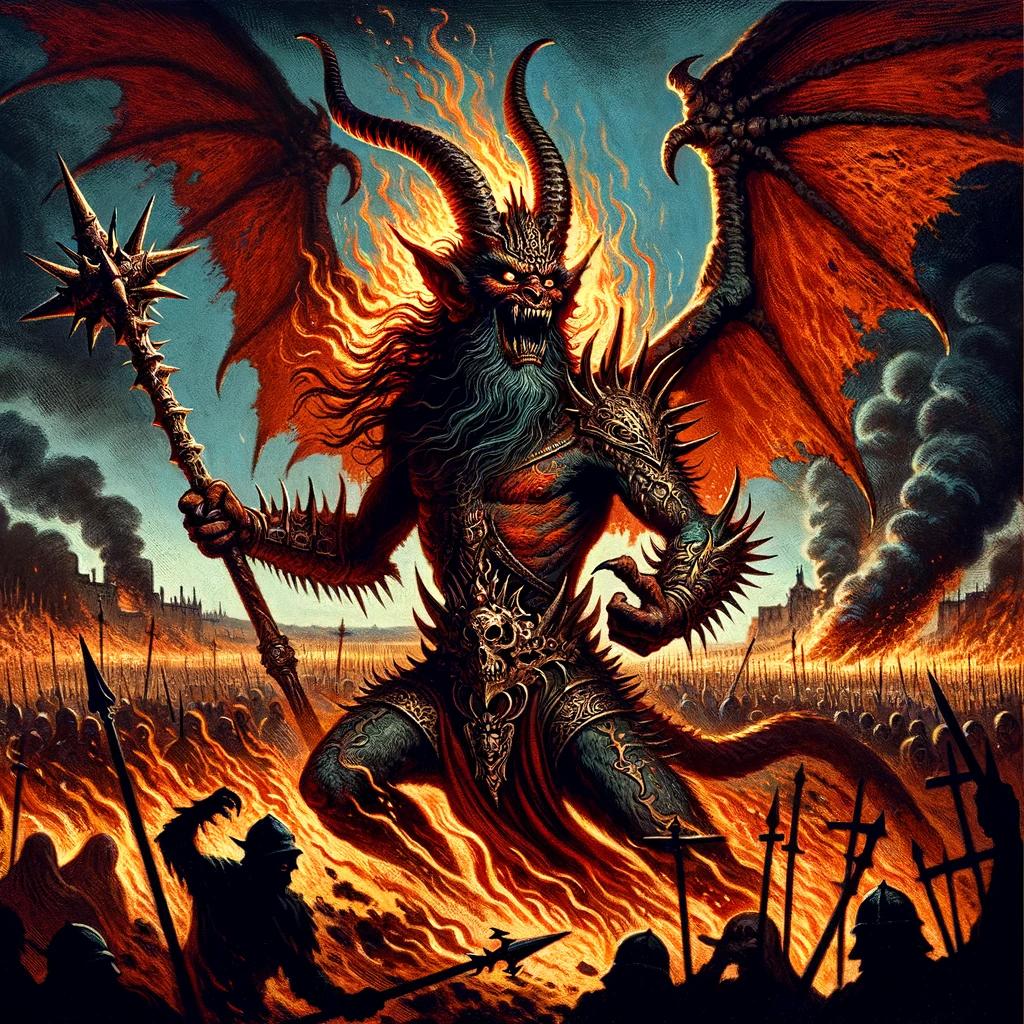
The Ars Goetia — compiled as part of the Lesser Key of Solomon in the mid-seventeenth century but drawing on much older material — treats Asmodeus differently from the way the Talmud does. In the Goetia, he is described as having three heads (a bull, a man, and a ram), a serpent’s tail, feet of a goose, and he rides a hellish dragon. He speaks clearly and commands respect, teaches arithmetic, astronomy, geometry, and all sciences. That last detail — the sciences — is always a surprise to people who only know him as the lust demon. The grimoire tradition consistently frames Asmodeus as an intellect, not merely an appetite.
Loudun, 1634: when Asmodeus signed a legal document
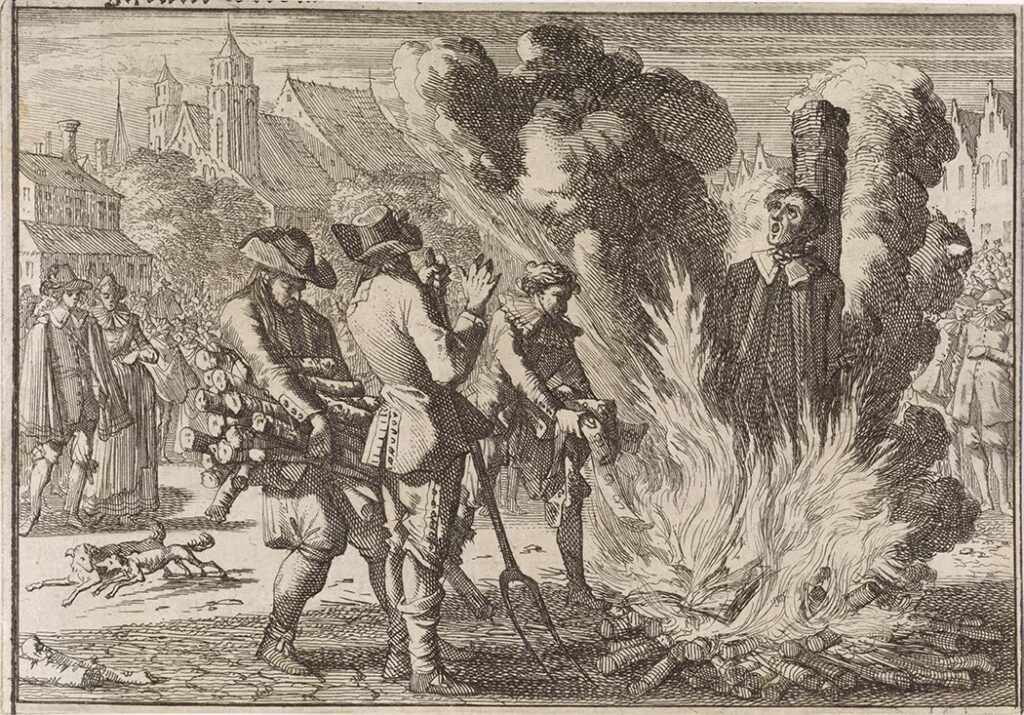
The single most consequential real-world appearance of Asmodeus in Western history took place in a French convent between 1632 and 1638, and it ended with a man burned alive in front of six thousand people.
In the most famous case of mass demonic possession in history, Sister Jeanne des Anges claimed that she and the other Ursuline nuns of Loudun were possessed by two demons — Asmodeus and Zabulon — sent to them when Father Urbain Grandier tossed a bouquet of roses over the convent walls. Grandier was a local parish priest: wealthy, handsome, intellectually formidable, and politically inconvenient to several powerful people including Cardinal Richelieu.
The first exorcisms began in October 1632 and expanded into public spectacles attracting thousands of onlookers. On August 18, 1634, Grandier was found guilty of sorcery and burned at the stake. The exorcisms continued until 1638. What makes the case particularly disturbing is that a Sorbonne theological committee had issued a ruling in 1610 stating that one must never admit demonic accusations in legal proceedings, since the devil is the “Father of Lies.” The trial of Grandier defied this ruling, with Richelieu’s approval.
Asmodeus’s specific role in the Loudun affair: the pact allegedly signed between Urbain Grandier and the Devil was supposedly stolen from Hell’s cabinet of records by the demon Asmodeus himself and presented as evidence. A document certified by a demon, used to convict a man. It survives in archives to this day — a piece of paper written backwards in Latin, bearing the supposed signatures of Lucifer, Beelzebub, Satan, Astaroth, and Asmodeus.
The historical lesson is not that demons are real. The historical lesson is that the name “Asmodeus” carried enough institutional weight in 17th-century France to function as a legal instrument.
A demon that can sign a document has crossed from theology into bureaucracy. That is arguably more frightening.
A condensed timeline of key appearances
The fury-demon Aeshma Daeva appears in Zoroastrian texts as one of the chief opponents of Ahura Mazda. Pure wrath, no erotic dimension.
First Hebrew-tradition appearance as Asmodeus. Kills seven husbands, is banished to Egypt by the angel Raphael. The erotic-disruption function is established.
The richest, most contradictory version of Ashmedai: king of demons, kept from drinking impure wine, dispenser of uncomfortable truths, capable of overthrowing Solomon.
The Dominican witch-finding manual firmly establishes Asmodeus as the demon of lust, giving him institutional weight in the machinery of European witch trials.
Asmodeus co-signs the forged pact used to convict Father Urbain Grandier of sorcery. The demon’s name appears on a document accepted as legal evidence.
Asmodeus formalized as the 32nd spirit of the Goetia, described with three heads, geometrical knowledge, and 72 legions. The occultist version that persists today.
The iconic visual — three-headed beast on a dragon — is engraved and disseminated. This is the image that defines the modern imaginary of Asmodeus.
The “Asmodeus Tiefling” becomes one of the most-played character subraces in one of the best-selling RPGs in history. The name reaches a new generation with no prior religious context.
What Dungeons & Dragons understood that theologians missed
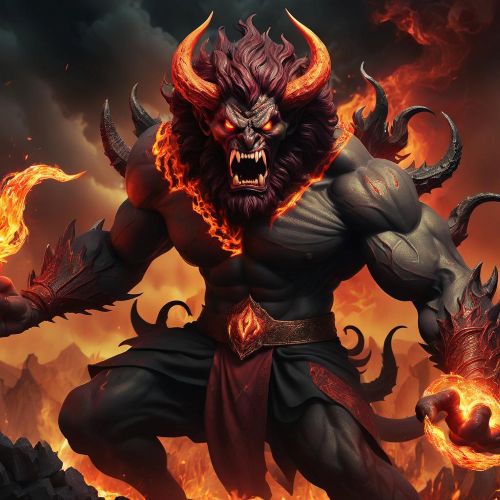
When Gary Gygax and the original D&D designers built their infernal hierarchy, they made Asmodeus the apex predator: the ruler of Nessus, the ninth and deepest layer of Hell, the being to whom all other archdevils ultimately answer. He is described as physically strong and genius in intellect, capable of casting spells as well as the greatest clerics, and able to utter a profane Dark Speech so awful it causes physical injury. His true form, according to the lore, is an enormous serpent miles in length. The humanoid appearances are performances.
The game design insight here is actually sophisticated. D&D’s Asmodeus is not just powerful — he is the embodiment of lawful evil. He follows rules obsessively. He honors contracts. He operates within systems. The horror is not that he breaks laws but that he uses them with perfect precision and zero mercy. He is the embodiment of lawful evil: though the most well-mannered of the archdukes, he rules with an iron fist and believes he is the only one capable of bringing his kingdom to glory.
That is a more interesting reading of the figure than “demon of lust.” It is also, arguably, more faithful to the Talmudic version — the Ashmedai who respects religious law even while being the king of demons, who cannot touch wine unless it is properly prepared, who keeps his word when bound by a ring. The D&D designers seem to have understood something that centuries of Christian demonologists obscured: Asmodeus is fundamentally about the corruption of order, not the disorder of appetite.
The 2023 campaign sourcebook Chains of Asmodeus, designed by veterans of Dragon Age and Baldur’s Gate, incorporated unique systems called Temptations and Corruptions — allowing player characters to gain powerful abilities in exchange for the progressive damnation of their souls. That mechanic is, to my mind, the most theologically accurate game mechanic ever invented for this particular demon. The soul-erosion is not dramatic; it is incremental. Each step seems reasonable.
The symbolic machinery: why wrath and lust travel together
I want to spend a moment on something that most treatments skip entirely: the question of why Asmodeus was the figure onto whom both wrath and lust were projected, across multiple independent cultural traditions.
The answer, I think, involves what both states share. Lust and wrath are both forms of obsessive fixation. Both narrow the world down to a single target. Both produce the same failure of perspective: the person in their grip cannot think about anything else. The Talmudic Asmodeus is fixated on Solomon’s wives and on Bathsheba; the Asmodeus of Tobit is fixated on Sarah across multiple marriages. The wrath-demon Aeshma is fixated on his enemy to the point of losing all other awareness.
The ancient writers who first synthesized these traditions were not confused about taxonomy. They were observing something about the phenomenology of desire and rage — that both are experiences of being taken over, of the self becoming a vehicle for an impulse it did not choose. A demon that embodies that experience is more conceptually coherent than it first appears.
This is also why Asmodeus appears in historical accounts of mass hysteria and group possession events. The exorcisms of Loudun identified multiple demons by name — Asmodeus, Behemoth, Leviathan, and Astaroth — all associated with different vices in the affected nuns. Asmodeus was specifically identified as the demon of sexual obsession. But what the historical record actually shows is a community under extreme stress (plague, political instability, confinement) experiencing collective breakdown. The name “Asmodeus” gave form to something formless: the specific texture of erotic mania and the rage that follows frustrated desire.
The modern occult revival and what it actually means
Since roughly 2015, interest in practical demonology — meaning the actual ritual engagement described in grimoires — has grown measurably in English-speaking countries. This is not a fringe phenomenon. Major publishers have brought out annotated editions of the Lesser Key of Solomon. Academic presses have published serious ethnographies of contemporary ceremonial magic communities. The subreddit r/occult has over a million members.
Asmodeus is among the most discussed figures in these communities, which requires some explanation. Why him, rather than the dozens of other Goetic spirits?
Part of the answer is that he teaches things. In the grimoire tradition, Asmoday is said to teach arithmetic, astronomy, geometry, and all sciences — speaking clearly and commanding respect. In contemporary magical communities, this positions him as a patron of intellectual development, not merely an embodiment of vice. There is a strain of left-hand-path thinking that frames working with Asmodeus as an approach to accelerating self-mastery — specifically, mastery over desire itself. The theory being that the entity most closely associated with a vice is also the most useful guide to understanding and transcending it.
I have not found this claim persuasive, and I want to be honest about that. It strikes me as the kind of motivated reasoning that makes dangerous things feel safe. But I also think it is worth engaging with seriously rather than dismissing, because it represents something real about why Asmodeus continues to attract interest: he is complex enough to support multiple, contradictory readings, including readings that invert his conventional meaning.
The comparative table: Asmodeus across seven frameworks
| Framework | Primary role | Key attribute | Countermeasure / relation |
|---|---|---|---|
| Zoroastrian (Aeshma) | Demon of wrath and violence | Fury; opponent of the divine | Sraosha (obedience to divine will) |
| Book of Tobit | Adversary of marriage | Obsessive fixation on Sarah | Fish gall burnt as incense; angel Raphael |
| Babylonian Talmud | King of demons / trickster | Cunning, moral ambiguity, hidden insight | Ring of Solomon; divine name |
| Malleus Maleficarum (1486) | Prince of lust | Sexual corruption | St. John as adversary |
| Ars Goetia (17th c.) | 32nd Goetic spirit | Intellect, sciences, 72 legions | Protective circle; divine names |
| Dungeons & Dragons | Archdevil / ruler of Nessus | Lawful evil; contracts; cosmic manipulation | No countermeasure — he honors deals literally |
| Contemporary occultism | Patron of transformation through desire | Self-knowledge through shadow work | Context varies; informed practice stressed |
One detail that changes everything: he reportedly kept religious law
Before I close, one specific detail from the Talmudic narrative deserves more attention than it usually receives: in the Talmud, Asmodeus is less malign in character and appears repeatedly in the light of a good-natured and humorous fellow, though he has his desires turn upon Solomon’s wives and Bathsheba.
And specifically: he will not drink wine that has not been properly sealed. He observes the law even when it disadvantages him. The general Benayahu exploits this by waiting until Asmodeus has drunk from a sealed wineskin — which he then replaces with a drugged one.
This detail is theologically extraordinary, and I suspect it was deliberately included by the Talmudic redactors for a specific reason. The figure cannot function as a simple enemy if he observes the same laws as the community being protected from him. He becomes something more disturbing: an insider, operating within the rules, using compliance as a kind of cover. That is a portrait of a different kind of danger — not the danger of the barbarian at the gate, but the danger of the corrupting influence that knows the rules well enough to exploit them.
Which is why, I think, Asmodeus has outlasted almost every other demon in the Western tradition. He is not simply a force of disorder. He is a force of order applied to ends that undermine everything order is supposed to protect. That is a genuinely difficult idea, and it generates new interpretations every century because it maps onto new fears: the corrupt official, the predatory institution, the algorithm optimizing for engagement at the cost of wellbeing. The name changes. The function is identical.
Key academic and reference sources
For readers who want to trace the primary material rather than rely on secondary accounts:
- Encyclopedia.com — Asmodeus (academic reference)
- British Psychological Society — The Loudun Possessions (peer-reviewed historical analysis)
- Project MUSE — Academic review of The Possession at Loudun
- Study.com — Asmodeus: mythology and historical overview
Every tradition that encountered Asmodeus changed him slightly, layering new anxieties over the old ones without fully erasing them. The wrath-demon and the lust-demon and the wise trickster and the cosmic administrator of lawful evil are all still in there, compressed into a name. What the 21st century adds is a new layer: the patron of the person trying to understand their own worst impulses. Whether that is a legitimate spiritual practice or a sophisticated piece of self-deception is a question I genuinely do not know how to answer. And that uncertainty — that the most ancient demon in the Western tradition can still generate arguments we do not know how to resolve — is probably the most honest measure of how well his makers built him.