

Can AI Really Fill In the Missing Pages?
Someone actually tried. A Georgetown-led team pointed a neural network at one of the most notorious gaps in the Gospel of Philip — the passage where Jesus kisses Mary Magdalene […..] — and the result is stranger, and more honest, than any headline claiming AI has “restored lost scripture.”
The gap everyone quotes and nobody can finish
If you’ve spent any time around Gnostic studies or its noisier internet cousins, you’ve run into Gospel of Philip, Saying 55. It’s the line that launched a thousand documentaries and at least one Dan Brown paperback: Jesus “used to kiss her on the ….. many times” — “her” being Mary Magdalene. The Coptic manuscript is physically damaged at exactly the word that would tell us where he kissed her. Mouth. Cheek. Forehead. Hand. Nobody knows, because the papyrus itself is gone at that spot.
That five-to-six-letter hole is a lacuna — the technical term for a gap in a damaged manuscript, usually marked in scholarly editions with brackets and dots, like […..]. The Nag Hammadi codices are riddled with them. And in 2024, a real research team did something nobody had done before: they trained a neural network specifically on Coptic and pointed it at that exact gap.
This article is about what actually happened when they did — not a speculative “AI reconstruction” of Gnostic scripture, which doesn’t exist and which any site claiming otherwise is fabricating. What exists is more interesting: a peer-reviewed, publicly documented case study in exactly where AI helps historians read the ancient world, and exactly where it runs out of road.
What’s actually missing from Nag Hammadi, in numbers
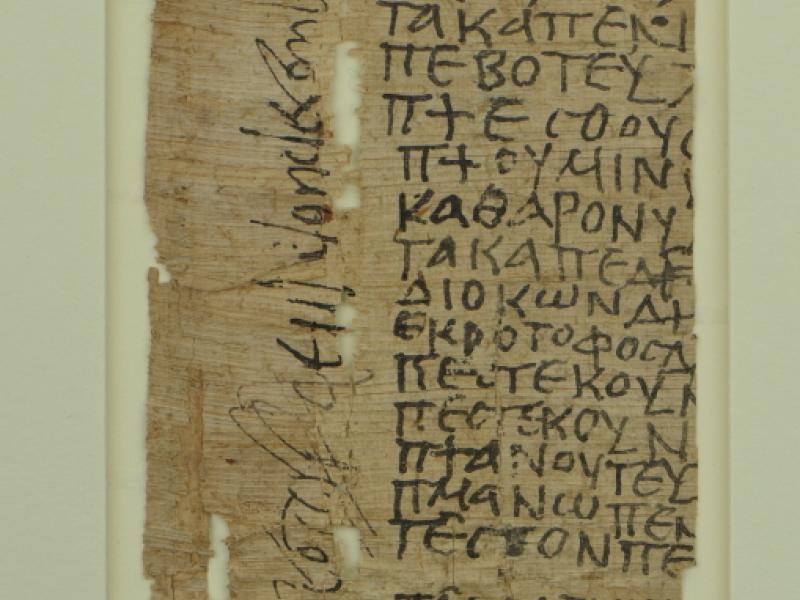
The Nag Hammadi library was found by farmers digging for fertilizer near Jabal al-Ṭarif in Upper Egypt in December 1945: thirteen leather-bound papyrus codices, copied in Coptic in the mid-fourth century, sealed in a jar. Between them they preserve 52 tractate copies — roughly 45–46 distinct works once duplicates are accounted for — including the Gospel of Thomas, the Gospel of Philip, the Gospel of Truth, and Sethian, Valentinian and Hermetic texts that had been effectively erased from history since the fourth-century campaigns against “heretical” writings.
Of the roughly 1,000 original pages, about 794 survive intact, with the rest partially preserved or lost outright. Ten of the thirteen codices are close to complete; one has considerable lacunae; two are fragmentary. The damage is concentrated at the top and bottom margins of pages — exactly where papyrus deteriorates first — which is why so many of the field’s most argued-over passages, Saying 55 included, sit at the edge of a hole rather than in open text.
For most of the New Testament and classical corpus, scholars can often patch a damaged line by comparing it to a second surviving copy. The Gospel of Philip doesn’t have that luxury. No other manuscript of it exists anywhere in the world. Whatever fills that gap has to come from internal grammar, dialect patterns, and informed guesswork — which is precisely the situation a language model is built for, and precisely where its limits show fastest.
The experiment: an RNN trained to think in fourth-century Coptic
The paper is Lacuna Language Learning: Leveraging RNNs for Ranked Text Completion in Digitized Coptic Manuscripts, published in 2024 by Lauren Levine and Cindy Tung Li at Georgetown, with Lydia Bremer-McCollum (University of Oklahoma) and Nicholas Wagner (Duke), funded by a National Endowment for the Humanities grant. It’s the first published attempt to apply neural language modeling to Coptic lacuna reconstruction at all.
Coptic is not a small hurdle. It’s the final stage of the Egyptian language — the longest continuously attested language on Earth — written in a 24-letter Greek-derived alphabet plus extra glyphs borrowed from Demotic, split across more than a dozen historical dialects, with irregular spelling of Greek loanwords layered on top. The team’s entire training corpus, drawn from the open Coptic SCRIPTORIUM project, was about 1.22 million tokens. For comparison, that’s a fraction of the data available for Greek epigraphy, which we’ll come back to.
Their model was a four-layer bidirectional LSTM — not a transformer, and deliberately so: with that little data, an older recurrent architecture generalized better than the giant models people default to now. It was trained to predict masked characters, the same basic trick that powers BERT, just applied letter-by-letter to Coptic instead of word-by-word to English.
The headline number the team reports is 72% accuracy on predicting a single missing character. That sounds strong — until you learn it collapses to below 37% once the gap runs six characters or longer, which is the range that matters for anything resembling a word. The model is genuinely useful for guessing a stray letter under a fingernail-sized hole in the papyrus. It is not close to “reconstructing” a sentence, a saying, or a page.
What the model actually said about the kiss
Here’s where it gets uncomfortable in the way good research sometimes is. When the team pointed their best models directly at the five-and-six-letter gaps in Saying 55, asking them to freely generate the missing word rather than rank existing proposals, neither model produced an attested Coptic word at all. Not “mouth.” Not “cheek.” Not anything in the dictionary. Two different models, two different training strategies, and the direct output was linguistic noise dressed up as plausible letter sequences.
So the researchers pivoted to the more honest use of the tool: instead of asking the model to invent an answer, they asked it to rank the answers real scholars had already proposed. Textual critics Bentley Layton and Hans-Martin Schenke had, between them, floated four candidates for that gap over the preceding decades: mouth (two different Coptic words for it), cheek, foot, and forehead.
| Model | 1st ranked | 2nd ranked | Scholars’ own favorite |
|---|---|---|---|
| Smart-Once RNN | cheek (ⲟⲩⲟϭⲉ) | forehead (ⲧⲉϩⲛⲉ) | Schenke: mouth (ⲧⲁⲡⲣⲟ) |
| Random-Dynamic RNN | forehead (ⲧⲉϩⲛⲉ) | cheek (ⲟⲩⲟϭⲉ) |
Both of the model’s actual picks disagree with the two-millennia-old scholarly favorite. Source: Levine et al. 2024, Section 6.2 and Table 2.
Neither model’s top pick agrees with the reading you’ll find quoted in most popular retellings of the “kiss” passage (mouth). Both ranked cheek and forehead above it, based purely on which letter sequences were statistically more common in surviving Coptic. That doesn’t mean the model is right and eighty years of Coptic scholarship is wrong — it means a frequency-trained language model and a philologist reading grammar, context and comparative theology are answering genuinely different questions, and conflating them is exactly how bad “AI reconstruction” content gets made.
This, and not a fabricated “AI translation,” is the real texture of what’s happening at the frontier of Gnostic textual studies right now: a modest, well-documented tool that adds one more line of statistical evidence to a centuries-old argument, without settling it.
The comparison that puts it in perspective: Greek got there first, and did better
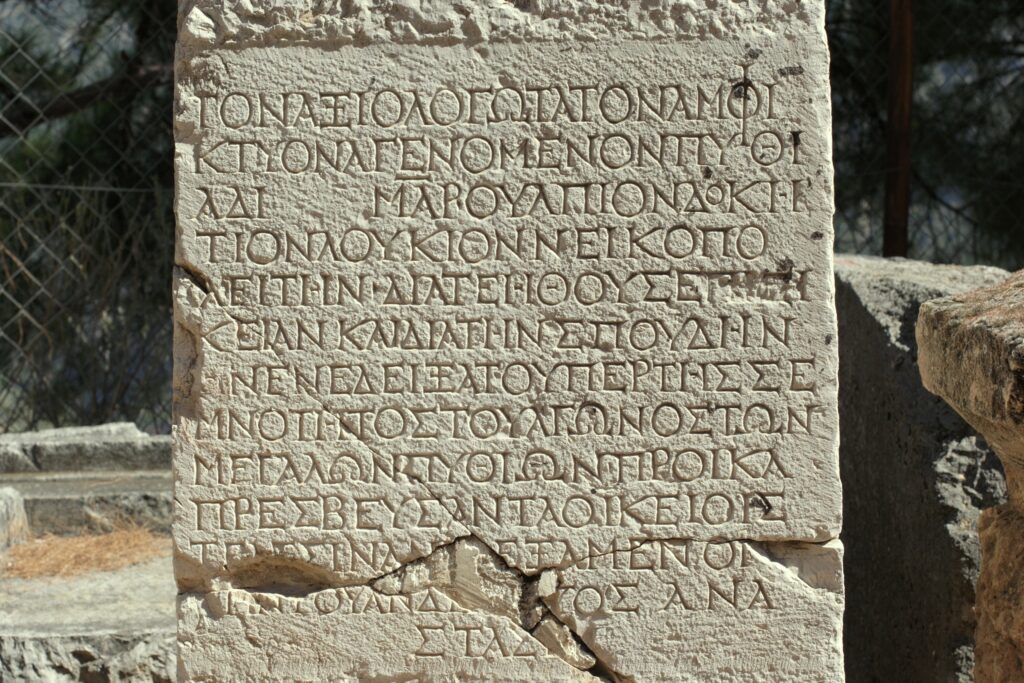
Coptic isn’t the first ancient language AI has been pointed at — it’s arguably the hardest case so far, because so much less digitized text exists to train on. The benchmark to compare against is Ithaca, the DeepMind model built with Ca’ Foscari University of Venice, Oxford, and the Athens University of Economics and Business, published on the cover of Nature in March 2022.
Ithaca was trained on 78,608 Greek inscriptions — an order of magnitude more data than the Coptic project had available — and it does three things: restores damaged text, geographically attributes an inscription, and estimates its date.
Ithaca alone hits 62% on damaged-text restoration — nearly double the Coptic model’s best real-world figure. And when historians use Ithaca as a collaborator rather than an oracle, their own accuracy climbs from 25% to 72%. It also attributes inscriptions to a place of origin with 71% accuracy and dates them to within roughly 30 years of expert consensus.
The gap between the two projects isn’t a gap in ambition or technique — both use variants of the same masked-language-modeling idea. It’s a gap in digitized training data. Greek epigraphy has decades of machine-readable corpora behind it (the Packard Humanities Institute’s PHI dataset alone). Coptic manuscript studies, by comparison, is still a small field doing heroic work on a comparatively tiny digital corpus. That’s not a permanent ceiling — it’s a funding and digitization problem, and it’s the actual reason nobody has “reconstructed” Nag Hammadi with AI yet, rather than any inherent limit of the technology.
Where this is actually headed: the scrolls that started speaking again
If you want to see what “AI plus ancient text plus enough data” looks like at full strength, look two miles down the Bay of Naples from where Nag Hammadi scholars work, at a project that has nothing to do with Egypt and everything to do with what’s technically possible.
The Vesuvius Challenge, launched in March 2023 by Brent Seales (University of Kentucky) together with Nat Friedman and Daniel Gross, set out to read the carbonized papyrus scrolls buried by Mount Vesuvius in 79 AD — scrolls so fragile that physically unrolling them destroys them, which is why several hundred have sat sealed in Naples for two centuries.
On June 25, 2026, the project announced that scroll PHerc. 1667 had been virtually unwrapped and read from beginning to end — the first time that’s happened for an intact Herculaneum scroll. The recovered text runs to roughly 1.4 metres of writing surface across some twenty-two columns of Greek: a philosophical treatise on ethics that internal evidence points to as Stoic, its final preserved column naming Aristocreon, a nephew and disciple of the Stoic philosopher Chrysippus, dating the work to around the second century BC.
The pipeline is worth understanding because it’s the honest version of what “AI reads ancient text” actually means in practice: a micro-CT scanner produces a 3D X-ray volume; machine-learning models trace and flatten the scroll’s tightly wound geometry into a 2D surface (a step the project itself still calls semi-automated, since fully automating it remains an open research problem); a separate ink-detection model highlights carbon ink that is otherwise almost invisible against carbonized papyrus in an X-ray scan; and only then do human papyrologists read, transcribe and verify the recovered Greek. As the project’s own team has been careful to say, the model amplified expert work — it did not replace it.
That division of labor — AI recovers the signal, humans read the meaning — is exactly the model the Coptic RNN paper is groping toward for Nag Hammadi, just several years and one very large training corpus behind.
What it would actually take to get closer to Ithaca-level results for Coptic
- A much bigger annotated corpus. Ithaca trained on 78,608 inscriptions; the Coptic RNN trained on 1.22 million tokens drawn from a far smaller manuscript base. Digitizing and transcribing more Coptic manuscripts to the Coptic SCRIPTORIUM standard is the single highest-leverage fix, and it’s a funding and labor problem, not an algorithm problem.
- Dialect-aware modeling. Coptic split into more than a dozen regional dialects; the current model normalizes everything toward Sahidic, which the researchers themselves flag as a simplification that may cost accuracy on texts written in other dialects.
- Architecture upgrades once data allows it. The team explicitly chose an older RNN over a transformer because the dataset was too small to benefit from one — precisely the kind of tradeoff Ithaca didn’t have to make, thanks to its far larger training set.
- Ranking, not generation, as the actual product. The paper’s own conclusion is that the tool is most defensible as a way to rank candidate readings scholars already propose, not to invent new ones from scratch. Any future Coptic tool worth trusting will likely keep that constraint rather than abandon it for splashier “full reconstruction” marketing.
- Cross-project learning from Vesuvius Challenge. The Herculaneum project’s ink-detection and iterative pseudo-labeling techniques were built for a different medium (carbonized papyrus, X-ray CT) but the underlying idea — bootstrap a model from a small set of confidently-labeled examples, then use it to find more — is directly transferable to expanding labeled Coptic lacuna data.
How to spot a fake “AI reconstructed lost scripture” claim
Because this niche attracts exactly this kind of content, a short, honest checklist:
- Does it name a specific model, paper, and accuracy figure? Real work (Ithaca, the Coptic RNN paper, Vesuvius Challenge) always does, with a citable source. Vague claims of “AI analysis” with no named system are a tell.
- Does it admit the failure cases? The Coptic team’s headline finding is arguably that their model failed to produce real words for the most famous lacuna they tested. A source that only reports wins is filtering the evidence.
- Does the accuracy number survive contact with a real gap? 72% single-character accuracy is real; “AI has reconstructed the missing text” is not the same claim, and conflating them is where honest research becomes clickbait.
- Is there an actual second manuscript, or is the text unique? Restoration confidence is completely different when a second copy exists (as with the Duke Isaiah fragment in the same paper) versus when it doesn’t (as with Gospel of Philip, which has none).
Questions people actually ask about this
Has AI actually filled in missing pages of the Nag Hammadi library?
No. What exists is a single 2024 peer-reviewed study that used a neural network to predict individual missing characters and rank existing scholarly proposals in one passage of the Gospel of Philip. It did not generate new pages, sentences, or verified readings, and its own authors describe it as a supplementary tool, not a reconstruction method.
What did the AI actually predict for the “kiss” passage in the Gospel of Philip?
When asked to freely generate the missing word, neither of the team’s best models produced an attested Coptic word. When asked instead to rank scholars’ existing proposals (mouth, cheek, foot, forehead), the models ranked “cheek” and “forehead” above the traditionally favored “mouth.”
Why is Coptic harder for AI than Greek?
Mainly training data. The DeepMind Ithaca model for Greek inscriptions trained on 78,608 inscriptions; the Coptic RNN trained on about 1.22 million tokens from a much smaller digitized manuscript base, plus Coptic’s dozen-plus regional dialects add complexity Greek epigraphy doesn’t have in the same form.
Is the Vesuvius Challenge related to the Nag Hammadi library?
Not directly — different texts, different materials (carbonized papyrus scrolls vs. bound Coptic codices), different millennia. They’re related only in that both are frontier cases of “AI helps recover ancient text,” and the Vesuvius Challenge’s human-plus-AI pipeline is the more mature version of what Coptic manuscript studies is beginning to attempt.
Can I trust a website that claims to show the “true” missing text of a Gnostic gospel?
Treat it skeptically unless it names a specific, checkable model or study and reports accuracy honestly, including failure cases. No published research has produced a verified full reconstruction of a Nag Hammadi lacuna.
Who funded the Coptic AI research?
The National Endowment for the Humanities, through its Humanities Collections and Reference Resources program (grant PW-290519-23), supported the Georgetown-led team’s work.
Where can I read the Gospel of Philip’s Saying 55 in full scholarly context?
Bentley Layton and Wesley Isenberg’s critical edition, The Gospel of Philip, Nag Hammadi Codex II, 2-7 (Brill, Nag Hammadi Studies 20, 1989), and Hans-Martin Schenke’s German edition (Akademie Verlag, 1997) remain the primary scholarly editions the AI study itself worked from.
Primary sources
- Levine, L., Li, C. T., Bremer-McCollum, L., Wagner, N. & Zeldes, A. (2024). “Lacuna Language Learning: Leveraging RNNs for Ranked Text Completion in Digitized Coptic Manuscripts.” arXiv:2407.12247. Georgetown University, University of Oklahoma, Duke University.
- Sommerschield, T., Assael, Y., Pavlopoulos, J. et al. (2022). “Restoring and attributing ancient texts using deep neural networks.” Nature 603, 280–283. DeepMind, Ca’ Foscari University of Venice, University of Oxford, Athens University of Economics and Business.
- Vesuvius Challenge (2026). “An entire Herculaneum scroll has been read for the first time.” scrollprize.org, June 25, 2026, with preprint on arXiv.
- University of Kentucky (2026). “The day the Herculaneum scrolls began speaking again.” UKNow, June 26, 2026.
- Robinson, J. M. (ed.) (1988). The Nag Hammadi Library in English, 3rd ed. Brill.
- Coptic SCRIPTORIUM Project. copticscriptorium.org Open digital corpus underlying the 2024 Coptic RNN study.