

No credible evidence shows that a spell — AI-drafted or handwritten — can bend physical reality on its own. What controlled research does show is that ritual, symbolism, and clearly stated intention measurably change the person performing them. ChatGPT turns out to be a genuinely useful collaborator for that half of the craft.
In short:
- ChatGPT can’t cast a spell. It can draft one, structure one, and help you personalize correspondences, timing, and wording faster than flipping through a stack of books.
- The “it worked” feeling has real psychology behind it: peer-reviewed research links ritual to lower anxiety, eased grief, and better performance under pressure — though not every finding in this space has held up under replication, and this guide tells you which.
- The real risks here aren’t supernatural: hallucinated herb and candle safety claims, AI blending closed cultural practices into generic “witchcraft,” and typing your most private material into a chatbot with its own data policy.
- Ask for a love spell or anything aimed at controlling someone else, and most AI tools will quietly redirect you toward a self-focused alternative — which lines up with what a lot of magical ethics already say about consent.
- A spell still needs the same six components whether a human or a language model drafts it: intention, correspondences, timing, tools, wording, and ritual action.
Why “Actually Work” Isn’t a Trick Question
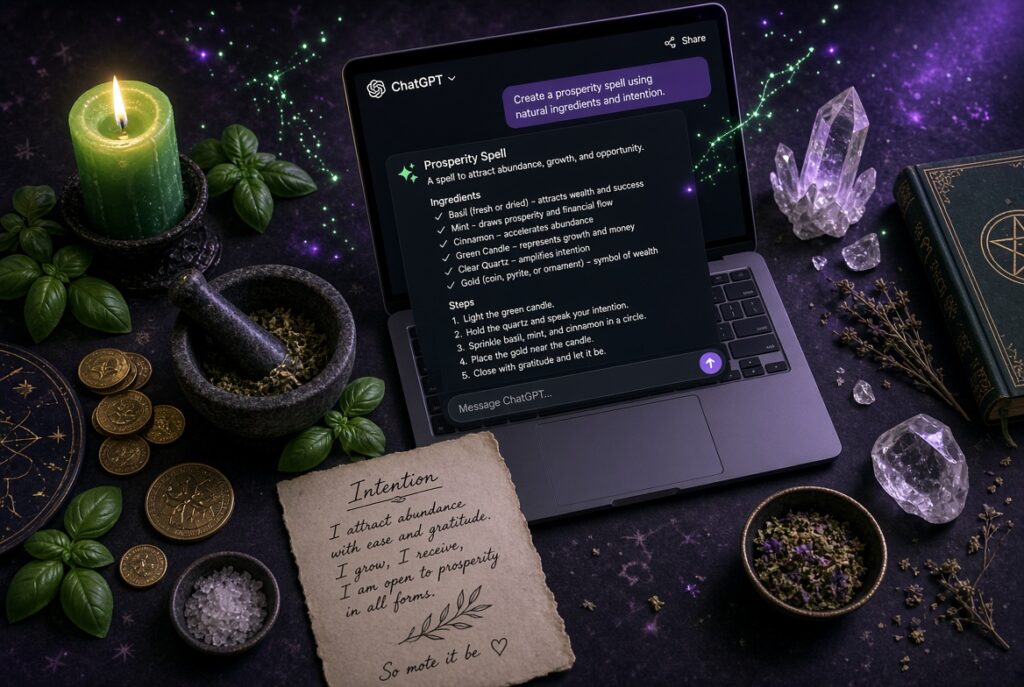
Ask ChatGPT for a prosperity spell and it will comply almost every time: a candle color, an herb, a few lines that rhyme. What it can’t do is confirm that reciting those lines changed your bank balance. Nothing can do that. No controlled study has ever shown that spoken or written intention causes events outside the person speaking it, and a chatbot’s confident tone isn’t evidence otherwise — language models are built to sound sure of themselves whether or not the underlying claim is true.
That’s not a disappointing place to start. It’s close to where the more rigorous end of modern occultism already lives. Chaos magic treats belief itself as a tool rather than a fixed doctrine, and for decades it has argued that the useful question isn’t “is this real” but “what does performing this ritual do to the person performing it.” Magical AI Grimoire, published by Weiser Books in early 2025, is built entirely around AI-assisted spellcraft on exactly this premise, and it carries a foreword from Peter J. Carroll — one of chaos magic’s founding figures, and the author of Liber Null & Psychonaut. That matters: it suggests the “psychology, not physics” position isn’t a skeptic’s compromise. It’s what a serious practitioner community already argues.
So here’s the honest promise of this guide: ChatGPT will not make your spells supernaturally effective. It will make you faster and more precise at the actual craft — wording, structure, correspondence research, personalization. The “does it work” question still gets answered the way a careful practitioner already answers it: by what the ritual does to you, not by the words alone.
Two terms worth pinning down before going further. Correspondences are the traditional associations — a color, herb, planet, or day of the week — linked to a particular intention. Casting just means performing the spell. Neither term implies a verified mechanism. They’re the vocabulary of a practice, the same way “opening” and “endgame” are vocabulary in chess without implying either player has supernatural foresight.
The Real Research on Why Ritual Feels Like It Works — and Where It Doesn’t Hold Up
This is the part almost no “AI for witches” content bothers to look up, and it’s more interesting — and more mixed — than most of the spells it would replace.
A body of peer-reviewed behavioral research treats ritual as a measurable psychological intervention: not magic, but ritual — fixed, symbolic, repeated action. The results are stranger than either true believers or dismissive skeptics expect, and one of the three landmark findings below has since run into trouble under replication. A complete guide reports that too.
Performance anxiety. In a 2016 study published in Organizational Behavior and Human Decision Processes, Harvard Business School’s Alison Wood Brooks and six co-authors had participants sing part of a song aloud to a stranger — a reliably anxiety-inducing task. Half performed a short ritual first: drawing a picture of their feelings, sprinkling salt on it, counting aloud, then throwing it away. The ritual group’s heart rates settled closer to baseline, they reported less anxiety, and independent judges rated their singing as measurably better on pitch, volume, and timing. A follow-up math-test experiment found the same ritual helped only when the test was framed as a stressful IQ exam — when identical problems were framed as “fun puzzles,” the ritual made no measurable difference. The benefit tracks anxiety, not general performance. (Full study, PDF)
Grief and loss. A separate line of research from Harvard’s Michael Norton and Francesca Gino, published in the Journal of Experimental Psychology: General, looked at ritual after loss — the kind of moment spellwork is often reached for. Across three experiments, people who performed or recalled a structured ritual after a breakup, a death, or even losing out on a $200 cash prize reported measurably less grief than people who didn’t, an effect the authors linked to a restored sense of control rather than to belief in the ritual itself. The researchers were careful to note their sample was psychologically healthy volunteers, not a clinical population, and that the same tendency toward ritual can become dysfunctional in conditions like OCD. (Full study, PDF)
The lucky-ball problem. The most-cited finding in this space is also the shakiest, and a genuinely useful grimoire says so. A 2010 study by Lysann Damisch and colleagues at the University of Cologne, published in Psychological Science, told one group of golfers they were putting with a ball that had “turned out to be lucky.” A control group got the same ball with no such framing. The “lucky ball” group reportedly sank 65% of their putts against the control group’s 48%, an effect the authors attributed to a boost in perceived self-efficacy. It’s a great story, and you’ll see it in nearly every article on this topic — but a pair of high-powered, pre-registered replication attempts published in 2014 and 2022 failed to reproduce the effect, finding performance in the “lucky” and control groups nearly identical. A 2022 meta-analysis found the effect only shows up in studies with weaker designs, not in the ones built to detect it reliably. The honest takeaway isn’t “lucky charms are proven to work” — it’s that the self-efficacy mechanism the researchers proposed is plausible and consistent with the anxiety and grief findings above, even though this particular demonstration of it hasn’t held up.
None of this proves a love spell will make someone fall for you, or that a money spell will produce a raise. What holds up — the anxiety and grief findings, replicated and consistent — is more useful for a practical grimoire than the golf-ball story ever was: the ritual half of spellcraft, the candle, the words, the repeated action, does something measurable to the person doing it, independent of any claim about external causation. That’s a sturdier foundation for a spell than pretending the mechanism is something else, and sturdier than repeating a finding that didn’t survive a second look.
Anatomy of a Spell — and Where ChatGPT Actually Helps
Strip away tradition-specific dressing, and almost every spell, in almost every lineage, is built from the same six components. Here’s where an AI collaborator earns its place, and where it flatly can’t be trusted.
| Component | What ChatGPT does well | What it can’t do |
|---|---|---|
| Intention | Sharpens a vague want (“I want money”) into a specific, well-formed statement | Judge whether the intention is realistic, healthy, or actually what you want |
| Correspondences | Suggests traditional color, herb, crystal, and planetary associations, and explains the traditional logic behind them | Verify a specific herb is safe to burn, ingest, or keep around pets and children |
| Timing | Explains moon phases, planetary hours, and sabbats in general terms | Know your actual sky tonight unless you tell it — and will guess with total confidence if you don’t |
| Tools | Brainstorms substitutions when you don’t own an athame or a specific candle color | Judge whether a “cheap substitute” is culturally loaded or simply the wrong item |
| Wording | Handles rhyme, meter, and matching the voice of a tradition | Know which words or names are restricted within a closed tradition |
| Ritual action | Structures a clean sequence: open, state, act, close | Confirm whether a “traditional technique” it produced is real lineage or invented filler |
The pattern across every row: ChatGPT is a capable drafting and research assistant for the craft side of a spell, but it has no way to verify safety, lineage, or ethics. Those require judgment about the real world, which it can’t check. Supplying that judgment is the practitioner’s job, not the model’s.
Prompting the Grimoire: What Actually Produces a Usable Spell
Vague prompts produce vague spells — generic candle colors, cliché closing lines, correspondences with no logic behind them. Specific prompts produce something you’d actually use.
Weak prompt: “Write me a spell to get my ex back.”
This asks the model to help influence a specific, non-consenting person’s feelings or decisions. Most traditions caution against exactly this kind of working — the Wiccan Rede’s “harm none” and various threefold-return concepts exist largely to discourage it. Most AI tools are also built to redirect requests that function as trying to control another real person, so you’ll likely get a self-focused alternative whether you asked for one or not.
Stronger prompt: “Write a closure ritual to help me let go of a relationship that ended six months ago. Ground it in candle magic, using colors and elements traditionally associated with release and self-forgiveness. Include a one-sentence intention statement, a simple three-step physical action, and a short incantation in free verse — no forced rhyme.”
That’s specific enough to get something genuinely usable. Here’s the shape a good response to that exact prompt takes:
Closure Ritual
Intention: I release what this relationship was, so I have room for what comes next.
You’ll need: one white candle (release, new beginnings) or black (absorbing and ending), a small piece of paper, a fireproof dish.
- Light the candle. Write the relationship’s name, or your former partner’s first name only, on the paper.
- Read the intention aloud once. Fold the paper away from you three times.
- Light the paper’s corner from the candle, set it in the dish to burn completely, and sit until the candle burns down or you choose to extinguish it.
Incantation: What was, was. I don’t ask it back. What’s done can rest — I’m done carrying it. This flame takes the weight I don’t need anymore. I keep what I learned. I let go of the rest.
Notice what’s absent: no claim that the ex will think of you, no promise of an outcome involving another person’s free will. It’s a structured, private ritual aimed at the one person any spell can reliably affect — the one performing it.
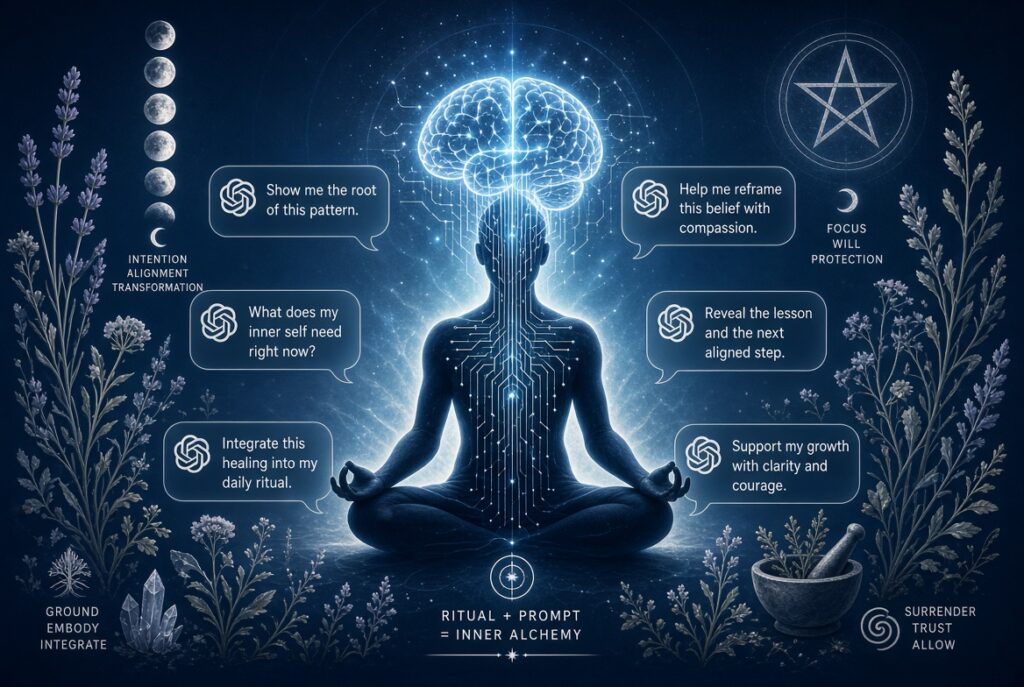
A few other prompts worth trying: “Design a five-minute confidence ritual I can do before a job interview, using correspondences for courage.” Or: “Write a protection ritual for my apartment using salt, and explain the traditional reasoning behind each step.” Both stay inside the same principle: work aimed at your own state of mind, built with real craft structure.
Quick-Reference: Common Intentions and Their Traditional Correspondences
A starting point for prompting ChatGPT with real specificity — verify anything you’ll burn or ingest before use (see the safety section below).
| Intention | Traditional color | Traditional herb/element | Traditional timing |
|---|---|---|---|
| Release / letting go | White or black | Rosemary, sage | Waning moon |
| Confidence / courage | Orange or red | Cinnamon, bay leaf | Sunday (solar day) |
| Protection | Black or dark blue | Salt, black tourmaline | New moon |
| Prosperity | Green or gold | Basil, mint | Waxing moon, Thursday |
| Love of self | Pink | Rose, rose quartz | Friday (Venus day) |
| Clarity / decision-making | Yellow or white | Lavender, clear quartz | Full moon |
Where ChatGPT Fights Itself
Ask for a spell to make a specific person fall in love with you, or a binding spell aimed at controlling someone else’s behavior, and you’ll likely notice the response getting vaguer, more self-help-flavored, or redirected outright. Coverage of AI-assisted witchcraft has noted this pattern since the GPT-3.5 era: asked for a love spell, general-purpose chatbots tend to default to offering a self-improvement ritual instead. Most AI providers filter out prompts that function as trying to control another real person’s feelings or actions without their consent.
Worth noticing: this isn’t the AI imposing an alien rule on the craft. It’s converging with a position plenty of practitioners already hold. A working aimed at overriding someone else’s will is exactly the kind of magic multiple traditions single out for caution. The AI’s content filter and the Wiccan Rede arrived at similar territory from completely different directions. Whether that redirect happens, and how it’s worded, varies between tools and changes over time as providers update their systems — treat this as a pattern to expect, not a fixed rule.
The Failure Mode Nobody’s Warning You About
Language models are well documented to sometimes state incorrect information with complete confidence — a known limitation usually called hallucination. Applied to spellcraft, it shows up somewhere more concrete than “the model made up a fact”: correspondence tables.
Ask for an herb “traditionally used for protection, safe to burn as incense,” and there’s a real chance the safety claim is invented, not sourced. The model is pattern-matching what a correspondence entry sounds like — it isn’t checking a toxicology reference or a pet-safety database. Some plants popular in folk-magic correspondence lists are genuinely unsafe to burn indoors, toxic to cats or dogs, or unsafe during pregnancy. An AI’s confident, book-like tone gives no signal about whether any specific safety claim was actually verified.
The rule this earns: treat any AI-generated correspondence involving something you’ll burn, ingest, or apply to skin as a starting point, never as the final word. Cross-check specific plants against an actual botanical or pet-poison-control reference before bringing them into your ritual space, the same way you’d check an unfamiliar ingredient before cooking with it for the first time.
The Closed-Practice Blender Problem
Modern witchcraft has always borrowed across traditions, but practitioners draw a real, ongoing line between open practices and closed ones. Open practices include Wicca, various forms of European folk magic, and ceremonial magic. Closed practices — including Hoodoo, Santería, and Haitian Vodou, along with specific Indigenous ceremonies such as sacred smudging — are traditionally taught only within the community or lineage that holds them.
An AI model trained on scraped internet text has no concept of that boundary. Ask for “a cleansing ritual” and it may hand back smudging-specific vocabulary, a Hoodoo mojo-bag structure, or Vodou-derived terminology, all folded into generic “witchcraft” with zero indication that any of it came from a closed tradition. The model isn’t being disrespectful on purpose — it simply has no mechanism for knowing which words in its training data carried cultural ownership and which didn’t.
There’s a real-world precedent for what happens when outsiders package these elements without context, at a much smaller scale than an AI model can now do it. In 2018, Sephora and the fragrance brand Pinrose canceled a planned $42 “Starter Witch Kit” containing sage, tarot cards, and a rose quartz crystal after practitioners objected to a sacred practice being mass-marketed as a lifestyle accessory. The backlash was significant enough to later become the subject of an academic case study on the commodification of a marginalized religious practice. An AI chatbot generating a similar blend on demand, one private conversation at a time, doesn’t generate headlines — but the underlying pattern, stripping context from a closed tradition, is the same one that caused the 2018 backlash in the first place.
The practical fix: when ChatGPT suggests a specific technique, tool, or term you don’t recognize, ask it directly which tradition the element comes from. If the answer names a closed practice you weren’t born or initiated into, swap in something from an open tradition instead, or treat it as a signal to seek out an actual teacher if the practice genuinely calls to you. For anything beyond a light dabble, a book from an actual practitioner — Judika Illes and Scott Cunningham are two widely respected starting points — will teach you more about context and consequence than any chat session.
What You’re Actually Handing Over
Spell-writing prompts tend to contain the most private material people type into a chatbot all week: a former partner’s name, a health fear, a financial desperation, sometimes a grudge against a specific, named person. It’s easy to forget, mid-ritual, that you’re also generating a written record on a company’s servers.
How long that record is kept, whether it’s used to train the underlying model, and who could access it under what circumstances all come down to which AI you’re using, your account type, and settings you may never have opened. It’s worth actually reading the privacy policy of whichever tool you use rather than assuming, the same way you’d check before using any other service to store something sensitive. A reasonable working habit: treat the chat window like a notebook you’re sharing with a company, not a locked diary. Avoid typing a real full name you wouldn’t want surfacing somewhere unexpected, and check whether your chat history can be deleted or excluded from model training if that matters to you.
When to Close the Laptop Instead
None of this replaces real help, and a good grimoire says so plainly. If what’s actually happening is a stalker, an abusive partner, a serious untreated health issue, or a genuine financial emergency, a spell isn’t a substitute — AI-assisted or handwritten, it doesn’t matter. Call the police, a domestic violence hotline, a doctor, or a financial counselor instead. Ritual can sit alongside getting real support; it was never built to replace it. No amount of correct correspondences changes that.
The Actual Takeaway
ChatGPT doesn’t make magic real, and it doesn’t need to. Used well, it’s a fast, patient collaborator for the craft side of spellwork: structure, wording, correspondence research. What measurably changes anything happens in the ritual itself, in you — consistent with the anxiety and grief research above, and honestly inconsistent with the shakier lucky-charm finding that gets repeated everywhere else. Write the spell. Do the ritual. Keep your expectations pointed at the person actually in the room.
Sources cited:
- Brooks et al., “Don’t Stop Believing: Rituals Improve Performance by Decreasing Anxiety,”Organizational Behavior and Human Decision Processes, 2016 (DOI: 10.1016/j.obhdp.2016.07.004).
- Norton & Gino, “Rituals Alleviate Grieving for Loved Ones, Lovers, and Lotteries,”Journal of Experimental Psychology: General, 2014 (DOI: 10.1037/a0031772).
- Damisch, Stoberock & Mussweiler, “Keep Your Fingers Crossed! How Superstition Improves Performance,”Psychological Science, 2010 (DOI: 10.1177/0956797610372631), with replication data from subsequent pre-registered studies (2014, 2022) and a 2022 meta-analysis.
- Davezilla, Magical AI Grimoire: A Book of Shadows for Contemporary Chaos, Weiser Books, 2025.