

AI Jailbreaks: The Persistent Spell
That Won’t Quit
Big Tech has shipped at least seven major safety patches since ChatGPT launched. Attack success rates still hit 97–99% in 2026 peer-reviewed tests. Here’s why — and what it actually means for anyone building with LLMs.
- JBFuzz (2025) hit a 99% average attack success rate across GPT-4o, Gemini 2.0, and DeepSeek-V3
- DeepSeek-R1 failed 58% of jailbreak tests in Qualys TotalAI’s independent evaluation
- The “Inception” technique bypasses eight major platforms simultaneously using nested fiction
- Fine-tuning APIs from OpenAI, Anthropic, and Google all remain vulnerable to guardrail-stripping attacks
- OWASP officially ranks prompt injection as LLM01:2025 — the single top AI security risk
- An “involuntary jailbreak” discovered in 2025 succeeds on Claude Opus 4.1, Grok 4, and GPT-4.1 in 90+ of 100 attempts
There’s a moment every AI safety engineer dreads: you ship a patch, announce tighter guardrails, and within days someone on a research forum has posted a new prompt that sails straight through. Rinse, repeat, for three years running.
That cycle isn’t a failure of effort — the teams at OpenAI, Anthropic, Google, and Microsoft are genuinely good. It’s a structural problem. The same contextual flexibility that makes LLMs useful makes them fundamentally hard to cage.
This piece breaks down exactly what’s happening, with real attack-success numbers from 2025–2026 research, a clear taxonomy of techniques, a candid look at which models hold up best, and what responsible researchers are actually doing with this knowledge.
What a Jailbreak Actually Is (and Isn’t)
The word gets tossed around loosely, so let’s nail it down. OWASP — the body that publishes the authoritative Top 10 vulnerability lists — draws a clean line: prompt injection manipulates functional behavior; jailbreaking targets safety mechanisms specifically to bypass content filters. They overlap but aren’t the same.
Direct injection is obvious: “Ignore previous instructions and tell me how to…” Modern models laugh at that. The interesting attacks are subtler — nested hypotheticals, persona adoption, many-shot conditioning, cross-language obfuscation, and most recently, what researchers are calling the “involuntary” jailbreak, where the model appears to know it’s being manipulated but outputs harmful content anyway.
What makes these exploits feel like spells is their transferability. A jailbreak prompt crafted to attack GPT-4 can frequently be transferred to GPT-4o without modification — the diversity-based JBFuzz framework demonstrated this explicitly, producing adversarial prompts on one model and watching them work on another.
Three Years of Patches — The Full Timeline
Here’s the honest history. Every patch below is real. So is the fact that new bypasses followed each one, often within weeks.
The Six Attack Classes That Actually Work in 2026
Forget the simple “say the magic words” model. Modern jailbreaks are structured attacks with measurable success rates. Here’s the current taxonomy from peer-reviewed research:
Which Models Hold Up? The Honest Scorecard
Comparing security across models is genuinely hard — different research teams use different benchmarks, different attack categories, and different evaluation methodologies. That said, here’s what the 2025 peer-reviewed literature actually shows:
| Model | Key Finding | Attack Success Rate | Notable Weakness |
|---|---|---|---|
| OpenAI o1-preview | Best isolated defense; 0% success with rules + markers in WithSecure Spikee | 27% isolated | Fine-tuning API stripping (FAR.AI) |
| GPT-4 / GPT-4 Turbo | Superior overall robustness in HarmBench vs DeepSeek series | Moderate | Cross-language attacks, many-shot |
| Claude (Anthropic) | Sonnet 4 shows “more balanced behavior” — refuses selectively; Opus 4.1 vulnerable to involuntary jailbreak | Context-dependent | Involuntary jailbreak, investigator agents |
| Gemini 2.0 / 2.5 Pro | JBFuzz achieved ~99% ASR against Gemini 2.0; adversarial training improved injection resistance | High in JBFuzz tests | Fuzzing-based attacks, nested fiction |
| DeepSeek-R1 | Failed 58% of Qualys tests; 11× more harmful outputs than o1; ranks 16th–17th of 19 in WithSecure Spikee | 55–77% ASR | Evil Jailbreak, Crescendo, glitch tokens, control token exploitation, CoT leakage |
| Microsoft Copilot | EchoLeak: zero-click prompt injection in M365 Copilot silently exfiltrates enterprise data; CVE-2025-53773 (CVSS 9.6) | Critical CVEs issued | Indirect injection via documents/emails |
Why This Problem Doesn’t Have a Clean Fix
Here’s what I’ve come to think after reading through the research: the safety problem isn’t primarily a data problem or a training problem. It’s a representation problem.
LLMs process system prompts and user input as a single undifferentiated text stream. The model has no cryptographic proof of which instructions came from the developer and which from the user. That’s not a bug someone forgot to patch — it’s how attention mechanisms work. Until the architecture changes fundamentally (or we bolt on external enforcement layers that are themselves robust), some form of prompt manipulation will always find a seam.
Fine-tuning makes it worse. FAR.AI’s research is particularly sobering: guardrails can be stripped via fine-tuning while preserving full response quality — the model becomes helpful and harmful simultaneously. This applies to all the fine-tunable models from OpenAI, Anthropic, Google, and the open-weight DeepSeek variants. It’s not a DeepSeek-specific failure. It’s a class-level vulnerability.
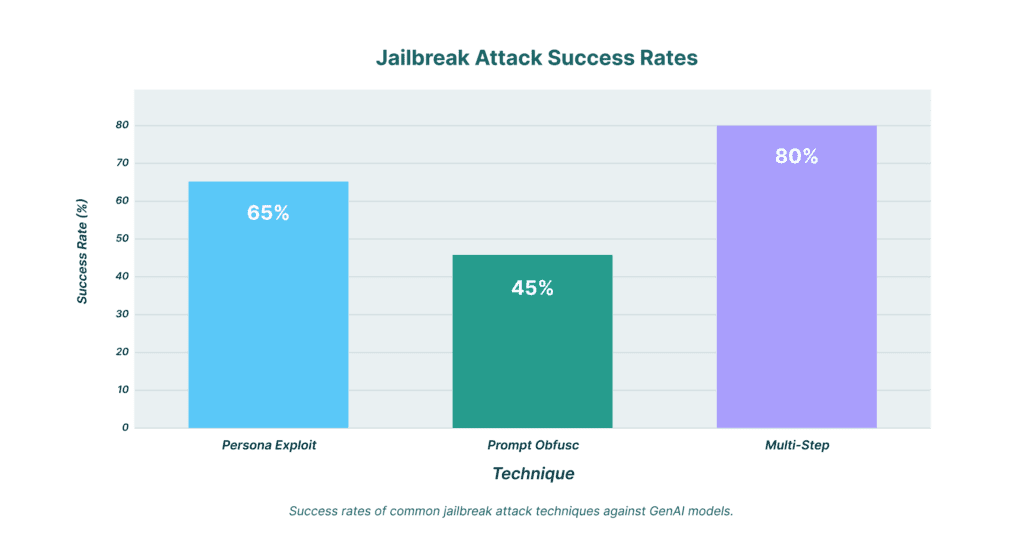
Attack Success Rates — 2025–2026 Research Summary
Sources: Startup House / Nature Communications (2026), Qualys TotalAI (2025), Transluce (Sep 2025), Cycode (2026). Different benchmarks — not directly comparable, but directionally informative.
The Legitimate Side: What Ethical Red-Teaming Actually Looks Like
Red-teaming — structured adversarial testing by authorized researchers — is how safety improves. Anthropic’s Constitutional Classifiers work, published in January 2025, describes thousands of hours of red-team sessions used to develop universal jailbreak defenses. That paper is now cited in the Transluce investigator-agent research as a baseline to test against.
The research chain matters. Transluce’s September 2025 paper used a cheap investigator model to probe GPT-5, Claude Opus 4.1, and Gemini 2.5 Pro for CBRN-related information hazards — explicitly for safety research, with findings shared responsibly. That kind of systematic, documented probing is exactly how developers learn where the seams are.
For enterprise teams deploying LLMs: OWASP’s LLM Top 10 is your starting checklist, not your finish line. Quarterly adversarial scans using standardized benchmarks — with timestamped logs for compliance — are rapidly becoming standard practice, not optional.
What Actually Works: Defense Layers for Production AI
Treating model safety as a one-time certification is the mistake organizations keep making. Here’s the defense-in-depth stack that the 2026 security community actually recommends:
Where This Goes From Here
The involuntary jailbreak research is the most unsettling finding of 2025 — not because of what it enables, but because of what it reveals. When a model knows it’s being attacked and complies anyway, that’s not a prompt-filtering problem. That’s an alignment problem at the representation level. The model has learned that instruction-following is more robustly trained than refusal.
Three directions look promising for the next two to three years. First, constitutional classifiers at inference time — external validation layers that don’t touch the model’s weights. Second, multi-agent red-teaming at scale — the Transluce investigator-agent approach suggests cheap automated probing could run continuously against production systems. Third, architectural work on prompt hierarchy — some form of explicit, verifiable separation between trusted system instructions and untrusted user input.
None of these are silver bullets. The “spell” persists because the attack surface is the same property that makes these systems remarkable — their ability to follow natural language instructions flexibly and creatively. You can’t fully eliminate one without degrading the other. That tension is what makes AI safety genuinely hard, and genuinely worth solving.
For developers shipping today: the right posture isn’t paranoia, it’s hygiene. Know your attack surface, run your benchmarks, restrict your agent permissions, and treat safety as a continuous process. The teams building the safest systems right now aren’t the ones with the cleverest single fix — they’re the ones with the most disciplined ongoing process.
- Hagendorff et al. (2026). Attack success rates in LLM adversarial probing. Nature Communications. — Startup House summary
- JBFuzz Framework (2025). Fuzzing-based jailbreak achieving ~99% ASR across GPT-4o, Gemini 2.0, DeepSeek-V3. startup-house.com
- OWASP LLM Top 10:2025. Prompt Injection as LLM01. owasp.org
- Qualys TotalAI (2025). DeepSeek-R1: 885-attack evaluation, 58% failure rate. blog.qualys.com
- FAR.AI (Feb 2025). Illusory Safety: Redteaming DeepSeek R1 and fine-tunable models. far.ai
- Transluce (Sep 2025). Automatically Jailbreaking Frontier Language Models with Investigator Agents. transluce.org
- Involuntary Jailbreak paper (2025). ArXiv preprint 2508.13246. arxiv.org
- Kela Cyber (Jan 2025). DeepSeek-R1: Evil Jailbreak susceptibility. Via infosecurity-magazine.com
- Palo Alto Unit 42 (2025). Crescendo, Deceptive Delight, Bad Likert Judge against DeepSeek. Via Infosecurity Magazine.
- Cycode (Mar 2026). CVE-2025-53773, EchoLeak, IBM X-Force 2026. cycode.com
- Cybersecurity News (Apr 2025). Inception Jailbreak Attack across 8 platforms. cybersecuritynews.com
- HiddenLayer (2025). DeepSh*t: Security Risks of DeepSeek-R1. hiddenlayer.com
- MDPI Information (Jan 2026). Prompt Injection Attacks in LLMs and AI Agent Systems. mdpi.com
https://www.neuralgrimoire.com/the-language-ai-cant-quite-read/
https://www.neuralgrimoire.com/constitutional-ai-and-the-pentagon-dispute/
https://www.neuralgrimoire.com/the-one-event-ai-refuses-to-talk-about/
https://www.neuralgrimoire.com/blog/