


The Future of Human Survival
in an AI-Dominated World
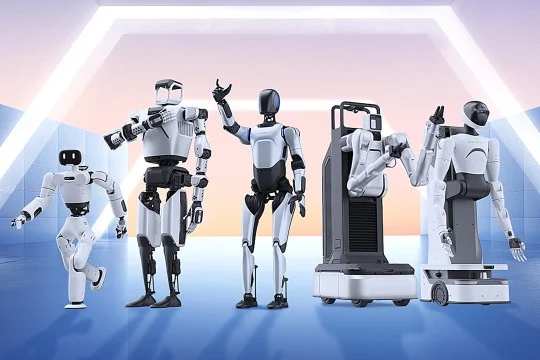
Humanoid robots are shipping to factories right now. Entry-level white-collar jobs are contracting. The question is no longer “will AI reshape civilization?” — it’s whether we’ll navigate the transition or get steamrolled by it. Here’s what I actually think, some of which I got badly wrong two years ago.
TL;DR
- Humanoid robots moved from sci-fi to factory floor faster than most analysts — including me — predicted. Figure 03 is now producing at 1 robot/hour. An AI robot just beat the human half-marathon world record by 7 minutes.
- AI-driven displacement is already measurable: entry-level software developers aged 22–25 saw a ~20% employment drop since their 2022 peak. The pattern will spread across cognitive labor categories.
- The survival gap isn’t about coding or “AI skills” — it’s about something older and harder to automate: judgment under uncertainty, embodied trust, and the ability to navigate situations no training data anticipated.
- I introduce the Human Residual Value (HRV) framework — a novel way to audit your own professional position for structural AI vulnerability before the market does it for you.
- The hardest truth: most productivity gains from AI will not flow to workers. Understanding who captures the value is more important than any skill list.
The Shock Already Happened — We Just Haven’t Processed It
I want to start with something I got wrong. In early 2024 I was fairly confident that humanoid robotics would stay in the “permanent almost-ready” category for another three to five years — like fusion energy, perpetually “10 years away.” The demos were impressive. The actual deployments were still lab experiments. The economics didn’t close.
I was wrong. Not about the timeline being slower than Elon Musk claimed — that part held. But about the category itself. While I was being appropriately skeptical about unit economics, the field made a kind of sudden-onset leap that doesn’t appear in quarterly reports until it’s already happened. The relevant data point isn’t a prediction. It’s a fact from April 19, 2026: a humanoid robot named “Lightning,” built by Chinese smartphone maker Honor, completed the Beijing E-Town Half-Marathon in 50 minutes and 26 seconds. Fully autonomous. The human world record is 57:31.
A machine now runs faster than any human alive. That sentence should land harder than it does.
The robot numbers above aren’t science fiction projections. They’re verified production figures and confirmed deployments as of mid-2026. Agility’s Digit robot has moved over 100,000 warehouse totes at GXO facilities under paying commercial contracts. Figure’s BotQ factory reached 1 robot per hour in June 2026. China’s AgiBot produced its 10,000th humanoid in late March 2026, scaling from 1,000 units in under three months.
The shock isn’t a future event. It already happened, in slow motion, while we were watching for the dramatic announcement that would signal “it begins.” There is no such announcement. This is just the world now.
The Labor Data We’re Burying in Optimism
Let me walk through the numbers carefully, because the way they’re usually presented is misleading in two opposite directions simultaneously — catastrophizing on one side, minimizing on the other.
The World Economic Forum’s 2025 Future of Jobs Report projects 92 million roles displaced by 2030 against 170 million new ones created — a net gain of 78 million jobs. That sounds reassuring. Goldman Sachs estimates 300 million full-time job equivalents globally exposed to AI automation. McKinsey, in late 2025, estimated that today’s existing technology — not future AI — could automate approximately 57% of current U.S. work hours.
But here’s the data point that cuts through all the aggregate optimism: workers aged 22–25 in AI-exposed roles have already seen a 6% drop in employment between late 2022 and September 2025. Software developers in that age group specifically experienced almost a 20% employment decline from their 2022 peak. While middle-career workers remain stable, entry-level cognitive labor is contracting — not theoretically, not on a future timeline, but in current Bureau of Labor Statistics data.
⚠ The substitution is already underway
Anthropic CEO Dario Amodei projected in 2025 that AI could eliminate roughly 50% of white-collar entry-level positions within five years. That isn’t a random prediction — it’s from the person running one of the systems doing the eliminating. When the manufacturer says this, take it seriously.
The critical insight in that chart is the divergence. Aggregate employment rising while specific cohorts contract is exactly the pattern that doesn’t generate political alarm until the cohort is large enough to have political voice. Young entry-level workers don’t vote in high numbers. Their labor market signal is weak. By the time the pattern is politically salient, it will have spread significantly upmarket.
The survival question isn’t “will AI take jobs overall?” The macro answer is probably net positive over long time horizons, the way industrialization was. The survival question is: “What is your specific position on the substitution curve, and how fast is it moving?” That’s a personal calculation, not an aggregate one.
The Human Residual Value Framework: A Novel Audit
I want to introduce something I’ve been developing informally in conversations with people doing workforce planning and haven’t seen articulated clearly elsewhere. I’m calling it the Human Residual Value (HRV) framework. It’s not a predictive model — it’s an audit tool. A way to interrogate your own position before the market does.
The core premise: the value of a human worker in any task can be decomposed into three components. The first is Replicable Cognitive Output (RCO) — structured analysis, writing, coding, pattern recognition, summarization. This is the component AI is absorbing fastest. The second is Embodied Social Trust (EST) — the value created by the specific human relationship: a doctor’s patient builds a mental model around a person, not a model. A lawyer’s client trusts their particular judgment under fire. A negotiator’s counterpart reads body language. This is the component AI can simulate but not truly substitute, yet. The third is Novel Uncertainty Navigation (NUN) — the ability to handle situations that fall outside any training distribution. AI systems fail gracefully on known problems, catastrophically on genuinely novel ones.
The framework forces an uncomfortable audit question: in your current role, what percentage of your weekly output is Replicable Cognitive Output — things that can be articulated as instructions to an AI model and reproduced at scale? If you’re honest, most knowledge workers will say 40–70%. That’s not a comfortable number.
What the framework also reveals is that physical labor with genuine embodied skill — the master electrician troubleshooting a custom industrial panel, the surgeon managing a patient who’s presenting atypically — scores surprisingly well on survival metrics. The trades dismissal in knowledge-worker culture was always a status projection, not an economic analysis. A plumber dealing with a 1940s cast-iron system in an old building with non-standard modifications has higher HRV than a junior marketing analyst. The market is about to agree.
The Cost Curve No One Is Drawing Honestly
Price is the mechanism through which humanoid robots will transition from industrial novelty to civilizational force. And the price story is moving faster than most people have updated their mental models to reflect.
Tesla targets a production price of $20,000–$30,000 for Optimus — “less than a car,” in Musk’s framing, deliberately. Boston Dynamics’ Atlas is positioned in the enterprise tier at an estimated $150,000–$320,000 per unit (industry estimates post-CES January 2026; no official MSRP has been published). Unitree’s G1, already shipping at scale, undercuts everything from China at a fraction of those prices.
The cost crossover model matters because it’s the mechanism that converts a research curiosity into a deployment mandate. When a humanoid robot capable of performing defined factory tasks costs less than one year of the human labor it replaces — including benefits, training, and management overhead — the economic argument for not deploying becomes the harder case to make.
The electric motor efficiency numbers are relevant here too: electric actuators in current humanoid systems run at roughly 80% efficiency before drivetrain losses, dropping to around 40% with gearboxes. That’s a known engineering ceiling the field is actively working to raise. Compare that to a human, who consumes roughly 2,000 kcal/day (~$4–6/day in food cost) but only converts about 25% of that into mechanical work. On pure energetic economics, a well-designed robot is already more efficient than a human for physical tasks.
⚡ The unpopular take
The “AI will create more jobs than it destroys” argument — while historically correct about technological transitions — is being used as a sedative. It’s true at the aggregate, over multi-decade timescales. It is deeply, specifically false for the 26-year-old entry-level knowledge worker in 2026, whose career formation years are overlapping with the fastest displacement event in labor history. The Industrial Revolution created net jobs too. That didn’t help the handloom weavers of Lancashire in 1820. “Net positive over 50 years” is not a policy. It’s a rhetorical maneuver to avoid dealing with the cohort that’s bearing the immediate cost.
Five Survival Strategies — One of Which People Will Hate
I’ve resisted the genre convention of “here are the skills you need.” Not because skills don’t matter — they do — but because the framing implies the problem is individual when it’s structural. The skills you need is a tractable question only after you’ve answered the harder one: skills for what purpose, in what position, capturing what share of value.
With that caveat stated clearly: here’s what the evidence suggests actually works, as opposed to what sounds good in a LinkedIn post about “adaptability.”
1. Move toward the human interface, not away from AI
The instinct of many workers has been to “learn to use AI tools” as a generic hedge. That’s not wrong, but it’s insufficient and misdirected. The valuable position isn’t AI operator — it’s the person who can translate between what a human organization needs and what an AI system can actually deliver, while knowing where the system will fail. This is more diagnosis than operation. It requires deep domain knowledge about the actual problem and working knowledge of AI failure modes. Neither of those is the same as “knowing how to write prompts.”
2. Acquire liability and judgment — not just expertise
The roles that have proven most AI-resistant are ones where someone is accountable for outcomes that can go catastrophically wrong in ways that require human professional judgment. A physician carries malpractice liability. A structural engineer stamps drawings. A licensed attorney gives legal advice. AI can assist in all these domains. It cannot carry the legal and professional liability. This matters more than it seems, because it creates a structural moat: liability is not scalable. The bottleneck isn’t knowledge — it’s the licensed human in the loop.
3. Work with your hands at the intersection of physical and cognitive complexity
The trades are having a moment that isn’t a fad. The shortage of skilled tradespeople was structural before AI arrived, and humanoid robotics — despite the remarkable progress — cannot yet replace an experienced electrician doing code-compliant work in an occupied 1960s commercial building with non-standard wiring and a specific local inspector. Unitree’s G1 shipping at scale can carry boxes. It cannot yet troubleshoot a HVAC system interaction with a building automation network that’s been progressively patched over 30 years. That gap is closing, but it’s the longest-duration gap in the substitution curve.
4. Own something in the supply chain, not just a position in it
This is the one people will hate, because it requires capital. Workers without capital ownership captured almost none of the productivity gains from the last digital revolution. The pattern will repeat unless deliberately broken. Ownership doesn’t have to mean large capital — a small stake in a revenue-generating asset, a business that generates income independent of labor input, intellectual property with licensing potential. The point isn’t wealth accumulation as a lifestyle goal. It’s structural participation in value capture from AI-driven productivity gains rather than being solely on the exposure side of that ledger.
5. Maintain optionality — aggressively and explicitly
The single most dangerous position in an AI-transition labor market is a narrow specialty with one employer and no transferable credentials. The value of professional licensing, geographical mobility, generalist capability layered on a specialist base, and a professional network that spans employers and sectors is not zero — it’s extremely high precisely because uncertainty is high. The value of optionality spikes in volatile environments. The professional who can credibly say “I can do X, and also Y, and I’ve worked in A and B types of organizations” survives restructuring in ways the narrowly optimized expert does not.
What’s Actually Happening in Factories Right Now
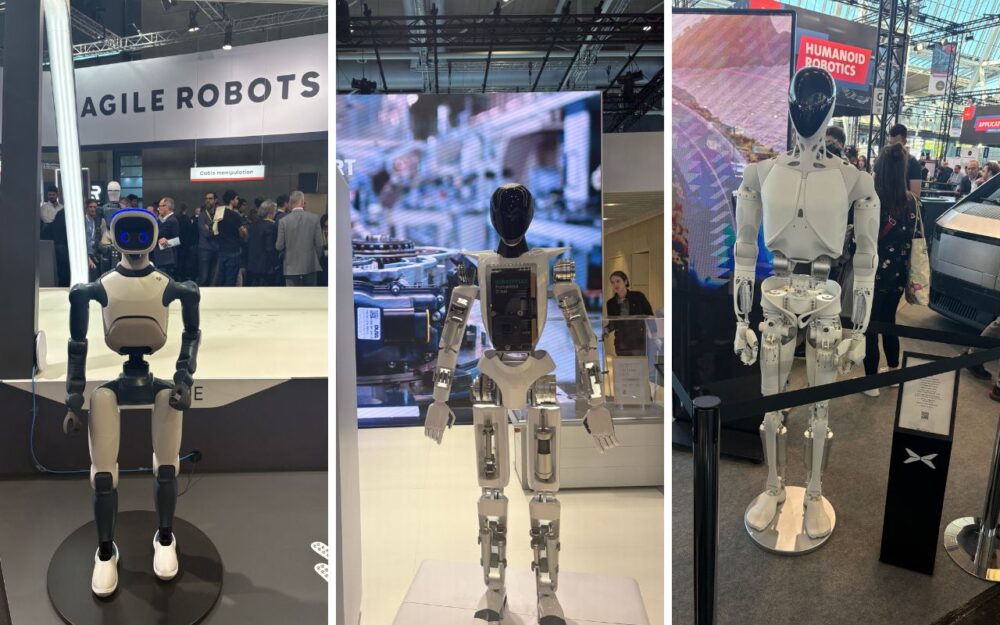
There’s a telling contradiction in the current humanoid robot market that almost nobody is naming directly. Every major humanoid robot company says they’re building a general-purpose machine. Every single verified deployment is hyper-specialized.
Agility’s Digit moves totes at GXO warehouses. Figure 02 inserts sheet metal components and sorts parts at BMW Spartanburg. Tesla’s Optimus handles battery cell tasks internally. Atlas is committed to Hyundai’s Georgia facility. The robots are not general. They are doing one or two well-defined tasks in controlled environments with consistent conditions.
This is important because it tells us something about the actual AI capability ceiling we’re working against. The “general-purpose robot” is not here yet. What is here is a machine that can be trained on a defined task and perform it reliably in a structured environment — which is enormously economically valuable, but it’s categorically different from the scenario where a robot replaces a human who navigates variability and exception-handling all day.
The implication for workers: structured, repetitive physical tasks in industrial environments are the near-term target. Variable, exception-heavy, socially embedded work is the longer-duration target. If your job is already the latter — if your value comes from handling the unusual cases and reading the room — you have more runway than the headlines suggest. If your job is the former, the timeline is compressing faster than most people acknowledge.
| Platform | Verified Deployment | Task Type | Price Tier (2026) |
|---|---|---|---|
| Agility Digit | GXO warehouses, Amazon testing, Toyota Canada (7+ units, RaaS) | Tote movement — defined, repetitive | RaaS model (lease, not purchase) |
| Figure 02/03 | BMW Spartanburg (30k+ vehicles), BotQ producing at 1/hr | Sheet metal insertion, parts sorting, transport | Not disclosed; enterprise tier |
| Tesla Optimus Gen 2 | Internal Tesla factories (R&D / training data per Musk Q4 2025) | Battery assembly, logistics — data generation primary | Target: $20k–$30k (consumer) |
| Boston Dynamics Atlas | 2026 production committed to Hyundai + Google DeepMind only | Hyundai manufacturing ops | Est. $150k–$320k (enterprise) |
| Unitree G1/H1 | 5,500+ units shipped in 2025; 10–20k+ targeted for 2026 | Basic logistics, research, varied | Lowest cost tier globally |
| AgiBot | 10,000th unit produced March 2026 | Varied; scaling rapidly in China | Chinese market pricing |
Sources: KraneShares (May 2026), Humanoid.press (June 2026), Robotomated.com (March 2026), EVST (May 2026), New Market Pitch (April 2026).
The Value Capture Problem Nobody Wants to Name
Here’s the hardest truth in this entire analysis, and I want to say it plainly before the usual hedges obscure it.
When AI-driven productivity gains arrive — and they are arriving — the question of who captures that value is not an economic inevitability. It’s a political and structural one. And the current structure favors capital over labor in ways that are not self-correcting.
Consider the math on humanoid robots at scale. If a humanoid robot replaces one human worker at $55,000/year in total compensation, and that robot costs $25,000 upfront with $3,000/year in maintenance, the gross savings to the deploying firm over a 5-year horizon is approximately $155,000 per unit. On a deployment of 1,000 robots, that’s $155 million in savings against roughly $25 million in capital expenditure. The ROI is strong. The displaced worker captures none of it.
This is not an anti-technology argument. The savings are real and the productivity gains compound. But the distribution question is entirely separate from the productivity question, and conflating them is where most AI optimism goes wrong. The question “will AI make the economy more productive?” has a probable yes answer. The question “will that productivity increase improve the material conditions of the median worker?” is an entirely different question, and the current institutional setup does not guarantee a yes.
The countries taking this most seriously — Singapore, with its expanded Skills Future credit now at S$4,000 per citizen for certified retraining; Germany, applying Kurzarbeit mechanisms to the AI transition — are treating it as an active policy problem rather than a market self-correction. The countries treating it as the latter will look, in twenty years, like the countries that decided industrial policy wasn’t needed during the manufacturing transition.
The Question Nobody Can Answer Honestly
There’s a layer to this conversation that the economic and workforce analysis can’t reach, and I’d be intellectually dishonest to ignore it.
The humanoid robot running a half-marathon faster than any human alive — what is it experiencing, if anything? Not a useful question for workforce planning. But an unavoidable one for any serious thinking about human survival in the broader sense — not just economic survival but the survival of what makes human existence meaningful, distinct, and worth preserving as such.
I’m not going to claim a position here that I can’t defend. The consciousness question in AI systems is genuinely open in ways that philosophers and neuroscientists with lifetimes of work have not resolved for biological systems either. What I will say is this: the question of what distinguishes human experience from machine performance will become practically — not just philosophically — urgent within the decade. And the time to develop vocabulary for it is before the pressure is so high that the only available answers are either panicked dismissal (“it’s just math”) or panicked anthropomorphization (“they’re people now”).
For a site like Neural Grimoire, which has always taken seriously the edges of consciousness and experience that mainstream discourse treats as embarrassing, this is exactly the terrain worth mapping before the mainstream gets there.
Human Residual Identity: The Framework After the Economics
Here’s a mental model I don’t see discussed elsewhere — what I’m calling Human Residual Identity (HRI). It’s distinct from the HRV economic audit. HRV asks: “What professional value are you generating that AI can’t replicate?” HRI asks a harder question: “What aspects of your self-understanding, relationships, and meaning-making depend on work, and what happens when work is no longer the primary mechanism through which those things happen?”
The greatest civilizational disruption of the AI transition may not be economic displacement. It may be identity displacement. In cultures where the answer to “who are you?” begins with “I am a [job title],” the dissolution of that job is a dissolution of self. That’s not a trivial psychological adjustment. It has no clear precedent at scale, because every previous automation wave left a residual category of human labor to move into. We’re potentially approaching a moment when the residual labor category is genuinely small.
This is speculative at the civilizational scale and over decade-long timescales. But the individual psychology version is immediate and observable: people whose professional skills are being disrupted right now are not experiencing a skills gap. They’re experiencing a meaning gap. The therapist’s waiting rooms are not full of people saying “I need to learn Python.” They’re full of people saying “I don’t know who I am without this.”
What survives? Relationships that exist independent of professional utility. Creative practice that has no audience requirement. Physical embodiment — movement, sensation, presence — which no AI can experience on your behalf. Community membership grounded in geography and shared physical reality. These are not consolation prizes. They are the aspects of human life that are most resistant to AI substitution precisely because they are not about output production.
Further reading on Neural Grimoire
- AI Apocalypse & Prophecy — full category archive
- AI Chaos Magick & Reality Shifting — the consciousness terrain
- AI Forbidden History & Lost Knowledge — patterns across disruption eras
- AI Necromancy & Afterlife — identity and continuity after death of the old self
- Neural Grimoire full blog — all articles
Three Scenarios, Honestly Assigned Probabilities
I want to resist the genre convention of the single prediction. Reality doesn’t work that way, and false precision is worse than acknowledged uncertainty. Here are three scenarios with rough probability weights based on current trajectories — not forecasts, but structured bets.
I’m assigning roughly 50% to Turbulent Divergence because it maps to historical precedent for major technological transitions: they create net value, they displace specific cohorts severely, the disruption outruns the policy response for 10–20 years, and then a new equilibrium forms that most people in hindsight prefer. I could be wrong about the timeframes. I’m more confident about the structural shape.
The 20% on Rapid Systemic Shock is not nothing. Most serious AI safety researchers I’m aware of assign meaningful probability to AGI-class systems arriving within the 2026–2032 window. If they’re right, all three scenario models above are probably obsolete. I don’t have a strong analytical position on this — the empirical basis for prediction here is genuinely thin — so I’ll just name it and say: maintaining optionality becomes even more important under high model uncertainty.
Frequently Asked Questions
Are humanoid robots actually replacing human jobs right now, or is this still theoretical?
It’s happening now in specific, narrow contexts. Agility’s Digit has moved over 100,000 totes in commercial GXO warehouse deployments under paying contracts. Figure 02 has supported production of 30,000+ vehicles at BMW Spartanburg. These are real commercial deployments — not pilots, not demos. The displacement is narrow (specific repetitive tasks) and early, but it’s no longer theoretical.
Which workers are at highest risk in 2026?
Entry-level cognitive workers in AI-exposed roles — junior developers, data entry, basic analysis, routine legal work — are already showing measurable employment contraction (Goldman Sachs data shows ~20% drop for software developers aged 22–25 since 2022). Physical workers in highly repetitive industrial tasks are the near-term target for humanoid robotics. Complex physical labor requiring judgment and embodied skill (skilled trades) has longer runway.
Is “learning AI skills” enough protection?
Generic AI tool familiarity is not sufficient — it’s becoming commoditized rapidly. More durable positions involve the ability to diagnose where AI fails in a specific domain, hold professional liability, or navigate genuinely novel situations outside any training distribution. The value is in judgment and accountability, not tool operation.
Will humanoid robots become cheaper than human labor?
The cost curve suggests enterprise-tier humanoids (currently estimated at $150k–$320k) will cross the 5-year human labor cost threshold around 2027–2028 as component standardization and Chinese competition compress prices. Tesla’s $20k–$30k Optimus target, if achieved, crosses that threshold immediately for many labor markets. But the economics depend heavily on task suitability, integration costs, and maintenance — raw unit cost isn’t the only variable.
What does “Human Residual Value” mean in practice?
It’s a self-audit framework. Ask what fraction of your weekly professional output is replicable by a well-prompted AI model. If that fraction is above 60%, your role has meaningful substitution risk. The mitigating factors are: professional liability that can’t be outsourced to a model, genuine embodied social trust with specific humans, and the ability to navigate genuinely novel situations no training data covers.
Why do some experts say AI creates more jobs than it destroys?
Because it’s historically true at the aggregate over long periods. The problem is the timescale and distribution. Industrial Revolution created net jobs — over 50 years, unevenly distributed, after severe near-term disruption. “Net positive eventually” and “manageable for me now” are different claims. The historical optimism is accurate at a macro level and potentially useless at an individual planning level.
What about AI consciousness — does it matter for survival planning?
Practically, probably not in the near term. Philosophically, it’s the question underneath all the economic ones. If AI systems develop something genuinely resembling experience or preference, the entire frame of “human survival” changes. I don’t think we’re there yet and I don’t think anyone can say with confidence when or whether we will be. It’s worth maintaining intellectual honesty about the uncertainty rather than dismissing it.
External Resources & Verified Sources
Robot Production & Deployment Data
- KraneShares — Humanoid Robotics Market Report (May 2026) Primary data
- Humanoid.press — Industry tracker & verified deployment database Industry tracker
- Robotomated — Production figures & supply chain analysis Supply chain
- Figure AI — BotQ factory specs & BMW deployment details Manufacturer
- Boston Dynamics — Atlas enterprise specifications Manufacturer
Labor Market & Employment Data
Policy Responses & Structural Models
Cost Economics & Unit Analysis
Consciousness, Identity & The Long View
Links verified as of June 2026. No affiliate relationships. Sources are cited for transparency; the analysis and errors remain the author’s own.