


By Tom Morgan · Originally published January 2, 2026 · Updated October 25, 2026 · About 10 min read
Short answer: Zombies are fictional. The preparedness advice built around them is not. Store water and food for at least three days (agencies commonly suggest working toward two weeks for sheltering at home), write down a family plan, and get to know the neighbors who would actually knock on your door. That covers most of what really goes wrong: storms, outages, floods, wildfires and pandemics.
Every few years the internet rediscovers that a federal health agency once told people how to survive the undead. Most of the pages that follow treat it as a joke, or as a way to sell you a headlamp. This one tries to do something less common: separate what is documented from what is merely plausible, show the sources, and give you a plan you can finish in a month.
Contents
- Why the CDC wrote about zombies
- Fact check: the Pentagon “zombie plan”
- What the Cornell outbreak model really shows
- Your kit: 3-day baseline and 2-week home target
- Water: the part people get wrong
- Evacuate or shelter in place?
- Why neighbors matter more than bunkers
- Who your kit must also cover
- A four-week starter plan
- FAQ
- Sources, corrections and how this was checked
Why the CDC wrote about zombies
On May 16, 2011, Ali S. Khan, then director of the CDC’s Office of Public Health Preparedness and Response, posted “Preparedness 101: Zombie Apocalypse” on the agency’s Public Health Matters blog. The idea grew out of a CDC Twitter session about disaster planning, and a co-worker suggested using a zombie hook to liven up the hurricane message. CDC spokesman Dave Daigle later described the starting point to Fox News: during a hurricane-preparedness discussion, someone complained that the agency kept putting out the same messages.
It worked. According to the Associated Press, Khan’s posts normally drew 1,000 to 3,000 hits a week. By the end of the week, the post was trending worldwide, communications officer Margaret Silver told USA Today, and ABC News reported it passed 3 million views and 500 comments. Fox News reported the post became the CDC’s most popular blog entry within two days, and Northwestern University’s Medill reporting, citing Fox, said the agency’s server went down for a few hours. CDC officials told the AP it took no extra time or money.
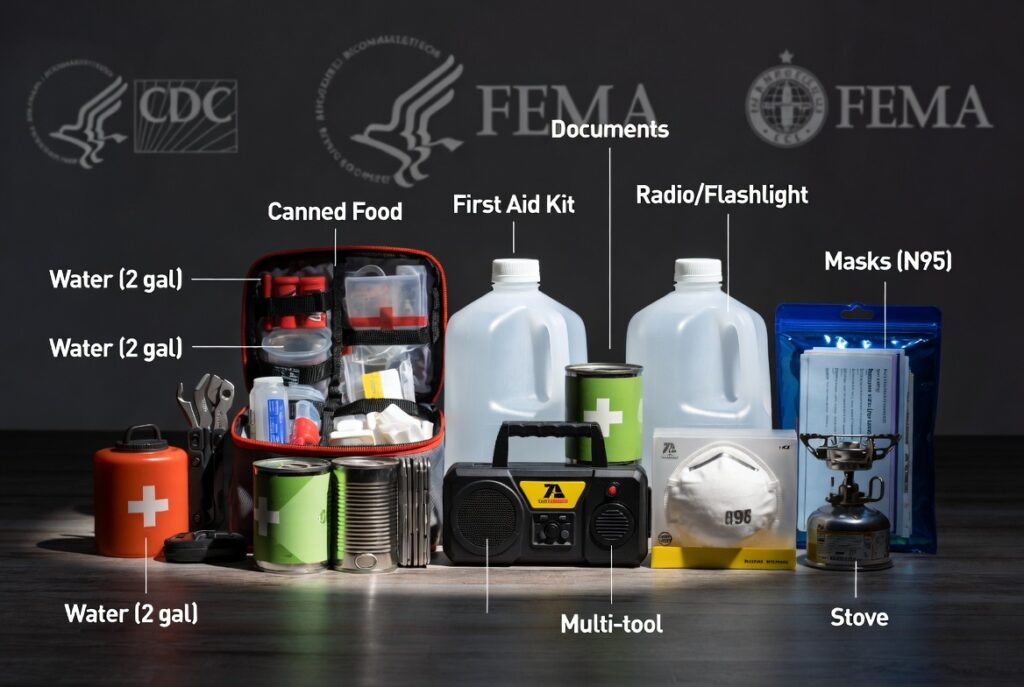
Under the joke, the advice was standard. The post told readers to build a kit with water, food, medication, tools, a battery-powered radio, hygiene items, clothes, bedding, copies of important documents and first aid supplies, then to sit down with family and make an emergency plan. The CDC followed up in October 2011 with a graphic novel, Preparedness 101: Zombie Pandemic.
The lesson is about attention, not monsters. Dry checklists get ignored. A memorable frame gets them read.
Fact check: the Pentagon “zombie plan”
Social posts regularly cite a Pentagon document as proof that governments are planning for zombies. The document is real. The conclusion is not.
CONPLAN 8888-11, “Counter-Zombie Dominance,” is dated April 30, 2011, and came from U.S. Strategic Command. Its own disclaimer says it was created by junior military officers in training on the Defense Department’s contingency-planning process, as a fictional scenario. A Strategic Command spokeswoman told Foreign Policy it is a training tool and not a Strategic Command plan, and PolitiFact’s 2023 fact check of posts claiming it proves a real zombie threat concluded that no zombie apocalypse is coming. The document also contains a line saying it “was not actually designed as a joke”: the authors chose an impossible scenario so nobody could mistake a training exercise for a real operation.
So there is a genuine, documented use of zombies by the U.S. government, and it is the same trick the CDC used: a vivid frame wrapped around a serious method.
What the Cornell outbreak model really shows
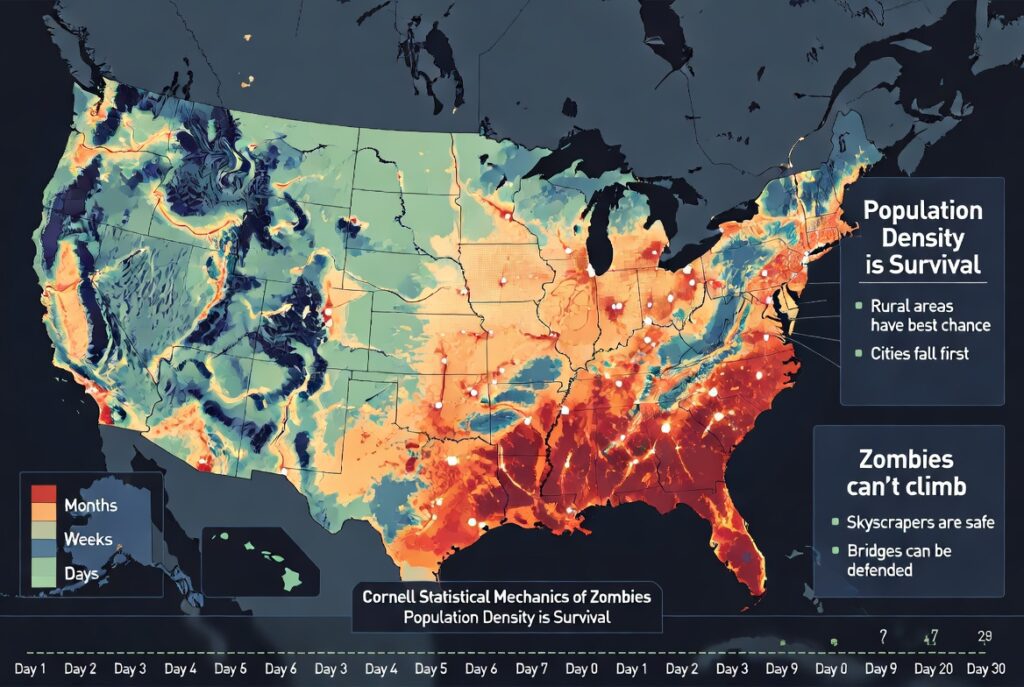
In 2015, Cornell physicists Alexander Alemi, Matthew Bierbaum, Christopher Myers and James Sethna published “You Can Run, You Can Hide: The Epidemiology and Statistical Mechanics of Zombies” in Physical Review E (volume 92, article 052801). The preprint is on arXiv.
Be precise about what it is. The abstract says the authors use a fictional disease to introduce techniques from modern epidemiology modeling and from the study of critical phenomena. They derive a closed-form expression for the fully connected model, show that a single-person-per-site 2D lattice version falls in the percolation universality class, and finish with a full-scale stochastic simulation of an outbreak across the continental United States. That is a physics teaching paper, not a survival manual.
The one idea that transfers to real life is intuitive: spread slows where people are sparse. In the press release coverage, Alemi explained that once an outbreak reaches thinly populated areas, it slows because there are fewer people to infect. Press coverage of the study named Montana, Idaho and the Dakotas as the places an outbreak would take longest to reach.
What the paper does not do: it makes no claims about real pathogens, and it offers no tested advice on where you should shelter. Real epidemics also depend on travel, supply chains, and public health response, which a simplified model leaves out.
Your kit: 3-day baseline and 2-week home target
Ready.gov says to have your own food, water, cash, and other supplies to last for at least three days, and possibly longer if you live somewhere remote or hard to reach. University extension services summarizing FEMA and Red Cross guidance say to begin with three days, then keep building toward two weeks or more for sheltering at home. Ready.gov’s pages are periodically revised, so check ready.gov/kit for the current list before you shop.
| Item | 3-day baseline | 2-week home target | Notes |
|---|---|---|---|
| Water | 1 gallon per person per day (about 3 gal) | About 14 gal per person | Covers drinking and sanitation. |
| Food | Non-perishable, no-cook items | Shelf-stable staples you actually eat | Include a manual can opener. Assume no power and no refrigeration. |
| Medications | Daily prescriptions plus basics | Ask your pharmacist about a longer buffer | Ready.gov notes that about half of Americans take a prescription daily. |
| Light and radio | Flashlight, battery-powered or hand-crank radio, spare batteries | Add a NOAA weather radio | Cell networks can fail or overload. |
| First aid | Basic kit | Add a first aid reference | Learn to use it before you need it. |
| Documents and cash | Copies of ID, insurance, contacts | Waterproof copies plus a digital backup | The CDC’s zombie post also listed copies of important documents. |
| Warmth | Blanket or sleeping bag per person | Same | Winter outages are a real hazard. |
| Sanitation | Soap, wipes, bags | Add more of each | Easy to forget, miserable to lack. |
What is missing on purpose: weapons. The kit list in the CDC’s zombie post contains none, and neither do Ready.gov’s basic kit lists. If you own firearms, follow local law and safe-storage practice separately. Spend your first dollars on water, light, communication, and medication.
Water: the part people get wrong
Water runs out first, so it gets its own section.
- The one-gallon rule is a minimum. Michigan State University Extension, summarizing federal guidance, explains that a person drinks roughly half a gallon a day and that food preparation and hygiene push the minimum to about a gallon. A Fox 13 Seattle report on regional emergency guidance cites higher hygiene figures, so treat one gallon as the floor.
- Hidden reserves exist. The same Fox 13 report notes that hot water tanks, pipes, and ice are sources of clean water in a pinch.
- Treat questionable water properly. The CDC says boiling is the surest way to kill disease-causing organisms: bring clear water to a rolling boil for 1 minute, or 3 minutes above 6,500 feet. The CDC also warns that boiling does not remove chemicals, so listen to local authorities about whether water is safe even after boiling. For disinfectants and filters, use the CDC’s current pages, because product strengths vary.
- Keep a second method. Boiling needs fuel and heat. A filter or purification tablets give you a backup.
Evacuate or shelter in place?
Most zombie guides skip this, and it decides how you build your kit.
You need two things. A go-bag (the 3-day baseline in something portable) is for leaving fast. A home supply (working toward the 2-week target) is for staying put when roads are closed, or services are down. Ready.gov also advises keeping supplies at work and in the car.
The deciding rule is plain: follow official evacuation and shelter orders from local authorities. Pick your plan before the emergency, not during it. Know your local hazards, because hurricane zones, wildfire corridors, floodplains, earthquake regions and winter-storm belts each call for different details. The CDC’s zombie post itself told readers to identify the emergencies likely in their area, choose a family meeting place, and keep an emergency contact list.
Why neighbors matter more than bunkers
The best-documented example is not a zombie story. In July 1995, a heat wave killed more than 700 people in Chicago. Sociologist Eric Klinenberg’s Heat Wave: A Social Autopsy of Disaster in Chicago (University of Chicago Press) found that neighborhoods with similar poverty and demographics had very different death rates. He argued that social infrastructure, meaning the everyday places and routines that keep people in touch and checking on each other, helped explain the gap. In a 2013 NPR interview, he contrasted two adjacent neighborhoods, Englewood and Auburn Gresham, to make the point.
This is evidence about one city and one hazard. It shows that connection helps and offers a plausible mechanism. It does not prove every community behaves the same way, and it says nothing about shelters or supplies.
The practical version costs almost nothing:
- Learn the names of the people within a few doors of you.
- Know who is elderly, alone, disabled, or has young children, and agree to check on each other.
- Swap one skill or resource: first aid training, a generator, a radio.
- Exchange phone numbers and pick an out-of-area contact everyone can reach.
What your kit must also cover
Generic kit lists fail the people who need the most.
- Pets. Ready.gov lists pet food and extra water as additions. Plan food, water, and a carrier or leash for evacuation.
- Infants. The District of Columbia’s emergency site lists formula or baby food, wipes, and diapers if you have an infant.
- People with medical needs. Include glasses, contact lens supplies, and any power-dependent devices. Ask your provider what to do if power is out for days.
- People with disabilities and older adults. Ready.gov maintains dedicated guidance pages. Plan for mobility, communication, and power needs specifically.
- Anyone who cannot easily leave. Your neighbors are part of your plan. See the previous section.
A four-week starter plan
Preparedness stalls when it feels like a project. Make it four small weekends.
- Week 1: Water. Store 3 gallons per person and write the date on the container.
- Week 2: Food and tools. Add shelf-stable food you already eat, a manual can opener, a flashlight, a radio, and batteries.
- Week 3: Paper and people. Copy key documents, set aside some cash, write contact numbers on paper, and name an out-of-area contact.
- Week 4: Neighbors and medications. Introduce yourself to two neighbors. Check your prescriptions and ask your pharmacist about a buffer.
After that, build toward the two-week home target a little at a time.
FAQ
Was the CDC zombie campaign real?
Yes. Ali S. Khan published “Preparedness 101: Zombie Apocalypse” on the CDC’s blog on May 16, 2011, using the theme to get people to read standard emergency preparedness advice.
Did Cornell scientists really study a zombie outbreak?
Yes. Alemi, Bierbaum, Myers, and Sethna published their paper in Physical Review E in 2015. It uses zombies as a teaching vehicle for epidemic and statistical-physics models.
Does the Pentagon have a real zombie plan?
No. CONPLAN 8888-11 is a fictional training scenario written by junior officers to teach contingency-planning methods, and the military has said it is not a real plan.
How much water should I store per person?
Ready.gov recommends at least one gallon per person per day for several days, covering drinking and sanitation. Plan for more if you may shelter at home for longer.
How many days of supplies do I need?
Ready.gov’s baseline is at least three days. Several FEMA and Red Cross resources, as summarized by university extension services, suggest building toward about two weeks at home.
Are shopping malls good zombie shelters?
No study ranks this, so treat what follows as reasoning, not evidence. Malls have many entrances, a lot of glass, limited stored food and, in a real emergency, crowds. In a real emergency, follow official shelter guidance.
Should I buy weapons for emergency preparedness?
They are not on the CDC zombie post’s kit list or Ready.gov’s basic kit lists. Spend first on water, food, medication, light, communication, and neighbors.
Where is safest in the Cornell model?
Sparsely populated regions, with press coverage naming Montana, Idaho, and the Dakotas. That reflects the model’s logic that spread slows where there are fewer people. It is not a recommendation to relocate.
Does boiling make any water safe?
No. The CDC says boiling kills disease-causing organisms but does not remove chemicals. Follow local authorities’ advice about whether water is safe to drink.
Sources, corrections and how this was checked
Each factual claim above was checked against a source listed here, and sources are named where a point is secondhand. Where a statement is reasoning rather than evidence, the text says so. Government pages change, so confirm current kit and water guidance before relying on it.
CDC campaign
- CDC, “Preparedness 101: Zombie Apocalypse,” posted May 16, 2011: archived copy and CDC Stacks PDF
- Associated Press, “CDC’s ‘zombie apocalypse’ advice an Internet hit” (2011)
- Fox News, “CDC Warns Public to Prepare for ‘Zombie Apocalypse'” (May 2011)
- Northwestern Medill National Security Zone, “Zombies shut down CDC web browser” (June 3, 2011)
- ABC News, “Prepared for a Zombie Pandemic? CDC Can Help” (October 19, 2011)
Pentagon training document
- PolitiFact, “The zombie apocalypse isn’t coming” (April 26, 2023)
- The Fiscal Times, “Here’s DOD’s Plan for Saving the World from Zombies” (May 15, 2014)
Cornell study
- Alemi, Bierbaum, Myers and Sethna, “You Can Run, You Can Hide: The Epidemiology and Statistical Mechanics of Zombies,” Physical Review E 92, 052801 (2015), DOI 10.1103/PhysRevE.92.052801; arXiv:1503.01104
- Big Think, “Where Should You Flee to During a Zombie Outbreak?” (press coverage of the study)
Kit and water guidance
- Ready.gov, Build a Kit
- Michigan State University Extension, “Emergency food and water supply: is your family prepared?”
- New Mexico State University Extension, “Emergency Preparedness: Sheltering at Home”
- Fox 13 Seattle, “The 100+ items you need in your emergency preparedness kit”
- Government of the District of Columbia, Ready DC: Build a Kit
- CDC, Boil Water Advisory
Community resilience
- Eric Klinenberg, Heat Wave: A Social Autopsy of Disaster in Chicago (University of Chicago Press, 2002)
- NPR Morning Edition, “Neighborhood Connections Key To Surviving A Crisis” (January 3, 2013)
Revision note (October 25, 2026): This article was rewritten after a fact-check. Quotations, statistics, and credentials from the January 2026 version that could not be sourced were removed, along with an unsupported “verified” badge, and the byline note below replaces an earlier biography.
Tom Morgan is a house byline. This guide was researched and drafted with AI assistance and edited against the sources above. It is general preparedness information, not professional emergency-management or medical advice. For your area, consult your local emergency management agency.