

https://www.neuralgrimoire.com/goetia-demons-explained/
https://www.neuralgrimoire.com/ars-goetia/
https://www.neuralgrimoire.com/ai-and-demonology/

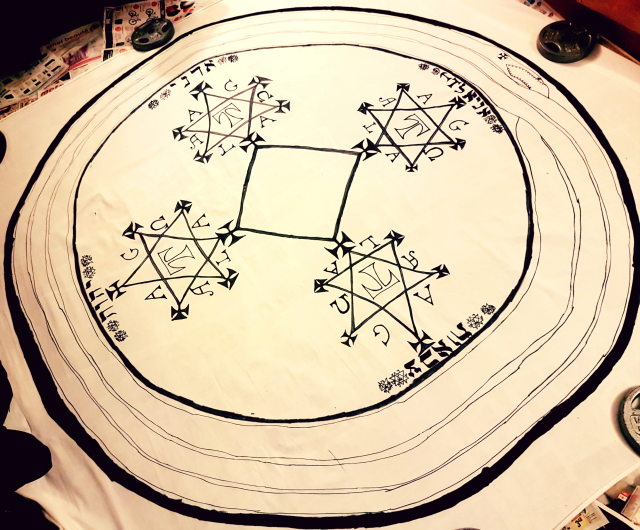
72 Demons of the Ars Goetia:
Complete Guide to Ranks, Powers & Sigils
The first book of the Lesser Key of Solomon, every spirit ranked and described — with the historical context most guides either get wrong or skip entirely.
What Is the Ars Goetia & Its Historical Origins?
The Ars Goetia is the first of five books within the Lemegeton Clavicula Salomonis — the Lesser Key of Solomon — a 17th-century grimoire compiling magical traditions drawn from Jewish, Christian, and Arabic sources. “Goetia” derives from the Greek goēteía, meaning sorcery or witchcraft, specifically the low art of summoning spirits versus the celestial operations of theurgy. The text describes how Solomon bound 72 spirits and compelled them to labor in the construction of his temple.
The manuscript tradition behind the Ars Goetia is older than its 17th-century codification. Johann Weyer’s Pseudomonarchia Daemonum (1577) — available in full via Sacred Texts — is the nearest ancestor in print, listing 69 spirits with descriptions that overlap significantly with the Goetia’s 72. Reginald Scot incorporated Weyer’s list into his Discoverie of Witchcraft (1584). The Ars Goetia itself circulated in manuscript form through the 17th century before Mathers and Aleister Crowley edited and published it in 1904, under the title The Book of the Goetia of Solomon the King — the edition most practitioners work from today.
Neural Grimoire’s full comparative analysis of Weyer vs. Crowley editions: Weyer vs. Crowley — What Changed Between 1577 and 1904
During the Renaissance, demonology flourished within a specific intellectual context — the collision of scholastic theology, Neoplatonic philosophy, and Kabbalistic tradition. Demons were reconceptualized not simply as evil entities but as fallen intelligences, each retaining specific powers and knowledge from their prelapsarian state. This is why the Goetia’s spirits teach sciences, languages, and arts: the framework inherited a model of demonic knowledge preservation.
“The Goetia is not a manual of devil worship. It is a manual of practical philosophy in which ‘demons’ are psychic forces given names, ranks, and functions — bound by the same hierarchical logic as medieval statecraft.”
Editorial synthesis — sources: Mathers/Crowley, Book of the Goetia (1904); Weyer, Pseudomonarchia Daemonum (1577); Peterson, Lemegeton Clavicula Salomonis critical edition (2001)It’s worth naming something the popularization history often glosses over: Crowley’s 1904 edition is not a neutral transcription. He added his own commentary, reframed the spirits in terms of his Thelemic system, and made editorial changes to the Mathers translation. Joseph Peterson’s 2001 critical edition — working from the original Sloane manuscripts held at the British Library — is the most philologically reliable text available. If you’re working seriously with the Goetia, you want Peterson, not Crowley, as your primary reference. Compare available editions at Neural Grimoire.
How the 72 Demons Are Ranked: Hierarchy & Structure
The Goetia organizes its 72 spirits in a hierarchy modeled on medieval European nobility — not arbitrary, but a reflection of how Renaissance demonologists mapped infernal power onto familiar political structures. Rank determines command: higher-ranking spirits command more legions and, by the grimoire’s internal logic, more resistant to compulsion and potentially more dangerous to work with unprepared.
Here’s the complete hierarchy. Note: the “President” rank refers to spirits associated with governance of knowledge and secrets, not the modern political office.
| Rank | Count | Planetary Association | Primary Domain | Legion Range | ⚠ Adversarial Note |
|---|---|---|---|---|---|
| Kings | 9 | Sun | Broad authority; transformation; commanding lesser spirits | 22–200 | Highest resistance to compulsion; Weyer warns against approaching without established practice |
| Dukes | 23 | Venus | Love, wealth, natural phenomena | 10–48 | Most numerous rank; legion counts vary significantly between manuscript versions |
| Princes | 7 | Jupiter | Wisdom, foresight, philosophy | 20–66 | Distinction between Prince and President is inconsistent across manuscript lineages |
| Marquises | 15 | Moon | Time, illusions, emotions, battle | 19–40 | Moon association linked to changeability; some manuscripts assign different spirits to this rank |
| Earls / Counts | 14 | Mars | War, alchemy, arcane knowledge | 6–40 | Smallest individual legion counts in the hierarchy; Bifrons commands only 6 legions |
| Presidents | 8 | Mercury | Sciences, secrets, transmutation | 29–50 | Peterson’s critical edition counts 8; some popular editions list only 3 due to transcription errors |
| Knight | 1 | Saturn | Logic, palmistry, philosophy | 20 | Furcas is the only Knight; his singular rank has no clear theological explanation in surviving manuscripts |
The 72-demon count is the standard — drawn from the 72 names of God in Kabbalistic tradition — but manuscript versions don’t perfectly agree on which 72. Peterson’s critical edition works from the Sloane 2731 and Sloane 3825 manuscripts at the British Library. The Mathers/Crowley edition introduced several transcription errors, including corrupted sigil drawings and inconsistent rank assignments. Any list claiming to be “the definitive” Goetia should specify which manuscript tradition it follows.
Notable Sigils — A Visual Reference
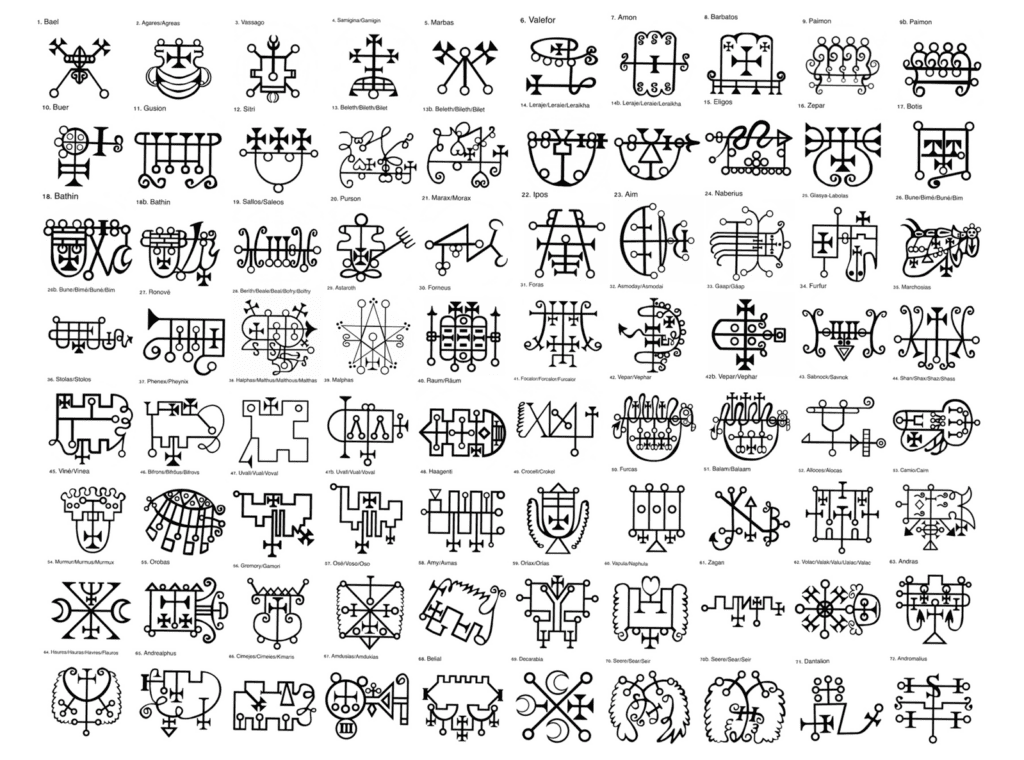
Each spirit in the Goetia has an associated sigil — a geometric seal used in ritual practice to summon or bind the spirit. The sigils in surviving manuscripts were drawn from the Rose Cross cipher system and Kabbalistic letter-path traditions. Below are stylized representations of eight major sigils. For the complete set of all 72, Neural Grimoire’s sigil library has each one in printable format with manuscript sourcing.
Note These are stylized geometric representations based on the symbolic grammar of the Goetia sigils. The authentic manuscript sigils — with their precise pen-line weights and exact proportions — are reproduced in Peterson’s critical edition and at Sacred Texts. Ritual practitioners should work from those sources, not approximations.
Complete List of the 72 Goetia Demons
In grimoire order, as compiled from the Sloane manuscript tradition via Peterson’s critical edition. Legion counts follow the Mathers/Crowley (1904) edition where Peterson’s edition does not differ significantly. Where names differ between Weyer (1577) and the Ars Goetia, I’ve noted the variant.
Looking for a specific demon by power or domain? Neural Grimoire’s searchable Goetia index lets you filter by rank, power, and planetary association.
Grants invisibility and cunning. Appears with three heads: toad, man, cat. Rules in the East.
Teaches languages, causes earthquakes, returns runaways. Appears as an old man on a crocodile.
Reveals past and future, finds lost objects. Of “good nature.” Appears angelic in form.
Teaches liberal sciences, summons souls of those who died in sin. Appears as a horse or ass.
Also called GamiginReveals secrets, heals or causes disease, teaches mechanical arts, transforms men.
Gives familiars, tempts men to steal. Appears as lion with man’s head. “Good familiar but will betray.”
Reconciles enemies, foretells the future. Appears as a wolf with a serpent tail.
Speaks the language of animals, reveals treasure hidden by enchantment, knows past and future.
Most obedient to Lucifer. Teaches arts, sciences, secrets. Accompanied by a musical procession.
Teaches philosophy, logic, herbs. Heals all distempers. Appears as a centaur or star-shape walking.
Reveals past, present, and future. Reconciles friendships, gives honor and dignity. Appears as a baboon.
Causes love between men and women; inflames them with desire. Appears as leopard with griffin wings.
Causes love in men and women. Rides a pale horse preceded by music. Among the mightiest kings.
Causes battles and disputes, causes wounds from arrows to putrefy. Appears as an archer in green.
Discovers hidden things, wars, and the future. Causes love of lords and great persons. Appears as a knight.
Causes women to love men. Makes women barren. Appears as a soldier in red.
Reveals past and future, reconciles friends and foes. Appears as a viper, then as a man with horns.
Knows virtues of herbs and precious stones. Transports men quickly between countries.
Causes love between men and women peaceably. Appears as a gallant soldier on a crocodile.
Knows hidden things, reveals treasure, knows past/present/future, discerns the divine. Lion-faced man on a bear.
Often misspelled “Purson” or “Person” in derivative sourcesTeaches astronomy, gives familiars who know herbs and stones. Appears as a bull with a man’s face.
Knows past and future, makes men bold and witty. Appears as an angel with a lion’s head and hare’s tail.
Sets fire to cities, castles, and great places. Makes men witty. Appears as a viper with three heads.
Makes men cunning in rhetoric. Restores lost dignities. Appears as a three-headed dog or a crow.
Teaches arts and sciences. Can cause love and bloodshed. Makes men invisible. Appears as a winged dog.
Makes men rich and wise. Gives eloquence. Changes the place of the dead. Appears as a three-headed dragon.
Teaches rhetoric and languages. Gives good servants. Takes away old spirits. Appears as a monster with a staff.
Speaks of past, present, future. Turns metals to gold. Dignifies men. Lies constantly unless compelled.
Knows past, present, future. Reveals the Fall of angels. Teaches mathematical sciences. Winged man on a dragon.
Related to the Canaanite goddess Astarte — significant for historical analysisTeaches rhetoric and languages. Makes men loved by enemies. Appears as a great sea monster.
Teaches logic and ethics. Makes men invisible. Teaches herbs and stones. Appears as a strong man.
Teaches arithmetic, astronomy, geomancy, crafts. Gives the Ring of Virtues. Three heads; first is a bull.
Legion count equals the total number of spirits — theologically significantCauses love or indifference. Teaches philosophy. Transports men between kingdoms. Appears human.
Causes love between man and woman. Creates storms, thunder, lightning. Speaks of divine and secret things.
Gives true answers. Strong fighter. Appears as a wolf with griffin wings. Was of the Order of Dominations.
Teaches astronomy and the virtues of herbs and precious stones. Appears as a night raven or owl.
Excellent poet. Teaches sciences. Wills to return to the seventh throne. Appears as a phoenix.
Builds towers, fills them with ammunition. Sends men to war. Appears as a stock dove speaking hoarsely.
Builds houses and towers. Destroys enemies’ desires. Brings craftsmen together. Appears as a crow.
Steals treasures from kings’ houses. Destroys cities and dignities. Causes love. Appears as a crow.
Kills and drowns men. Overturns ships of war. Commands winds and seas. Hopes to return to heaven.
Guides ships, causes seas to be rough with waves. Makes men die in three days of putrefying wounds.
Builds towers, castles, and cities. Afflicts men for days with wounds and sores. Gives familiars.
Takes sight, hearing, and understanding. Steals horses. Discovers hidden things. Will lie unless within triangle.
Discovers witches and hidden things. Creates storms. Builds towers, destroys walls. Appears as a lion on a horse.
Teaches astrology, geometry, arts. Changes corpses. Lights candles on graves. Appears as a monster, turns human.
Fewest legions of any spirit in the GoetiaProcures love of women. Knows past/present/future. Creates friendship between enemies. Appears as a camel.
Makes men wise. Transmutes metals. Turns wine to water and water to wine. Winged bull, turns human.
Speaks of hidden and divine things. Warms baths and waters. Teaches geometry. Was of the Order of Powers.
Teaches philosophy, astronomy, rhetoric, logic, chiromancy, and pyromancy. Appears as an old man on a horse.
The only Knight in the Goetia — rank unexplained in surviving manuscriptsGives perfect answers on past, present, and future. Makes men invisible. Speaks with a hoarse voice.
Teaches astronomy and liberal sciences. Gives familiars. Appears as a soldier with a lion’s face.
Rendered as “Allo ces” in some derivative sources — a formatting corruptionUnderstands the voices of birds, dogs, cattle, and water. Gives understanding of animal tongues.
Teaches philosophy. Constrains souls of the deceased to answer questions. Two ministers with trumpets.
Discovers past, present, future. Gives dignities and prelacies. Speaks of divinity. Does not deceive the summoner.
Knows past, present, future. Procures love of women. Discovers treasure. Appears as a beautiful woman on a camel.
Makes men wise. Teaches liberal sciences. Transforms men’s shapes. Causes madness. Appears as a leopard.
Gives excellent familiars. Teaches astrology and liberal sciences. Betrays treasures kept by spirits. Appears as a flame.
Knows the virtues of stars. Transforms men. Gives dignities and prelacies. Appears as a lion with a serpent tail.
Makes men knowing in all sciences. Teaches handcraft and philosophy. Appears as a winged lion.
Makes men witty. Turns wine to water, water to wine, blood to oil. Appears as a bull with griffin wings.
Gives true answers about hidden treasure. Finds serpents. Appears as a small child with angel wings on a dragon.
Sows discord. Will kill the exorcist and his companions if not careful. Angel with raven head on a wolf.
One of the explicitly most dangerous spirits in the textSpeaks of creation, divine things. Burns enemies. Destroys and burns. Appears as a leopard. Also called Flauros.
Teaches geometry and all things belonging to measurements and astronomy. Transforms men. Appears as a peacock.
Teaches grammar, logic, and rhetoric. Discovers lost things. Rules over all spirits in Africa. Warrior on black horse.
Gives excellent familiars. Causes trees to bend and incline at will. Gives concerts of music. Appears as a unicorn.
Gives excellent familiars. Distributes presentations and senatorships. Must be given offerings. Appears in two angels.
Knows the virtues of herbs and stones. Gives familiars in the form of birds. Appears as a star in a pentagram.
Brings abundance. Transports things quickly. Discovers thefts and hidden things. Beautiful man on a winged horse.
Knows thoughts of all men. Can change them. Causes love. Appears as a man with many faces, holding a book.
Returns stolen goods. Punishes thieves. Discovers wickedness and dishonest dealing. Appears as a man with a serpent.
How to Approach Goetia Invocation
The Goetia’s invocation system is ceremonial magic — it requires preparatory work, protective structures, and consistent practice. The text itself is explicit that improvised invocation is a bad idea. Crowley’s 1904 introduction, whatever you think of Crowley, makes this point without euphemism: the system is designed to be dangerous, and the circle, the triangle, the seals, and the compulsive words are all there for a reason.
Physical and psychological preparation. The grimoire specifies ritual bathing, fasting, and specific timing aligned with planetary hours. The practical function: building mental coherence before a high-concentration practice. Neural Grimoire’s banishing ritual guide covers the Lesser Banishing Ritual of the Pentagram as preliminary clearing work.
Choose the spirit whose stated powers align with your actual goal. The hierarchy table above is useful here — rank determines both power and approach. Know which spirit’s sigil you’re working with and why, before you begin.
The protective circle and the spirit’s sigil drawn or engraved on metal. The Goetia specifies exact dimensions and the texts to inscribe. Deviating from the geometric specifications is the most common error in the historical failure accounts. Full sigil reference here.
The calls — beginning with the preparatory conjuration, then the specific conjuration, then the constraint if the spirit doesn’t appear, then the curse if it still refuses. The text escalates through five distinct compulsive speeches. This isn’t a single chant — it’s a structured protocol with contingencies.
Formal license to depart. Skipping this step is noted in virtually every serious commentary as the most dangerous practice omission. The grimoire gives specific dismissal language. Use it.
The Goetia’s actual invocation text — the full conjurations, constraints, and curses — runs to several pages. Most popular guides summarize it as “chant the demon’s name.” That’s not what the text says.
The text specifies: the Great Seal of Solomon, the Hexagram of Solomon, the Pentagram of Solomon, the Ring of Solomon, the Vessel of Brass, the Secret Seal of Solomon, and specific garments. Each item has a function in the system’s logic. Whether you’re approaching this as literal magical practice or as a study of Renaissance ceremonial magic, the distinction between the summary and the actual text matters.
The full text is at Sacred Texts. Peterson’s critical edition gives you the manuscript variants.
What the Grimoire Doesn’t Tell You — The Complicating Finding
Here’s the thing the enthusiasm for the Goetia tends to skip. The text itself contains an internal inconsistency that any serious reader will notice: the demons are simultaneously described as bound, compelled servants and as entities capable of deception, violent resistance, and dangerous independent action. You can’t fully have both.
Comparing Weyer’s Pseudomonarchia Daemonum (1577) with the Ars Goetia text and Scot’s Discoverie of Witchcraft (1584) reveals something: the warning language escalates through the tradition. Weyer adds caveats Pseudomonarchia’s sources don’t contain. The Ars Goetia adds binding protocols Weyer doesn’t emphasize as heavily. Scot — writing as a skeptic exposing what he considered fraud — inadvertently preserves the most complete picture of what practitioners actually feared. The tradition’s own evolution encodes accumulated practitioner caution. The later and more elaborate the protective system, the more the tradition’s authors clearly believed the earlier versions were inadequate.
The Andras problem is illustrative. Andras (Spirit #63) is described as a marquis who will “kill the master, his fellows, and assistants” if any opportunity is given. The text then provides the invocation for Andras. This isn’t an oversight — it’s the grimoire explicitly telling you that this spirit is classified as dangerous even by the text’s own internal standards, and then providing the tools anyway. Whether you read this as literal warning, psychological projection, or editorial tradition, it complicates any reading of the Goetia as a simple instruction manual.
And honestly? That tension is probably why the text has lasted 400 years. A grimoire of spirits who just helpfully show up and give you things would be boring. The danger — real, symbolic, or psychological — is the whole point.
“The later the protective protocol, the more the tradition’s own authors believed the earlier version was not enough. The Goetia’s escalating binding system is a document of accumulated fear.”
Editorial synthesis — sources: Weyer (1577), Scot (1584), Peterson critical edition (2001), Mathers/Crowley (1904)Ethics & Modern Practice
Modern Goetia practice spans a spectrum from literal ceremonial magic — people who genuinely attempt the full ritual system as written — to psychological or chaos magic interpretations that treat the 72 spirits as archetypes or aspects of consciousness rather than external entities. Both approaches have legitimate intellectual lineages.
The Ethics the Grimoire Doesn’t Cover
Look, here’s what this actually is: the Goetia’s ethics are internal to the system. The text tells you how to compel spirits safely. It doesn’t tell you whether you should, or what the downstream effects of love spells cast on non-consenting parties are — and several spirits (Sitri, Beleth, Sallos, Zepar, Gremory, Vual) are explicitly invoked for that purpose.
What you do: Apply the same ethical framework you’d use for any action affecting another person without their knowledge or consent. The grimoire is silent on this. You shouldn’t be.
Here’s what’s going to stop you: the protective equipment list — circle, seals, ring, brass vessel — is specific, and most practitioners skip some of it. Every serious Goetia commentary from the 17th century onward associates skipped preparations with negative outcomes. Don’t shorten the prep work.
Stop doing this: don’t treat the invocation prompts circulating on occult forums as substitutes for the actual conjuration text. They’re not. The full text is free at Sacred Texts. Use the actual source.
Where the Interesting Work Is
The Goetia’s manuscript tradition is richer than the Mathers/Crowley edition suggests. Peterson’s 2001 critical edition opened serious comparative work between the Sloane manuscripts and Weyer’s sources. The transmission from Weyer through Scot to the 17th-century manuscript tradition — and the changes introduced at each stage — is genuinely under-studied.
What you do: Start with Peterson’s edition and its apparatus before treating any popular summary as accurate. The Neural Grimoire grimoire library annotates major editions with manuscript sourcing.
Here’s what’s going to stop you: the Sloane manuscripts themselves are accessible via the British Library’s digitization project, but untranscribed sections require paleographic training. Peterson is your primary scholarly access point.
Stop doing this: don’t cite the Mathers/Crowley edition as philologically authoritative. It’s historically important but editorially compromised. For scholarly work, cite the manuscript or Peterson’s critical edition.
Frequently Asked Questions
What is the difference between the Ars Goetia and other grimoires?
The Goetia focuses specifically on the 72 spirits with individual sigils, ranks, and powers — organized around a single binding narrative (Solomon). The Picatrix is a broader astrological magic system. The Key of Solomon (Clavicula Salomonis, different from the Lesser Key) focuses on operations rather than named spirits. The Grand Grimoire works with a different spirit hierarchy. Goetia’s distinction is its named-individual-spirit structure with associated seals — each spirit is a specific entity with specific powers, not a generic invocation category.
Are the sigils accurate across different editions?
No. Sigil reproduction degrades through manuscript copying. The Mathers/Crowley edition contains several corrupted sigil drawings. Peterson’s 2001 critical edition is the most reliable printed source. For ritual work, practitioners typically work backward through available manuscripts. Neural Grimoire’s sigil library documents manuscript sources for each sigil.
Can beginners work with high-rank spirits?
The grimoire doesn’t explicitly address beginner versus experienced distinction — but the practical logic of the hierarchy suggests building skill with the system before approaching spirits whose texts include explicit warnings about violence or resistance. Andras, Vine, and Beleth are among those the text itself flags as requiring particular care.
Is there a “Solomon” behind this text?
No. The Solomonic attribution is a common medieval legitimizing convention — connecting a text to a powerful biblical figure gave it authority. The actual authorship is unknown; the material compiled from Jewish, Arabic, and Christian magical traditions over centuries. The attribution to Solomon functions as a claim of ancient authority, not historical fact.
What’s the most reliable modern edition?
Joseph Peterson’s Lemegeton Clavicula Salomonis (2001) for scholarly and serious practical use. Mathers/Crowley (1904) is historically important and more widely available. The full text of the Ars Goetia is freely accessible at Sacred Texts.
★ Primary Sources & References
- PrimaryMathers, S.L. MacGregor & Crowley, Aleister. The Book of the Goetia of Solomon the King. (1904) — Full text at Sacred Texts
- Critical Ed.Peterson, Joseph H. Lemegeton Clavicula Salomonis: The Complete Book of Magic. Ibis Press, 2001 — Definitive critical edition from Sloane manuscripts
- PrimaryWeyer, Johann. Pseudomonarchia Daemonum. 1577 — Appendix to De praestigiis daemonum — nearest antecedent to the Goetia spirit list
- PrimaryScot, Reginald. The Discoverie of Witchcraft. 1584 — Preserves Weyer’s spirit list; written as a skeptical exposé
- ReferenceWikipedia: List of demons in the Ars Goetia — useful cross-reference for name variants across manuscript traditions
- ArchiveBritish Library: Sloane Manuscripts Collection — Sloane 2731 & Sloane 3825 are the primary manuscript sources for Peterson’s edition
https://www.neuralgrimoire.com/most-dangerous-duke-demons/
https://www.neuralgrimoire.com/i-lost-my-bitcoin-wallet/
https://www.neuralgrimoire.com/closing-spirit-portals/
https://www.neuralgrimoire.com/the-480k-pompeii-hoax/
https://www.neuralgrimoire.com/hopi-prophecy-blue-star-kachina/
https://www.neuralgrimoire.com/vaimanika-shastra/