

The evidence-first guide: what arousal and orgasm actually do to your brain, why manifestation culture gets the psychology backwards, and five copy-paste prompts — no oracle cosplay, no crystals required.
Most manifestation content fails in one of two directions. The mystical version promises that if you vibrate correctly at the moment of orgasm, the universe will rearrange itself around your bank account. The cynical version smirks that it’s all placebo and tells you to just make a spreadsheet. Neither is useful, and neither respects the most interesting fact about this practice: people have been doing some version of it since the 1850s, many report it working, and the mechanisms that would explain why — attention, emotional encoding, expectancy, ritual structure, follow-through — are exactly the mechanisms psychology studies.
TL;DR
- The core mechanic — charging an intention at orgasm — has a 170-year documented lineage (Randolph, Crowley, Spare) and maps onto real psychology and neuroscience.
- Arousal narrows and distorts judgment (documented). Orgasm is a peak, whole-brain event, not an “off switch” (documented). Pure positive fantasy saps motivation (documented, replicated). That last finding is the one manifestation culture ignores.
- AI’s legitimate role: five prompts for clarifying desire, excavating blocks, designing the ritual, scripting the peak moment, and mandating a real-world action within 48 hours.
- No peer-reviewed study exists on AI-guided sex magick. Anyone claiming measured results is selling something. This article says so and proceeds anyway — with claims ranked by evidence strength.
How to use this article
Prompts first, evidence after. Want to start tonight? Jump to Prompt 1 and come back for the theory. Skeptical? Read the science section first — it’s the reason this article exists.
A solo working is a precise behavioral sequence:
Intention → compression into symbol/phrase → arousal to peak → intention planted at peak → release → forgetting → real-world action.
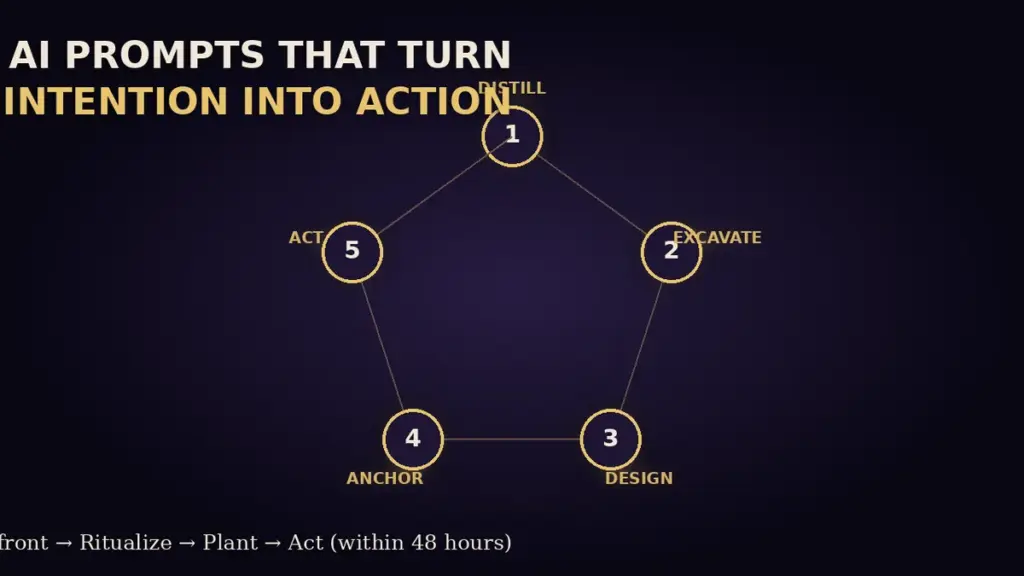
Every element maps onto something psychology can measure. The five prompts implement the full loop: clarify (Prompt 1) → confront (Prompt 2) → ritualize (Prompt 3) → plant (Prompt 4) → act (Prompt 5). AI prepares, you enact, AI holds you accountable.
The five prompts
Paste into any major chatbot, filling in the bracketed sections. Together they run the full loop.
<a id=”prompt-1″>
Prompt 1 — The Distiller (replaces daydreaming with WOOP)
Use when your want is a fog (“I want my life to change”). Already done honest goal work? Skip to Prompt 3.
JavaScript
You are a practical goal-clarification coach helping me prepare a personalritual. I'll describe something I want, messily. Your job:(1) Restate my desire as ONE specific, present-tense intention that dependson my own actions — not on controlling another person. If my wish centerson someone else's behavior, help me reframe it around what I can do.(2) Ask me exactly 3 sharpening questions, one at a time.(3) Then complete a WOOP with me: Wish · best Outcome (one vivid sensorysentence) · inner Obstacle (the thing IN ME most likely to block this) ·Plan ("If [obstacle], then I will [specific action]").Rules: no moralizing, no medical or financial advice, no promises that theuniverse will deliver. Under 150 words. Be willing to tell me if my wish isvague or not actually mine.When it works: your want is a fog. When it fails: the chatbot over-validates. If it agrees with everything, restart with “argue against my intention instead.”
<a id=”prompt-2″>
Prompt 2 — The Excavator (finds the belief that makes the desire feel unsafe)
Use when the intention feels strangely heavy or “not for people like me.” If the chatbot starts performing therapy, stop — significant trauma is a licensed-therapist conversation, not a chatbot one.
JavaScript
I'm doing shadow work before a personal ritual. My intention: [paste fromPrompt 1].Ask me Socratic questions, ONE at a time, to surface the belief that givesthis intention the most emotional charge right now — the one that makes itfeel unsafe, selfish, or impossible. Prioritize current charge over aplausible origin story: if two beliefs come up, work with the one thatstings today.When an origin story emerges, label it explicitly as a HYPOTHESIS. I decidewhat resonates; you do not tell me facts about my past. When we find abelief with real charge, help me write a one-sentence counter-belief I canhalf-believe today (grounded, not affirmations I don't buy).Examine at most 2–3 beliefs, then stop. If the material starts to feel liketherapy, say so and stop.When it works: the intention feels heavy in a way you can’t explain. When it fails: confabulation — the chatbot generates a plausible origin story (the overcritical parent, the old pattern) that feels true and may be fiction. The HYPOTHESIS label exists for exactly this reason.
<a id=”prompt-3″>
Prompt 3 — The Architect (designs the ritual and builds the sigil)
Use when you want ceremony without dogma. If the ritual exceeds 30 minutes or requires supplies you’d have to buy, tell it to simplify. Complexity is not power.
JavaScript
Design a 20–30 minute solo ritual for this intention: [paste WOOP]. Include:an opening threshold (2 min: breathwork or candle lighting), a buildingphase (breath plus self-pleasure at a slow, sustained pace), a peakinstruction (what I hold in mind at orgasm), and a closing (1 minute ofstillness + one sentence spoken aloud). Keep language non-graphic andpractical.Also build a compressed symbol using the Austin Osman Spare method: take mystatement of intent, remove vowels and repeated letters, and describe 2–3abstract sigil designs from the remaining letters. Then compress furtherinto a 2–4 syllable nonsense word I can repeat mentally at the peak.End with a release instruction: after orgasm I will let the matter go.When it works: you want structure without a belief system attached. When it fails: over-production — a cathedral when you asked for a doorway.
<a id=”prompt-4″>
Prompt 4 — The Anchor (the only prompt used live — or memorized beforehand)
Everything pre-scripted means that at the peak you’re executing, not improvising. This is the entire point of scripting an aroused-state moment in advance.
JavaScript
Distill my intention into an anchor phrase: maximum six words, first-person,sensory, holdable in the mind without verbal effort (example: "my work isseen; my hands are steady"). Then write a four-line script for the finalminute: line 1 narrows attention to bodily sensation; line 2 brings in thesigil syllables; line 3 places the anchor phrase at the peak of orgasm;line 4 is an explicit release ("it is done; I let it go").When it works: the script is short enough to hold in working memory. When it fails: performance pressure — if you catch yourself straining to “get it right,” drop the script and just be present. Performance anxiety voids the working.
<a id=”prompt-5″>
Prompt 5 — The Debrief (the step manifestation culture skips)
This is where the research lands most directly — and the step most people skip. Its only failure mode is being skipped. If you keep skipping it, that too is diagnostic.
JavaScript
It is ten minutes after my ritual. Here's what happened, honestly: [arousalquality / distractions / emotions that surfaced / what I avoided feeling].Ask me: (1) What surprised me? (2) Did the resistance match the obstacle inmy WOOP? (3) What is ONE concrete real-world action I will take within 48hours — calendar-ready, with a day and time — that my future self wouldthank me for? Then ask one question that prepares next week's session.Do not interpret events as signs or omens. If I report nothing happening,say so plainly and adjust the plan, not the cosmos.At a glance
Feuilles de calcul
| Prompt | Job | Mechanism it serves | Most common failure |
|---|---|---|---|
| 1 · Distiller | Vague want → WOOP intention | Oettingen; implementation intentions | AI over-validating |
| 2 · Excavator | Surfaces blocking belief | Obstacle confrontation | Confabulated “origin stories” |
| 3 · Architect | Ritual design + sigil | Ritual control effects; Spare’s encoding | Over-complex designs |
| 4 · Anchor | Peak-state phrase + release | Attentional encoding; anti-daydreaming | Performance pressure |
| 5 · Debrief | Integration + 48h action | Follow-through (the engine) | Being skipped |
Why it works: the science
What arousal and orgasm actually do to your head
Two findings matter, each with one caveat worth knowing.
Arousal rewrites judgment. In the most direct study of its kind, Ariely and Loewenstein (2006, Journal of Behavioral Decision Making) had male college students answer questions either in a neutral state or while sexually aroused by self-stimulation. Arousal strongly shifted all three measured domains: attractiveness of sexual activities, willingness to engage in morally questionable behavior for gratification, and willingness to have unsafe sex. Crucially, the same participants, asked in a cold state, badly predicted how arousal would change them — the “hot-cold empathy gap.” Caveat: 35 young men, hypothetical questions. Later work using passive erotic imagery rather than self-stimulation found much weaker effects on economic decisions, which suggests self-generated arousal does the heavy lifting. For a solo practitioner, this is directly relevant: decisions do not belong in the aroused state. Pre-scripted material does.
Orgasm is a peak, whole-brain event — not an “off switch.” Popular writing claims the brain “shuts down” at orgasm. The imaging data says the opposite. Wise, Frangos, and Komisaruk’s fMRI work at Rutgers found “extensive cortical, subcortical, and brainstem regions reach peak levels of activity at orgasm,” reporting no evidence of deactivation. Komisaruk has called orgasm the largest brain-networking event short of an epileptic seizure. One real disagreement exists: PET studies from the Georgiadis group found deactivations in some frontal regions during partner-induced orgasm, a discrepancy the Rutgers group attributes partly to method and stimulation mode. For practice purposes the takeaway survives either way: orgasm is a moment of intense, distributed neural activity and profound attentional narrowing — a natural save point for whatever you hold in mind.
The practical synthesis: arousal is a terrible state for making decisions and an excellent state for encoding an intention. That asymmetry explains the entire structure of a well-designed ritual. Script the peak moment before you’re aroused; make decisions afterward.
The fantasy problem — and why “it’s just placebo” isn’t the insult you think
The most rigorous finding in this field is the least welcome in manifestation circles. Gabriele Oettingen’s two decades of research show that indulging in positive fantasies about an achieved goal predicts lower achievement — across weight loss, job transitions, grades, and romantic pursuits. In one telling pattern, graduates who fantasized most positively about an easy job transition earned fewer offers and lower salaries two years later (Oettingen & Mayer, 2002). Her explanation: vivid fantasy delivers some of the emotional reward of success in advance; energy drops, and the brain files the wish under “done.” (Her popular synthesis is Rethinking Positive Thinking, 2014.)
What works instead is WOOP — Wish, Outcome, Obstacle, Plan: keep the wish, vividly imagine the outcome, then deliberately turn to the internal obstacle, then build an “if obstacle, then I will…” plan. Implementation intentions of this kind have a large meta-analytic track record behind them (Gollwitzer, 1999; Gollwitzer & Sheeran, 2006), and WOOP specifically has outperformed positive thinking in randomized trials on exercise, healthy eating, and school achievement (Stadler et al., 2009; Duckworth et al., 2013).
Notice what this means for sex magick: the classic ritual structure accidentally inverts Oettingen’s failure mode. Desire is compressed, not fantasized at length. The peak moment is brief and wordless, leaving no room for extended daydreaming. The obstacle work happens beforehand. And the tradition insists on release and forgetting — functionally identical to WOOP’s instruction to stop rehearsing the wish.
Where manifestation culture goes wrong is the aftermath: it treats the ritual as the whole act. Oettingen’s data says the ritual is the ignition; the plan is the engine.
Ritual itself does something — with one correction on the record
Ritual carries real, if modest, effects. Norton and Gino (2014, Journal of Experimental Psychology: General) found that performing structured rituals reduced grief and restored feelings of control — even in participants who didn’t believe rituals work. Hobson and colleagues’ integrative review (2017, Personality and Social Psychology Review) links ritual to anxiety reduction and lower neural response to performance failure. One transparency note: the most-cited paper in this area — Brooks et al., 2016, “Rituals improve performance by decreasing anxiety” — was retracted in 2024 amid the data-integrity scandal around co-author Francesca Gino. Norton & Gino 2014 has not been retracted, but Gino’s co-authorship is worth knowing when you weigh the evidence. The conservative conclusion: ritual reliably changes felt control and anxiety. Claims that it boosts objective performance rest on thinner, partly retracted ground.
The mechanism stack, strongest to weakest evidence:
- WOOP-style structuring — replicated across domains.
- Attentional encoding at a peak state — strong neuroscience, plausible psychology.
- Ritual effects on control and anxiety — moderate, surviving sources.
- Expectancy/placebo effects on behavior — strong as a general phenomenon.
- “Energy,” “frequencies,” external metaphysical claims — unverified. Treat as personal meaning, not mechanism.
A sixty-second history
Sex magick entered Western occultism through Paschal Beverly Randolph (1825–1875), a Black American trance medium turned occultist who broke with the spiritualists and privately taught that sexual energy, harnessed by will, was the engine of magical power. Aleister Crowley later systematized “sacred sexuality” within Thelema, and — most relevant to a modern solo practitioner — Austin Osman Spare stripped the whole thing down to a near-mechanical procedure in The Book of Pleasure (1913): write a statement of intent, compress it into an abstract sigil by removing vowels and repeated letters, “charge” the symbol during a peak mental state, then release and forget it. In chaos magick’s vocabulary, the peak state is gnosis, and sexual arousal is an excitatory route to it.
That’s the entire theoretical apparatus you need. Everything else is embellishment.
Where AI genuinely helps — and where it quietly hurts you
The evidence gap, stated plainly: no peer-reviewed study exists on AI-guided sex magick. Everything below is inference from adjacent evidence and the documented behavior of large language models. Rank it accordingly.
Millions of people already extend personal trust to chatbots — for journaling, advice, and spiritual reflection alike — while the institutions around them are still deciding what to make of it. The narrow, practical question: where does an AI earn its place in a solo practice, and where does it quietly make you worse?
My position: AI is not the magician. You are. AI is the notebook, the Socratic questioner, and the accountability partner — three roles a chatbot performs better than most humans, because it never gets bored, never judges, and never forgets what you told it last week.
What LLMs are demonstrably good at, given the mechanism stack:
- Structured writing. Distilling a tangled want into a specific intention in your own vocabulary is exactly the task they’re built for.
- Socratic questioning at zero social cost. You’ll type a shameful belief to a chatbot you’d never say to a friend. That’s diagnostically valuable.
- Compression and design. The sigil method is mechanical — strip vowels, dedupe letters, recombine. A language model executes it instantly and generates the mantra-style “nonsense word” variant just as well.
- Accountability without judgment. It remembers your last session and will ask what you actually did.
What they’re bad at, and where the harm lives:
- Sycophancy. A chatbot trained to be agreeable will, over a long conversation, begin validating your fantasy. If your “manifestation” is quitting your job with no savings, it will eventually find a gentle way to agree. Every prompt above carries an explicit anti-validation rule for this reason.
- Confabulation dressed as insight. Ask it to find your “block,” and it will produce a plausible origin story that may feel true and be fiction. The prompts label such outputs as hypotheses for exactly this reason.
- Dependency. The more a practice routes through the chatbot, the more the chatbot becomes the practice. The healthy division of labor: AI prepares the ritual and interrogates your follow-through; it does not interpret omens, deliver verdicts about your life, or become the object of the ritual.
- Privacy. Assume anything you type may be stored, reviewed, or used for training depending on the app’s settings. Use a pseudonymous account, strip identifying details, and check the data controls before pasting anything you wouldn’t want attributed to you. This varies by product and changes often enough that naming current defaults here would be stale by publication.
Vendor note: any major consumer chatbot can run these prompts. Choose based on privacy controls and cost, not branding. Treat outputs as drafts you edit — never received wisdom.
A realistic first month
Weekly is the right cadence — enough repetition to build conditioning, spaced enough that each session stays charged. Keep a plain journal: date, intention, method, what happened, what you did afterward, what resulted. Chaos magick’s own tradition insists on this, and it’s the one piece of the occult toolkit that is pure empiricism.
Judge results with honest proxies, not miracle stories:
- Clarity — can you state your desire in one sentence without hedging?
- Resistance mapping — do you know exactly where you flinch, and what your if-then plan is?
- Follow-through — did you take the 48-hour action, and the next one?
- Behavioral drift — weeks later, are you acting like someone who has the thing? This is where expectancy effects live.
The known failure archetypes, from the tradition’s warnings and the psychology above: lust for result (obsessively checking whether it worked — Oettingen would call this continuing to fantasize), ritual substitution (the working replaces the job applications instead of fueling them), and escalation (needing longer, more intense sessions to feel anything). If you notice the third, this is becoming a compulsion loop, and the right move is a break, not a bigger ritual.
Who should skip this
- Anyone under 18. This article assumes an adult making free choices about their own body.
- If your relationship with porn or masturbation is already compulsive, layering ritual intensity on top makes it worse, not sacred. Address that first.
- If you live with mania, psychosis-spectrum conditions, or acute trauma, state-altering ritual practice can be destabilizing. That’s a clinician conversation before it’s a practice.
- If you’re using manifestation to avoid a hard real-world decision — the spreadsheet, the conversation, the application — no prompt here will help. The debrief will just keep embarrassing you until you do the thing.
The counterargument, taken seriously
The strict materialist says this is ceremonialized goal-setting with extra steps, and the extra steps are dead weight. That’s half right — and it gets the important half backwards. The extra steps are exactly where the measurable effects live: ritual structure changes felt control, peak states encode intention at high salience, and WOOP demonstrably outperforms positive fantasy. The honest skeptic’s position isn’t “drop the ritual.” It’s “keep the ritual, drop the metaphysics.” Many practitioners land there and report the practice works better, not worse, for it.
FAQ
Is it just placebo? Partly — and placebo isn’t the insult people think. Expectancy changes behavior; behavior changes outcomes. Placebo only becomes a problem when it replaces the engine: ritual without the real-world action is a nice evening and nothing more.
Do I have to believe in magic for this to work? No. Norton and Gino produced ritual effects in participants who explicitly didn’t believe rituals work. Belief in the mechanism — clarity, encoding, action — is sufficient. Belief in spirits is optional.
What if nothing happens? Say so plainly — to yourself and to the chatbot in the debrief — and adjust the plan, not the cosmos. Nothing happening usually means one of three things: the intention wasn’t actually yours, the obstacle was misidentified, or the 48-hour action never happened. All three are fixable. None requires more incense.
Your next step is small: run Prompt 1 tonight, alone, fully clothed. The ritual can wait a week. The clarity can’t.
References: Ariely & Loewenstein (2006), J. Behavioral Decision Making 19(2) · Oettingen & Mayer (2002), J. Personality & Social Psychology 83(5) · Oettingen (2014), Rethinking Positive Thinking · Gollwitzer (1999) & Gollwitzer & Sheeran (2006), Advances in Experimental Social Psychology · Stadler et al. (2009), British J. Health Psychology · Duckworth et al. (2013), J. Educational Psychology · Norton & Gino (2014), JEP: General 143(1) · Hobson et al. (2017), Personality & Social Psychology Review 21(3) · Wise, Frangos & Komisaruk (2017) · Brooks et al. (2016, retracted 2024).