
The Mohenjo-Daro “Nuclear War”
A ruined city, thirty-seven scattered skeletons, and a fifty-year-old rumor about radiation — and what real archaeologists actually found when they went looking.
There is no peer-reviewed evidence that Mohenjo-daro was destroyed by a nuclear blast, ancient or otherwise. No blast crater has been found, no confirmed elevated radiation has ever been published in the archaeological literature, and the “massacre” skeletons the theory leans on turned out to span up to a thousand years of burials, not one bad afternoon. The real story — a five-thousand-year-old city undone by a slow-motion climate shift — doesn’t have a mushroom cloud in it. It’s still one of the best-documented urban collapses in the ancient world, and it deserves to be known on its own terms.
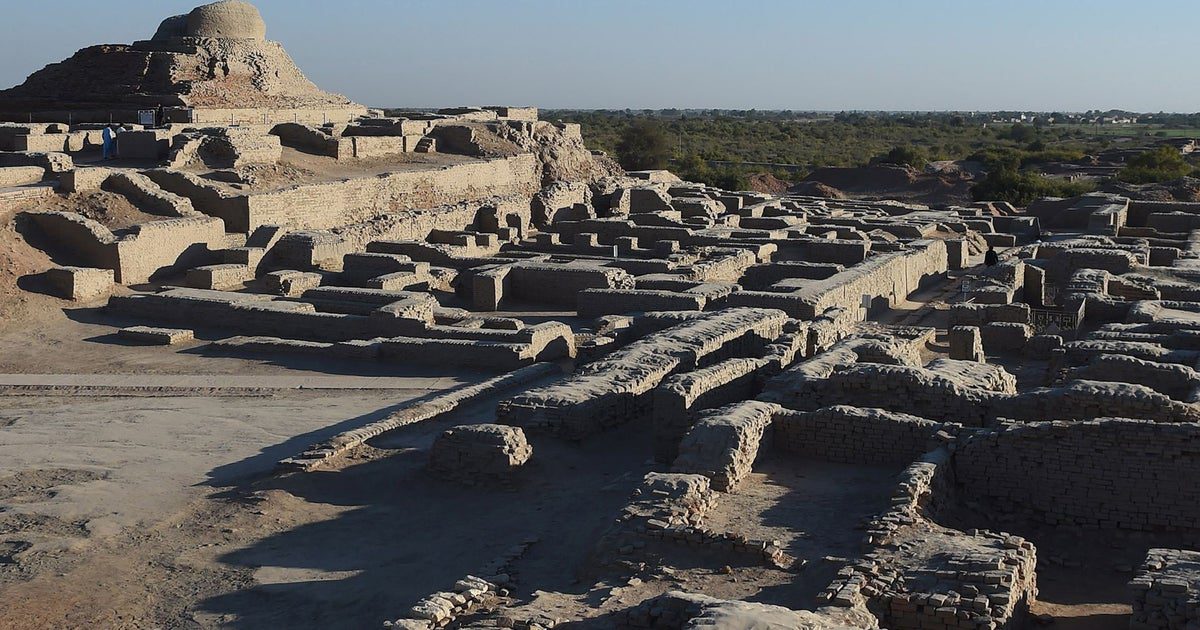
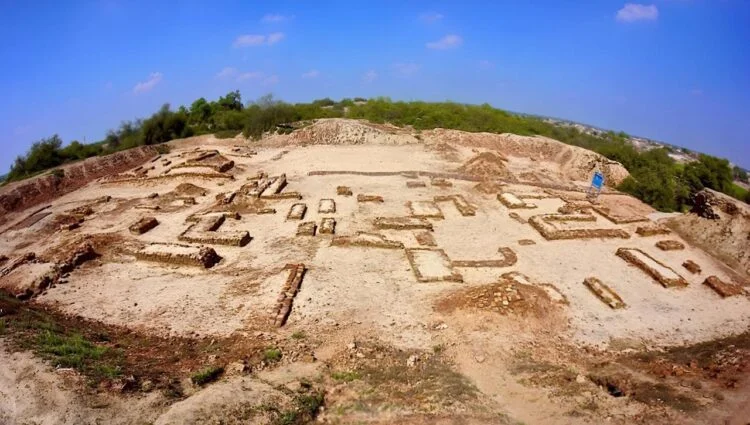
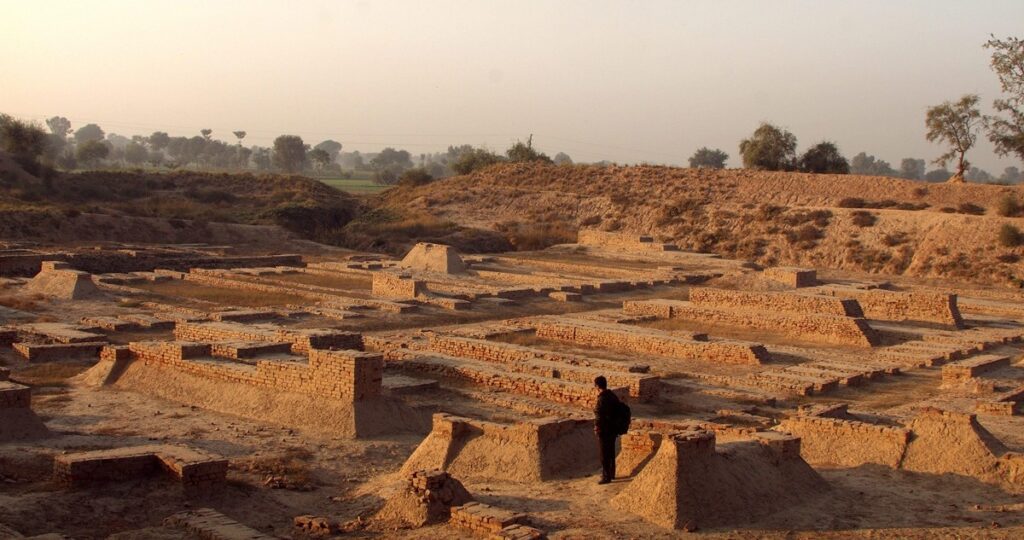
In 1922, an Archaeological Survey of India officer named R. D. Banerji climbed a Buddhist stupa mound in the Sindh province of what is now Pakistan and found, underneath it, bricks that had no business being that old. What his team eventually uncovered — over the following decades of excavation — was Mohenjo-daro: a planned city of roughly 40,000 people, with covered drains, standardized baked bricks, a public bathing structure, and street grids that predate the Roman forum by two thousand years. It’s one of the two great capitals of the Indus Valley Civilization, alongside Harappa, and by any honest measure it’s one of the most impressive urban achievements of the Bronze Age.
Then, around 1900 BCE, people stopped living in it the way they had been.
That’s the part of the story that’s genuinely mysterious, genuinely debated by real archaeologists, and genuinely interesting. It’s also the part that got hijacked, starting in the 1960s, by a much louder story: that Mohenjo-daro was vaporized in an ancient atomic war, evidence of which was covered up or overlooked by mainstream science for half a century. That version has run on cable television for over a decade. This piece traces where it came from, checks each of its three load-bearing claims against the actual excavation record, and lays out what professional archaeologists and paleoclimatologists have actually concluded — because the real answer, once you follow the citations, turns out to be more interesting than the myth, not less.
01 Where the “Ancient Nuclear War” Claim Comes From
The theory doesn’t originate with archaeologists. It traces most directly to Erich von Däniken’s 1968 book Chariots of the Gods?, which reframed a number of ancient sites — Mohenjo-daro among them — as evidence of extraterrestrial visitation. From there it was picked up and elaborated by a string of fringe authors through the 1970s and 1990s, then given a much larger platform by the History Channel’s Ancient Aliens, which built a full episode around it, and more recently by podcast appearances — Billy Carson’s discussion of the theory on The Joe Rogan Experience is a widely cited recent example of the claim reaching a mainstream audience.
The case, as it’s typically presented, rests on three pieces of evidence, repeated in roughly the same order every time:
- Scattered skeletons found lying in the streets and lower town, some in what’s described as postures of sudden death — offered as proof of a single catastrophic event.
- “Vitrified” brick and stone — surfaces that appear fused or glassy, offered as proof of extreme, sudden heat.
- Elevated radiation supposedly detected in the human remains, offered as the smoking gun connecting the site to a nuclear event specifically, rather than an ordinary fire or massacre.
Each of these three claims has a real archaeological or documentary record behind it. None of the three records says what the theory says it says. Let’s go through them in order, because the gap between the claim and the citation is, itself, the most instructive part of this story.
02 The Skeletons: What Wheeler Saw, and What Kennedy Found
Start with the number. Nine years of excavation at Mohenjo-daro, between 1922 and 1931, recovered a total of roughly 37 to 44 skeletons or partial skeletons that can be attributed with any confidence to the Indus period, out of a city site covering roughly three miles in circuit. That’s the entire skeletal population the “massacre” and “nuclear war” theories are built on — a few dozen individuals, not the thousands you’d expect from a city-wide catastrophe.
The idea that these deaths were violent and simultaneous has a specific origin: British archaeologist Sir Mortimer Wheeler, excavating in the 1940s, connected a group of skeletons found in the Lower Town to a line in the Rigveda about the god Indra destroying forts, and floated the idea of an Aryan invasion. His often-quoted line — “on circumstantial evidence, Indra stands accused” — was closer to a rhetorical flourish than a forensic conclusion, and Wheeler himself treated it as speculative. But it stuck, and by the time the nuclear-war theory needed a foundation of sudden mass death, Wheeler’s invasion hypothesis was sitting right there, ready to be repurposed.
The scattered skeletons prove Mohenjo-daro’s population was massacred in a single violent event.
Archaeologist George Dales, who excavated the site, pointed out what a genuine massacre or invasion should have left behind and didn’t: no burned fortifications, no weapons, no armor, no destruction layer covering the city’s final period, and no bodies at the citadel — the one place you’d expect a last stand. His 1964 paper is literally titled “The Mythical Massacre at Mohenjo-daro.”
The forensic case fell apart further in the 1980s, when biological anthropologist Kenneth A. R. Kennedy and colleagues examined the skeletal collection directly, rather than relying on the field notes of excavators working sixty years earlier. Kennedy found no skeletal evidence of violent trauma consistent with a massacre. The “evidence” for sudden violent death had always been about how the bodies were arranged — disorderly, in some cases stacked or contorted — not about cut marks, fractures, or embedded weapons on the bones themselves. Disorderly disposal and violent death are not the same finding, and Kennedy’s analysis showed the field had been treating them as interchangeable.
The final piece came from dating. More precise stratigraphic and skeletal dating showed that the supposed “massacre victims” weren’t from a single moment at all — some individuals dated to a much earlier Intermediate period of the city’s occupation, and researchers now estimate the skeletons span an interval of up to roughly 1,000 years between the earliest and latest deaths. A subsequent craniometric study led by Brian Hemphill, comparing skull morphology against populations across Central Asia, Iran, and East Asia, further undercut the idea that these were a coherent group of invaders or defenders — the skeletal population looked, if anything, like it included later squatters and outsiders who moved into an already-declining city, not victims of one catastrophic afternoon.
“Where are the burned fortresses, the arrowheads, weapons, pieces of armor, the smashed chariots and bodies of the invaders and defenders?”
— George F. Dales, “The Mythical Massacre at Mohenjo-daro,” Expedition magazineSo: a few dozen skeletons, spread across as much as a millennium, showing no forensic signature of mass violence, in a city with no destruction layer and no fortification breach. That’s the actual evidentiary basis for “scattered skeletons prove a sudden catastrophe.” It doesn’t hold the weight the theory puts on it.
03 The “Glassed” Bricks: Vitrification, Examined
Vitrification — the fusing of stone, sand, or clay into a glass-like state under extreme heat — is a real phenomenon, and it’s genuinely associated with high-energy events. It happens at some Iron Age hillforts in Scotland, apparently from deliberate or accidental structural fires. It happens at the Trinity test site in New Mexico, where the 1945 detonation fused desert sand into a green glass now called trinitite. Nuclear detonations reliably produce vitrification. The claim, as it’s usually made about Mohenjo-daro, inverts that logic: it treats vitrification as if it were exclusive to nuclear events, and therefore proof of one wherever it appears.
The specific source for the Mohenjo-daro vitrification claim is a British researcher named David Davenport, who wrote about finding a roughly 50-yard fused area at the site and interpreted it as an explosion epicenter. Davenport’s claim has circulated in popular and paranormal literature for decades. What it has not done, in that time, is appear as a peer-reviewed archaeological or materials-science finding that independent researchers have been able to verify against the excavation record. No formal excavation report from Mohenjo-daro documents a fused epicenter of that description, and no published materials analysis has confirmed vitrification on the scale or in the pattern Davenport describes.
Melted-looking fusion of brick, sand, or clay can result from kiln firing, structural fires burning at unusually high, sustained temperatures, and — less commonly — lightning strikes, which can fuse sand into natural glass structures called fulgurites. Mohenjo-daro’s baked-brick construction depended on kilns that already ran hot enough to vitrify clay under ordinary, intentional conditions. A site built out of kiln-fired brick, later exposed to structural fires or reused as a brick-scavenging quarry for centuries after abandonment, is not a mysterious environment for localized melted-looking material to turn up.
None of this proves Davenport was lying, or that nothing unusual was ever observed at the site. It means the vitrification claim currently rests on one researcher’s unverified interpretation, has no confirmed materials analysis behind it, and has a mundane, well-documented set of alternative explanations that a real Bronze Age brick-kiln city would be expected to produce on its own.
04 The Radiation Claim: Tracing It to Its Source
This is the claim that does the most work in the popular version of the theory, and the one with the thinnest paper trail behind it. The story, as it’s usually told, involves either Soviet researchers or unnamed scientists measuring elevated radiation in one or more of the Mohenjo-daro skeletons.
Tracked back to its origin, the claim does not connect to any published, peer-reviewed radiological study of the Mohenjo-daro skeletal collection. No excavation report from the site — British, Indian, or Pakistani — documents a radiation anomaly. The specific figure that circulates in some retellings, describing a skeleton with roughly fifty times normal background radiation, cannot be traced to an identifiable published source; some researchers who’ve attempted to run the claim to ground suggest it may have been conflated, at some point in decades of retelling, with an unrelated and separately murky claim about an Egyptian mummy specimen. In short: this is the load-bearing claim of the entire “nuclear” interpretation, and it is also the one claim in the whole theory that has never been anchored to a citable scientific source.
That distinction matters. A theory can survive one weak leg. “Ancient nuclear war at Mohenjo-daro” needs all three — the massacre, the melted brick, and the radiation — to point toward the same conclusion at the same time. Take away a verified massacre and a verified radiation signature, and what’s left is a Bronze Age city with some structurally unremarkable fire damage. That’s not a controversial finding. It’s what you’d expect to find at almost any Bronze Age city that burned at some point in four thousand years.
05 What Actually Ended the Indus Valley Cities
Here’s where the real story gets good, and where it’s worth being honest that archaeologists don’t have this fully settled either — they just disagree about the details of a slow environmental unraveling, not about whether a bomb went off.
The Indus Valley Civilization’s great cities were built on the surplus generated by strong, reliable monsoon rainfall feeding two river systems: the Indus itself, and the now-vanished Ghaggar-Hakra, which many researchers associate with the river the Rigveda calls the Sarasvati. A 2016 study published in Scientific Reports, using oxygen-isotope analysis of animal teeth and bone from a continuously occupied site at Bhirrana, found that the monsoon had been weakening gradually for roughly two thousand years before the mature Harappan cities even reached their peak — meaning Indus communities had been adapting to a drying trend for a very long time before things came apart.
What seems to have actually happened, based on the isotope, sediment, and settlement-pattern evidence, is closer to a slow-motion supply-chain failure than a single disaster:
- The monsoon kept weakening through the third and early second millennium BCE, reducing the flood-driven agricultural surplus the cities depended on.
- The Ghaggar-Hakra system dried up, likely accelerated by tectonic shifts in the Himalayan foothills that diverted its Sutlej and Yamuna tributaries toward what’s now the Ganges basin — cutting off one of the two river systems the civilization was built around.
- Population didn’t vanish — it redistributed. Settlement patterns show people moving east, toward the more reliably monsoon-fed Gangetic plain, and shifting toward smaller, rain-fed farming communities instead of the large-surplus irrigation agriculture that had supported cities like Mohenjo-daro.
- Urban infrastructure decayed before it was abandoned. The archaeological layers show large, well-planned houses at Mohenjo-daro being subdivided into cramped, poorer-quality dwellings in the city’s final generations — a signature of urban decline you’d expect from economic contraction, not a signature you’d expect from a single catastrophic event.
Fig. 1 — The gap between the claim entering popular culture (1968) and the forensic and climate evidence that undercuts it (1980s–2016) is roughly forty years. Orange markers: excavation record. Red marker: direct rebuttal. Teal markers: evidence for the climate-driven decline.
None of this happened overnight, and it didn’t happen everywhere at once — Mohenjo-daro’s decline played out over generations, roughly between 1900 and 1700 BCE, with the wider Indus Valley Civilization’s urban phase winding down across a similar span. That’s a genuinely dramatic story: one of the world’s first great urban civilizations, undone not by an enemy or a weapon but by the slow failure of the river systems it was built around. It’s also a story with direct, uncomfortable relevance to the present, since it’s a documented case of a sophisticated agricultural society outrunning the climate stability it depended on.
06 Why the Myth Keeps Outrunning the Evidence
It’s worth asking why “ancient nuclear war” beats “gradual monsoon failure and river migration” in the popular imagination, because the answer isn’t that the evidence is ambiguous. It’s fairly one-sided. The pull is structural, not evidentiary.
A catastrophe with a single cause and a single moment of impact is a better story than a centuries-long climate drawdown — it has a villain, a scene, and a clean causal arrow. Climate-driven urban decline doesn’t have any of that; it has isotope ratios in animal teeth and settlement-density maps, which are the kind of evidence that wins peer review and loses television ratings. Ancient Aliens ran for over a decade specifically because “here’s what a 2016 oxygen-isotope study in Scientific Reports actually shows” is a much harder hook to build an episode around than “ancient nuclear war,” even though the isotope study is the thing that’s actually true.
There’s also a real, if unintentional, cost to the myth: it quietly displaces the civilization’s genuine achievements. Mohenjo-daro’s covered drainage system was more advanced than anything Europe would build for another three thousand years. Its brick sizes were standardized across the entire Indus Valley trade network, roughly a thousand kilometers apart, with a consistency that implies real administrative coordination. The city didn’t need a fictional weapons program to be remarkable — and treating “ancient nuclear war” as its headline story means most people who’ve heard of Mohenjo-daro have never heard about the drains, the standardized bricks, or the still-unresolved mystery of the Indus script, which real epigraphers are still working on today.
Not everything about the Indus Valley decline is settled science. Researchers still disagree about the relative weight of monsoon weakening versus tectonic river diversion versus trade disruption with Mesopotamia, and about exactly how gradual versus punctuated the final abandonment of individual cities was. That’s a real, ongoing scientific debate — conducted through isotope studies, sediment cores, and settlement surveys, not through claims about radiation that no excavation report has ever recorded.
· Claim vs. Evidence, Side by Side
| Popular claim | What the record actually shows |
|---|---|
| Skeletons prove a single mass-casualty event | ~37–44 individuals total; dating spans up to ~1,000 years; no skeletal trauma consistent with violence (Kennedy, 1980s) |
| Vitrified stone proves an explosion epicenter | No peer-reviewed materials analysis confirms Davenport’s claim; kiln firing and structural fire both produce similar fusion in this exact building material |
| Elevated radiation was measured in remains | No identifiable published source; claim cannot be traced to any excavation report or radiological study of the site |
| No destruction layer or weapons found — case closed? | Correct, and it cuts the other way: no burned fortifications, no arms, no citadel last-stand — the absence argues against sudden violent destruction of any kind, nuclear or otherwise |
| City vanished suddenly around 1900 BCE | Gradual urban decline over centuries, tracked through housing subdivision, trade contraction, and isotope-dated monsoon weakening (Sarkar et al., Scientific Reports, 2016) |
07 Frequently Asked Questions
Did any archaeologist ever actually claim Mohenjo-daro was destroyed by a nuclear weapon?
No professional archaeologist or nuclear physicist has published a peer-reviewed case for this. The theory originates in popular fringe literature, beginning with Erich von Däniken in 1968, and has been amplified since by television and podcast media, not by archaeological research.
Is vitrified stone real evidence of extreme heat?
Yes — vitrification is a genuine, well-documented effect of extreme heat, seen at sites ranging from Scottish Iron Age hillforts to the Trinity nuclear test site. The problem isn’t the phenomenon; it’s that the specific claimed vitrification at Mohenjo-daro has never been confirmed by a published materials analysis, and the site’s own kiln-fired brick construction is a mundane source of similar-looking fusion.
Where does the “radioactive skeleton” claim actually come from?
It cannot be traced to a specific published excavation report or radiological study. It circulates via secondhand retellings referencing unnamed Soviet-era measurements, and some researchers who’ve tried to run it down suspect it may be a garbled reference to an unrelated claim about an Egyptian specimen.
How many skeletons were actually found at Mohenjo-daro?
Roughly 37 to 44 individuals or partial remains, recovered across nine years of excavation (1922–1931) from a city site covering about three miles in circuit — a small number relative to what a city-wide catastrophe would be expected to leave behind.
Were the skeletons all from the same time period?
No. Refined stratigraphic and skeletal dating showed the remains span an interval researchers estimate at up to roughly 1,000 years, ruling out a single catastrophic event as their common cause.
What does mainstream archaeology say actually ended the Indus Valley Civilization?
A gradual, multi-generational decline driven primarily by weakening monsoon rainfall and the drying of the Ghaggar-Hakra river system, likely worsened by tectonic shifts that diverted its Himalayan tributaries — leading to eastward population migration and de-urbanization rather than sudden collapse.
Do any ancient Indian texts actually describe nuclear-style weapons?
The Mahabharata contains vivid descriptions of powerful, fire-and-light weapons used in mythic warfare. Whether to read these as poetic epic imagery or as something else is a matter of literary and religious interpretation — but they are not physical evidence about Mohenjo-daro specifically, and no archaeological finding at the site has ever independently corroborated a connection between the two.
Is this article saying ancient India had no advanced technology?
The opposite. Mohenjo-daro’s covered drainage system, standardized brick sizes across a trade network spanning roughly a thousand kilometers, and sophisticated urban planning were genuinely ahead of their time. The nuclear-war myth, if anything, distracts from those real, verifiable achievements by replacing them with an unverifiable one.
Why did the “Ancient Aliens” version of this story get so much traction?
A single dramatic cause with a clear villain and moment of impact is simply a more compelling narrative structure for television than a centuries-long climate and hydrology story — even though the climate story is the one with the isotope data and excavation reports behind it.
Has the Indus script been deciphered — could it settle this?
No. The Indus script remains undeciphered, and that’s a genuinely open scholarly problem being actively worked on. It’s a real mystery worth following — just a separate one from the nuclear-war claim, which concerns physical and skeletal evidence rather than text.
· Sources
- Dales, G. F. (1964). “The Mythical Massacre at Mohenjo-Daro.” Expedition, University of Pennsylvania Museum.
- Kennedy, K. A. R. (1980s skeletal analyses); summarized in Hemphill, B. et al., “Who Were the ‘Massacre Victims’ at Mohenjo-daro? A Craniometric Investigation,” and in coverage by Ancient Origins.
- Sarkar, A., Mukherjee, A. D., Bera, M. K., et al. (2016). “Oxygen isotope in archaeological bioapatites from India: Implications to climate change and decline of Bronze Age Harappan civilization.” Scientific Reports 6, 26555.
- Giosan, L. et al. (2012). Study on the Ghaggar-Hakra paleochannel system and Harappan decline, summarized by ScienceDaily, “Climate change led to collapse of ancient Indus civilization, study finds.”
- Wheeler, R. E. M. (1947 excavation reports); “Aryan invasion” hypothesis as discussed in subsequent academic literature, including Harappa.com’s summary of Hemphill’s craniometric work.
- Ancient Aliens Debunked, “Ancient Nuclear Warfare” — documentation and sourcing of the televised claim’s specific talking points.
- Von Däniken, E. (1968). Chariots of the Gods? —原 popularizing source of the ancient-technology framing applied to Mohenjo-daro.
Last updated: August 2026.