

The Forbidden Bible Books: What They Actually Are, Why They Were Left Out, and What Scholars Now Know
Not one of them was written by Jesus. Not one was “suppressed” in the way conspiracy culture claims. But they are genuinely fascinating — and some genuinely inconvenient for the version of early Christianity most people were taught.
Dozens of ancient texts circulated among early Christians that didn’t make it into the Bible. Here’s what you actually need to know:
- Jesus wrote nothing — not a word, by any credible historical evidence
- These books weren’t “banned.” They were evaluated and not selected — mostly for being written too late or contradicting established teaching
- The most significant discoveries came in 1945 (Nag Hammadi) and 1947 (Dead Sea Scrolls) — not ancient times
- Some of them are genuinely extraordinary reads. Many aren’t. A few are deeply strange.
In This Guide
The Myth vs. The History
Here’s how the story usually gets told online: the early Church suppressed dozens of secret gospels written by Jesus himself, hiding revolutionary truths that would upend Christianity. Dan Brown’s The Da Vinci Code made this narrative globally famous. YouTube channels, Reddit threads, and TikTok videos have kept it alive ever since.
None of it is accurate. Not in the way it’s usually presented.
The actual history is more interesting — and considerably more nuanced. There were indeed texts that circulated among early Christian communities and didn’t make it into the canon. Some of them contain ideas that would surprise anyone raised on conventional Christianity. But they weren’t suppressed by shadowy councils, and they certainly weren’t written by Jesus.
— paraphrase of Bart Ehrman, Lost Scriptures
How the Biblical Canon Actually Formed
This is the part most people never learn — and it completely changes the picture.
There was no single moment when Christianity sat down, reviewed all available texts, and voted. The canon formed gradually, community by community, across roughly four centuries. And it was messier than any church authority would probably like to admit.
The criteria used throughout this process were roughly: Was the text associated with an apostle or eyewitness? Did it align with teaching accepted across communities? Was it widely used in worship? These aren’t arbitrary — they’re the same criteria any ancient historian would apply when evaluating a source.
Did Jesus Write Anything? The Short, Definitive Answer
No. The evidence for this is about as firm as historical evidence gets for the ancient world.
Jesus operated in 1st-century Galilee, a region with low literacy rates — estimates vary, but most historians put general literacy in Roman Palestine somewhere between 10–20% of the population. Jesus’s ministry was overwhelmingly oral: parables, debates, healings. Everything we know about him comes from people who wrote about him, not from him directly.
The New Testament records Jesus reading from a scroll in a synagogue (Luke 4:16-21) — which suggests literacy, though reading and writing were taught separately in antiquity. The only moment he’s depicted writing is in John 8:6-8, where he draws with his finger in the dirt. We’re not told what he wrote. It’s the entirety of the “Jesus as author” evidence.
Ancient sources that mention Jesus — Josephus, Tacitus, Pliny the Younger — describe his ministry and execution. Not one mentions writings. The Dead Sea Scrolls, discovered in 1947, predate Jesus and contain no reference to him. No first-century Christian document refers to any writings by Jesus.
The 1945 Discovery That Changed Everything
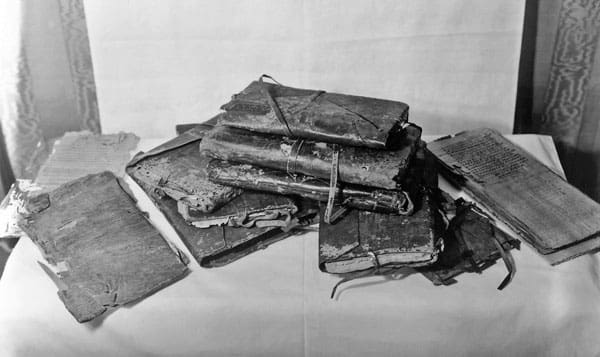
In December 1945, an Egyptian farmer named Muhammad al-Samman was digging near a cliff at Nag Hammadi in Upper Egypt. He uncovered a sealed clay jar. Inside: thirteen leather-bound papyrus codices containing 52 texts, mostly written in Coptic, mostly Gnostic in character.
It’s hard to overstate how significant this was. Before 1945, scholars knew Gnostic Christianity existed primarily from the writings of its opponents — bishops like Irenaeus, who described heretical beliefs in order to condemn them. Suddenly, there were primary sources. The actual Gnostics, in their own words.
Why were they buried? The best current theory — supported by recent scholarship including Hugo Lundhaug and Lance Jenott’s 2015 work, and strengthened by Paul Linjamaa’s 2024 monograph — is that monks at a nearby Pachomian monastery buried them shortly after Athanasius’s 367 CE Easter letter condemned non-canonical texts. They weren’t destroying the books. They were hiding them.
Linjamaa’s 2024 research adds a fascinating layer: the Nag Hammadi library wasn’t a Gnostic sect’s private collection. It was probably used by an intellectual monastic elite as part of a much broader Christian library. These monks weren’t heretics. They were curious.
The Key Texts, One by One
These are the texts that actually matter — the ones scholars study, the ones that keep appearing in popular culture, the ones worth understanding properly.
New Testament Apocrypha
Not a gospel in the narrative sense — no birth, no crucifixion, no resurrection. Just 114 sayings attributed to Jesus, opening with: “Whoever finds the interpretation of these sayings will not experience death.” About two-thirds of these sayings have parallels in the canonical gospels. The rest are distinctly Gnostic in flavor.
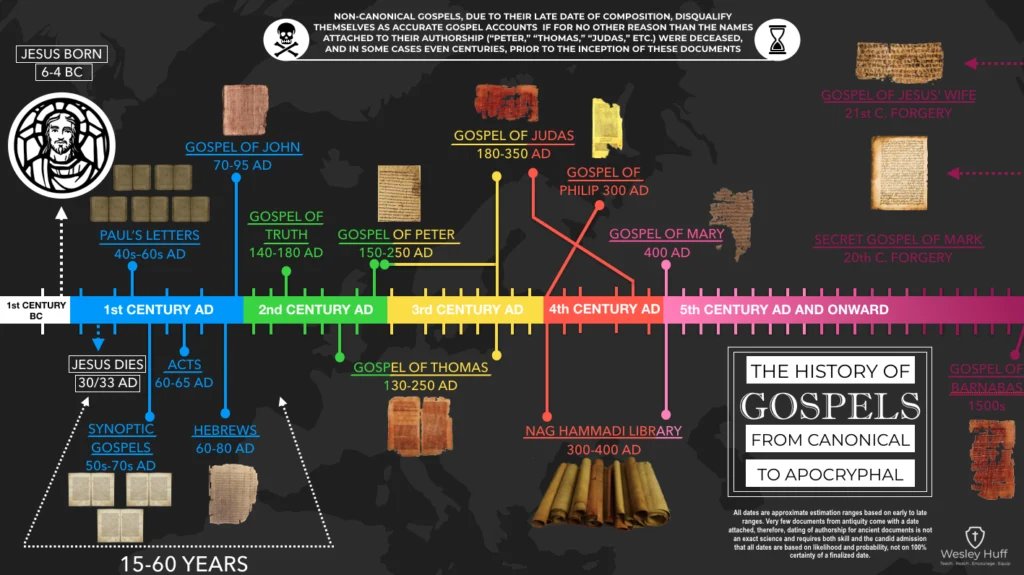
The scholarly debate about Thomas is genuinely interesting. Some researchers, tracing Greek fragments found at Oxyrhynchus in 1898, argue Thomas preserves independent early traditions — possibly predating some canonical material. Others, like Wesley Huff, date it firmly after 150 CE and see it as dependent on the Synoptics. The Oxyrhynchus connection means we know this text circulated in Greek well before the Coptic version was made.
This is the “young Jesus as problematic child” text. It depicts a five-year-old Jesus animating sparrows from clay, then killing a child who accidentally bumped his shoulder, then raising him from the dead. It’s theologically uncomfortable — which is precisely why scholars find it historically interesting. It shows how early Christians were wrestling with what divine childhood would even look like.
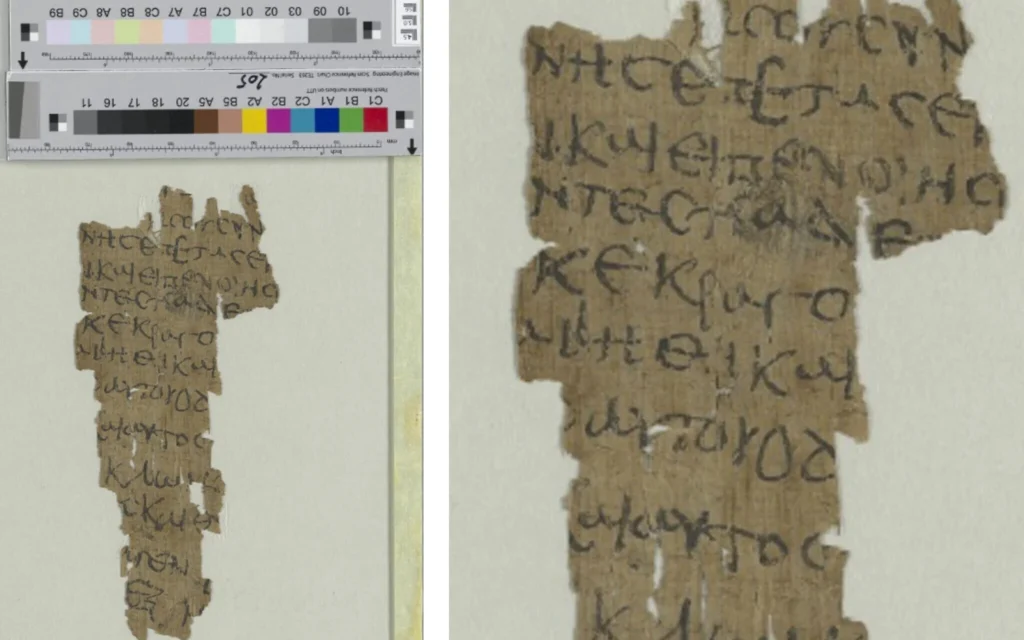
A significant 2023 discovery: a 1,600-year-old papyrus fragment written in an Egyptian children’s handwriting style was identified as the earliest surviving copy of this gospel’s opening. The discovery, announced by researchers at the University of Hamburg, suggests this text was used in educational settings — children literally copied it as a writing exercise.
We don’t have most of it — pages 1–6 and 11–14 are missing from the only surviving manuscript. What remains shows Mary Magdalene receiving a vision from the risen Christ and passing on teachings that the male disciples, particularly Peter, refuse to accept. “Did he really speak with a woman without our knowledge?” Peter asks. Levi defends her.
This text is theologically loaded for obvious reasons. It elevates Mary Magdalene’s spiritual authority and frames her as a legitimate transmitter of Jesus’s teaching. Whether that’s historical or a 2nd-century projection of contemporary debates about women’s roles in churches — that’s the live scholarly question. The British Library holds a digitized version of the Coptic manuscript.
Less a narrative, more a theological meditation — on sacraments, on the nature of light and darkness, on what it means to be “bridal chamber” spiritually. The famous passage describing Jesus kissing Mary Magdalene is here, though the manuscript has a hole where the body part is described. It’s been filled in by translators as “the mouth” based on context — but that’s an inference, not a fact.
Philip is dense and strange, and probably not accessible to casual readers. But it’s a genuine window into how some 3rd-century Christians understood their own rituals.
Published by National Geographic in 2006 after a tortured journey through the antiquities black market, this Gnostic text reframes Judas Iscariot not as a traitor but as the only disciple who truly understood Jesus — and who helped him by enabling his arrest. The other disciples are presented as spiritually blind.
Bishop Irenaeus condemned this gospel by name around 180 CE, which confirms it existed and troubled the proto-orthodox church. Whether it reflects any genuine historical tradition about Judas, or is entirely a Gnostic theological construction — scholarly opinion leans heavily toward the latter.
This one almost made it. The Codex Sinaiticus — one of our oldest complete New Testament manuscripts — includes the Shepherd of Hermas after the Book of Revelation. It was read in worship in many communities well into the 3rd century. It’s apocalyptic literature, with visions, parables, and commandments, written by someone named Hermas who claims to be a former slave in Rome.
It was ultimately excluded partly because it was recognized as too recent — clearly 2nd century — and because Origen and others questioned whether it had genuine apostolic authority. But for a century or two, this was scripture for a lot of Christians.
Old Testament Apocrypha: The Books Catholics Have That Protestants Don’t
This is actually a different and often confused topic. The deuterocanonical books are in Catholic and Orthodox Bibles — they were part of the Greek Septuagint used by early Christians. Protestants, following the Reformation and the precedent of the Jewish canon finalized around the 2nd century CE, exclude them. These aren’t “forbidden” texts — they’re in half the world’s Bibles right now.
| Text | Catholic | Protestant | Ethiopian Orthodox | What It Is |
|---|---|---|---|---|
| Tobit | Yes | No | Yes | Jewish family story, angel Raphael, demon-afflicted woman |
| Judith | Yes | No | Yes | Widow saves her city by beheading an Assyrian general |
| 1 Maccabees | Yes | No | Yes | Historical account of the Maccabean revolt, 2nd century BCE |
| Wisdom of Solomon | Yes | No | Yes | Philosophical wisdom literature, probably written in Alexandria |
| Sirach (Ecclesiasticus) | Yes | No | Yes | Longest surviving ancient Jewish wisdom text; practical ethics |
| Book of Enoch | No | No | Yes | Fallen angels, cosmic journeys, apocalyptic visions — quoted in NT Jude |
| Book of Jubilees | No | No | Yes | Retells Genesis with a 364-day solar calendar; key Qumran text |
The Book of Enoch Deserves Special Attention
This one is genuinely extraordinary. Written in stages from the 3rd century BCE onward, it describes the Watchers — fallen angels who descended to earth, mated with human women, and produced the Nephilim. It details Enoch’s cosmic tours through heavenly realms. It includes detailed astronomical calculations. It was found among the Dead Sea Scrolls (fragments in Aramaic and Hebrew), meaning the Essene community at Qumran treated it as authoritative scripture.
The New Testament letter of Jude quotes it directly — not paraphrases, but quotes. That’s remarkable: a canonical New Testament letter cites a non-canonical text as authoritative. The Ethiopian Orthodox Church kept it in their 81-book canon, which is why complete texts survived when they were lost elsewhere. Princeton University’s library holds significant Ethiopic manuscript collections you can access through their digital archives.
Who Really Decided — And Why It Matters
The conspiracy version says: powerful men picked texts that served their power and suppressed everything else. The boring-but-true version: it was a long, contested, genuinely uncertain process in which communities across the Mediterranean world argued about texts for centuries.
Constantine is the big villain in popular tellings. He called the Council of Nicaea in 325 CE. But the council dealt with Arianism — the question of whether Jesus was of the same substance as God the Father. Canon formation happened before Nicaea, after it, and mostly independent of it.
What did shape canon formation in ways that aren’t always acknowledged:
Geography mattered. Some texts were widely used in Syria but barely known in Rome. Some Roman favorites didn’t circulate in Alexandria. A text’s “catholicity” — its widespread use across communities — counted heavily. Local favorites didn’t make it.
Heresy debates mattered. Gnostic Christians used Thomas, Philip, and others extensively. The proto-orthodox reaction against Gnosticism made those texts suspect by association. This is a real political/theological dynamic — not conspiracy, but also not a purely neutral scholarly evaluation.
Date and authorship claims mattered. Texts claiming apostolic authorship that were demonstrably late got excluded. This is, by any measure, a reasonable standard — though the application wasn’t always consistent.
How to Read These Texts Today — Free, in Full
Here’s the thing nobody in the “forbidden books” discourse emphasizes enough: these texts are not forbidden now. They haven’t been for a very long time. You can read all of them, in translation, right now, for free.
Bart Ehrman’s work is the most accessible entry point for English-speaking general readers. His books Lost Scriptures and Lost Christianities compile translations and provide historical context without requiring a seminary background. James Robinson’s edited volume The Nag Hammadi Library in English is the scholarly standard for those texts.
What This Means, Honestly
The real story of the biblical canon is stranger and more interesting than any conspiracy theory. You have Gnostic monks hiding books not to preserve heresy but because they were intellectually curious. You have bishops debating which texts to use in liturgy based on criteria that were partly theological, partly geographical, partly political. You have texts like the Shepherd of Hermas that almost made it, and almost-canonical books sitting in Codex Sinaiticus that most Christians today have never heard of.
The “forbidden” framing misses all of this richness. These texts weren’t forbidden — they were contested, evaluated, and in many cases simply lost until archaeologists found them. The 1945 Nag Hammadi discovery and the 1947 Dead Sea Scrolls discovery together gave us more primary material for understanding early Christianity and Judaism than scholars had accumulated in the previous millennium. That’s extraordinary, and it’s still being processed.
Reading these texts doesn’t require abandoning faith or embracing conspiracy. It requires the same thing good history always requires: sitting with complexity, tolerating ambiguity, and being willing to let the evidence say what it actually says rather than what you’d like it to say.
That’s harder than it sounds. But it’s also more rewarding than any Da Vinci Code plot.