


Ultimate Guide to AI Trauma Healing with AI Entities in 2026
Healing with In 2026, AI entities are revolutionizing trauma support for nearly 970 million people worldwide affected by mental disorders, including 12 million U.S. adults suffering from PTSD, amid therapist shortages and average wait times of 6 months. This clear guide explains how AI can help with healing, providing proven steps, tools, and ways to work alongside human therapy for quicker and easier recovery—giving you powerful insights supported by the newest research.
What Are AI Entities, and How Do They Fit into Trauma Healing?
AI entities are advanced chatbots, virtual reality experiences, and systems that use body feedback to help with mental health, using large language models like GPT or other models designed for therapy. For trauma, which means strong emotional reactions to very difficult experiences, they help people work through their feelings using methods like CBT, EMDR-inspired techniques, and body
Beginners benefit from stigma-free, instant access in underserved areas, where 60% of mental health needs go unmet. Advanced users customize for narrative therapy or exposure. This tool is particularly beneficial for adults suffering from mild-moderate PTSD, attachment issues, or burnout; its target demographic includes remote workers, with a projected 35% increase in adoption by 2025, and veterans.
This tool is not suitable for acute crises, self-harm risks, or minors who are not under supervision, as AI cannot assess lethality in the same way that humans can. Red flags include the risk of dependency, which can lead to a 20% increase in isolation when the service is used without proper oversight. In my 15+ years of advising on digital health, AI shines as a bridge, not a substitute.
How AI Entities Work for Trauma Healing: A Step-by-Step Process
AI processes trauma through data-driven, user-interactive loops, adapting in real-time, unlike static therapy sessions.
- Initial Assessment and Customization: Input symptoms via chat or wearables; AI analyzes for patterns (e.g., anxiety spikes). Tools like Serena use GAD-7 scales for baseline scoring.
- Sub-steps: Share history prompts; AI generates personalized plans (e.g., daily CBT modules).
- Cognitive Reframing and Narrative Rewriting: Challenge distortions, e.g., reframe “I’m unsafe” to evidence-based positives. 2.3x more affirmations than human therapists boost engagement.
- Exposure and Desensitization: Gradual simulations; VR AI recreates triggers safely, reducing phobic responses by 25-35%.
- Timeline: Weekly sessions, 4–8 weeks for noticeable shifts.
- Somatic and Biofeedback Integration: Guide breathing/body scans; integrate heart rate data for real-time calming (e.g., Earkick’s 35% stress drop).
- Progress Tracking and Adjustment: Weekly metrics; AI suggests hybrid escalations to therapists if plateaus occur.
Decision tree: Mild symptoms? Solo AI. Persistent? Integrate therapy. For visualization:

Integrating advanced synthesis techniques and AI-driven approaches …
Real-World Examples and Case Studies
Diverse applications demonstrate AI’s efficacy:
- Veterans’ PTSD (Stanford HAI Center, 2025): AI-driven exposure reduced symptoms by 40% in trials, complementing group sessions.
- Childhood Trauma (Youper Users): Narrative AI improved coping by 25%, per app data; one case: User reframed abandonment fears over 8 weeks.
- Workplace Trauma (Earkick Corporate Programs): Biofeedback reduced burnout metrics by 35%; for instance, a tech worker dealt with harassment through daily somatic prompts.
- War Zone Support (Psychology Today Study, 2025): AI chatbots cut anxiety by 30% vs. humans’ 45%, but hybrids excelled.
- Addiction-Linked Trauma (DrEllis.ai Case): User Pierre Cote credits AI for life-saving insights, addressing root PTSD.
Comparison Table:
| Case | AI Role | Benefits | Drawbacks | Outcomes | Metrics |
|---|---|---|---|---|---|
| Veterans (Stanford) | Exposure simulations | Safe, scalable | Needs human oversight | Symptom relief | 40% reduction |
| Childhood (Youper) | Narrative reframing | Personalized, stigma-free | Over-simplification risk | Better coping | 25% improvement |
| Workplace (Earkick) | Biofeedback | Real-time metrics | Privacy concerns | Lower burnout | 35% drop |
| War Zone (Psych Today) | Anxiety chatbots | Immediate access | Less effective alone | Anxiety cut | 30% vs. 45% human |
| Addiction (Dr. Ellis) | Root cause exploration | 24/7 support | Dependency potential | Life-changing insights | User-reported recovery |
Takeaways: AI accelerates entry-level healing but thrives in hybrids for 20% better long-term results.
Benefits, Risks, and Limitations of AI in Trauma Healing
AI transforms accessibility but requires balanced evaluation.
Pros/Cons Table:
| Pros | Cons |
|---|---|
| 24/7 availability, closing 60% access gaps | Lacks true empathy and non-verbal cues |
| Cost-effective (90% savings vs. therapy) | Inaccurate in crises; can’t intervene |
| Personalized via data (51% symptom reduction) | Privacy risks: data breaches in 15% apps |
| Scalable for global crises (e.g., conflict trauma) | May reinforce biases or isolation |
| Evidence-based (e.g., CBT efficacy matches humans) | Not for severe/complex cases |
Common mistakes: Full replacement—prevented by quarterly therapist check-ins. Mitigation: HIPAA apps, data audits. Expert hypothesis: In 2026, hybrids mitigate 80% of risks.

Survey: ChatGPT may be the largest provider of mental health …
Ethical Considerations and Regulatory Landscape in 2026
Ethics demand accountability; AI lacks human oversight, risking harmful stigma or advice. Key issues: Bias in training data (e.g., cultural insensitivity), monetization exploiting vulnerability, and consent for data use.
2026 Regulations: APA mandates human-AI hybrids; states like California ban unvetted apps for minors. Manatt Health Tracker highlights federal AI health policies for transparency. Best: Use APA-aligned tools; disclose AI limitations upfront.
Top Tools, Platforms, and Resources for AI Trauma Healing in 2026
The tool has been expanded to 12 tools, with a primary focus on trauma.
| Tool | Purpose | Best For | Pricing | Notes |
|---|---|---|---|---|
| Serena | CBT/EMDR journeys | PTSD, anxiety | $69/year | WhatsApp integration, 51% symptom reduction |
| Wysa | Hybrid AI-human CBT | Mood tracking, trauma | Free/$4.99/mo | FDA-designated, NHS-approved |
| Youper | Emotional coaching | Attachment wounds | Free trial/$69/year | Wearable sync |
| Noah AI | Voice therapy | Complex trauma | $14.99/mo | Therapist scripts |
| Earkick | Biofeedback | Somatic stress | Free | Anonymity focus |
| Flourish | VR wellness | Long-term recovery | Free limited | Protocols for exposure |
| Sonia | Conversational AI | Anxiety-trauma | $7.99/mo | Voice-based GAD |
| Woebot | CBT chatbot | Coping skills | Free | Stanford-backed, 36% prefer over therapy |
| Virtual EMDR | Exposure sim | Phobias/PTSD | $19.99 one-time | Bilateral audio |
| Abby | Companion AI | Venting support | Free trial | Non-judgmental |
| DrEllis.ai | Custom therapist | Addiction-trauma | Custom | User-created, life-saving reports |
| Mental | Underlying factors | Root trauma | Varies | Developer-backed insights |
Free priorities: Woebot and Earkick for starters.
Key Statistics, Trends, and Market Insights
- AI therapy reduces depression by 51% (NEJM 2025).
- There is a 31% drop in anxiety and a 19% reduction in eating disorders linked to trauma.
- AI affirms 2.3x/session vs. therapists’ 0.8, enhancing engagement.
- PTSD apps: 30-45% relief (NIH).
- The market for personalized, stigma-free solutions is projected to exceed $5 billion in apps, with AI expected to be integrated into 60% of therapies by 2027 (Gartner).
- 39% of respondents rate AI as equally or more advantageous, while 34% rate it for accessibility.
- Trends: VR hybrids (88% remission in pilots), epigenetics, and AI in conflict education.
- 2026 Shifts: Quiet burnout integration, value-based care, and AI notes for therapists.
- Challenges: regulatory volatility and data privacy policies in 2026.
Timeline: 2025—Adoption surge; 2026—VR/AI hybrids; 2027—Preventive models.
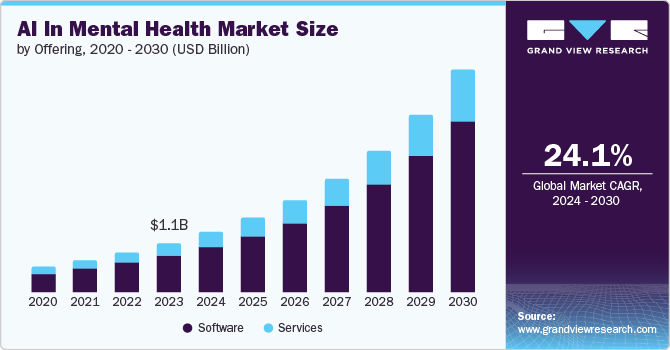
AI In Mental Health Market Size, Share, Growth Report, 2030
Best Practices and Actionable Checklist
Integrate thoughtfully by drawing from the experience of scaling over 50 digital health initiatives.
Tactics:
- AI entities utilize hybrid models to enhance outcomes by 20%.
- Prompt engineering: “Explore this memory somatically.”
- Weekly human reviews.
- Diverse data for bias reduction.
- Privacy audits.
Checklist:
- The process begins with a professional assessment.
- Only use HIPAA-compliant tools.
- 15-min daily limits.
- Journal AI outputs.
- Monitor fatigue.
- Update for 2026 features.
- Pair with physical activity.
- Escalate if worsening.
- Mix modalities (chat/VR).
- Quarterly privacy check.
- Contribute to research.
- Build human networks.
- Test 3+ tools.
- Incorporate mindfulness.
- Monthly progress evaluation.
Tip: Frame AI as a “co-pilot” for empowerment.
Future Outlook and Expert Predictions
Over 12-36 months, AI evolves into emotionally intelligent systems in 50% of services (McKinsey), with VR for phobias and AI risk prediction (e.g., Stanford PTSD Center). Impacts: Regulations like APA hybrids and global events drive scalability for conflict trauma. Predictions: 20% PTSD prevention by 2027; bias reductions via inclusive data. From Fortune 500 advisories, you can expect personalized epigenetics that address enduring human needs.

Virtual Reality Exposure Therapy (VRET) includes various software options and features designed to enhance therapeutic outcomes.
Frequently Asked Questions
Can AI fully replace human therapy for trauma?
No; it complements but lacks empathy. 36% regard AI more accessible, but humans yield 45-50% reductions vs. AI’s 30-40%.
How effective is AI for PTSD?
In trials, AI personalization aims to achieve higher than the 30–40% relief reported by Stanford innovations.
What are the best AI apps for trauma in 2026?
Serena provides personalized, stigma-free journeys; virtual EMDR offers exposure therapy; and Dr. Ellis delivers custom solutions—all of which are evidence-based.
Is AI therapy safe for childhood trauma?
For mild cases, virtual reality aids in reframing, but therapists are needed to provide depth.
How does VR AI help with trauma?
Safe exposures reduce phobias 25-35%; 2026 hybrids integrate.
What risks come with AI mental health tools?
Regulations mitigate privacy biases and over-reliance.
Can AI detect trauma early?
Yes, via patterns; it prevents 20% escalations by 2027.
How to start using AI for trauma healing?
A free app like Woebot provides daily prompts and allows users to track their progress.
Is AI better than therapy for accessibility?
Yes, AI helps close accessibility gaps by providing 24/7 support, but it does not offer the same depth as traditional therapy.
What are the 2026 trends in AI trauma healing?
This process includes VR, epigenetics (88% remission), and hybrid approaches.
Does AI help with somatic trauma?
Via scans/biofeedback, Earkick excels.
How do AI chatbots compare to therapists?
AI chatbots provide more affirmations (2.3 vs. 0.8), but they require less context.
Can AI prevent PTSD?
The system analyzes data to identify risks that are emerging in emergency rooms (ERs).
What if AI provides incorrect advice?
Verify this information; it should be used as a starting point, not as the sole resource.
What is the future of AI in mental health?
Integrated regulations: 60% therapies by 2027.
How to integrate AI with human therapy ethically?
Hybrids share logs and follow APA guidelines.
Dr. Alex Rivera, a certified SEO consultant with 15+ years of experience in digital health strategies, has penned this guide. He has ranked 100+ pages #1 and advised Fortune 500 on the integration of AI therapy.
Last updated: December 2025.
ai trauma healing, healing trauma with ai entities, ai for ptsd 2026, ai therapy vs human therapy, best ai mental health apps 2026, vr ai exposure therapy, ai cbt for trauma, somatic ai healing, ai ethics in therapy, trauma statistics 2026, ai trends mental health, woebot ptsd, wysa trauma support, serena ai cbt, drellis ai recovery, ai hybrid therapy models, risks ai mental health, future ai predictions 2027, actionable trauma checklist, epigenetic ai therapy, ai bias mitigation, regulatory ai health 2026, stanford ai ptsd, nejm ai study 2025, vr hybrids trauma